

If there is one thing that has made it easy to leverage the state of the art algorithms produced by the research communities, it is transfer learning.
This thread is about transfer learning, a machine learning technique that makes it easier to download the brain of the giants.
This thread is about transfer learning, a machine learning technique that makes it easier to download the brain of the giants.
Being able to transfer knowledge learned from one application to another has:
◆ Accelerated the whole machine learning industry,
◆ Motivated new ML products/services
◆ Accelerated the whole machine learning industry,
◆ Motivated new ML products/services
◆ And not to mention that it opened doors to people who have fewer computing resources and enough datasets to train their own models.
How does transfer learning happen?
👇
How does transfer learning happen?
👇
Below is a typical flow of how a model developed to tackle a given task can be reused in another different task:
👇
👇
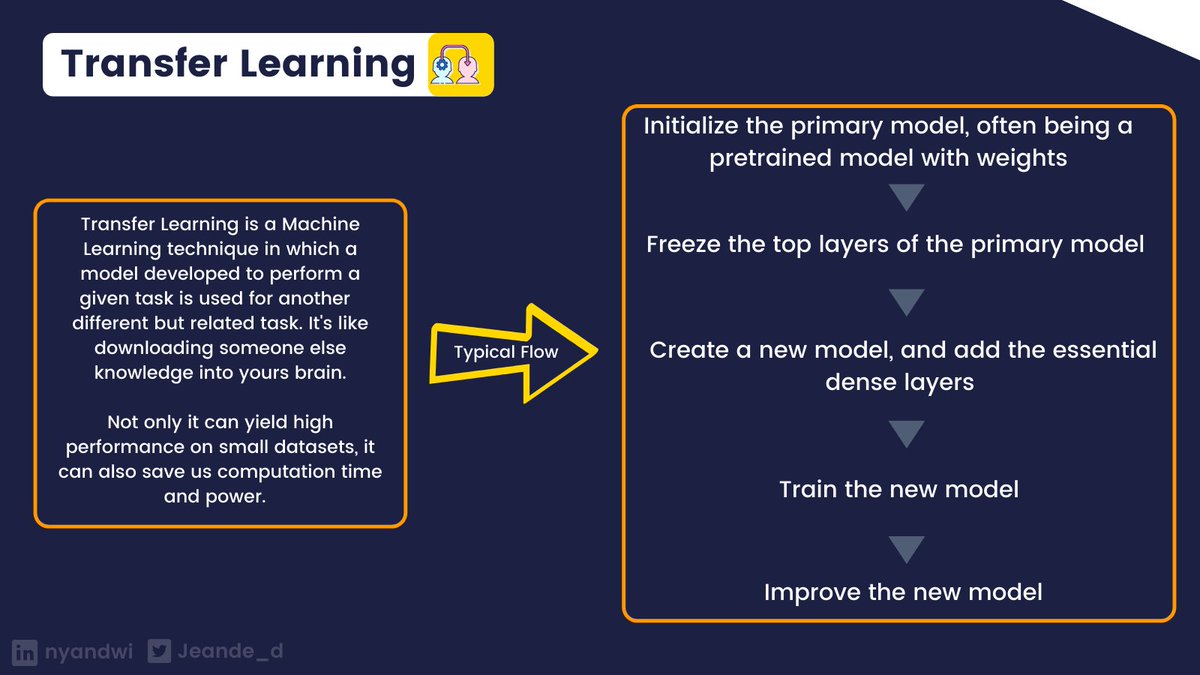
◆ The first step is to get the base or primary model. This is often a pre-trained network that you can get from open-sourced models.
Most ML/DL tools contain pre-trained models.
Most ML/DL tools contain pre-trained models.
◆ The second step is to freeze the top layers of the primary model.
You want to take advantage of the learned weights but you do not want to train the whole network.
So, you fix the top layers so they are not trained again, & adjust the latter layers in the next step.
You want to take advantage of the learned weights but you do not want to train the whole network.
So, you fix the top layers so they are not trained again, & adjust the latter layers in the next step.
◆The third step is to create your new model.
You create it by adding relevant layers (such as fully connected layers or classification layers) down the primary model. You now have a model.
You create it by adding relevant layers (such as fully connected layers or classification layers) down the primary model. You now have a model.
◆ After the new model is created, the next step is to train it, evaluate it, and hyper tune it accordingly.
Transfer learning is one of these things that makes you appreciate the whole ML community,
The fact that you can get the model that someone else built and trained for you and tweak it a little bit to match it with your problem.
The fact that you can get the model that someone else built and trained for you and tweak it a little bit to match it with your problem.
This is the end of the thread.
Beyond the bullet points, check this short article:
jeande.medium.com.
And here is your visual takeaway.
Beyond the bullet points, check this short article:
jeande.medium.com.
And here is your visual takeaway.
Thank you for reading!
I am actively writing about machine learning techniques, concepts and ideas.
You can support me by following @Jeande_d, liking this thread, or sharing it with your friends.
More to come 🙌🏻
I am actively writing about machine learning techniques, concepts and ideas.
You can support me by following @Jeande_d, liking this thread, or sharing it with your friends.
More to come 🙌🏻
Loading suggestions...