

one of the norms of the people upon falsehood is that they introduce non-shar'i terms that may carry elements of truth but also can carry falsehood.
what do you mean by visible?
what do you mean by visible?
What I have understood is that 'visibly present' or 'visible' means visible to non-mahram men in society and that a woman can be just as visible and active in society the way a man can.
Do the reports quoted support this?
Do the reports quoted support this?
Take the first report, how would a modern 21st century woman try and picture how Umm Sulaym was being 'visibly present' in this infographic?
I'd hazard a guess and say they'd imagine a female 'heroine' showing non-mahrams that she is equipped/ready to fight
I'd hazard a guess and say they'd imagine a female 'heroine' showing non-mahrams that she is equipped/ready to fight
Meanwhile the story actually mentions just 2 men that saw her with the dagger. Anas was the reporter. He was her son.
Abu Talha saw her. He was her husband.
The Prophet spoke to her. He was her mahram.
So who was she visibly present to in this story other than her mahrams?
Abu Talha saw her. He was her husband.
The Prophet spoke to her. He was her mahram.
So who was she visibly present to in this story other than her mahrams?
Take the second report. Note how it says 'authenticated by Al Albāni'.
What's correct is that this report is defective thus inauthentic according to the early Hadith critics, including Al Tirmidhī himself as is taken from his comment on the report.
What's correct is that this report is defective thus inauthentic according to the early Hadith critics, including Al Tirmidhī himself as is taken from his comment on the report.
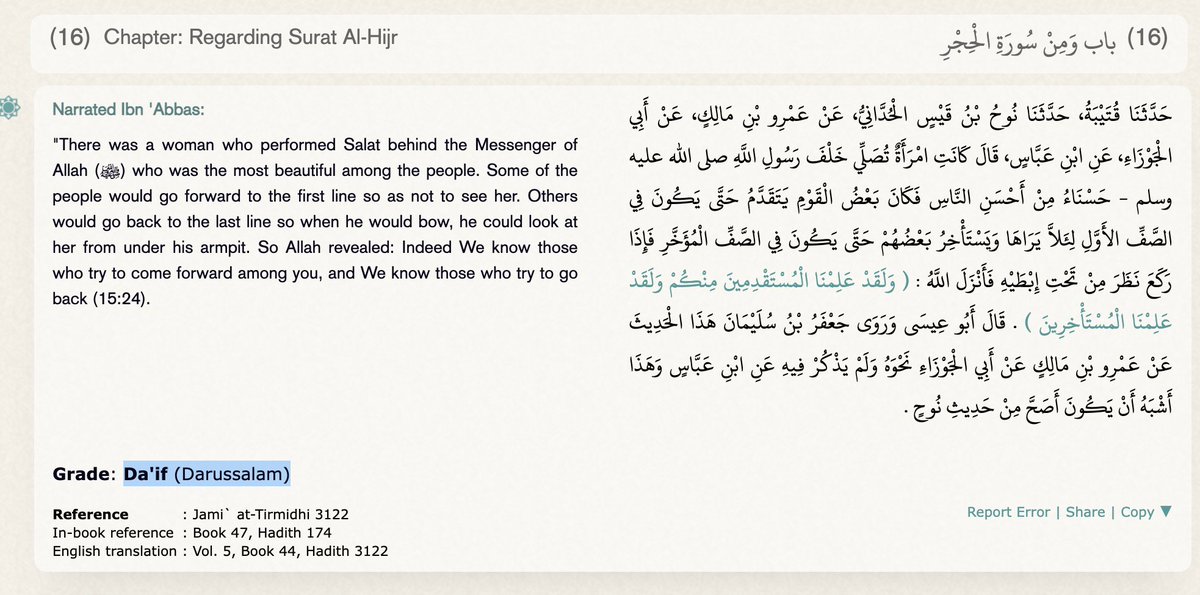
However, let us assume that it is authentic.
If she was 'visibly present', why would these men need to put in the effort to go to the back lines, wait for the people to go into rukū, go into rukū themselves & then try to look at her from under their armpits??
If she was 'visibly present', why would these men need to put in the effort to go to the back lines, wait for the people to go into rukū, go into rukū themselves & then try to look at her from under their armpits??
If she was 'visibly present', couldn't they just look at her face to face before and after the Salah?
Take the third report. The context is that Barīrah herself was a slave. But she was freed by A'ishah.
Upon her freedom, she was given the choice to remain a wife to Mughīth, her husband who was also a slave, or to leave him.
She chose to leave him.
Upon her freedom, she was given the choice to remain a wife to Mughīth, her husband who was also a slave, or to leave him.
She chose to leave him.
I ask how would a modern 21st century woman try and picture how Barīrah was being 'visibly present' in this infographic?
It is plausible that Barīrah had a need to go outside, given that she no longer has a husband for support and a child to feed as the report shows,
It is plausible that Barīrah had a need to go outside, given that she no longer has a husband for support and a child to feed as the report shows,
and so Mughīth took this opportunity to follow her around begging her to take him back as he can't take her back.
Or, as mentioned in the infographic, she was doing tawāf and he took that as an opportunity to beg her to take him back
So, yes this could be seen as an 'exception'
Or, as mentioned in the infographic, she was doing tawāf and he took that as an opportunity to beg her to take him back
So, yes this could be seen as an 'exception'
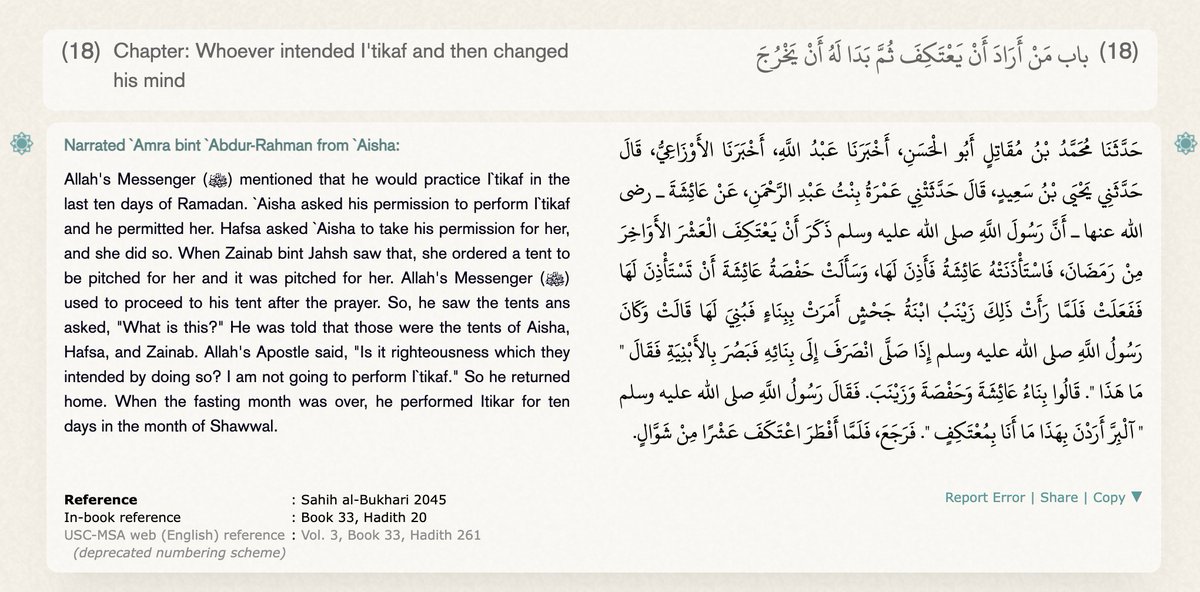
Take the fourth report, again I ask how would a modern 21st century woman try and picture how this wife of the Prophet was being 'visibly present' in this infographic?
I think the picture they would have is this wife being visibly seated with the Prophet in the praying area and that she would pray in the mosque with a basin underneath her so that blood dripping from her would fall into it, all whilst being 'visibly present' to non-mahram men.
If so, this is totally wrong as other reports show the Prophet and his wives had private tents pitched for them specifically for i'tikāf in the Masjid.
It was not a free-for-all inter-mixing event where women and men were 'visibly present' and as active as each other.
It was not a free-for-all inter-mixing event where women and men were 'visibly present' and as active as each other.
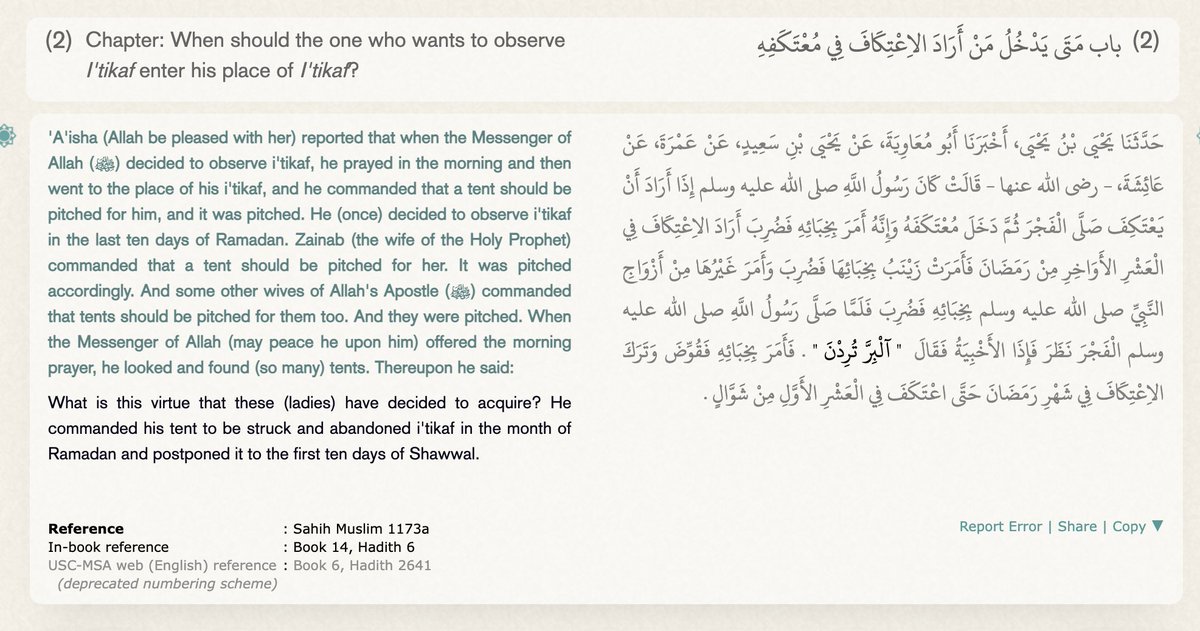
note that they mention a generic Hadīth on i'tikāf but won't mention other ahādīth and the consensus of the jurists that show a woman can only do i'tikāf if she has the permission of her husband.
Take the fifth report.
Firstly, this happened on an Eid day where women are specifically encouraged to come out to the Musalla by consensus.
So, them being 'visibly present' specifically on this day is something the other side does not deny...
Firstly, this happened on an Eid day where women are specifically encouraged to come out to the Musalla by consensus.
So, them being 'visibly present' specifically on this day is something the other side does not deny...
Second, why did Zaynab ask her husband to ask the Prophet?
If it was the norm to be 'visibly/actively present', she could have just gone out, without telling her husband, and asked the Prophet herself.
If it was the norm to be 'visibly/actively present', she could have just gone out, without telling her husband, and asked the Prophet herself.
Oh and, btw, this report is the same report wherein the Prophet famously declared women to be 'nāqisāt 'aql wa dīn'

Take the sixth report
I ask how would a modern 21st century woman try and picture how Umm Harām was being 'visibly present' in this infographic?
My guess is she will be pictured as someone who enlists in the naval forces of the Muslims to take a visible and active role in Jihād
I ask how would a modern 21st century woman try and picture how Umm Harām was being 'visibly present' in this infographic?
My guess is she will be pictured as someone who enlists in the naval forces of the Muslims to take a visible and active role in Jihād
The reality is a bit different.
First, Umm Haram is the sister of Umm Sulaym and the Prophet is a Mahram for her.
The report referenced in the infographic does not mention that the Prophet prayed for Umm Haram to be in a future military expedition.
First, Umm Haram is the sister of Umm Sulaym and the Prophet is a Mahram for her.
The report referenced in the infographic does not mention that the Prophet prayed for Umm Haram to be in a future military expedition.
Other reports state that she asked the Prophet to pray that she is from those whom the Prophet dreamed will be sailing on a green sea like kings on thrones.
He replied: "you are from them."
He replied: "you are from them."
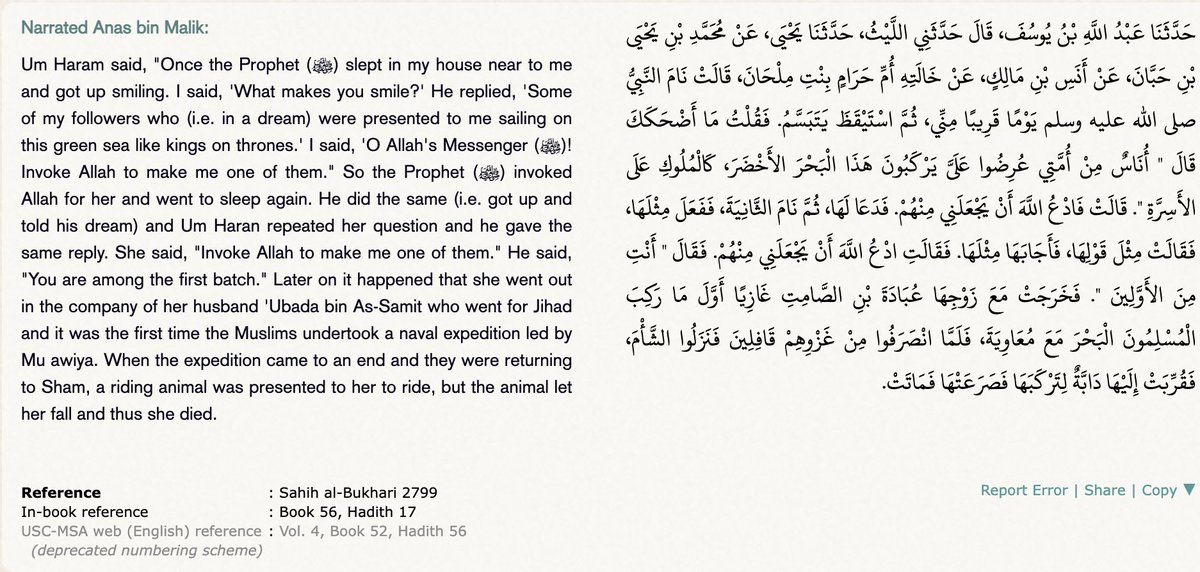
How was she from them?
The report tells us.
She married 'Ubadah b. Al Sāmit and she went out in the company of her husband 'Ubadah bin Al Sāmit who went for Jihad and it was the first time the Muslims undertook a naval expedition led by Mu awiya.
The report tells us.
She married 'Ubadah b. Al Sāmit and she went out in the company of her husband 'Ubadah bin Al Sāmit who went for Jihad and it was the first time the Muslims undertook a naval expedition led by Mu awiya.
Note how her husband is described as going for Jihād and she is described as going in the company of her husband
Don't think this will sit well with these folk
Anyhow, this is something the opposite side to this lady won't have an issue with as she went out with her husband
Don't think this will sit well with these folk
Anyhow, this is something the opposite side to this lady won't have an issue with as she went out with her husband
Take the seventh report.
assuming it is authentic, as there is a disconnection in the chain, this was a case of self-defence.
Who said that a woman cannot defend herself and her children if the need arises?
And it is said that Hassan was an old man (70+) at the time.
assuming it is authentic, as there is a disconnection in the chain, this was a case of self-defence.
Who said that a woman cannot defend herself and her children if the need arises?
And it is said that Hassan was an old man (70+) at the time.
How does this make her 'actively or visibly present'?
If she was 'actively or visibly present' in the society, given that the claim is she had the ability to fight, she should have been on the frontlines or at least with the men, not inside a tower with the women and children
If she was 'actively or visibly present' in the society, given that the claim is she had the ability to fight, she should have been on the frontlines or at least with the men, not inside a tower with the women and children
Also, the person who reports this incident is Abbad b. Abdullah b. Al Zubayr and the one who reports it from Abbad is his son Yahya b. Abbad.
Abbad is the great grandson of Safiyyah bt. Abdul Muttalib and so it can probably be claimed that it was a family story that worked its
Abbad is the great grandson of Safiyyah bt. Abdul Muttalib and so it can probably be claimed that it was a family story that worked its
way down the generations until Ibn Ishaq.
Nobody else reports it as far as I am aware.
Nobody else reports it as far as I am aware.
Take the eighth report
The reports referenced doesn't mention mosques or women actively coming to the mosques
It could refer to a prayer the Prophet prayed at home with his wives or daughters or in the home of Umm Sulaym etc. (given that it is Anas who is reporting the Hadith)
The reports referenced doesn't mention mosques or women actively coming to the mosques
It could refer to a prayer the Prophet prayed at home with his wives or daughters or in the home of Umm Sulaym etc. (given that it is Anas who is reporting the Hadith)
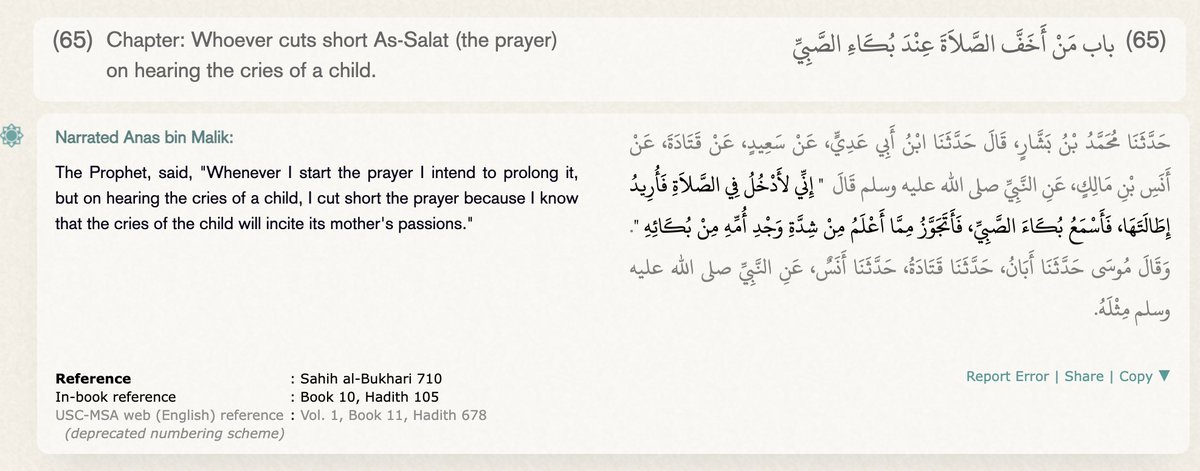
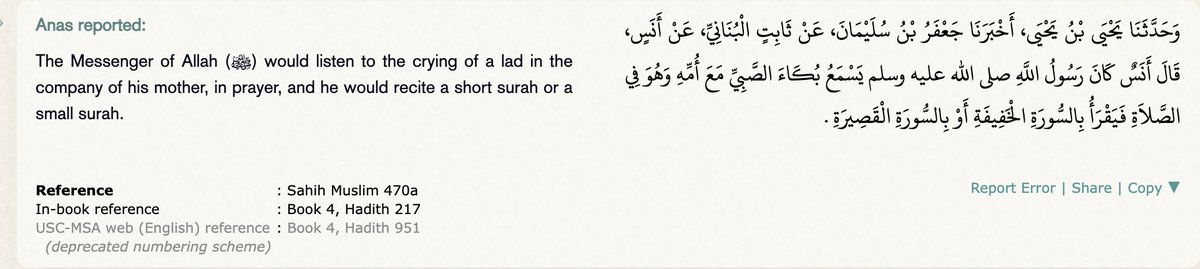
But let's assume the infographic is right and the report mentions mosque
He changed the intention in his prayer not only because of the cries but because of the pain/passions that these cries incite in the mother.
He changed the intention in his prayer not only because of the cries but because of the pain/passions that these cries incite in the mother.
Thus, this Hadith could be used as evidence for gender roles.
And that the role for the woman is to care for and nurture her children.
And that the role for the woman is to care for and nurture her children.
Take the ninth report.
Again, another case of necessity during warfare.
Anyone studying Fiqh knows that things which usually aren't done during times of peace become allowed during times of war and necessity.
Again, another case of necessity during warfare.
Anyone studying Fiqh knows that things which usually aren't done during times of peace become allowed during times of war and necessity.
And we can carry on until we complete the remaining reports but I think I have made the point pretty clear.
I do want to point out one further thing however concerning the report of Al Tabarani she quoted.
I do want to point out one further thing however concerning the report of Al Tabarani she quoted.
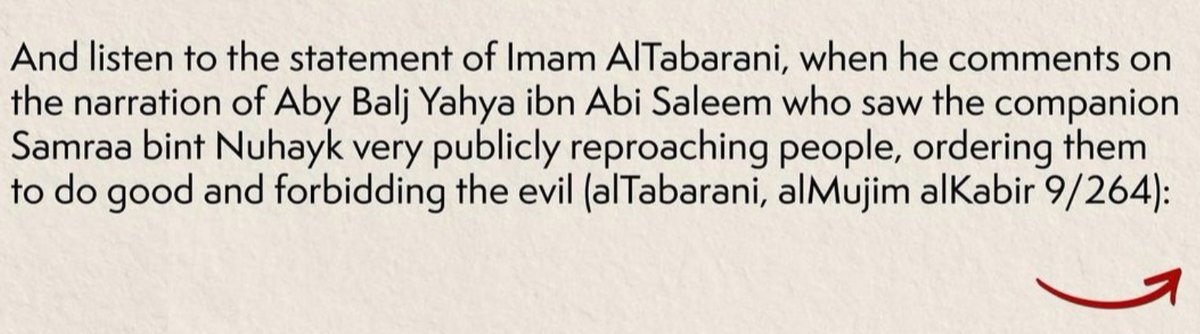
There's a few problems with this:
1- Abu Balj here is not Yahya b. Abi Sulaym and that this was an error as Yahya b. Abi Sulaym did not hear from Samraa' bt. Naheek
Rather, it is Abu Balj Al Sagheer Jaariyah b. Balj who heard from Samraa as Al Daraqutni & Ibn AbdulBarr mention
1- Abu Balj here is not Yahya b. Abi Sulaym and that this was an error as Yahya b. Abi Sulaym did not hear from Samraa' bt. Naheek
Rather, it is Abu Balj Al Sagheer Jaariyah b. Balj who heard from Samraa as Al Daraqutni & Ibn AbdulBarr mention
See: shamela.ws & shamela.ws
And is explicitly mentioned in this report:
shamela.ws & shamela.ws
2- Abu Balj Al Sagheer is Majhūl Al Hāl
And is explicitly mentioned in this report:
shamela.ws & shamela.ws
2- Abu Balj Al Sagheer is Majhūl Al Hāl
3- Yahya b. Abi Sulaym is differed upon and Ibn Hibban summarised his affair to be:
أرى أن لا يحتج بما انفرد من الرواية
And he is indeed alone in this report.
أرى أن لا يحتج بما انفرد من الرواية
And he is indeed alone in this report.
4- I did not come across the quote attributed to Al Tabarani in the infographic
#p1" target="_blank" rel="noopener" onclick="event.stopPropagation()">shamela.ws
If anyone can find it, do let me know
#p1" target="_blank" rel="noopener" onclick="event.stopPropagation()">shamela.ws
If anyone can find it, do let me know
What if 'visibly present' means that she is not actually seen but her presence is felt in society?
Although I don't think many of those sharing that infographic would agree or support that understanding, it shows how vague this term is and how it can be understood in multiple
Although I don't think many of those sharing that infographic would agree or support that understanding, it shows how vague this term is and how it can be understood in multiple
ways, some of which may be true and others not.
Look, I don't agree with women being prohibited from attending mosques and I do believe that a woman, if need arises, can be outside.
If that is what one means by 'visibly present' then there is little issue.
Look, I don't agree with women being prohibited from attending mosques and I do believe that a woman, if need arises, can be outside.
If that is what one means by 'visibly present' then there is little issue.
However, just by looking at the types of people sharing that infographic, it is clear that, for many of them, this is not what they believe by 'visibly present'
In fact, they'd probably hate the idea of 'visibly present' meaning themselves not actually being seen.
In fact, they'd probably hate the idea of 'visibly present' meaning themselves not actually being seen.
How you can read this report and conclude that women were themselves pitching tents is quite funny lol
Loading suggestions...