

An "inscription in Hebrew" would be quite something on a Medieval English brooch, but contrary to what this article says, the letters AGLA on this brooch are in Roman letters not Hebrew. And they likely *don't* even directly represent a Hebrew phrase. 1/6
livescience.com
livescience.com
The use of A+G+L+A is believed to *originally* have derived from a Hebrew phrase, but that's almost certainly *not* the sense in which they are used here, or on other similar medieval charms. 2/6
finds.org.uk
finds.org.uk
AGLA (אגלא) is a Hebrew word that appears in some amuletic contexts. Its meaning is not definitely agreed, but it's generally thought to be a Kabbalistic acronym for אַתָּה גִּבּוֹר לְעוֹלָם אֲדֹנָי ʾAtā gībōr ləʿōlām ʾĂḏōnāy, "Thou, O Lord, art mighty forever." 3/6
This phrase is said daily in the Gevurot, the second blessing of the Amidah (the central prayer of the Jewish liturgy, recited at both daily & festival services). However there is NO medieval evidence of the letters AGLA being interpreted in this sense in a Christian context. 4/6
AGLA is found in at least 31 runic inscriptions. During the Middle Ages, the word was interpreted in Germany as an acronym for Allmächtiger Gott, Lösche Aus, "Almighty God, extinguish the conflagration" and used as a talisman against fire. 5/6
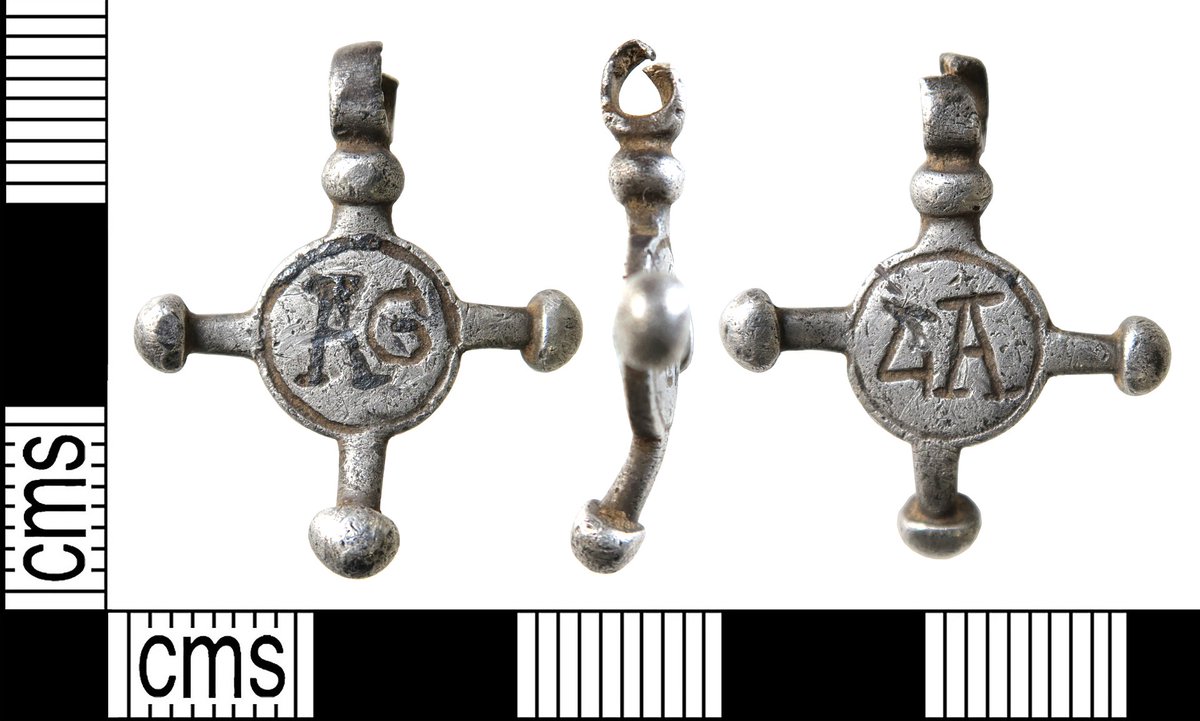
It has been found inscribed on several Medieval silver crosses & gold brooches from England recorded by the Portable Antiquities Scheme, where it was interpreted as a charm against fever. Almost certainly, that's what it was intended to mean in this newly discovered brooch. 6/6
HT @PortantIssues who first flagged up the error in this article.
Loading suggestions...