

Bond Market 101
Bonds have been traded far longer than stocks have
In this mega-thread, we will be covering the basics of how a bond market operates.
Kindly consider retweeting if you find the thread useful.
Bonds have been traded far longer than stocks have
In this mega-thread, we will be covering the basics of how a bond market operates.
Kindly consider retweeting if you find the thread useful.
Content
a) What Is a Bond Market and who issues bonds
b) Segments of the Bond Market
c) History of Bond Markets
d) Types of Bond Markets
e) The correlation between the stock market and the bond market
a) What Is a Bond Market and who issues bonds
b) Segments of the Bond Market
c) History of Bond Markets
d) Types of Bond Markets
e) The correlation between the stock market and the bond market
1) What Is a Bond Market?
A bond is a promise to pay investors interest along with the return of principal in exchange for buying the bond.
The bond market is a marketplace where investors buy debt securities that are fetched to the market by either government or corporations.
A bond is a promise to pay investors interest along with the return of principal in exchange for buying the bond.
The bond market is a marketplace where investors buy debt securities that are fetched to the market by either government or corporations.
2) Who issues it?
Governments typically issue bonds in order to raise capital to pay down debts or fund infrastructural improvements.
Companies issue bonds to raise the capital needed to maintain operations, grow their product lines or open new locations.
Governments typically issue bonds in order to raise capital to pay down debts or fund infrastructural improvements.
Companies issue bonds to raise the capital needed to maintain operations, grow their product lines or open new locations.
Bonds tend to be less volatile and more conservative than stock investments, but also have lower expected returns.
The bond market is also referred to as the debt market or fixed-income market.
The bond market is also referred to as the debt market or fixed-income market.
3) Segments of Bond Markets
The bond market is broadly divided into the primary market and the secondary market.
The primary market is frequently referred to as the "new issues" market in which transactions strictly occur directly between the bond issuers and the bond buyers.
The bond market is broadly divided into the primary market and the secondary market.
The primary market is frequently referred to as the "new issues" market in which transactions strictly occur directly between the bond issuers and the bond buyers.
In the secondary market, securities that have already been sold in the primary market are then bought and sold at later dates.
These secondary market issues can be packaged in the form of pension funds, mutual funds, life insurance policies, etc.
These secondary market issues can be packaged in the form of pension funds, mutual funds, life insurance policies, etc.
4) History of Bond Markets
Debt instruments' history traces back to 2400 B.C; for example, a clay tablet discovered at Nippur, (present-day Iraq.) used to record a guarantee for payment of grains and listed consequences if the debt was not repaid.
Debt instruments' history traces back to 2400 B.C; for example, a clay tablet discovered at Nippur, (present-day Iraq.) used to record a guarantee for payment of grains and listed consequences if the debt was not repaid.
In the middle ages, governments began issuing debts in order to fund wars.
The Bank of England, the world's oldest central bank still in existence, was established to raise money to rebuild the British navy in the 17th century through the issuance of bonds.
The Bank of England, the world's oldest central bank still in existence, was established to raise money to rebuild the British navy in the 17th century through the issuance of bonds.
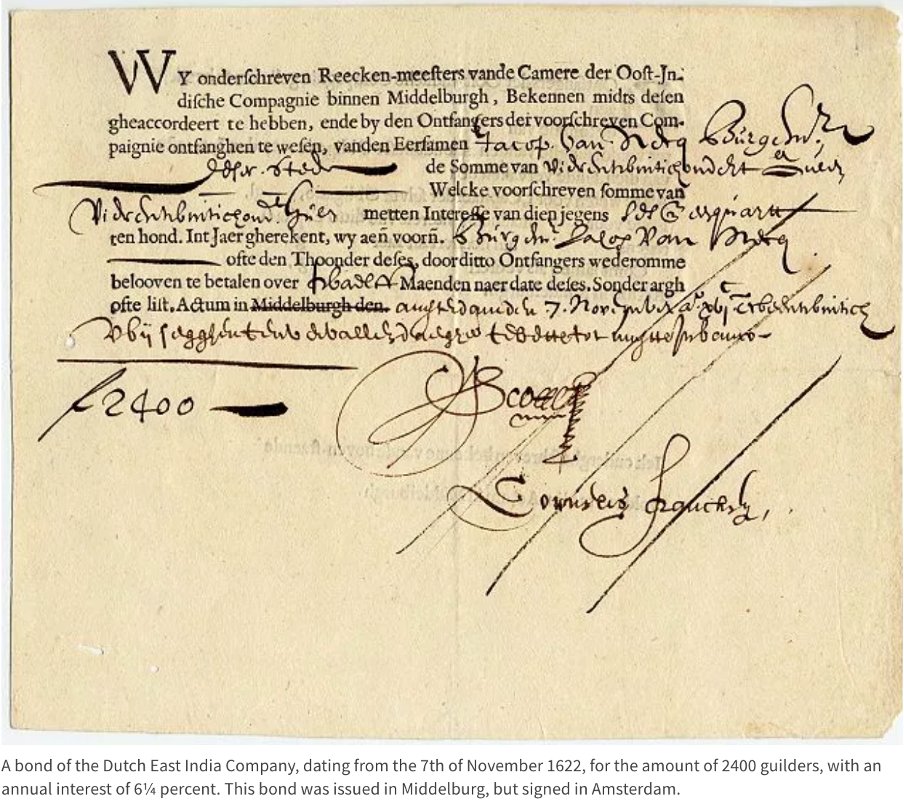
Early chartered corporations such as the Dutch East India Company issued debt instruments before they issued stocks.
These bonds, such as the one in the image below, were issued as "guarantees" or "sureties" and were hand-written to the bondholder.
These bonds, such as the one in the image below, were issued as "guarantees" or "sureties" and were hand-written to the bondholder.
5) Types of Bond Markets
i) Corporate Bonds
Corporate bonds describe longer-term debt instruments that provide a maturity of at least one year and above.
Corporate bonds are typically classified as either investment-grade or else high-yield (or "junk").
i) Corporate Bonds
Corporate bonds describe longer-term debt instruments that provide a maturity of at least one year and above.
Corporate bonds are typically classified as either investment-grade or else high-yield (or "junk").
This classification is based on the credit rating assigned to the bond and its issuer.
An investment grade is a rating that signifies a high-quality bond that presents a relatively low risk of default.
An investment grade is a rating that signifies a high-quality bond that presents a relatively low risk of default.
Junk bonds are bonds that carry a higher risk of default than most bonds issued by corporations and governments.
Junk bonds represent bonds issued by companies that are financially struggling and have a high risk of defaulting.
Junk bonds represent bonds issued by companies that are financially struggling and have a high risk of defaulting.
Junk bonds are also called high-yield bonds since a higher yield is needed to help offset any risk of default. These bonds have credit ratings below BBB-.
ii) Government Bonds
Because sovereign debt is backed by a government that can tax its citizens or print money to cover the payments, these are considered the least risky type of bonds.
Because sovereign debt is backed by a government that can tax its citizens or print money to cover the payments, these are considered the least risky type of bonds.
In the U.S., government bonds are known as Treasuries
a) A Treasury (T-Bill) is a short-term government debt obligation backed by the Treasury with a maturity of one year or less.
b) A Treasury note (T-note) is a debt with a fixed interest and a maturity between 1 and 10 years
a) A Treasury (T-Bill) is a short-term government debt obligation backed by the Treasury with a maturity of one year or less.
b) A Treasury note (T-note) is a debt with a fixed interest and a maturity between 1 and 10 years
6) The correlation between the stock market and the bond market
The correlation between equities and bonds has not always been stable
Up until about 1998 bonds and stocks correlated positively but then starting in 1998 that correlation flipped negative.
The correlation between equities and bonds has not always been stable
Up until about 1998 bonds and stocks correlated positively but then starting in 1998 that correlation flipped negative.
When inflation is high one tends to have a positive correlation between stocks and bonds.
When inflation comes down then the correlation flips negative and people become more concerned about deflation or maybe even a depression-like we had seen after the 2008 financial crisis.
When inflation comes down then the correlation flips negative and people become more concerned about deflation or maybe even a depression-like we had seen after the 2008 financial crisis.
The correlation between stocks and bonds has started to trend back positive lately due to quantitative easing and government stimulus leading to inflation across the economy.
If you found this thread useful, kindly:
1) Retweet the first tweet
2) Follow @stockifi_Invest
If you found this thread useful, kindly:
1) Retweet the first tweet
2) Follow @stockifi_Invest
Loading suggestions...