

Inflation numbers are coming out tomorrow. It’s expected to be the highest we’ve seen in 40 years.
Here’s a brief history of inflation and why it matters:
Here’s a brief history of inflation and why it matters:
Let’s start with the ultra basics. What is inflation?
Inflation is the continuous increase in the price of goods and services over time.
Basically, as prices rise over time, each unit of currency (dollar) buys less and less stuff.
Inflation is the continuous increase in the price of goods and services over time.
Basically, as prices rise over time, each unit of currency (dollar) buys less and less stuff.
Said another way: inflation is the decrease of the purchasing power of the dollar.
When we talk about "inflation", we usually mean inflation rate: the rate at which the price of stuff is increasing.
When we talk about "inflation", we usually mean inflation rate: the rate at which the price of stuff is increasing.
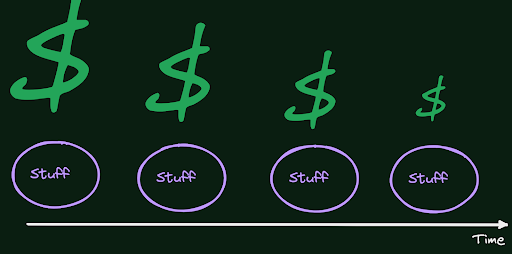
Basically, inflation tells us that money is going to become worthless over time, and we are going to have to keep re-indexing.
Every once in a while, the unit of currency will become so worthless that the benchmark needs to move:
$1 in the 1900s is the same as ~$35 today.
Every once in a while, the unit of currency will become so worthless that the benchmark needs to move:
$1 in the 1900s is the same as ~$35 today.
Why does the dollar decrease in value over time?
Given how annoying inflation is, can’t we just all agree to keep the value the same and get piece of mind?
Let’s go through some history to evaluate this.
Given how annoying inflation is, can’t we just all agree to keep the value the same and get piece of mind?
Let’s go through some history to evaluate this.
When economies were using gold and silver as primary medium of exchange, inflation had a simple cause:
The population was increasing over time, so the government needed to increase the supply of physical coins in circulation to meet the transaction needs of the economy.
The population was increasing over time, so the government needed to increase the supply of physical coins in circulation to meet the transaction needs of the economy.
There’s a limited amount of silver/gold in an economy (unless you’re Genghis Khan and you keep invading other countries to steal their gold).
Solution?
Melt silver coins and mix them with copper and other shittier metals to produce more coins.
Solution?
Melt silver coins and mix them with copper and other shittier metals to produce more coins.
The government would then issue these "mixed" coins at the same notional value:
Each 1 silver "mixed" coin is equal to 1 silver coin.
There is now more coins (real and mixed) in the economy: the relative value of each coin is worth less than it was.
Each 1 silver "mixed" coin is equal to 1 silver coin.
There is now more coins (real and mixed) in the economy: the relative value of each coin is worth less than it was.
For example, the denarius was 90% silver during the period close to when Christ was alive.
It had pretty much no silver in the year 250.
Roman emperors were schemy bast***s.
It had pretty much no silver in the year 250.
Roman emperors were schemy bast***s.
Through this method, the government can basically keep on printing new money.
This kept going for a while.
Until one day, someone was looking at the gold coins, and they thought to themselves “it’s crazy how this coin is mostly made out of garbage!”.
This kept going for a while.
Until one day, someone was looking at the gold coins, and they thought to themselves “it’s crazy how this coin is mostly made out of garbage!”.
Then they came up with a genius idea: “how about we forget about the gold, and just make the coins 100% garbage!”.
Enters paper money, or the “non-gold” standard.
Enters paper money, or the “non-gold” standard.
It makes perfect sense: no need to worry about what % of the coin is garbage if it’s guaranteed to be all garbage.
Also, any country has an infinite amount of garbage!
Now the government can print an infinite amount of money.
Also, any country has an infinite amount of garbage!
Now the government can print an infinite amount of money.
The government liked it, cause they can produce more coins with lower “cost”, and make more profit out of “seignorage” (aka inflation tax).
How does this work?
How does this work?
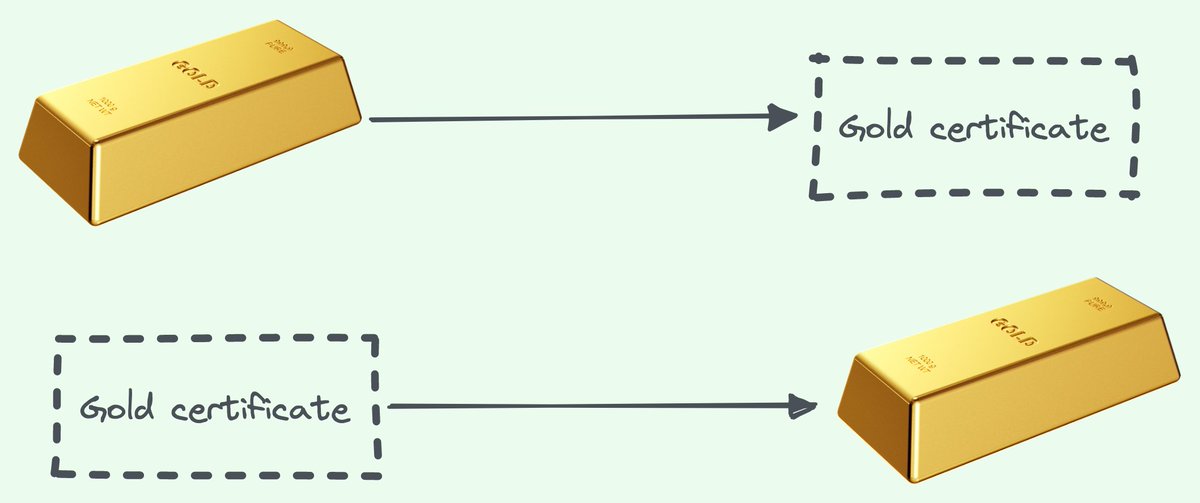
Lets say the government tells you: give me 1 bar today, in exchange for a “gold certificate” that says that they owe you 1 gold bar.
You keep the certificate for a year, then you come back to the government, and they give you your 1 gold bar back.
Clean and fair.
You keep the certificate for a year, then you come back to the government, and they give you your 1 gold bar back.
Clean and fair.
Lets say the government decides to be smart instead. Why? Cause governments are schemy.
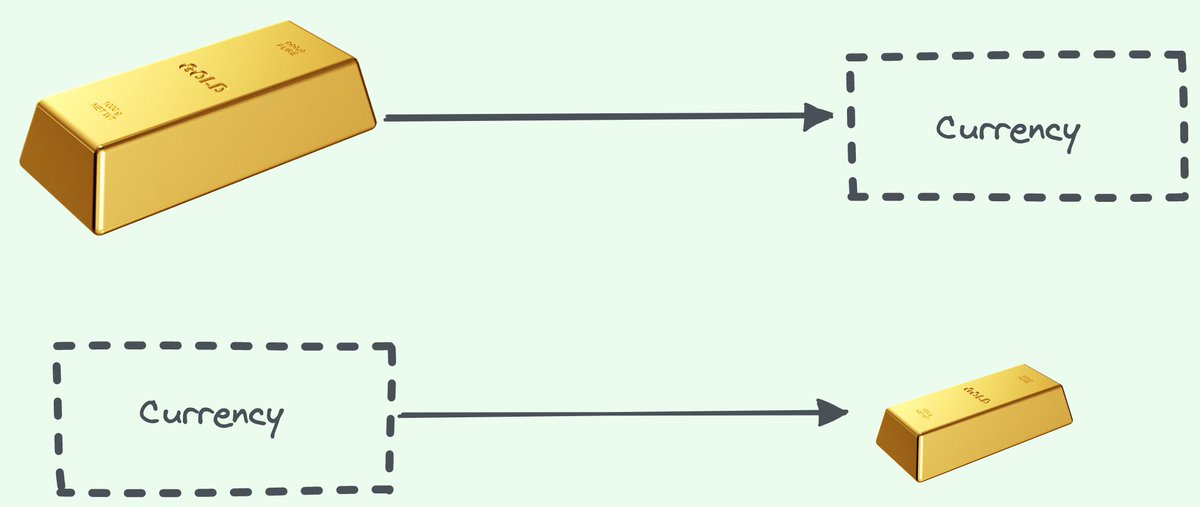
Instead of giving you a gold certificate, they give you a “non-gold standard” based currency instead.
Instead of giving you a gold certificate, they give you a “non-gold standard” based currency instead.
You keep the currency for a year. Then exchange it for gold at the currency's *new market value*.
If the value of the currency vs gold decreases, you get less gold in return.
If the value of the currency vs gold decreases, you get less gold in return.
What just happened here?
You started with 1 gold bar, and ended up with 1-x gold bar.
The gov started with 0 gold bar, and ended up with x gold bar.
Government 1 - 0 you.
"Seignorage" - the nobles whispered, as they counted their riches.
You started with 1 gold bar, and ended up with 1-x gold bar.
The gov started with 0 gold bar, and ended up with x gold bar.
Government 1 - 0 you.
"Seignorage" - the nobles whispered, as they counted their riches.
Going back to our main thread.
The move to fiat currencies made money supply changes significantly easier, which lead to more rapid inflation over time.
Seignorage is a cool concept, but it’s not the only reason that the value of currency decreases over time.
The move to fiat currencies made money supply changes significantly easier, which lead to more rapid inflation over time.
Seignorage is a cool concept, but it’s not the only reason that the value of currency decreases over time.
The long-term root cause is changes in the money supply relative to the growth of the economy.
If the economy is growing at rate X, and the supply of money is growing at rate Y, where Y > X, here is what happens in 1 year:
Goods go from 1 to 1+X
Money goes from 1 to 1+Y
If the economy is growing at rate X, and the supply of money is growing at rate Y, where Y > X, here is what happens in 1 year:
Goods go from 1 to 1+X
Money goes from 1 to 1+Y
Today: 1 money = 1 good
In one year: 1 money = (1+X)/(1+Y) so 1 money < 1 good
Money becomes less valuable over time.
I'll go in more depth in a later post, but you can read more here: economicshelp.org
In one year: 1 money = (1+X)/(1+Y) so 1 money < 1 good
Money becomes less valuable over time.
I'll go in more depth in a later post, but you can read more here: economicshelp.org
Why do we need to increase the money supply? That’s what we explained above (needing to increase the amount in physical circulation).
Now, while this explains long-term inflation, short-term inflation is explained by our usual friend: supply and demand.
(for a later post)
Now, while this explains long-term inflation, short-term inflation is explained by our usual friend: supply and demand.
(for a later post)
Anyway, inflation is heading into its highest level since the Yuppies used to run the world.
The last time inflation was this crazy was 1981, when inflation hit 8.92%.
macrotrends.net
The last time inflation was this crazy was 1981, when inflation hit 8.92%.
macrotrends.net

The CPI will be reflecting the surge in oil and gas prices caused by the Ukraine debacle.
The number is going to be high and it is going to be ugly.
To be frank, I'm pretty sick of prices rising like this.
The number is going to be high and it is going to be ugly.
To be frank, I'm pretty sick of prices rising like this.
Unfortunately, I'm bearing bad news.
The Kalshi markets are currently forecasting a 1.1% MoM inflation rate, so 8.4% YoY.
FactSet is forecasting the same.
kalshi.com
The Kalshi markets are currently forecasting a 1.1% MoM inflation rate, so 8.4% YoY.
FactSet is forecasting the same.
kalshi.com
Tomorrow's headlines will be about the print.
It is going to be an important release because it will give us a sense of whether: inflation is going to taper down by itself…
… or the FED will need to get even more aggressive.
It is going to be an important release because it will give us a sense of whether: inflation is going to taper down by itself…
… or the FED will need to get even more aggressive.
Btw, if you decide to signup and trade on inflation or other markets, we're currently matching your first trade*:
kalshi.com
kalshi.com

Loading suggestions...