

Caching is an easy and powerful ways to increase the performances of a system.
There are several caching strategies like:
1. Cache aside
2. Read through
3. Write through
4. Write back
5. Write around
How do they differ ?
Which one to choose ?
[thread] ↓
There are several caching strategies like:
1. Cache aside
2. Read through
3. Write through
4. Write back
5. Write around
How do they differ ?
Which one to choose ?
[thread] ↓
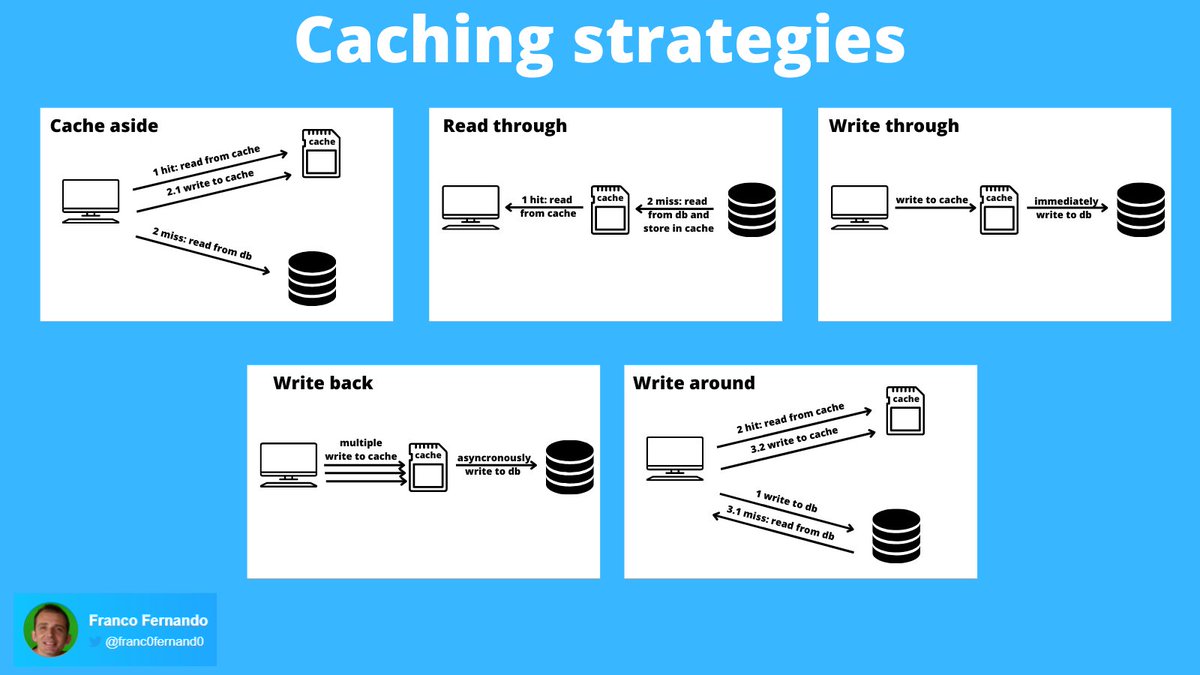
1. Cache aside
• The application read the data directly from the cache
• If the data is in the cache (hit), it's returned to the client
• Otherwise (cache miss), the application retrieves the data from the database and then writes it to the cache
• The application read the data directly from the cache
• If the data is in the cache (hit), it's returned to the client
• Otherwise (cache miss), the application retrieves the data from the database and then writes it to the cache
✅ good for read-heavy workloads
✅ database and cache are decoupled and can handle different data models
✅ lazy loading prevent the cache being loaded with unnecessary data
❌ stale data may be provided, without a proper expiration time
❌ many cache miss at the beginning
✅ database and cache are decoupled and can handle different data models
✅ lazy loading prevent the cache being loaded with unnecessary data
❌ stale data may be provided, without a proper expiration time
❌ many cache miss at the beginning
2. Read through
• Like read aside, but the application interacts only with the cache
• In case of a miss, the cache gets the data from the database and stores it, returning it to the application
✅ simpler application code
❌ require a custom plugin for fetching the data
• Like read aside, but the application interacts only with the cache
• In case of a miss, the cache gets the data from the database and stores it, returning it to the application
✅ simpler application code
❌ require a custom plugin for fetching the data
3. Write through
• The application write data to the cache
• The cache write immediately the data to the database
✅ data consistency between cache and database
✅ no data loss in case of cache crash
❌ higher latency for write operations
• The application write data to the cache
• The cache write immediately the data to the database
✅ data consistency between cache and database
✅ no data loss in case of cache crash
❌ higher latency for write operations
4. Write back
• The application write data to the cache
• The cache write asynchronously the data to the database
✅ good for write-heavy workloads (low latency)
✅ reduce the load on database
✅ tolerant to database failures
❌ possible data loss in case of cache crash
• The application write data to the cache
• The cache write asynchronously the data to the database
✅ good for write-heavy workloads (low latency)
✅ reduce the load on database
✅ tolerant to database failures
❌ possible data loss in case of cache crash
5. Write around
• The application write data directly to the database
• Only the data that is read get into the cache
✅ good for data written once and read less frequently (the cache store only re-read data)
❌ reading recently written data gives a miss (high latency)
• The application write data directly to the database
• Only the data that is read get into the cache
✅ good for data written once and read less frequently (the cache store only re-read data)
❌ reading recently written data gives a miss (high latency)
None of the above is the best caching strategy.
All depends on the data and data access patterns.
A good general purpose strategy for read intensive application is the cache around one.
Memcached and Redis are widely used caches implementing this strategy.
All depends on the data and data access patterns.
A good general purpose strategy for read intensive application is the cache around one.
Memcached and Redis are widely used caches implementing this strategy.
If you have instead write heavy workloads, a write back strategy is a good choice.
DynamoDB Accelerator (DAX) is an example of cache combining both read/write through.
If you have data written once and read rarely (i.e. real time logs), write around could be a good fit.
DynamoDB Accelerator (DAX) is an example of cache combining both read/write through.
If you have data written once and read rarely (i.e. real time logs), write around could be a good fit.
Thanks for reading!
I'm Franco Fernando and I often write about distributed systems.
If you enjoyed this read
✓ drop a comment
✓ leave a like or retweet
✓ check my blog (link in bio)
✓ follow me (@franc0fernand0) for similar content
I'm Franco Fernando and I often write about distributed systems.
If you enjoyed this read
✓ drop a comment
✓ leave a like or retweet
✓ check my blog (link in bio)
✓ follow me (@franc0fernand0) for similar content
Loading suggestions...