

The Cleveland Fed trimmed mean CPI is out & it is ugly.
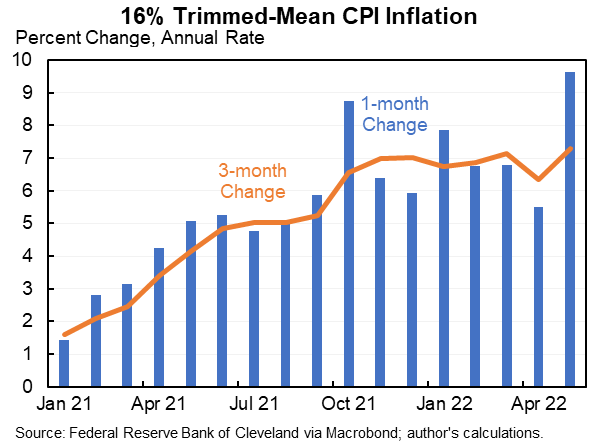
It was even higher than core CPI for May. For the first time this cycle it is running higher than core for the last 12 months.
Monthly and 12-month trimmed mean are both the largest on record (data back to '83).
It was even higher than core CPI for May. For the first time this cycle it is running higher than core for the last 12 months.
Monthly and 12-month trimmed mean are both the largest on record (data back to '83).
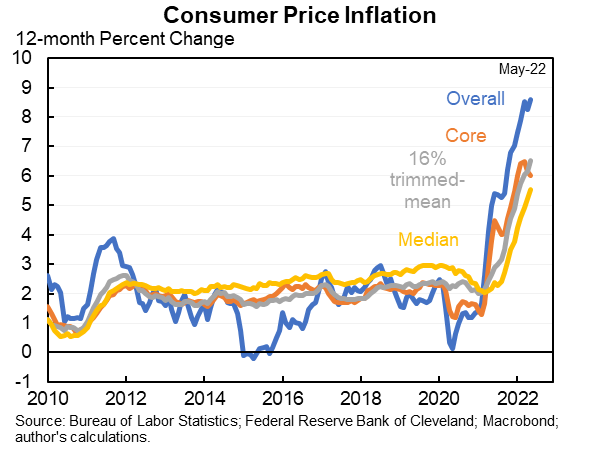
Here are the 12 month changes of four different CPI metrics. You can see trimmed mean finally passing core.
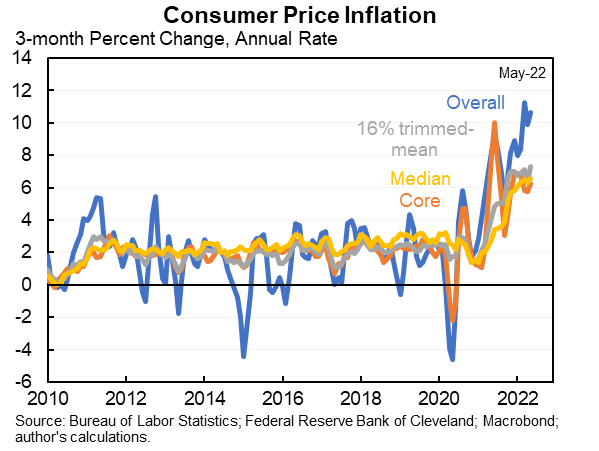
Here are the 3 month changes for those same for CPI metrics. You can see how much more volatile the core is than the trimmed mean or median. And how the core has come down a little while trimmed mean basically keeps strengthening.
Note, the CPI is not a good predictor of future inflation because volatile food and energy inflation tends not to carry forward.
Economists tend to look at core CPI and it's still my favorite. But it also has a lot of volatility around goods prices, especially for cars.
Economists tend to look at core CPI and it's still my favorite. But it also has a lot of volatility around goods prices, especially for cars.
Some have argued we should be looking at trimmed mean and median CPI because they don't just strip out an arbitrary pre-determined set of things (like core) but actually drop the most volatile.
They were more reassuring for much of 2021.
Not any longer.
They were more reassuring for much of 2021.
Not any longer.
You can find all of these data here. They all look somewhat different for the PCE (which the Fed targets), we'll see what that is like for May in a few weeks.
clevelandfed.org
clevelandfed.org
P.S. My preferred measure of core inflation is still nominal wage growth minus 1.5 (to account for productivity growth). That is running at about 4%. So I do think underlying inflation is much lower than what we're seeing but much higher than the Fed is expecting.
P.P.S. But if all I had to go on was the data in the CPI report (and you couldn't look at wages or anything else), you would think the underlying rate of inflation was 6%+.
P.P.P.S. One more measure I could have included (I was just showing the full set of Cleveland ones).
Loading suggestions...