

The Corpus Juris Civilis of the Emperor Justinian I: A Brief Summary of Some Civil Laws in the Byzantine Empire – Slavery and Miscellaneous Issues 🧵
In the last thread of the series, let’s first look at some laws concerning slavery as codified by Justinian I.
In the last thread of the series, let’s first look at some laws concerning slavery as codified by Justinian I.
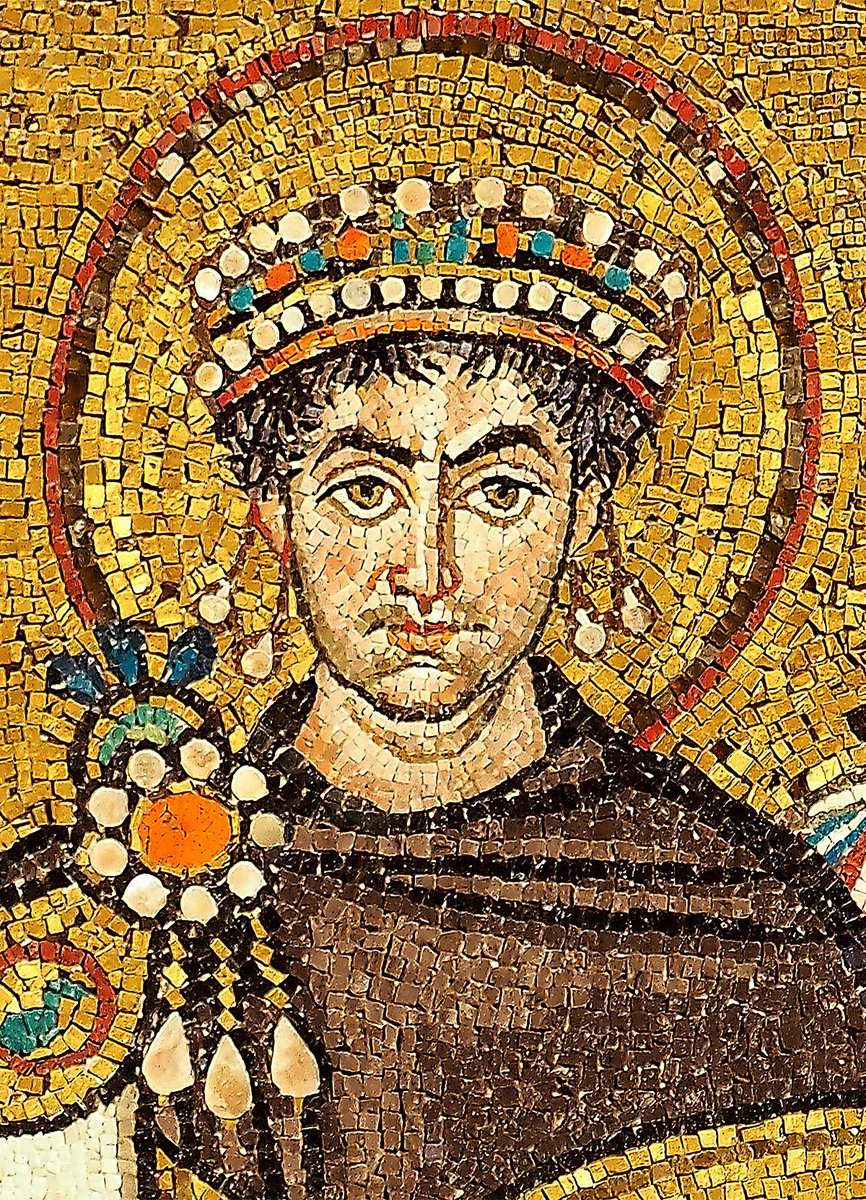
Slavery was allowed by the law. Christian societies, like all societies, did not consider slavery to be morally wrong. An examination of the New Testament also shows that neither Jesus nor his disciples ever preached against slavery.
It is understandable then that the Christians of the Byzantine Empire accepted slavery as a legitimate institution.
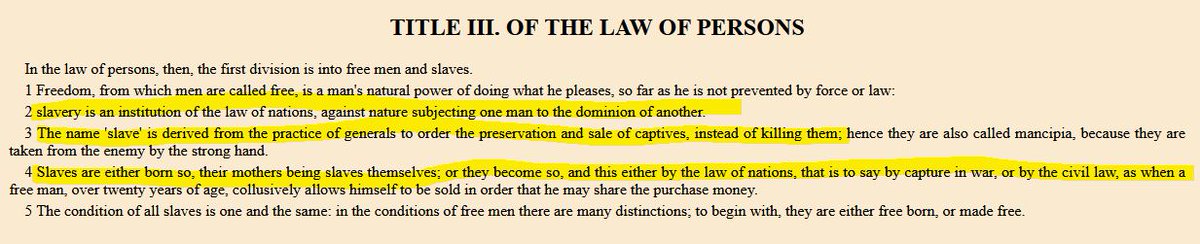
In the “Institutiones”, Book I, Title III (Of the Law of Persons), slavery is defined as an “institution of the law nations”, though it is “against nature subjecting one man to the dominion of another” (#link2H_4_0004" target="_blank" rel="noopener" onclick="event.stopPropagation()">gutenberg.org).
It also explains who a slave can be acquired. It could be through “capture in war” or “by the civil law”.
In the “Institutiones”, Book II, Title I, talks about the “law of things” (#link2H_4_0029" target="_blank" rel="noopener" onclick="event.stopPropagation()">gutenberg.org).
Part 17 states: “Things again which we capture from the enemy at once become ours by the law of nations, so that by this rule even free men become our slaves”.
Part 17 states: “Things again which we capture from the enemy at once become ours by the law of nations, so that by this rule even free men become our slaves”.

Slaves were also treated differently by the law. We previously noted that women were not allowed to be witnesses to wills. Slaves were also prohibited from this (Institutiones, Book II, Title X; #link2H_4_0038" target="_blank" rel="noopener" onclick="event.stopPropagation()">gutenberg.org).

Also, as stated in the “Novellae”, the criminal penalty for forgery was different for slaves compared to free persons. Slaves found guilty of forgery were put to death, while a “free man” was “deported” (Book III, Title XVIII; #link2H_4_0102" target="_blank" rel="noopener" onclick="event.stopPropagation()">gutenberg.org).

In the “Institiones”, Book IV, Title VIII, the law of “noxal actions” by slaves is discussed. The law concerns a slave, or “noxa”, who commits a crime such as “theft, damage, robbery, or outrage” (#link2H_4_0092" target="_blank" rel="noopener" onclick="event.stopPropagation()">gutenberg.org).

In such a case, the master is liable and has the option of paying for the damages or surrendering the slave to the injured party.
Torture of slaves was also allowed in specific cases, such as adultery, fraud, and treason. This is stated in the “Codex Justinianus”, Book IX, Title 41 (droitromain.univ-grenoble-alpes.fr).
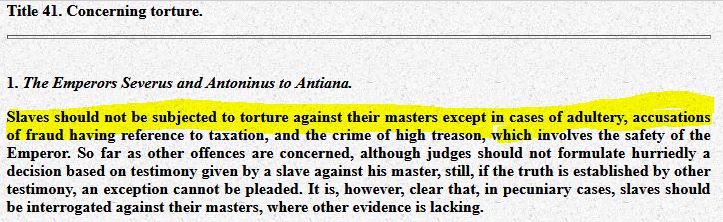
Interestingly, in the same chapter, torture of a woman who has “destroyed her husband by poison” is also allowed.

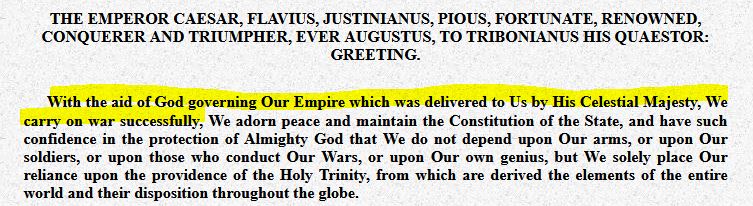
Now, let’s look at some miscellaneous laws. As noted in the first thread, the military activities and victories of the empire were credited to divine aid (droitromain.univ-grenoble-alpes.fr).
The preface of the “Digestum” states: “With the aid of God governing Our Empire which was delivered to Us by His Celestial Majesty, We carry on war successfully…”
This meant that foreign territories would be acquired and the taxation of such territories would be needed.
In the “Novellae”, Book 102, the taxation of Arabia (which would later be the birthplace of Islam & lead to the Muslim conquest of Byzantine territories) is discussed (droitromain.univ-grenoble-alpes.fr).
This concludes the series on the Corpus Juris Civilis. Clearly, Christians have never been very liberal in matters of law, criminal punishments, war, slavery, religious freedom, etc.
This should raise important questions: where do modern, liberal Christians get their ideas from? Why are their views so different from Christians from antiquity?
And Allah (Glorified and Exalted be He) knows best!
And Allah (Glorified and Exalted be He) knows best!
Loading suggestions...