

Justice J.B. Pardiwala of SC to deliver a keynote address on the theme "Vox Populi vs. Rule of Law: Supreme Court of India" in the post-lunch session of the 2nd Justice HR Khanna Memorial National Symposium, hosted by RMNLU & NLUO with the CAN Foundation.
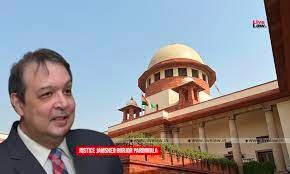
Justice Pardiwala commences his address by paying tribute to the colossal persona of late H.R. Khanna. "He has been one of the greatest judges of the Supreme Court of India."- Justice Pardiwala.
Justice Pardiwala mentions that "Vox Populi" was first used by the English archbishop of Canterbury against King Edward II who the Archbishop wanted to remove from the thrown. Thus, the term was initially used in a negative light.
Balancing will of people with rule of law is difficult. "Log kya kahenge" is what all judges think of when it comes to writing judgements which have social ramifications - Justice Pardiwala
Rule of law is the most distinguishing feature of the Indian democracy which began its career through the Indian Constitution. However, even in countries which are not governed by parliamentary democracy, rule of law prevails.
Even dictatorships have rule of law, thus, rule of law in a democracy like India must be scrutinized carefully - Justice Pardiwala
Justice Pardiwala: Public discussion, debate in the legislature and the decree of the court is what distinguish the mechanism of Indian law making from other governments.
For instance, in British, the sovereignty of parliament is absolute. However, in India, the spheres of legislature are defined and can be challenged in the court of law- Justice Pardiwala
Courts in India have the power to pronounce verdicts over validity of law in India. It is on this ground that we say that rule of law in India is distinguishable- Justice Pardiwala
I am a firm believer that there are no exceptions to rule of law and the opinion of the public hardly matters when it comes to judicial verdicts. Judicial verdicts must not be under the influence of public opinion: Justice Pardiwala
Justice Pardiwala quotes Prof K.T. Shah- "Where there is collective wisdom,there is after all real salvation" to state that the importance of Vox Populi as well.
In a democracy, we agree to live by the decisions of the court. It does not mean that court decisions are right- we still agree to live by them. In democracy, knowledge is more important than blindly following judgements of the court - Justice Pardiwala
Justice Pardiwala cited the Navtej Singh Johar judgement, which decriminalized homosexuality in India, as the "finest example" wherein the Supreme Court upheld the rule of law as opposed to the opinion of the public.
When we look at the decisions of SC, like the Sabrimala verdict, friction between the rule of law and public opinion comes to forefront.
Justice Pardiwala quotes the Sabrimala judgement to state that "Let every person remember that the holy book is the Constitution of India."
Let me also talk about the role of media. A trial is supposed to be carried out by the courts. Trials by digital media are undue interference for the judiciary. This crosses the "laxman Rekha" and is all the more problematic when only half truth is pursued : Justice Pardiwala
Social media is about personal opinions against the judges instead of providing opinions criticizing the judgements. This is what harming the judiciary in the country.: Justice Pardiwala
Personal attacks on judges for their judgements lead to a dangerous scenario where the judges have to think about what media thinks instead of what the law really thinks. This harms the rule of law: Justice Pardiwala
The remedy of judgements does not lie with social media but with higher courts in the hierarchy. Social and digital media leads to legal issues becoming political. An example would be the Ayodhya judgement where a contentious civil dispute became a political issue: J. Pardiwala
Regulation of social and digital media, especially in the context of sensitive trials which are sub-judice, must be looked at by the parliament: Justice Pardiwala
There have been several reports by national as well as international organisations handling the perpetual issues of media trials. One of the notable ones are the Madrid Principles on the Relationship between the Media and Judicial Independence, 1994: Justice Pardiwala
While stating that judges must not participate in social media discussions, Justice Pardiwala said- "Judges never speak through their tongue, only their judgements."
Justice Pardiwala concludes his address by stating that- "Judiciary cannot exist independent of society but the rule of law is insurmountable."
Loading suggestions...