
"My goal is to be happy" doesn't mean what we really want it to.
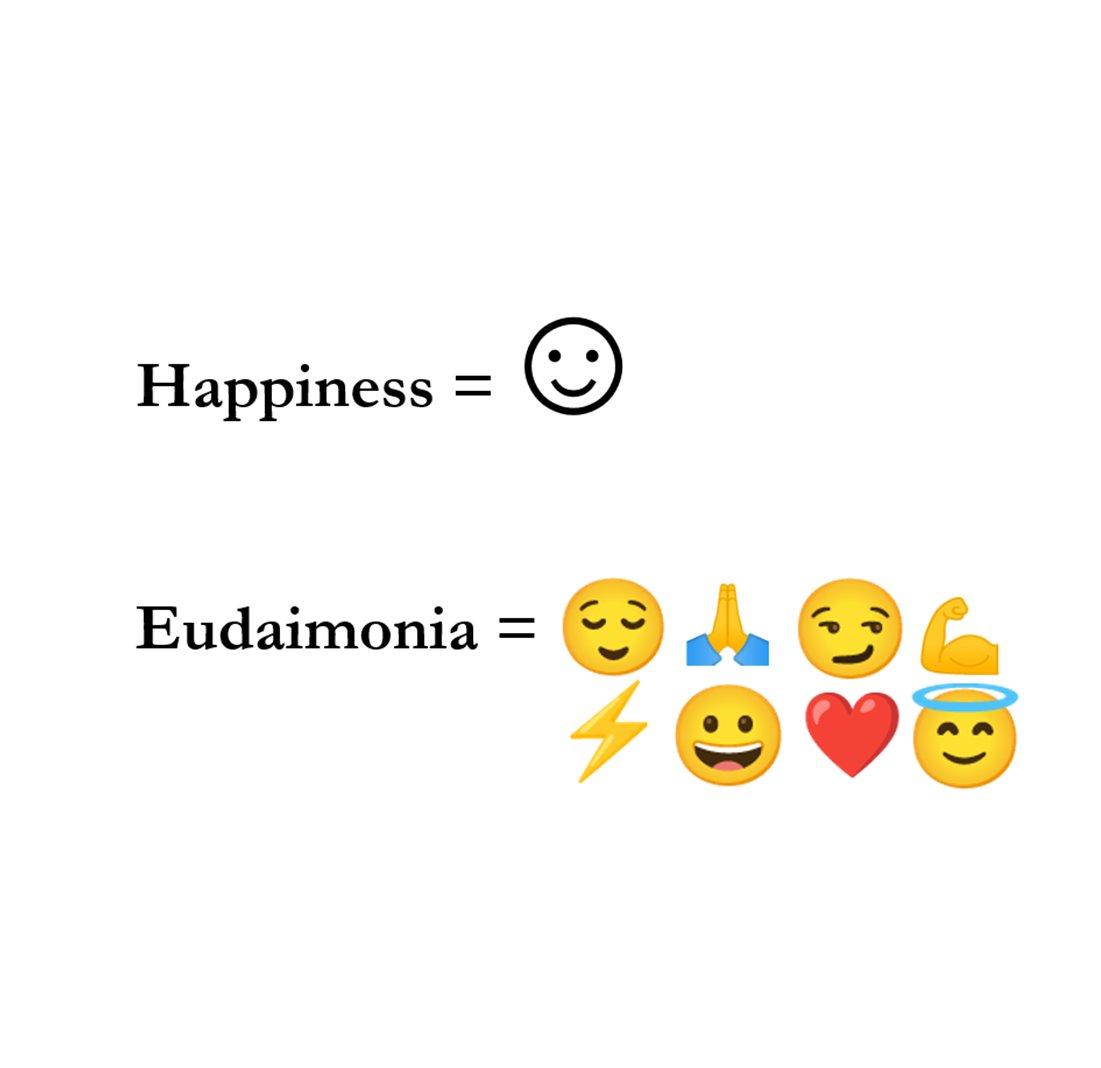
Happiness is an emotion. What people seek is something more.
The Ancient Greeks had a better word than happiness: Eudaimonia...
Happiness is an emotion. What people seek is something more.
The Ancient Greeks had a better word than happiness: Eudaimonia...
If you support a sports team, and that team wins a game, you'd probably say "I'm happy they won."
And yet people also say they're "happy" when they get married, have a child, graduate, or achieve something important.
Seems like the word "happy" is too broad...
And yet people also say they're "happy" when they get married, have a child, graduate, or achieve something important.
Seems like the word "happy" is too broad...
Because happiness is a fleeting, brief, often uncontrollable feeling. In other words, it's an emotion.
Which is why saying you "want to be happy in life" doesn't quite work.
That means you want to orientate your life around feeling a particular emotion.
Which is why saying you "want to be happy in life" doesn't quite work.
That means you want to orientate your life around feeling a particular emotion.
When people say they "want to be happy" they're really describing something else.
A sort of harmony with the world, being the best version of yourself, a state of peace and completion, of meaning, of purpose, of contentment.
The Ancient Greeks had a word for that: eudaimonia.
A sort of harmony with the world, being the best version of yourself, a state of peace and completion, of meaning, of purpose, of contentment.
The Ancient Greeks had a word for that: eudaimonia.
Eudaimonia is sometimes translated into English as "happiness", but that doesn't even nearly capture its full depth.
Other translations include "wellbeing", but that term is a bit cold and uninspiring, and has other connotations.
So what did it mean to the Ancient Greeks?
Other translations include "wellbeing", but that term is a bit cold and uninspiring, and has other connotations.
So what did it mean to the Ancient Greeks?
Aristotle defined eudaimonia as "living and doing well."
While Plato explained eudaimonia as "the good composed of all goods; an ability which suffices for living well; perfection in respect of virtue; resources sufficient for a living creature."
While Plato explained eudaimonia as "the good composed of all goods; an ability which suffices for living well; perfection in respect of virtue; resources sufficient for a living creature."
You'll notice that Plato refers to it as an "ability", while Aristotle emphasises *living* and *doing*.
And therein lies the key difference between happiness and eudaimonia...
And therein lies the key difference between happiness and eudaimonia...
Happiness is an emotion.
Whereas eudaimonia is more than having positive feelings in a particular moment.
It means you are doing what you want to be doing in the way you want to be doing it. It means you are the person you can and should be. It means things are *just right*.
Whereas eudaimonia is more than having positive feelings in a particular moment.
It means you are doing what you want to be doing in the way you want to be doing it. It means you are the person you can and should be. It means things are *just right*.
And that's why it's a much more accurate and useful word than "happiness."
Trying to make yourself happy is hard. You can't force an emotion. And it doesn't last long anyway.
Aiming for eudaimonia is about living, doing, and thinking in the best way possible.
Trying to make yourself happy is hard. You can't force an emotion. And it doesn't last long anyway.
Aiming for eudaimonia is about living, doing, and thinking in the best way possible.
The Ancient Greeks themselves disagreed about the precise definition of eudaimonia and how it could be achieved.
For example, Socrates firmly believed that virtue was a key part of eudaimonia.
For example, Socrates firmly believed that virtue was a key part of eudaimonia.
The Stoics also thought it could be reached through living a virtuous life.
While the Epicureans, who believed pleasure was the only intrinsic good, saw an absence of pain as a route to eudaimonia.
While the Epicureans, who believed pleasure was the only intrinsic good, saw an absence of pain as a route to eudaimonia.
The way to achieve eudaimonia is an important discussion; but it's a discussion for another day.
What matters here is that Socrates, Plato, Aristotle, the Stoics, and the Epicureans all believed eudaimonia is what humans seek above all else.
What matters here is that Socrates, Plato, Aristotle, the Stoics, and the Epicureans all believed eudaimonia is what humans seek above all else.
Like how in the 21st century we inaccurately describe "finding happiness" as life's ultimate goal.
Everybody knows the word "happy" isn't quite right. So let's use a more helpful and more accurate word.
Happiness -> Eudaimonia
Happy -> Eudaimonic
Everybody knows the word "happy" isn't quite right. So let's use a more helpful and more accurate word.
Happiness -> Eudaimonia
Happy -> Eudaimonic
Because when you can name something it allows you to understand and seek it properly.
So that *thing* you're striving for, which you know "happiness" doesn't quite describe... it might just be eudaimonia.
So that *thing* you're striving for, which you know "happiness" doesn't quite describe... it might just be eudaimonia.
Loading suggestions...