
Stories of magical items, weapons, and legendary objects are abound in the Islamic world. From talismans created to command the jinn, to the famous flying carpet each have unique origins and lore.
A thread
A thread
Likely the most famous magical object is the Seal of Solomon, a ring reputedly given to Solomon by the angel Jibra’il. It was inscribed with sacred symbols and the Greatest Name of God.
Possession of the ring granted him dominion over the jinn
Possession of the ring granted him dominion over the jinn
One time Solomon took off the ring and the wily jinn, Sakhr absconded with it. Using it he took on the guise of the king and ruled as an imposter for 40 days.
Solomon attempted to persuade the people of his true identity, but was rebuffed and forced to live as a fisherman.
Solomon attempted to persuade the people of his true identity, but was rebuffed and forced to live as a fisherman.
Sakhr ruled poorly and eventually either through boredom or need to escape fled in the guise of a bird promptly dropping the ring into the sea where it was swallowed by a fish.
Solomon, now a fisherman, would catch the fish randomly and upon cutting it open find his ring.
Solomon, now a fisherman, would catch the fish randomly and upon cutting it open find his ring.
With the ring placed back on his finger he was restored to power and had the usurping jinn dragged before him to be punished.
Al-Tabari relates the story which is drawn from the para-biblical Solomon and Ashmodei
Al-Tabari relates the story which is drawn from the para-biblical Solomon and Ashmodei
There are various tales of the ring, but by the medieval period it will be linked to the figure of Ali, the son-in-law of Muhammad via the Diwan-i-Ali
In some cases, it is said the ring was passed down to Ali and that upon his death was hidden within a stone where it remains until this day.
Knowledge of the Seal of Solomon would be particularly popular in Islamic occult literature and replica rings could be found among the fares of many talisman-makers.
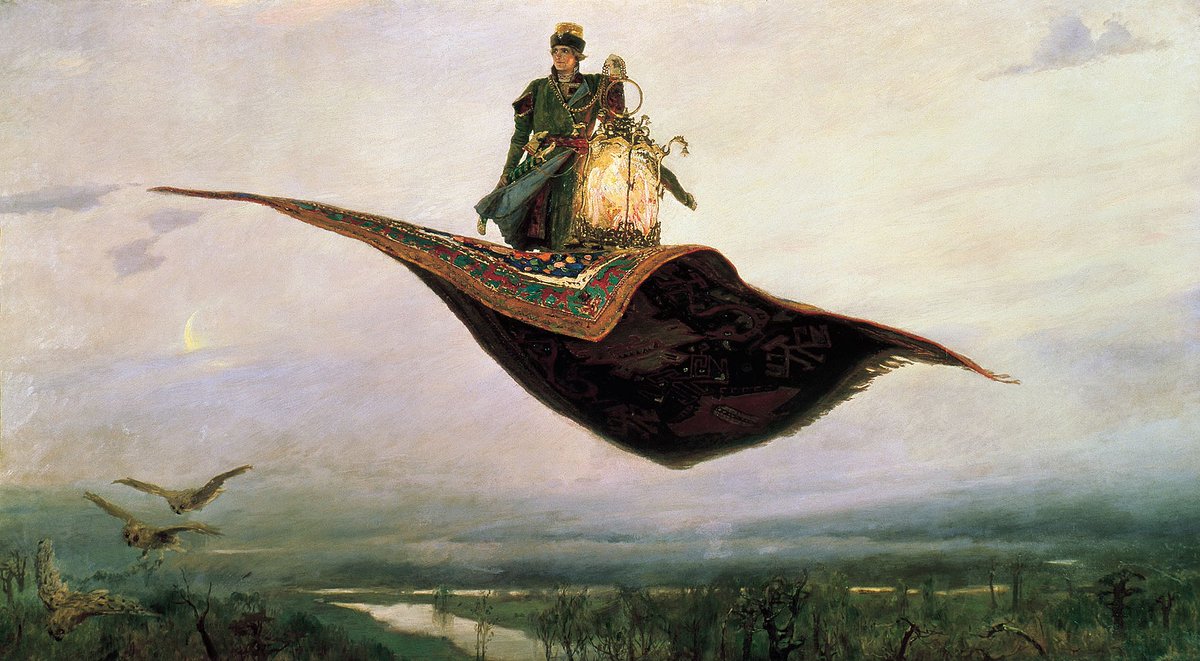
Magic carpets flying through the air would be popularized by A Thousand and One Nights, but evidence of these magic items are found throughout the region.
The historian Peter Brown indicates that some Parthian and Sassanian kings may have been associated with flying carpets, using them in warfare.
Jewish and Islamic sources accredit King Solomon with a flying carpet.
Jewish and Islamic sources accredit King Solomon with a flying carpet.
The Qur’an states the wind was subjected to Solomon and he could direct it as he commanded. (Q 34:12)
Ibn Kathir would go on to explain that Solomon would gather his troops upon a great carpet and under his direction the wind would carry the carpet allowing him to travel distances that normally took a month in a matter of a day.
Moses was another prophet who was attributed with a powerful item: his staff.
The wonders of Moses are attested to in the Bible and Qur’an both, but in the corpus of al-Buni the staff of Moses itself is a magical object.
The wonders of Moses are attested to in the Bible and Qur’an both, but in the corpus of al-Buni the staff of Moses itself is a magical object.
Reputedly it had the secret name of the angel Mitatrush inscribed upon and those who know the right verse to recite could unlock its power.
The staff is said to still reside in the world somewhere, but talisman-makers have tried to recreate it following instructions left by the mage, al-Buni.
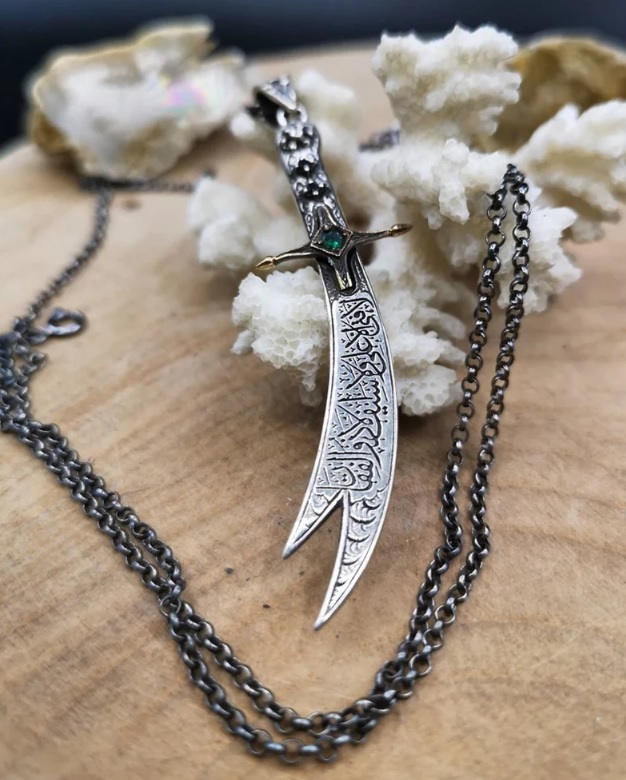
Among legendary weapons there is the sword of Ali, Zulfiqar.
According to ibn Abbas, the sword was given to him by Prophet Muhammad and is divine in origin.
It is recognizable by its unique form; having two points, or double-bladed.
It is recognizable by its unique form; having two points, or double-bladed.
Its legendary status would earn it a reputation throughout the Islamic world as it would be replicated in flags and images.
Talismans would boast the symbol of Zulfiqar in order to invoke its unbreakable power.
Talismans would boast the symbol of Zulfiqar in order to invoke its unbreakable power.
We also famously hear of magic mirrors.
Ibn Khaldun tells us sages craft magic mirrors through secret means that grant them the power to see into the future and into the minds of others.
Ibn Khaldun tells us sages craft magic mirrors through secret means that grant them the power to see into the future and into the minds of others.
These objects were popular among diviners who acquired them through special rituals and rites.
Like the Lord of the Rings Palatntir, these magic mirrors were precious items that could be passed down.
Like the Lord of the Rings Palatntir, these magic mirrors were precious items that could be passed down.
Some books also earned legendary reputations.
Shams al-Ma'arif and the book of astrological magic, Ghayat al Hakim both earned fearsome reputations as books of magic and the occult.
Shams al-Ma'arif and the book of astrological magic, Ghayat al Hakim both earned fearsome reputations as books of magic and the occult.
In popular imagination, simply owning or possessing either of these books invoked the attention of the hidden realms and influences and it is possible the reputation of the two inspired the later imagining of the Necronomicon.
Literature is full of many more of these objects; from necklaces to knives, from talismans to amulets.
The existence and reputation of these objects are a testament to the complex and rich material histories of the Islamic world.
Items like the Seal of Solomon are a fascinating trace to the cross-confessional nature of legends while magic mirrors may speak to the materiality of the objects and their history.
I shall cover more legends and histories from the Islamic world in future threads
Loading suggestions...