
History
Culture
Warfare
Anthropology
Indigenous Peoples
Native American Studies
War Studies
Indigenous Studies

What if you launched a war against your neighbours, not to gain land or treasure, but to forcibly create new people?
The Iroquois Wars for Mourning, Grief, Revenge and Beavers in the 17th Century.
The Iroquois Wars for Mourning, Grief, Revenge and Beavers in the 17th Century.

Some context - the Iroquois or Haudenosaunee Confederacy prior to 1722 was made up of the Five Nations: the Mohawk, Oneida, Cayuga, Seneca and Onondaga. For sheer size and power the Haudenosaunee were almost unrivalled in Native American history.

The 17th century was a period of tumultuous change around the Great Lakes. French fur traders and missionaries to the north, English colonies to the south and east, and Dutch traders selling weapons, tools and other materials to all sides.


The Iroquois had many traditional enemies - the Powhatan Empire, the Hurons and the Algonquians. Access to firearms through trading beaver and animal pelts sparked intensive hunting, tribes scrambling to get the upper hand by stockpiling weapons.


In the early 1600's the French had assembled an alliance of nations with whom they would trade fur for firearms. The Iroquois were excluded from this policy and the French helped the Huron and Algonquians defeat Iroquoian raids.

Famously Samuel de Champlain demonstrated his courage by standing in front of the Mohawk with his arquebus, single-handedly killing two chiefs and awing his allies. The Mohawk fled, casting off their now-useless armour, never to charge into battle en masse again.


Eager to secure a monopoly of trade with the Dutch, the Mohawk launched an attack on the Mohicans in 1622. They drove them across the Hudson and were able to strong-arm the Dutch into providing them with guns, while denying them to the enemy.


Despite Iroquoian supremacy in trade, the Confederacy was now running short of two vital commodities - beavers and people. The first annihilated through overhunting, the second through epidemics and diseases. Faced with a blockade on hunting to the north, it was time for war...

Iroquoian concepts of kinship were different to European, and it was possible to capture someone in war and 'make' them a member of the tribe. This was usually demanded by a clan matron, grieving over the loss of family member. Young men were expected to go find a replacement.

This is the basis of the 'mourning war', an alien concept which combines sorrow, revenge and revitalisation of the community in one of three ways. Either the captured person was killed and scalped or was violently subdued and then adopted into the family...

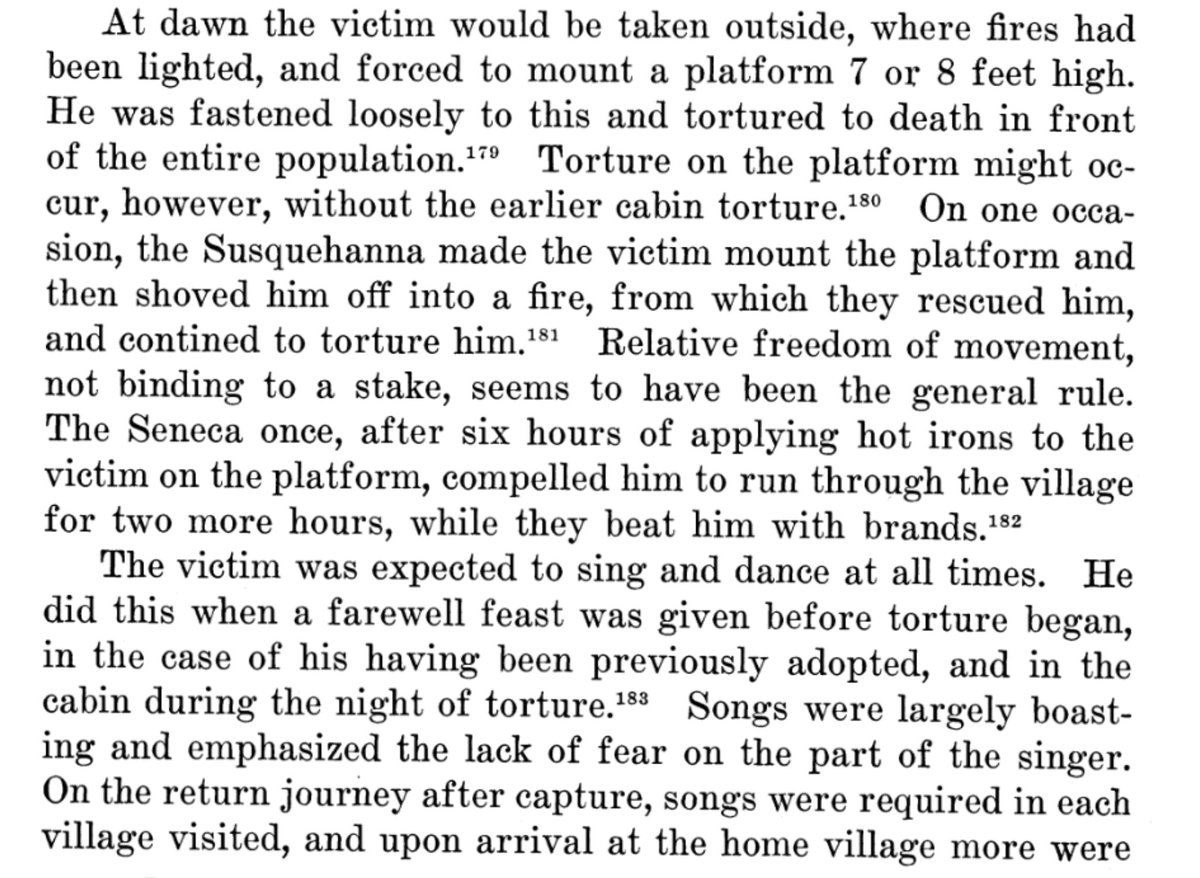
or they were horrifically and slowly tortured to death and eaten. The consumption of their body providing spiritual power, particularly if the person had faced their torments and agony with stoicism and bravery. The accounts make for gruesome reading.


The status of the newly adopted people has long been debated in academia - were they slaves, dependents, second-class, lower caste, quasi-kin or full members of society? We will probably never know exactly and it likely differed with each individual and family.


With this in mind we can set the scene - the 1640's, the Iroquois have lost many people to disease and they desperately need to replace them, revenge them and gain access to beaver-rich hunting grounds. The Mourning Wars begin in earnest.

In 1638 the Iroquois attacked a small buffer tribe - the Wenro - and confiscated their lands. The remaining Wenro threw themselves on the Huron for protection. The Iroquois stepped up and began attacking the Huron borders throughout the early 1640's.

Poor French diplomacy drew them into direct conflict with the Iroquois, the most confrontational of whom were the powerful Mohawk. By 1649 the Iroquois had driven the Huron out of their homelands, one of many large scale population displacements of the war.

In 1650 Iroquois assaults on the French and their allies cleared out the Shawnee from Ohio, quickly followed up by attacks on the Neutral peoples, many thousands of whom were adopted and assimilated into the Confederacy.

The complex mixture of refugees around the Great Lakes created new tribes and defensive pacts. Most famously the Wyandot people were born from the shattered remnants of the Tionontati, Attignawantan and Wenrohronon peoples, all survivors of Iroquois fury and aggression.

In 1654 the Iroquois ambitiously invaded Erie territory and within two years were able to destroy their confederacy, a victory borne out of confidence, vitality, energy and security in trade

But it wasn't all good fortune for the Haudenosaunee. The Susquehannocks, tired of decades of raiding, drove the Seneca back. The Mohicans, armed by New England Puritans, defeated the Mohawk. The Sokokis stopped the Onondagas, Mohawks and Oneidas, and so on.

At this point we need to reflect on how the traditional Mourning War had begun to spiral out of control. More lethal firearms, disease, the imperative to hunt furs and the need to replace the dead led to a death spiral. The Haudenosaunee lashed out in every direction.

Miamis, Dakota Sioux, Algonquins, Susquehannocks, Anishnaabe, Mannahoac. All came under attack even as the French organised counter-raids deep into Iroquois territory. By the 1670's potentially two-thirds of Iroquoians were adoptees, with a powerful Christian block.

Eventually the Iroquois brokered a peace settlement, cognizant that they were becoming a buffer zone in a much larger Anglo-French war. The treaty of 'Le Grande Paix', the Great Peace, was signed in Montreal in 1701, formally ending the wars.

Historians have often considered the prime motivation for the conflict to be economic, hence 'the Beaver Wars'. But others have argued that the mourning 'complex' better explains Iroquois military strategy, pushing out in all directions, the sheer overkill.

Hopefully this has been an interesting overview, I've missed out many great battles and individuals but aimed to keep to the general theme of the mourning war phenomenon. This article on the Mourning Wars has a great reading list for anyone interested.
chenussio.geneseo.sunycreate.cloud
chenussio.geneseo.sunycreate.cloud

Loading suggestions...