

If you invest, you MUST know how to identify a moat
Stocks with a competitive advantage outperform the market by 5% per year on average.
Here is everything you need to know:
Stocks with a competitive advantage outperform the market by 5% per year on average.
Here is everything you need to know:

1️⃣ What is a moat?
A moat or durable competitive advantage is a condition that puts a company in a superior business position.
This will allow the business to maintain and increase its profit margin and market share.
A moat or durable competitive advantage is a condition that puts a company in a superior business position.
This will allow the business to maintain and increase its profit margin and market share.

Warren Buffett once stated that the company itself can be seen as the equivalent of a castle and the value of the castle will be determined by the strength of the moat.
In other words: the moat protects those inside the castle and prevents outsiders from entering the fortress.
In other words: the moat protects those inside the castle and prevents outsiders from entering the fortress.

2️⃣ How do you know a company has a moat?
A moat is a structural business characteristic that allows a firm to generate excess economic returns for a long period of time.
There are two critical factors to determine whether a company has a moat.
A moat is a structural business characteristic that allows a firm to generate excess economic returns for a long period of time.
There are two critical factors to determine whether a company has a moat.
1. The company has a Return On Invested Capital (ROIC) greater than its Weighted Average Cost of Capital (WACC)
2. The ROIC has maintained high and constant for a reasonable period of time in the past.
2. The ROIC has maintained high and constant for a reasonable period of time in the past.
Looking at the evolution of the gross margin and ROIC over the past decade can already give you a great indication.
When both metrics are robust and (very) high, this is already a great sign that the company has a moat.
When both metrics are robust and (very) high, this is already a great sign that the company has a moat.
Morningstar states that a company has a sustainable competitive advantage when they will be able to generate a ROIC > WACC for at least the next 20 years.
Companies with a moat often have a lot of pricing power too.
Companies with a moat often have a lot of pricing power too.
Munger stated once that a few times in your lifetime, you’ll find a company which could raise its return enormously by just raising their prices, and yet they haven’t done it.
This gives them a lot of untapped picing power. These companies are the ultimate no-brainer.
This gives them a lot of untapped picing power. These companies are the ultimate no-brainer.
Coca-Cola, S&P Global and See’s Candies are great examples of companies with pricing power.

3️⃣ Different kinds of moats
In general, there are 5 different kinds of moats:
▪️ Switching costs
▪️ Intangible assets
▪️ Network effects
▪️ Cost advantages
▪️ Efficient scale
In general, there are 5 different kinds of moats:
▪️ Switching costs
▪️ Intangible assets
▪️ Network effects
▪️ Cost advantages
▪️ Efficient scale
▪️ Switching costs
The costs a consumer pays as a result of switching brands or products. These costs can be monetary, but also psychological, effort-based, and time-based.
The costs a consumer pays as a result of switching brands or products. These costs can be monetary, but also psychological, effort-based, and time-based.
A good example of a company with switching costs is Salesforce, a CRM company which tries to expand the relationship with its customers by cross-selling other services that provide additional value.
This makes it even harder for their customers to change to another CRM system.
This makes it even harder for their customers to change to another CRM system.
Switching from Windows to Apple and vice versa can also be seen as a switching cost as it takes some time to master the software.
Other examples: Automatic Data Processing and Intuitive Surgical.
Other examples: Automatic Data Processing and Intuitive Surgical.
▪️ Intangible assets
A moat based on intangible assets includes a competitive advantage because of the strong brand, patents, or regulatory licenses.
This may prevent competitors from duplicating products or allow a company to charge a premium price.
A moat based on intangible assets includes a competitive advantage because of the strong brand, patents, or regulatory licenses.
This may prevent competitors from duplicating products or allow a company to charge a premium price.
Buffett once stated that he didn’t know the value of a brand until Berkshire Hathaway bought See’s Candies.

Munger and Buffett try to determine the strength of a moat based on the brand by measuring whether a competitor can replicate or weaken the moat with massive investments.
Their test on Coca-Cola is a good example:
“If you gave me $100 billion and said take away the soft drink leadership of Coca-Cola in the world, I'd give it back to you and say it can't be done.” - Warren Buffett
“If you gave me $100 billion and said take away the soft drink leadership of Coca-Cola in the world, I'd give it back to you and say it can't be done.” - Warren Buffett
▪️ Network effects
A moat based on network effects is one of the strongest moats companies can create because this moat source is very scalable.
A moat based on network effects is one of the strongest moats companies can create because this moat source is very scalable.
A network effect exists when the value of a product or service grows as its user base expands.
Each additional customer increases the value of the product or service exponentially.
Each additional customer increases the value of the product or service exponentially.
Think about companies like American Express, Amazon, Mastercard & Visa, and Alphabet.
'“Google has a huge new moat. In fact I’ve probably never seen such a wide moat.” - Charlie Munger
'“Google has a huge new moat. In fact I’ve probably never seen such a wide moat.” - Charlie Munger
▪️ Cost advantage
Companies that are able to produce products or services at lower costs than its rivals benefit from cost advantages.
Companies that are able to produce products or services at lower costs than its rivals benefit from cost advantages.
Firms with a structural cost advantage can either undercut competitors on price while earning similar margins, or can charge market-level prices while earning relatively high margins.
Ikea and Walmart are two companies with strong cost advantages.
Ikea and Walmart are two companies with strong cost advantages.
For us personally, cost advantages are the least preferred moat source.
The reason for this is that these companies often have no pricing power.
Pricing power is a very important characteristic of quality companies.
The reason for this is that these companies often have no pricing power.
Pricing power is a very important characteristic of quality companies.
▪️ Efficient scale
Last but not least, efficient scale is the fifth moat source.
In some markets, there is only room for a few players. These kinds of markets are called monopolistic (only 1 company) or oligopolistic (only a few companies) markets.
Last but not least, efficient scale is the fifth moat source.
In some markets, there is only room for a few players. These kinds of markets are called monopolistic (only 1 company) or oligopolistic (only a few companies) markets.
Scale economies are very important in business. It is the dynamic in which a market of limited size is effectively served by few companies.
Existing players generate economic profits, but now entrants would cause returns for all playes to fall to a level below the cost of capital.
Great examples are S&P Global and Moody’s and US railroad stocks like Union Pacific.
Great examples are S&P Global and Moody’s and US railroad stocks like Union Pacific.
4️⃣ Durability of the moat
For quality investors, the margin of safety does not lay in a cheap valuation but in the strength of the competitive advantage.
That’s why for moats, durability matters.
For quality investors, the margin of safety does not lay in a cheap valuation but in the strength of the competitive advantage.
That’s why for moats, durability matters.
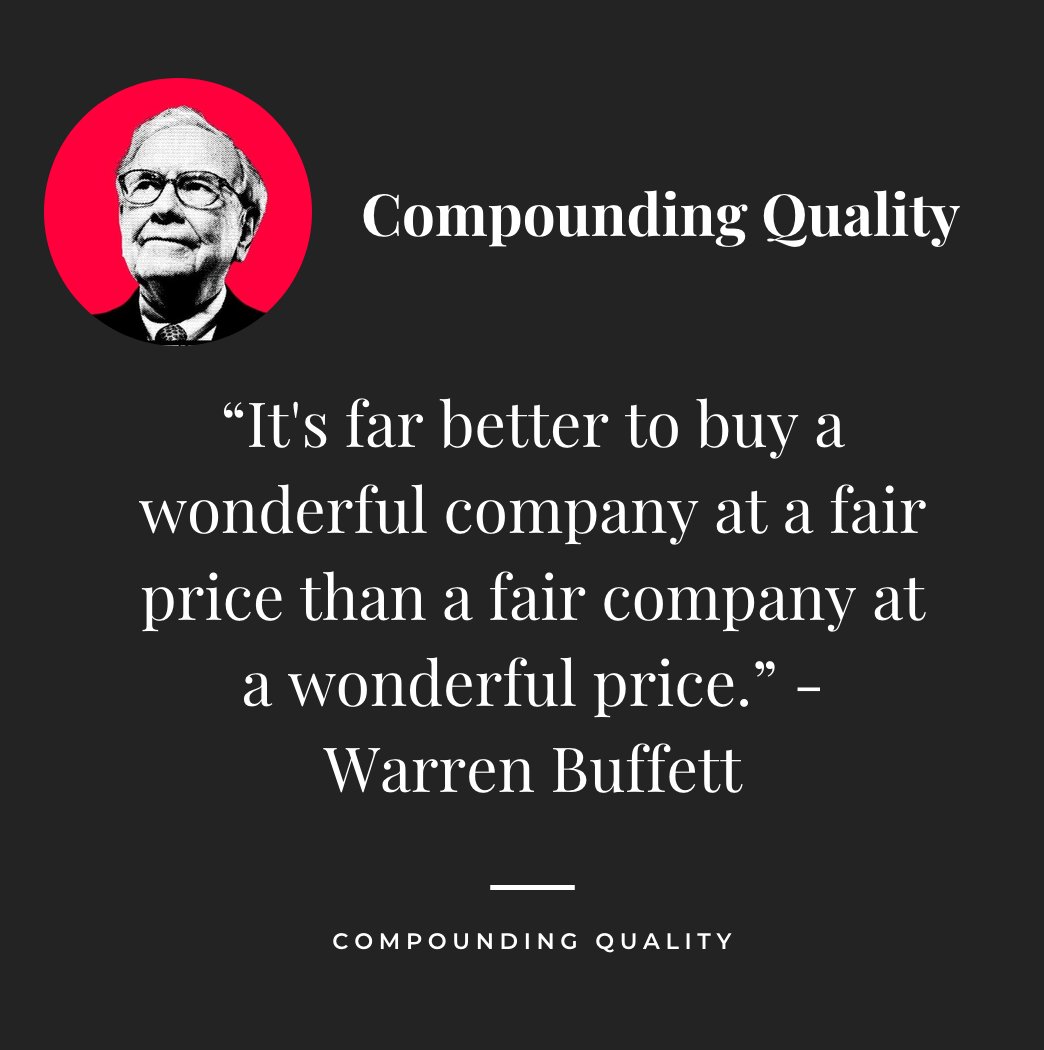
You want to invest in companies which will still have a huge competitive advantage in 5, 10, and 20 years from now.
Disruption is the greatest enemy of quality investors.
Disruption is the greatest enemy of quality investors.

5️⃣ No reversion to the mean
Mean reversion is a theory used in finance that states that historical returns will revert to the long-term average.
Mean reversion is a theory used in finance that states that historical returns will revert to the long-term average.
For stocks, this means that when a certain industry is very attractive, new competitors will start to get interested and enter the market which will result in a lower profitability for all companies active within that market.
Michael Mauboussin summarized it as follows:
“Companies generating high economic returns will attract competitors willing to take a lesser, albeit still attractive return which will drive down aggregate industry returns to the opportunity cost of capital.”
“Companies generating high economic returns will attract competitors willing to take a lesser, albeit still attractive return which will drive down aggregate industry returns to the opportunity cost of capital.”
In general, reversion to the mean indeed takes place in the economy. However, mean reversion does not take place for companies with a wide and durable moat.
Why?
Because no matter how many enterprises would like to enter a certain very attractive market, when the companies which are already active in that market have a huge economic moat, new entrants won’t be able to take market share from these existing companies.
Because no matter how many enterprises would like to enter a certain very attractive market, when the companies which are already active in that market have a huge economic moat, new entrants won’t be able to take market share from these existing companies.
Just look at this chart which states that companies with a high ROIC (a first indication that a company has a wide moat) tend to outperform over time:

6️⃣ Does investing in wide moat stocks work?
The question of $1 million is whether it helps to focus on companies with a wide moat.
The answer is YES!
The question of $1 million is whether it helps to focus on companies with a wide moat.
The answer is YES!
Between 2002 and today, the Morningstar Wide Moat index, an index with only wide moat companies, returned 14.7% per year to shareholders compared to 9.4% for for the MSCI World.
This means that wide moat stocks outperform the market with more than 5% per year over the past 2 decades:

Here you can find all companies withing Morningstar's wide moat index:

7️⃣ Conclusion
▪️ In investing, it all starts with the moat
▪️ A company has a moat when its ROIC > WACC for a very long period of time
▪️ You want to invest in companies that still have a moat in 20 years from now
▪️ Stocks with a moat outperform the market
▪️ In investing, it all starts with the moat
▪️ A company has a moat when its ROIC > WACC for a very long period of time
▪️ You want to invest in companies that still have a moat in 20 years from now
▪️ Stocks with a moat outperform the market
The end.
▪️ Each Tuesday we share 5 investment insights
▪️ Each Thursday we publish a deeper investment article
Read the full article here:
qualitycompounding.substack.com
▪️ Each Tuesday we share 5 investment insights
▪️ Each Thursday we publish a deeper investment article
Read the full article here:
qualitycompounding.substack.com
Loading suggestions...