

What is a Blockchain? A thread:
· What is a Blockchain?
It's a growing list of records (blocks)
The Blocks are linked together using cryptography.
It's described as data storage:
- trustless
- fully decentralized
- peer-to-peer
- immutable
It's spread over a network of participants (nodes)
It's a growing list of records (blocks)
The Blocks are linked together using cryptography.
It's described as data storage:
- trustless
- fully decentralized
- peer-to-peer
- immutable
It's spread over a network of participants (nodes)

· Blocks
They contain:
- a cryptographic hash of the previous one.
- a timestamp + transaction data.
The timestamp proves that the transaction data existed when the block was published in order to get into its hash.
The blocks form a chain (hence the name).
They contain:
- a cryptographic hash of the previous one.
- a timestamp + transaction data.
The timestamp proves that the transaction data existed when the block was published in order to get into its hash.
The blocks form a chain (hence the name).
· Resistance to modification
The recorded data in a block cannot be altered without altering all subsequent blocks
They are ban be managed by a p2p network for use as a publicly distributed ledger
Nodes adhere to a protocol to communicate/validate new blocks.
The recorded data in a block cannot be altered without altering all subsequent blocks
They are ban be managed by a p2p network for use as a publicly distributed ledger
Nodes adhere to a protocol to communicate/validate new blocks.
· Secure by design
Although blockchain records are not unalterable as forks are possible, blockchains may be considered secure by design.
They exemplify a distributed computing system with high Byzantine fault tolerance.
Although blockchain records are not unalterable as forks are possible, blockchains may be considered secure by design.
They exemplify a distributed computing system with high Byzantine fault tolerance.
· Structure
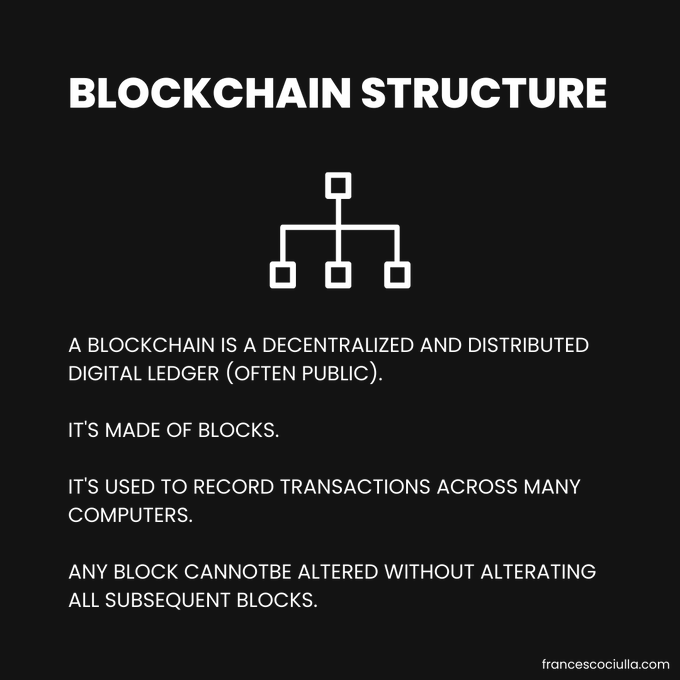
A blockchain is a digital ledger:
- decentralized
- distributed
- often public
It consists of records (blocks)
it's used to record transactions across many computers
Any block cannot be altered retroactively, without the alteration of all subsequent blocks.
A blockchain is a digital ledger:
- decentralized
- distributed
- often public
It consists of records (blocks)
it's used to record transactions across many computers
Any block cannot be altered retroactively, without the alteration of all subsequent blocks.
· Robust workflow
The uncertainty of the participants regarding data security is marginal.
The use of a blockchain removes the characteristic of infinite reproducibility from a digital asset, confirming that each unit of value was transferred once.
The uncertainty of the participants regarding data security is marginal.
The use of a blockchain removes the characteristic of infinite reproducibility from a digital asset, confirming that each unit of value was transferred once.
· Value Exchange protocol
A Blockchain can be seen as a value-exchange protocol.
A blockchain can maintain title rights.
When properly set up to detail the exchange agreement, it provides a record that compels both offer and acceptance.
A Blockchain can be seen as a value-exchange protocol.
A blockchain can maintain title rights.
When properly set up to detail the exchange agreement, it provides a record that compels both offer and acceptance.
· Layers
A blockchain can be seen as several layers:
- infrastructure.
- networking (node discovery, information propagation, verification).
- consensus (proof of work/stake).
- data (blocks, transactions).
- application (smart contracts/decentralized applications).
A blockchain can be seen as several layers:
- infrastructure.
- networking (node discovery, information propagation, verification).
- consensus (proof of work/stake).
- data (blocks, transactions).
- application (smart contracts/decentralized applications).
If this thread has been useful, follow @FrancescoCiull4 and retweet the tweet below.
Loading suggestions...