

Does Bitcoin operate on magical 4-year cycles that have to do with the Bitcoin Block Reward Halving?
Get ready to have your world flipped upside-down if you believe it does.
Because I'm about to build my case that it's an urban myth.
1/x
Get ready to have your world flipped upside-down if you believe it does.
Because I'm about to build my case that it's an urban myth.
1/x

The argument that 4-Year Block Reward Halving's are the cause of bull runs is due to reduced inflationary pressures on Bitcoin's price.
The less Bitcoin that is rewarded to miners, the less sell pressure they have.
Conceptually it makes sense.
But the charts have conflict.
The less Bitcoin that is rewarded to miners, the less sell pressure they have.
Conceptually it makes sense.
But the charts have conflict.
The most recent Bitcoin Block Reward Halving's have occurred on:
May 11, 2020
July 9, 2016
November 12, 2012
Below is the numbers of days it took Bitcoin to "touch" it's all time high post-halving date.
2012: 92-days
2016: 180-days
2020: 204-days
May 11, 2020
July 9, 2016
November 12, 2012
Below is the numbers of days it took Bitcoin to "touch" it's all time high post-halving date.
2012: 92-days
2016: 180-days
2020: 204-days

The first observation that can be taken from that data set is that the number of days post-halving are increasing. 92-days, 180-days, and then 204-days.
But over the years, I became skeptical of Bitcoin's cycle timing, and that the timing had confluence with the Dow Jones (DJI).
But over the years, I became skeptical of Bitcoin's cycle timing, and that the timing had confluence with the Dow Jones (DJI).
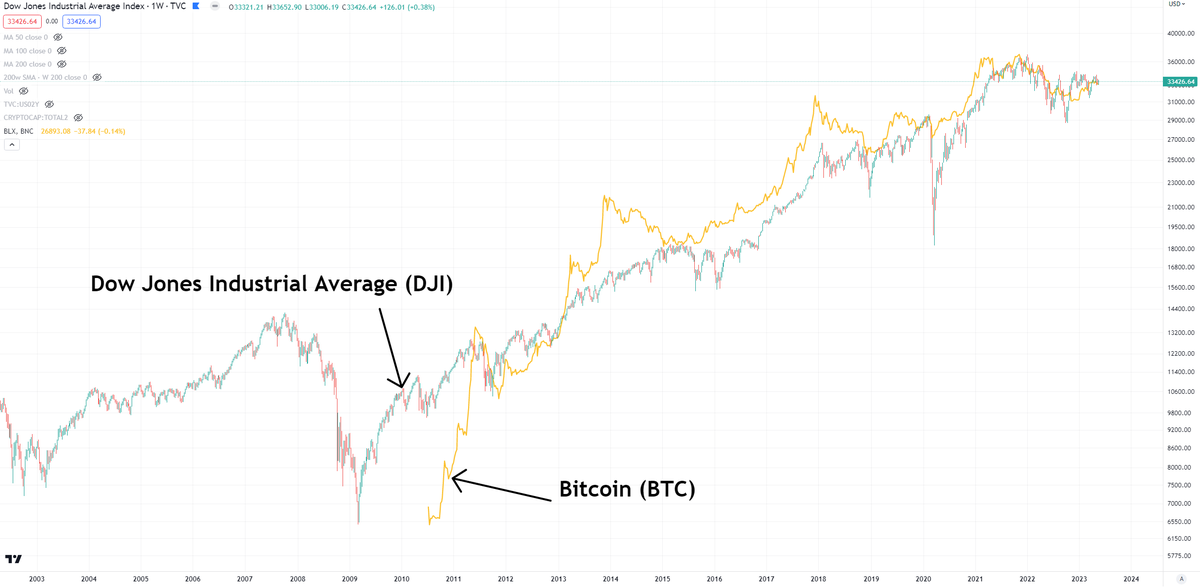
Let's start with 2012.
Bitcoin touched the all-time-high 92-days post halving date.
The new all-time-high was 15-days prior to DJI's new all-time-high, post Great Financial Crisis.
618-day bear market, BTC new all-time-high at DJI breakout of the Great Financial Crisis peak.
Bitcoin touched the all-time-high 92-days post halving date.
The new all-time-high was 15-days prior to DJI's new all-time-high, post Great Financial Crisis.
618-day bear market, BTC new all-time-high at DJI breakout of the Great Financial Crisis peak.
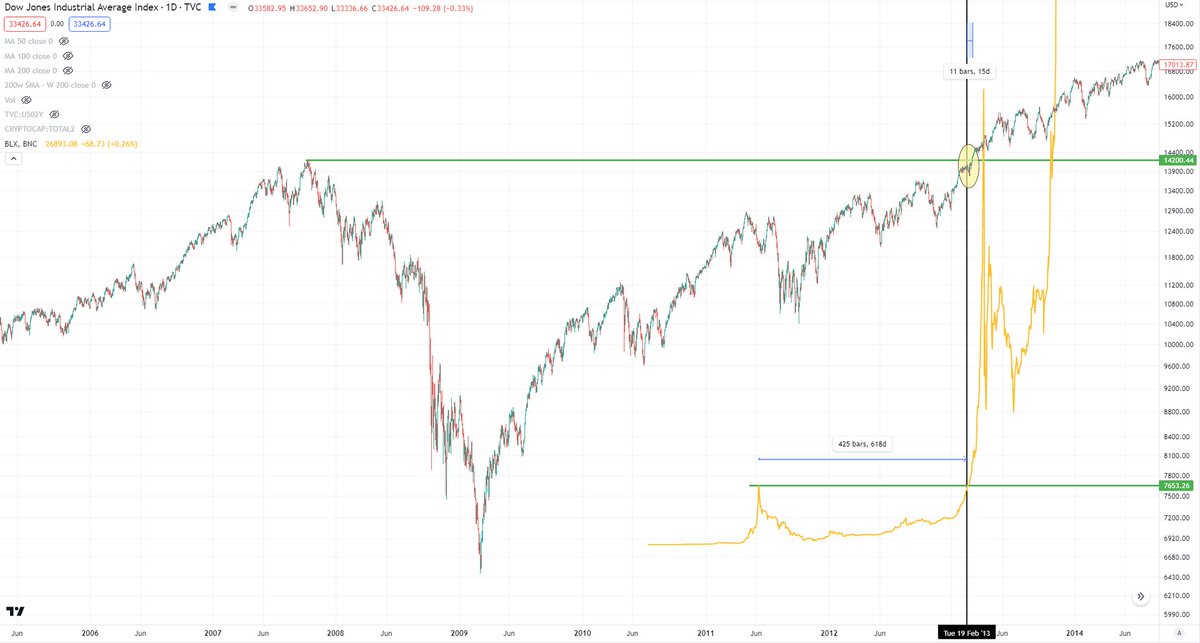
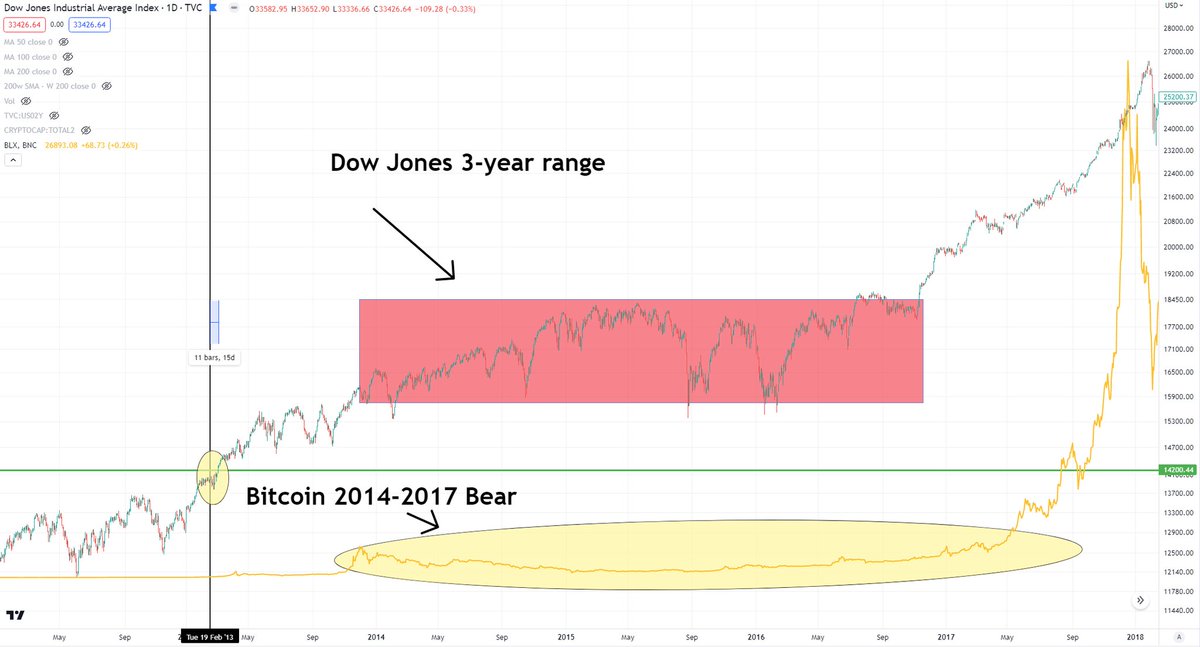
Once the 2013 peak was put into place, Bitcoin proceeded into the 2014-2016 bear market.
During this time period, the DJI also cooled off in a range between 15,400 and 18,300, touching each side of the range 3-times from 2014-2016.
During this time period, the DJI also cooled off in a range between 15,400 and 18,300, touching each side of the range 3-times from 2014-2016.
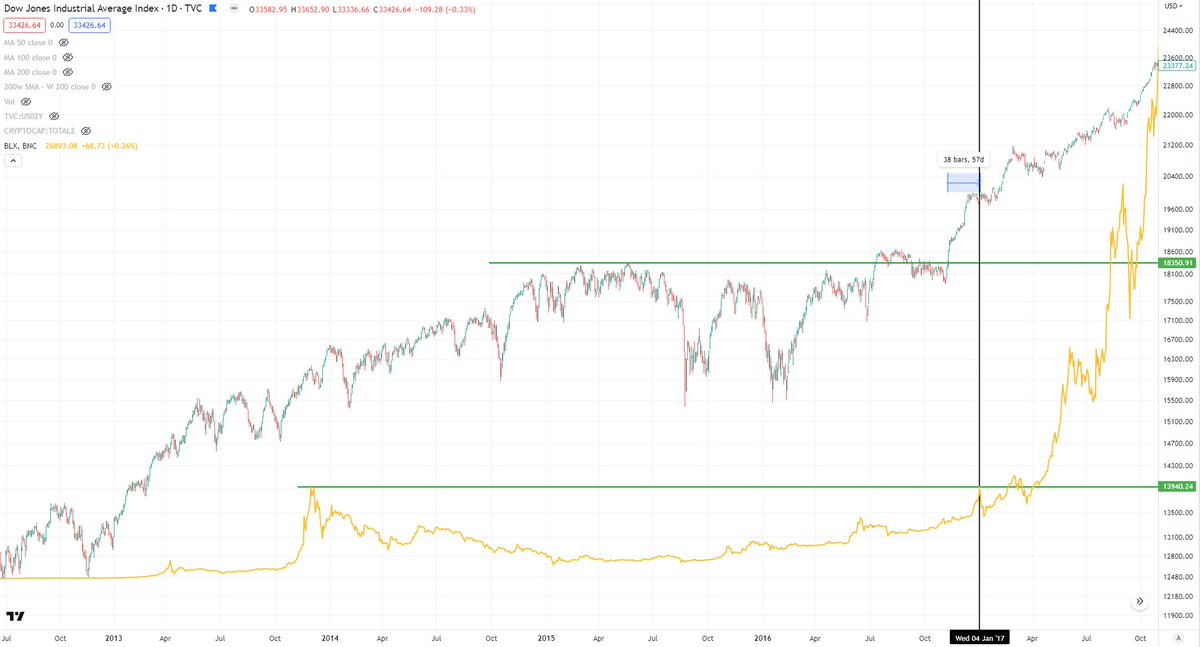
Moving to 2016.
Bitcoin touched the all-time-high 180-days post halving date.
The new all-time-high was within 57-days of the DJI breakout into a new all-time-high, finally leaving the 3-year range.
Bitcoin touched the all-time-high 180-days post halving date.
The new all-time-high was within 57-days of the DJI breakout into a new all-time-high, finally leaving the 3-year range.
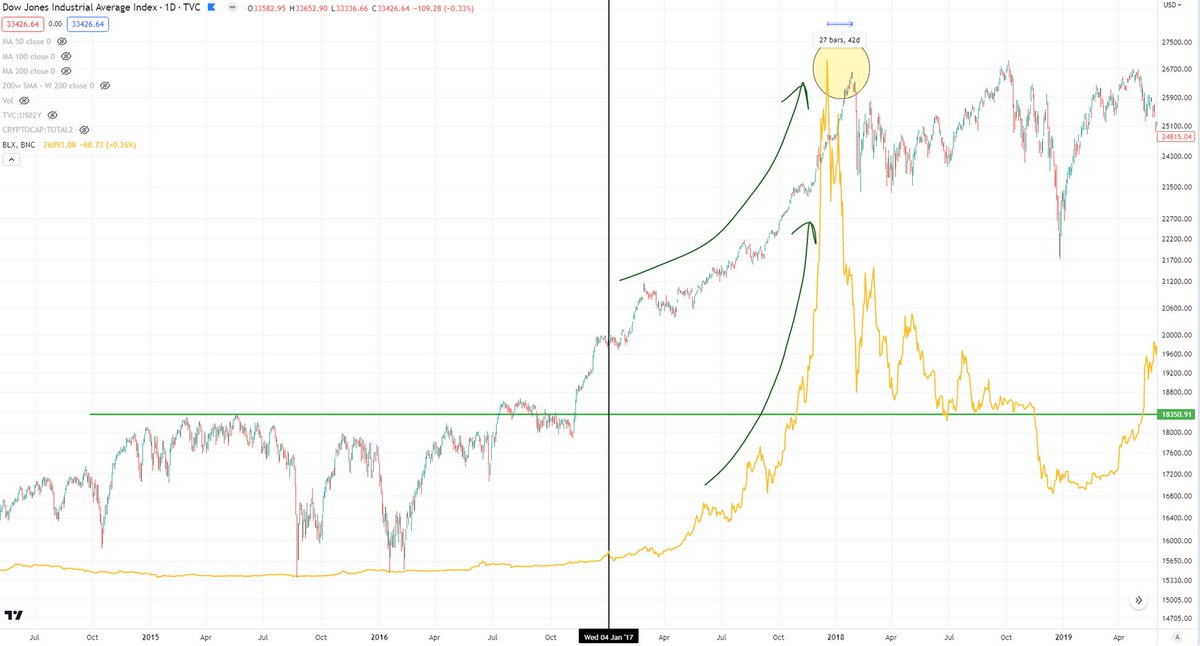
In 2017, Bitcoin and the Dow Jones Industrial Average had very similarly timed parabolas, ending within 42-days of each other.
After the 2017 bull run comes a more complicated pattern for many to appreciate as a "range" or a correction. It's a broadening wedge, which is a normal correction structure.
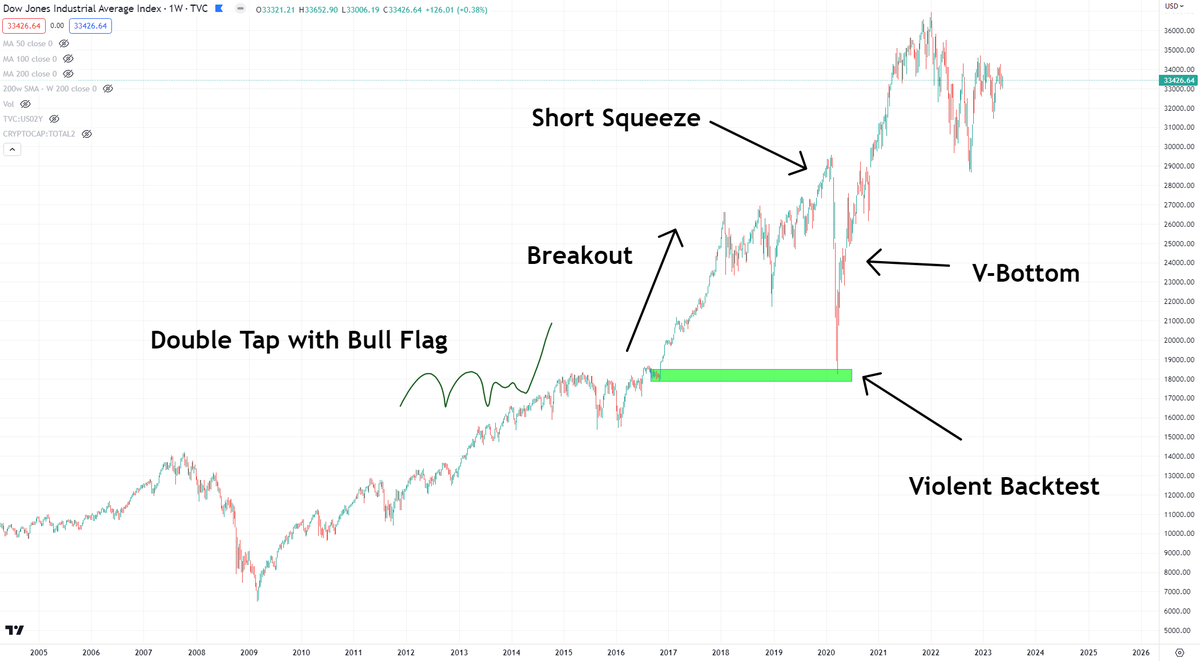
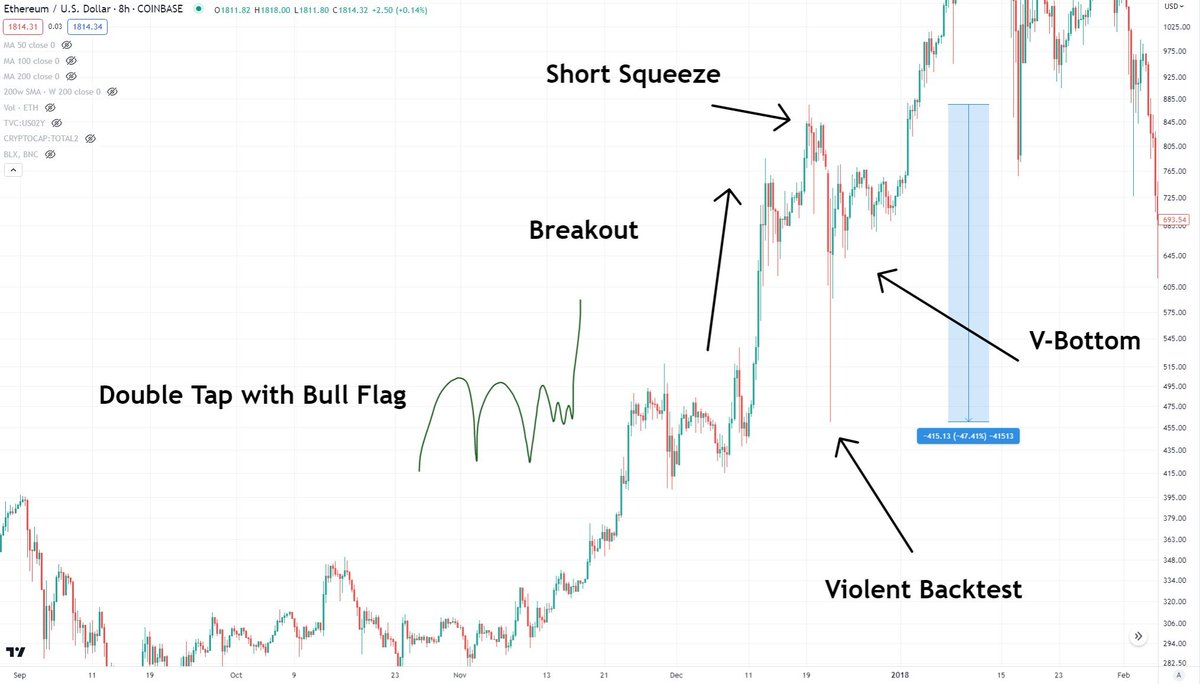
The humor is I refer to it as a "double tap bull flag breakout short squeeze back test v-bottom".
The humor is I refer to it as a "double tap bull flag breakout short squeeze back test v-bottom".
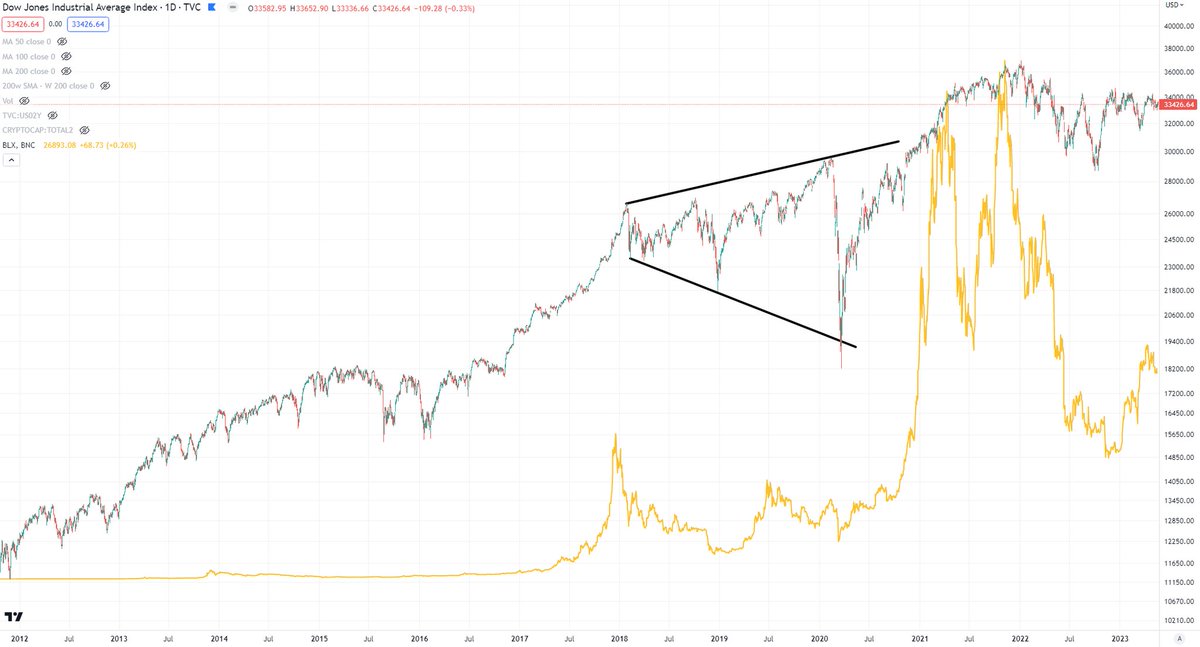
This is where most who believe in 4-year cycles can sooth themselves back into sleep about the "magic" by excusing the price action as:
"Well, what happened in March of 2020 would have never happened had it not been for Covid."
"Well, what happened in March of 2020 would have never happened had it not been for Covid."
I argue to differ. And that it was baked into the cake. This is a normal corrective structure. Even those who do believe in 4-year cycles and rhyming Bitcoin could come to the conclusion that "yes, I can see how it was baked into the cake," by merely comparing 2013 to 2017-2021:
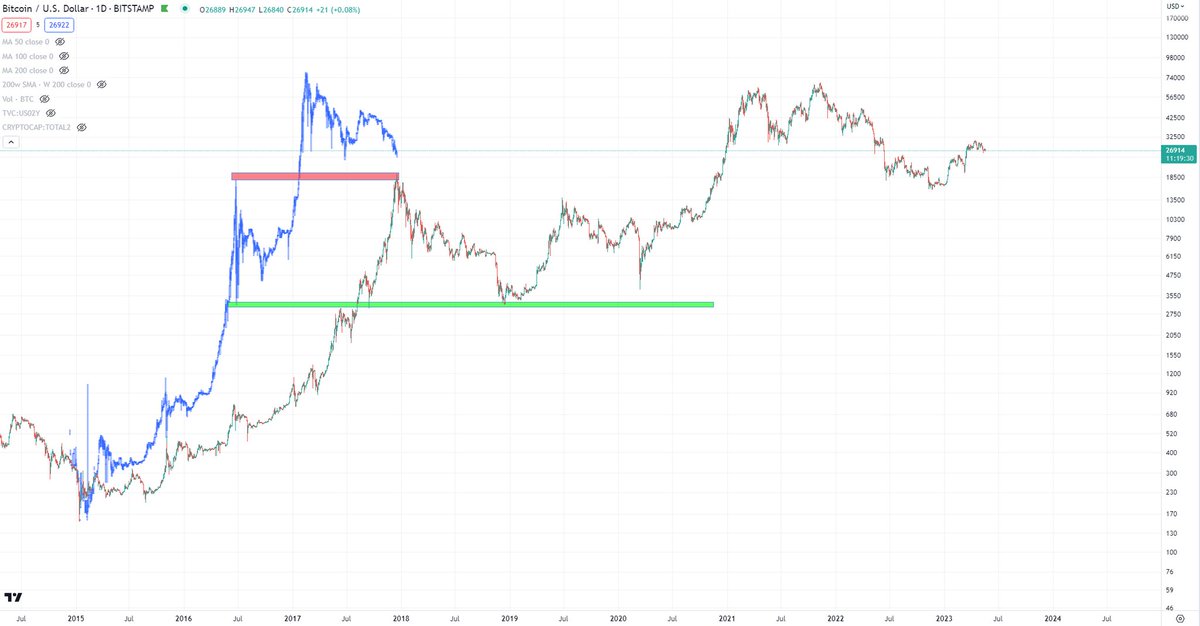
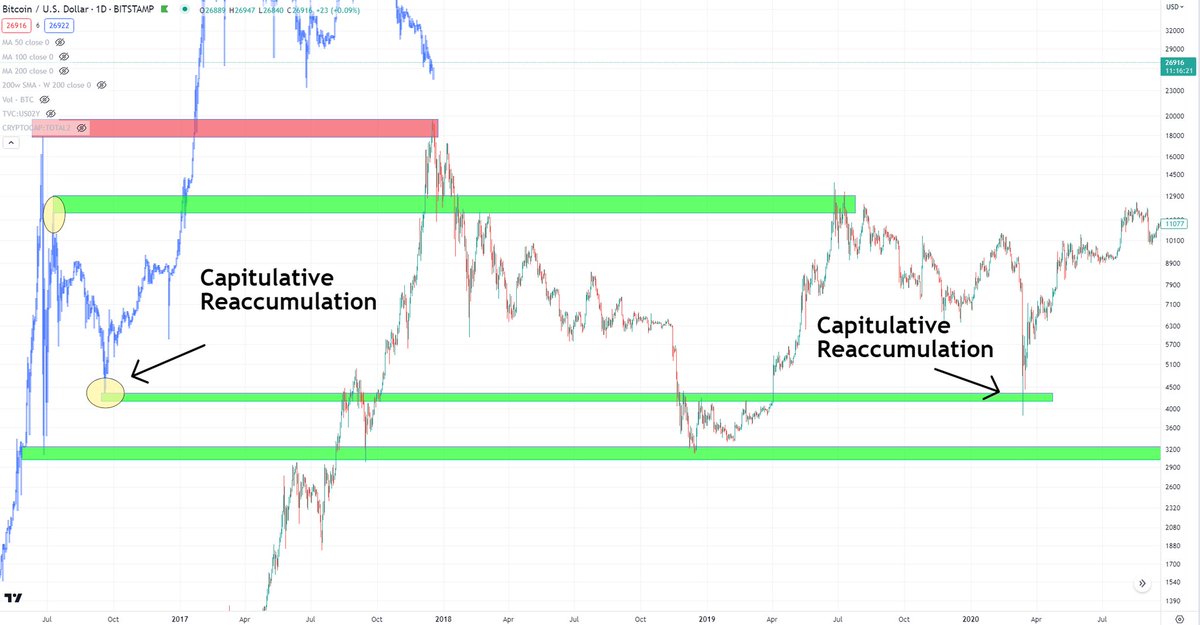
We've covered this before on Twitter and on my YouTube, but here's a closer look at 2017-2020:
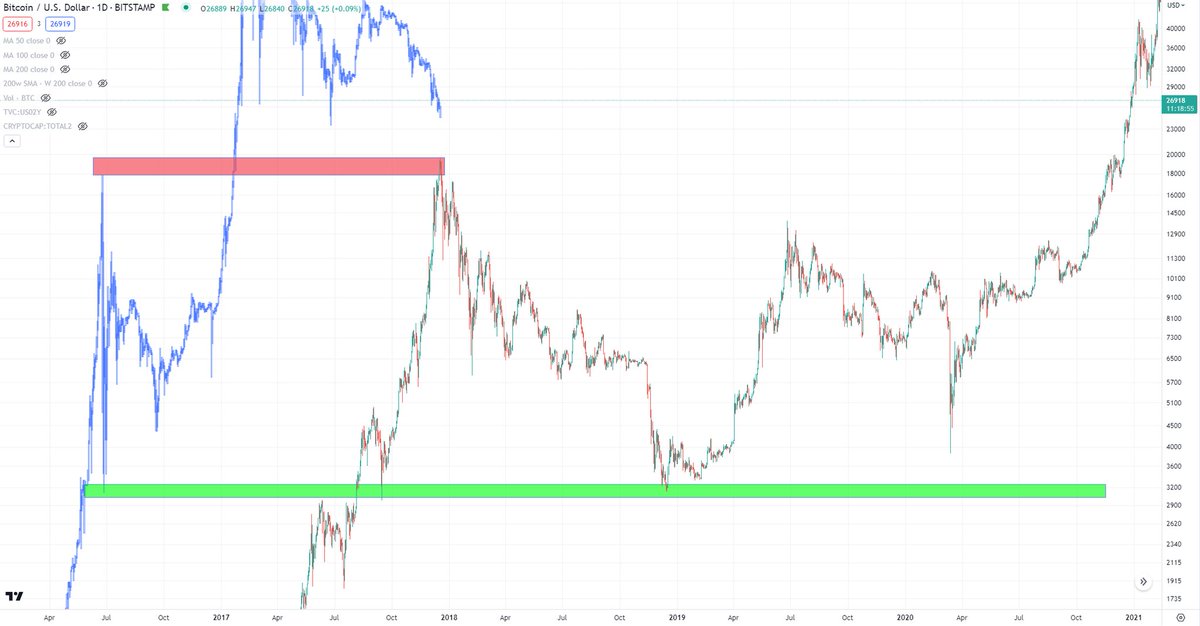
2013:
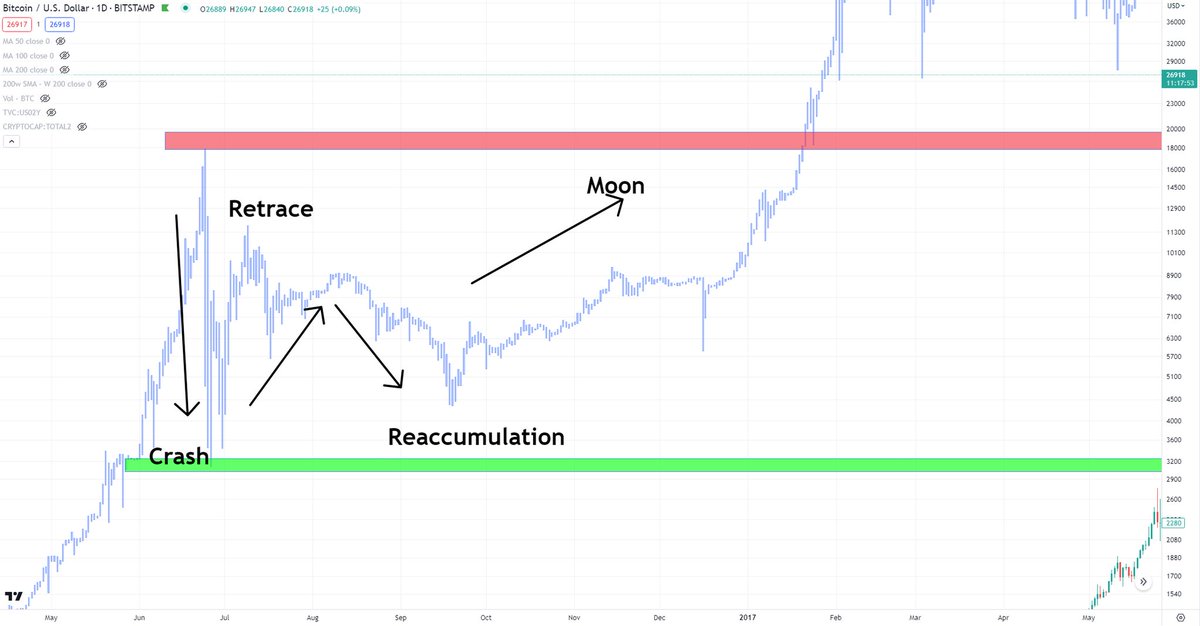
2017-2020:
The Captulative Reaccumulation Covid selloff was baked in.
(Did I make up a word there? Capitulative? Either way, I'm going with it.)
The Captulative Reaccumulation Covid selloff was baked in.
(Did I make up a word there? Capitulative? Either way, I'm going with it.)
I'm going to do my best to keep this short and sweet on what happened with the Dow Jones during the Covid selloff. But here is the general idea.
This is a common phenomenon in bubbles.
The March 2020 Covid Selloff was actually normal.
This is a common phenomenon in bubbles.
The March 2020 Covid Selloff was actually normal.
For example, here is Ethereum in 2017 as it was making its way up in it's own Bubble, performing the exact same phenomenon in it's parabola.
The point is that this is a normal corrective structure in the Dow Jones. To the untrained eye, they scream "Covid!" But, it's something I have discussed many times. And it's why I was a big fat bull when everyone was soiling their shorts in March-October 2020.
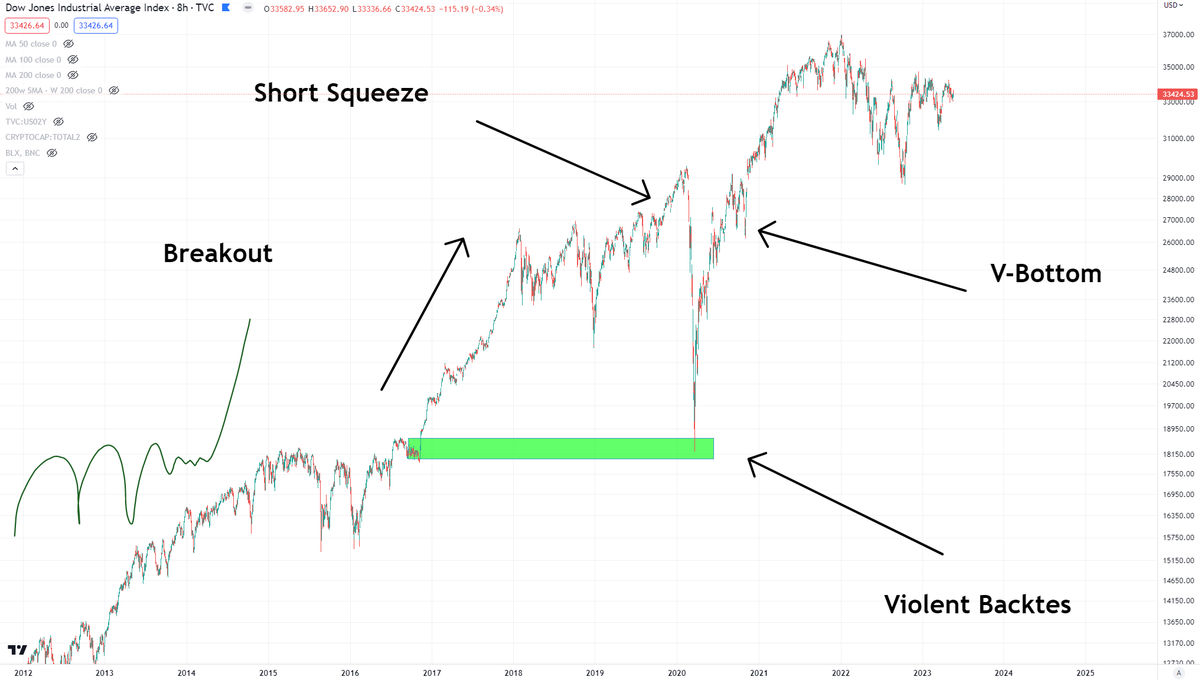
The point is that the broadening range was a correction from 2018-2020, just like Bitcoin was in a correction. The DJI was NOT READY to leave the range, and Bitcoin didn't either.
But the moment the DJI did leave the range, Bitcoin followed 14-days later.
204-days post halving.
But the moment the DJI did leave the range, Bitcoin followed 14-days later.
204-days post halving.
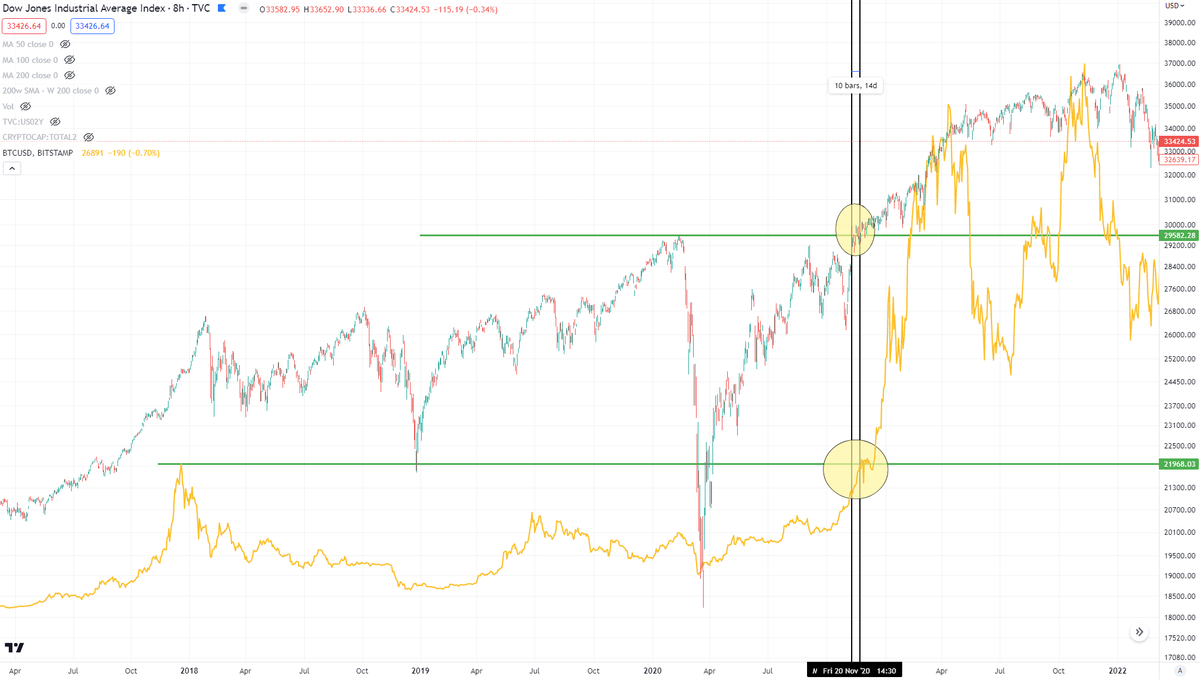
Bitcoin touches all time high:
2012:
92-days after Block Reward Halving
15-days before DJI breaks out above GFC
2016:
180-days after Block Reward Halving
57-days after DJI breaks out
2020:
204-days after Block Reward Halving
14-days after DJI breaks out
2012:
92-days after Block Reward Halving
15-days before DJI breaks out above GFC
2016:
180-days after Block Reward Halving
57-days after DJI breaks out
2020:
204-days after Block Reward Halving
14-days after DJI breaks out
With the Block Reward Halving, we see +92-days, +180-days, then +204-days.
And for DJI breakouts after multi year corrections/consolidations, we see -15-days, +57-days, and then +14-days.
Which one seems more correlated?
And for DJI breakouts after multi year corrections/consolidations, we see -15-days, +57-days, and then +14-days.
Which one seems more correlated?
I often express the unpopular opinion that it is possible that Bitcoin will not a set a new all time high and that it is not the Block Reward Halving, but that Bitcoin is dependent on the stock market setting a new all time high.
So will the stock market set a new all time high?
So will the stock market set a new all time high?
Remember this chart from just a few posts up? The "double tap breakout short squeeze bull flag back test v-bottom" here on Ethereum?
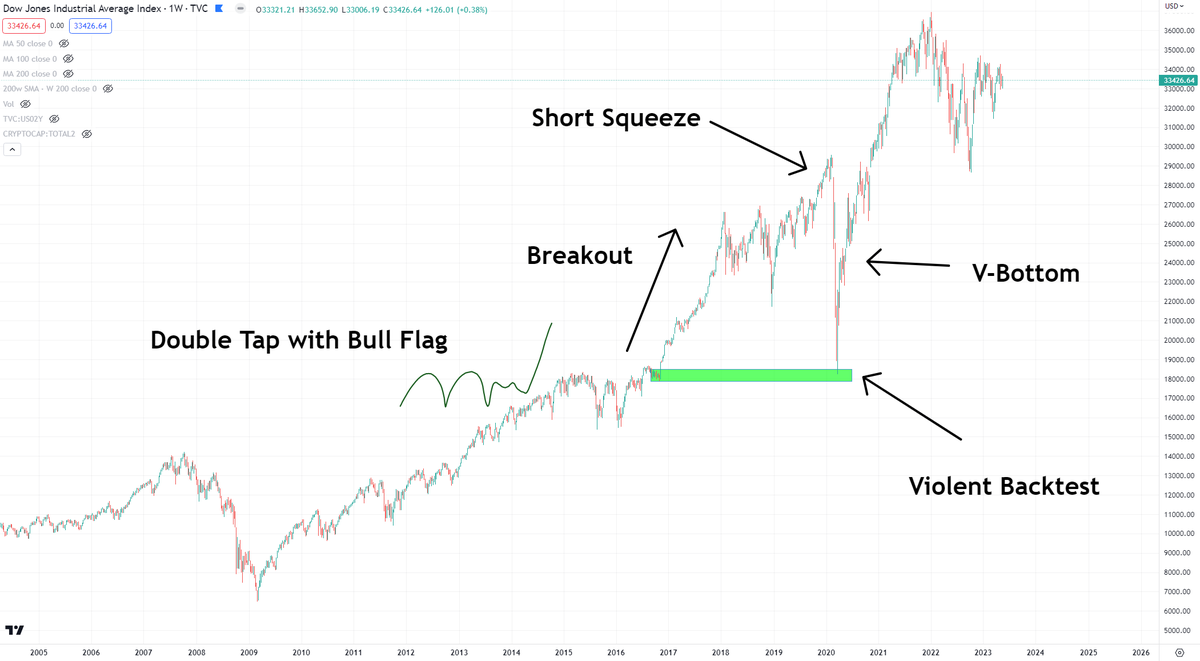
Technically speaking, the violent backtest phase is Wave-4 in Elliott Wave Theory.
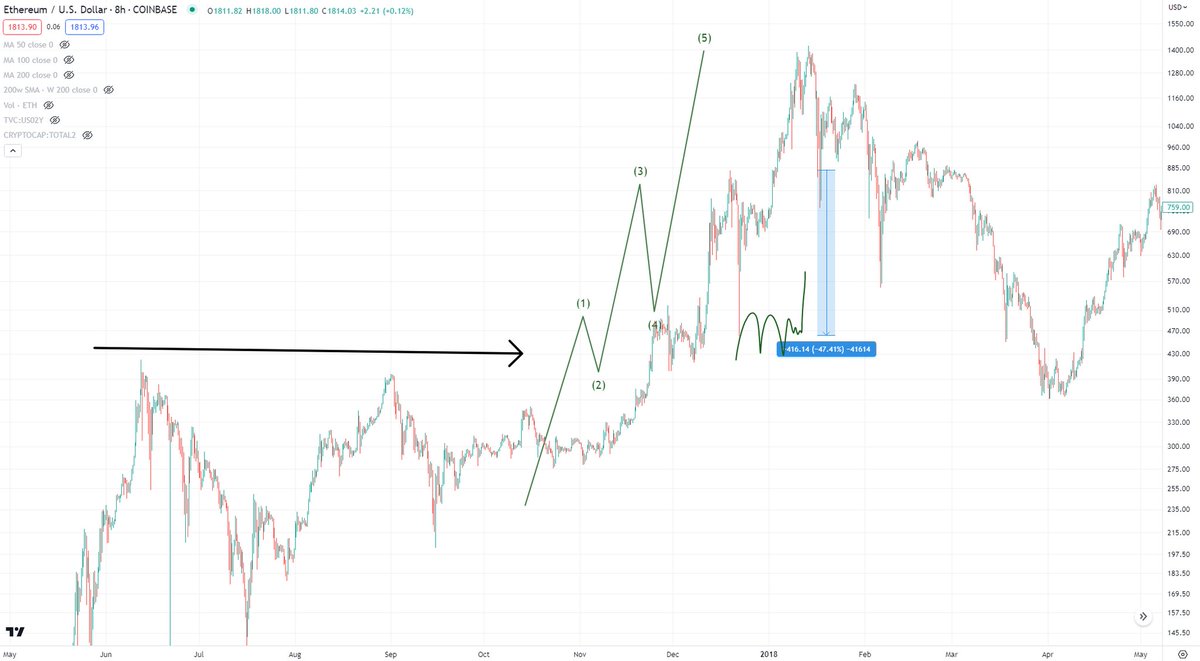
And when we look at the Dow Jones Industrial Average next to Ethereum... oh boy...
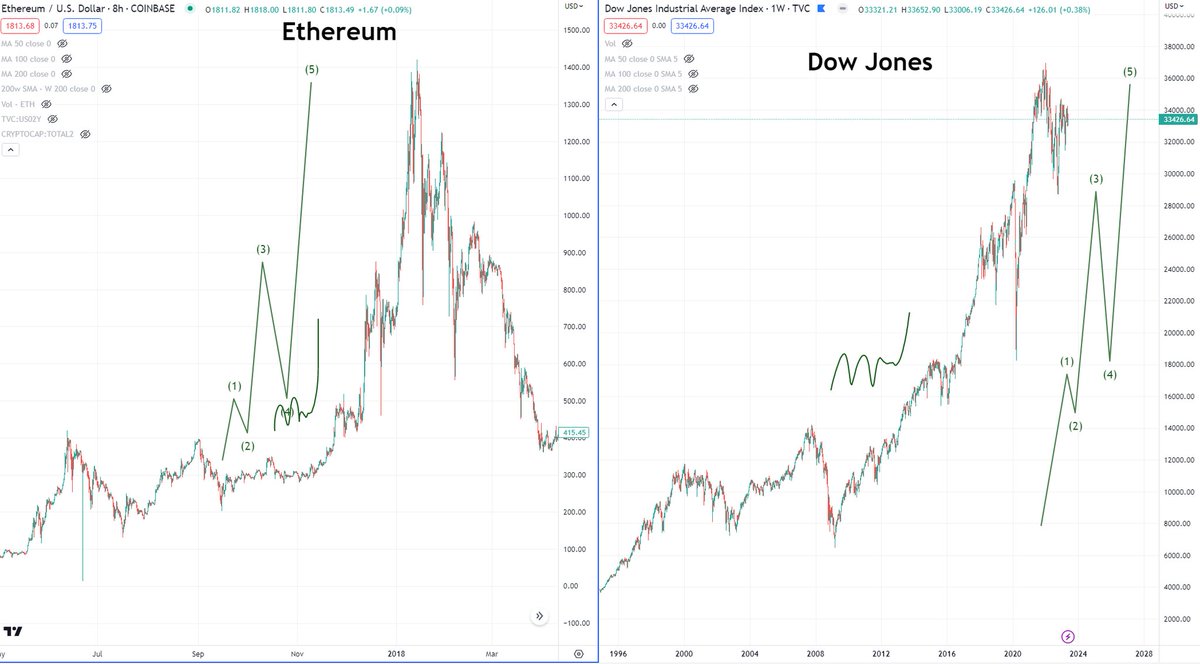
And then, when we zoom out even further on the Dow Jones, and zoom out even further on Ethereum... oh boy...
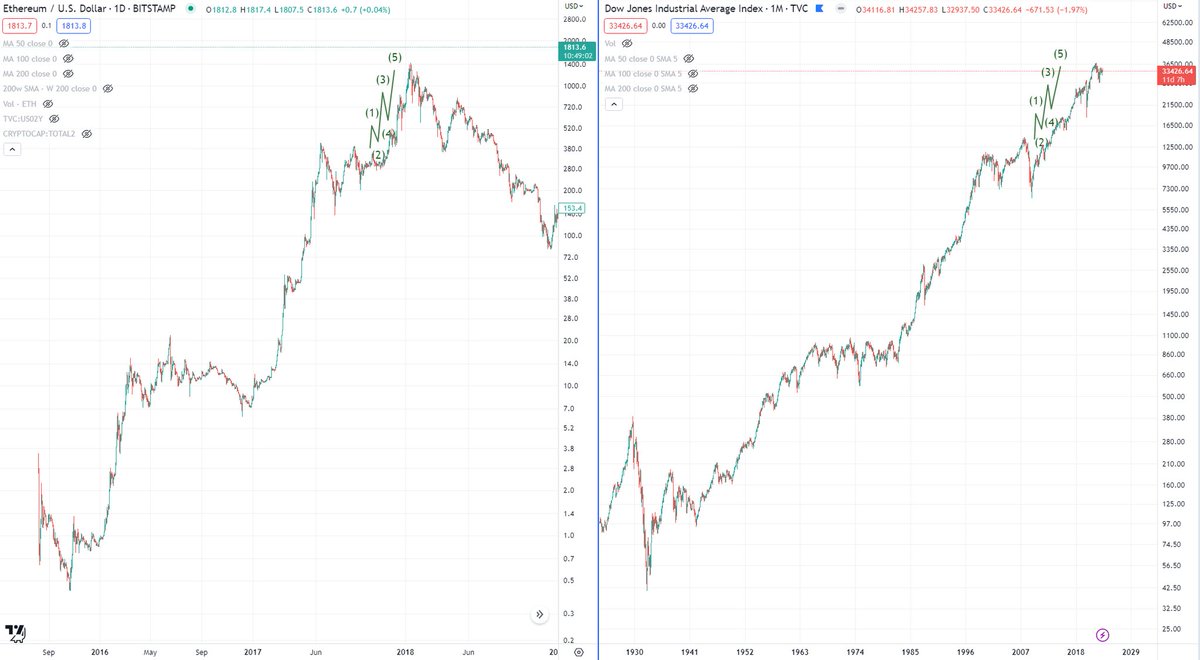
And where is the Dow Jones right now?
Oh, come on...
Oh, come on...
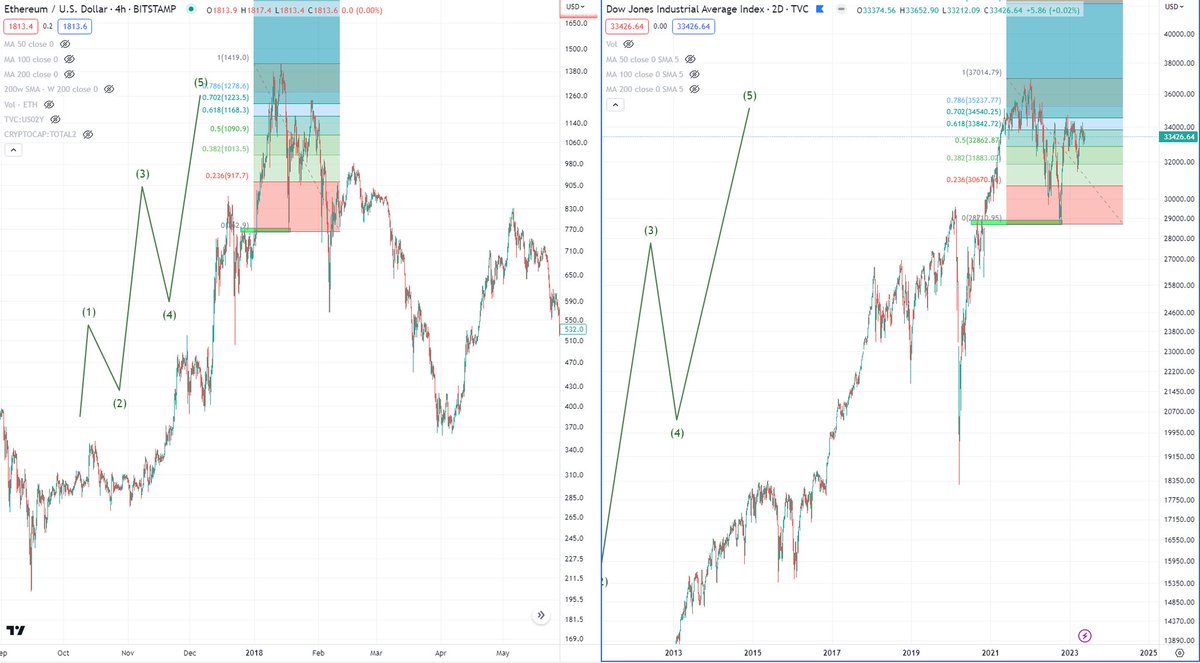
So the point of it all is that I see a wider and wider spread of the number of days after the Block Reward Halving. And I see a much tighter spread linking it to major DJI breakouts.
So, when I present the opinion that I do not believe in the 4-year cycle, it is because I find the confluence with the DJI to be more tightly related, and the 4-year Block Reward Halving just happens to be luckily timed for those DJI breakouts.
And, when I present the idea that I think it's possible Bitcoin does not set a new all time high, it is because the 2013, 2017 and 2021 bull runs all occurred when the DJI broke out.
We are in some seriously questionable locations here on the DJI on whether or not it's going to break out into a new ATH. And if it doesn't, well, as you saw from past bull runs, there are no examples of Bitcoin starting a bull run without the DJI.
End of thread.
End of thread.
Loading suggestions...