

Peter Thiel is one of the greatest thinkers I've come across in the business realm.
The concepts he brought to the table are absurdly interesting.
Here's the idea that impacted me the most:
The concepts he brought to the table are absurdly interesting.
Here's the idea that impacted me the most:

Lies that people tell
Peter has a binary view of companies. He believes companies are either extreme monopolies or non-monopolies.
"There's shockingly little in between"
Peter has a binary view of companies. He believes companies are either extreme monopolies or non-monopolies.
"There's shockingly little in between"
However, they both lie about the nature of their business.
These clouded narrative makes investors not be able to tell the difference between them, making reality appear to look like this:
These clouded narrative makes investors not be able to tell the difference between them, making reality appear to look like this:

But Thiel claims there are either extreme monopolies and extreme non-monopolies (image).
So their narratives does not show the point in the line they are really at.
Let's break down the lie each counterpart tells:
So their narratives does not show the point in the line they are really at.
Let's break down the lie each counterpart tells:

Non-monopolies usually tell investors they do have a monopoly because they want to attract money.
They generally say they operate at the intersection of many vertical, giving the appearance of them having a monopoly.
They do not.
They generally say they operate at the intersection of many vertical, giving the appearance of them having a monopoly.
They do not.
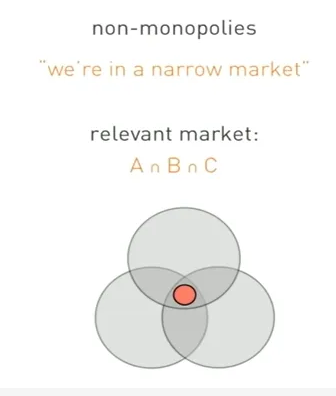
Monopolies will never claim they have a monopoly because that would attract regulators.
To avoid them, they will always claim they operate at huge markets, generally the union of many verticals.
To avoid them, they will always claim they operate at huge markets, generally the union of many verticals.
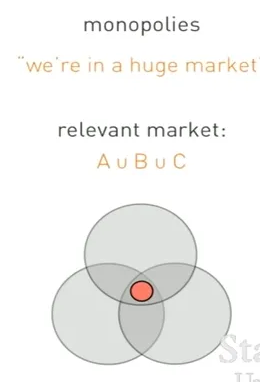
Examples of the lies.
1) "We are the only british food restaurant in Palo Alto"
2) Google: "We are a technology company, competing with Apple on phones, with Microsoft on Workspace and with Amazon on cloud"
1) "We are the only british food restaurant in Palo Alto"
2) Google: "We are a technology company, competing with Apple on phones, with Microsoft on Workspace and with Amazon on cloud"
Hope you enjoyed the thread and, if you have, sharing is very much appreciated!!
Loading suggestions...