

This week’s Commoncog essay is a deep dive into the cursed question: “what do you do in business when you can’t predict the outcomes of your actions?”
But let’s set this up …
But let’s set this up …
I’ve spent the last couple of months digging into ‘how to become data driven in business’. And the heart of the idea is that ‘management is prediction’ — you can’t be a good operator if you don’t know the business outcomes of your actions.
The job of data is to help you do that.
The job of data is to help you do that.
(There's a pretty cool mantra from Donald Wheeler, which goes "the job of analysis is insight, and so the best analysis is the SIMPLEST analysis that gets you that insight.")
But I digress.
But I digress.
But is that ALL there is? Are there situations in business where you CAN'T predict, where data is useless?
Sure there is. It's called entrepreneurship.
Let's face it: new venture creation is a crapshoot. If you read enough founding stories, success seems random.
Sure there is. It's called entrepreneurship.
Let's face it: new venture creation is a crapshoot. If you read enough founding stories, success seems random.
But let's say you accept this assertion: that entrepreneurship is impossible to predict ex-ante; that successful businesses are the result of luck and path dependence and lots of improv.
How do successful entrepreneurs THINK about this?
How do successful entrepreneurs THINK about this?
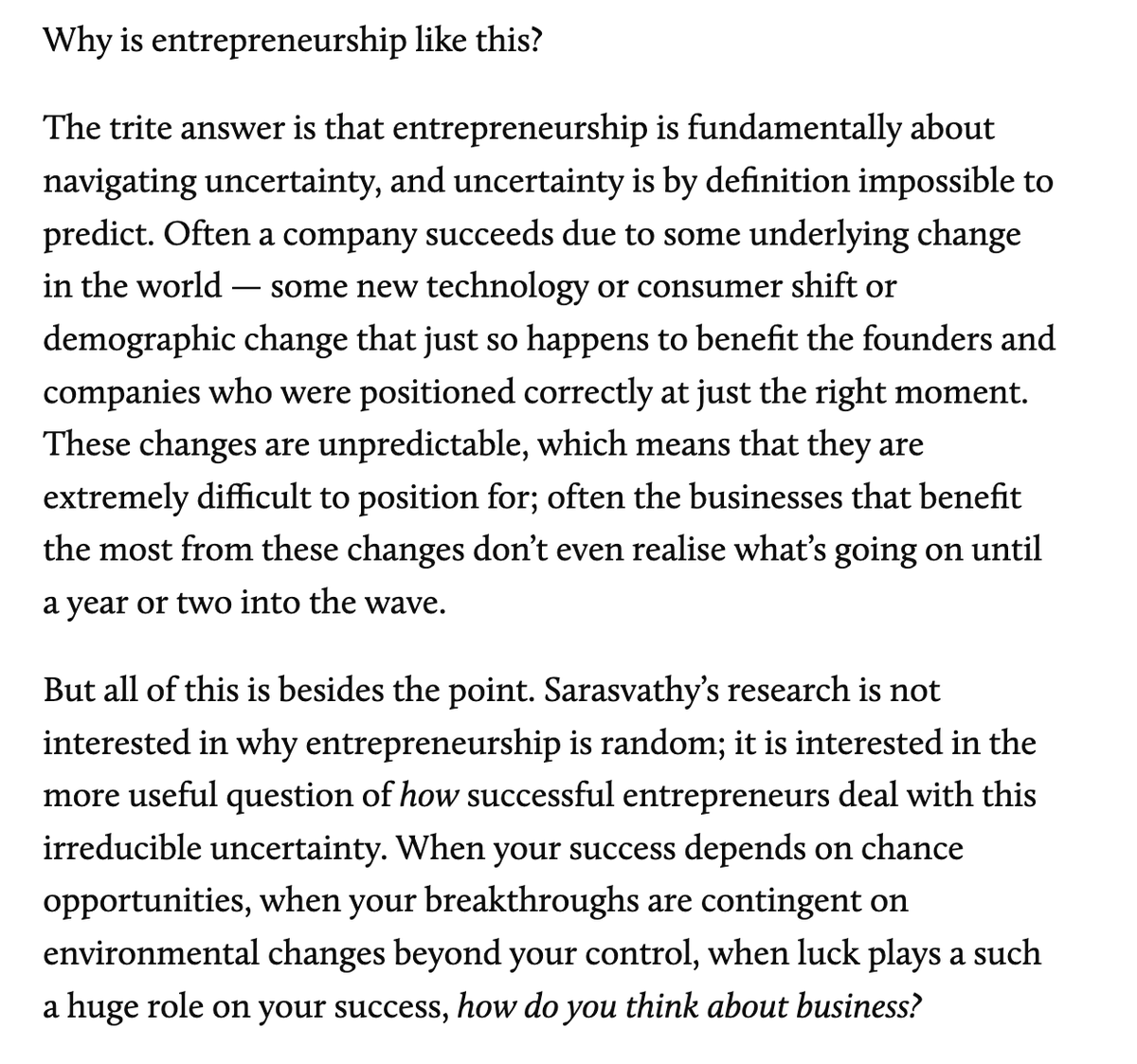
The answer is, broadly: effectuation.
Over the course of the 2000s Saras Sarasvathy hunted down a bunch of successful repeat entrepreneurs and got them to do a think aloud task to get at how they thought about starting new companies.
She repeated the test with MBA students.
Over the course of the 2000s Saras Sarasvathy hunted down a bunch of successful repeat entrepreneurs and got them to do a think aloud task to get at how they thought about starting new companies.
She repeated the test with MBA students.
The entrepreneurs displayed a different kind of thinking from the MBA kids.
The MBAs paid attention to market surveys and competitive analysis and planning.
The entrepreneurs mostly just went "ok let's just start selling, and we'll react to whatever our actions kick up."
The MBAs paid attention to market surveys and competitive analysis and planning.
The entrepreneurs mostly just went "ok let's just start selling, and we'll react to whatever our actions kick up."
Why?
Well, if new venture creation is an unpredictable crapshoot under total uncertainty, then the best policy is NOT to predict better, but to generate information through constant action.
This is not as insane as it sounds.
Well, if new venture creation is an unpredictable crapshoot under total uncertainty, then the best policy is NOT to predict better, but to generate information through constant action.
This is not as insane as it sounds.
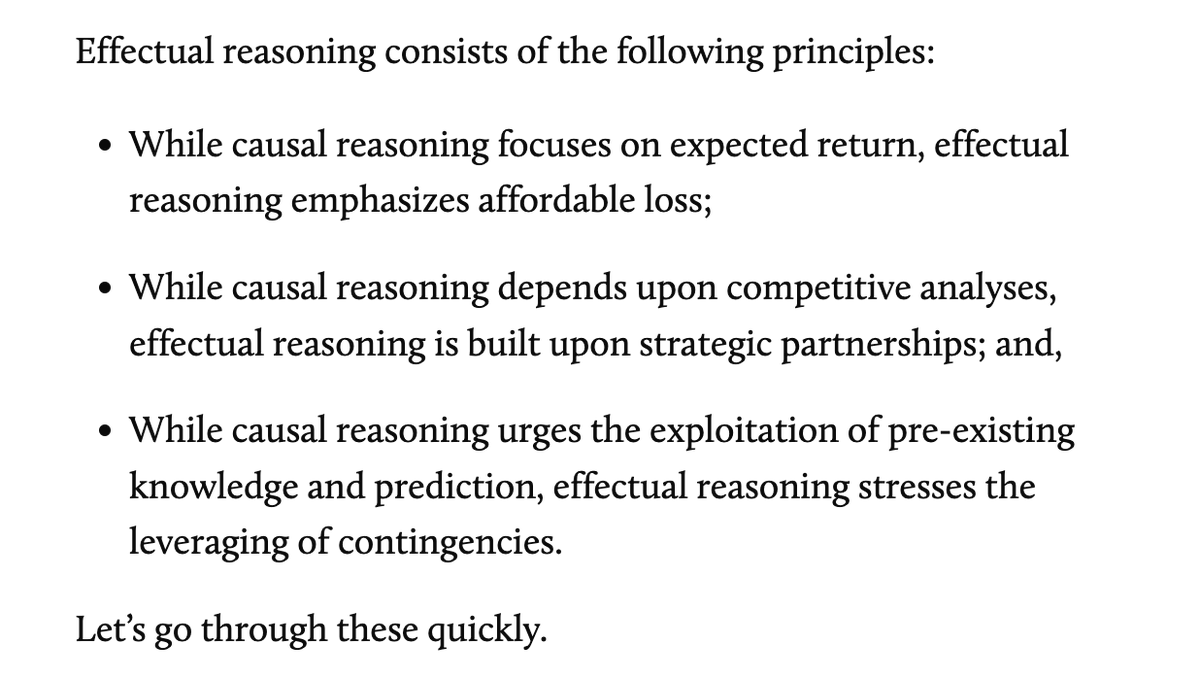
Sarasvathy contrasts this thinking with, urm conventional business books/MBA programs.
Biz books: pick a goal and work backwards to figure out everything you need to do to achieve that goal. (Causal thinking)
Entrepreneurs: work FORWARDS from what you have (Effectual thinking).
Biz books: pick a goal and work backwards to figure out everything you need to do to achieve that goal. (Causal thinking)
Entrepreneurs: work FORWARDS from what you have (Effectual thinking).
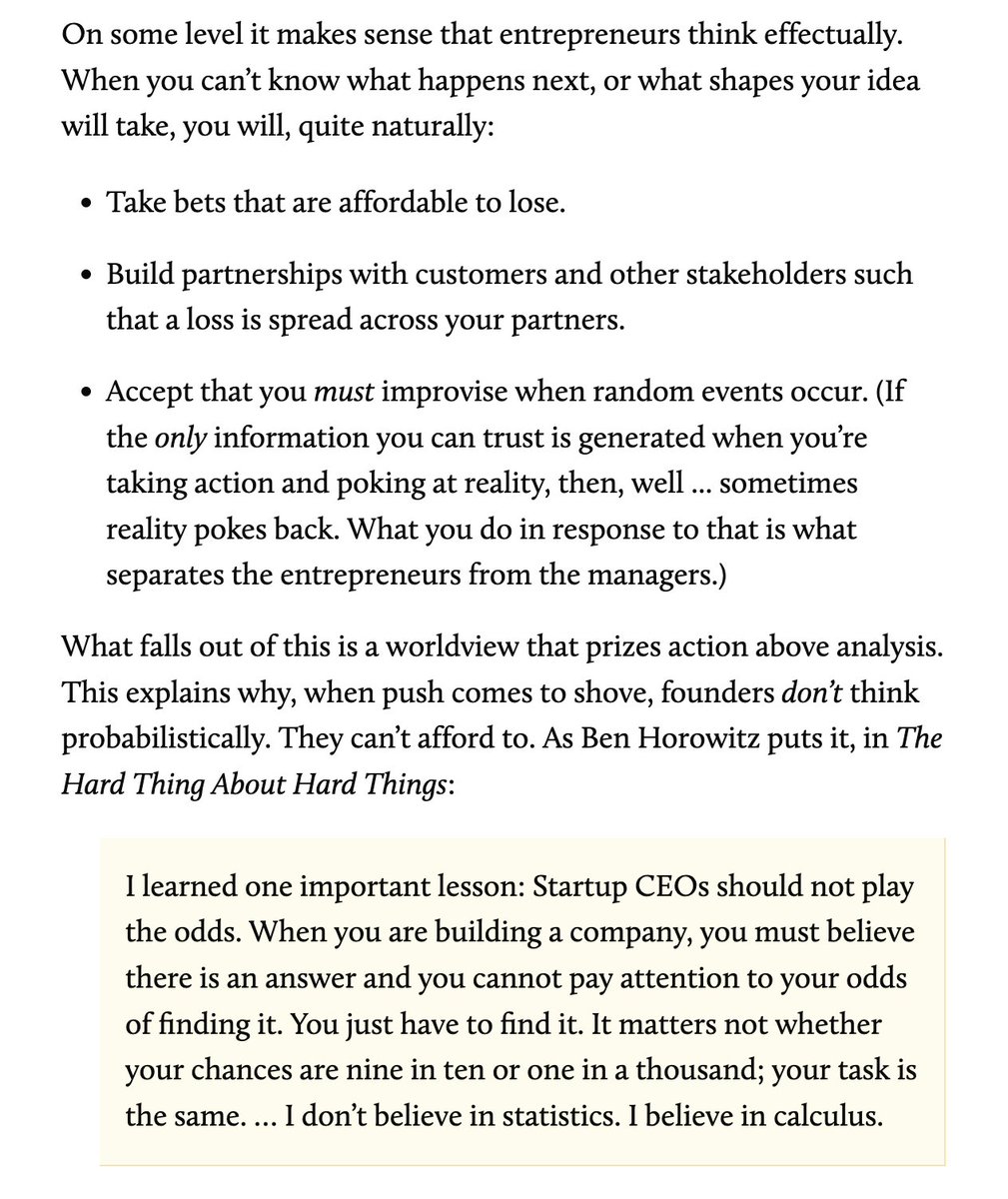
There are a whole bunch of subtle implications from this style of thinking.
The first one is that effectual thinking dominates under the highest uncertainty, which is typically earlier in the company journey. Causal thinking is not useless; it's just for later.
Also:
The first one is that effectual thinking dominates under the highest uncertainty, which is typically earlier in the company journey. Causal thinking is not useless; it's just for later.
Also:
I won't go into all the implications of this style of thinking in this thread.
I also won't go into why I believe this research is credible.
Read the blog post to find out: commoncog.com
I also won't go into why I believe this research is credible.
Read the blog post to find out: commoncog.com
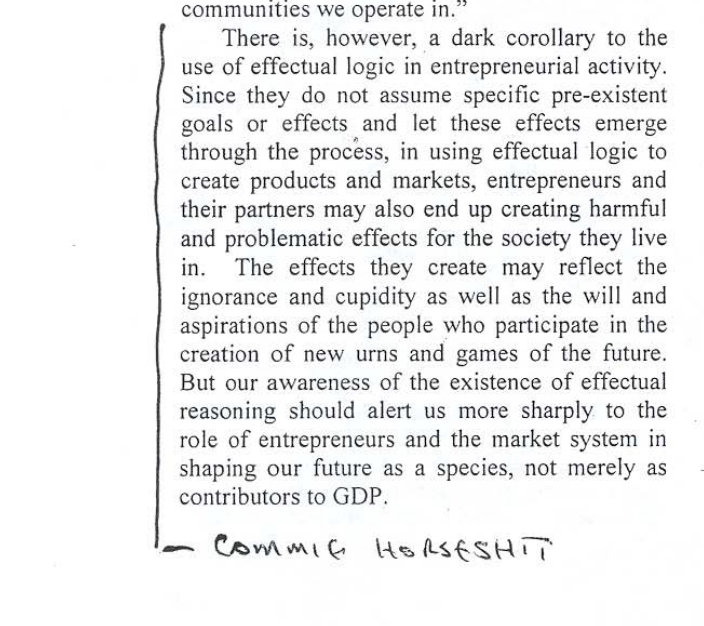
Finally, if you want to read Sarasvathy's most famous, original piece, I tend to point people towards the hilarious annotated version hosted on the Khosla Ventures site: khoslaventures.com
(The annotations are probably from Vinod Khosla himself).
(The annotations are probably from Vinod Khosla himself).
Loading suggestions...