

Seth Klarman is one of the most successful Value Investors in the World.
His Hedge Fund manages over $25 billion in assets.
In his famous book "Margin of Safety" he explains how he values companies.
I broke his valuation Framework down for you👇
His Hedge Fund manages over $25 billion in assets.
In his famous book "Margin of Safety" he explains how he values companies.
I broke his valuation Framework down for you👇

1. The Valuation Problem
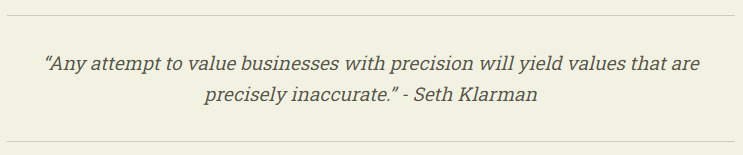
First of all, every valuation you'll ever do will be wrong.
That sounds discouraging, but it's actually not a problem.
You win by being less wrong than others.
Let's look at the strategies Klarman uses.
First of all, every valuation you'll ever do will be wrong.
That sounds discouraging, but it's actually not a problem.
You win by being less wrong than others.
Let's look at the strategies Klarman uses.
2. A Range of Value
Think of the fair value of a company as a range.
You do not want to calculate a precise number.
Instead, go into the valuation with the mindset of finding a realistic range.
Try to narrow the range as far as possible, but never too far!
Think of the fair value of a company as a range.
You do not want to calculate a precise number.
Instead, go into the valuation with the mindset of finding a realistic range.
Try to narrow the range as far as possible, but never too far!
3. Valuation Methods
Klarman uses three valuation methods.
1. Net Present Value (NPV):
The discounted value of all future cash flows a business is expected to generate.
2. Liquidation Value
The value resulting from a sell of all assets the company has.
Klarman uses three valuation methods.
1. Net Present Value (NPV):
The discounted value of all future cash flows a business is expected to generate.
2. Liquidation Value
The value resulting from a sell of all assets the company has.
3. Relative Value
How does this company trade in comparison to the competition?
The problem with this approach is that you need to compare companies that are very similar.
However, by definition, the better a company is, the less similar competitors will be.
How does this company trade in comparison to the competition?
The problem with this approach is that you need to compare companies that are very similar.
However, by definition, the better a company is, the less similar competitors will be.
4. Choosing between Valuation Models
NPV: For companies that are mature and in the cash flow generating phase of their life cycle
Liquidation Value: "Dying" companies with bad operating results
Relative Value: Homogenous industry or sector (companies that are very similar)
NPV: For companies that are mature and in the cash flow generating phase of their life cycle
Liquidation Value: "Dying" companies with bad operating results
Relative Value: Homogenous industry or sector (companies that are very similar)
5. Conclusion
There is no "One Size fits all" Method.
You have to look at the company in question and ask yourself:
1. What's the key driver for value in this company?
2. How can Shareholders get to the Value?
There is no "One Size fits all" Method.
You have to look at the company in question and ask yourself:
1. What's the key driver for value in this company?
2. How can Shareholders get to the Value?
I wrote an article on my website digging deeper into each Valuation Method. Maybe that's of interest to you.
If you learned something, please Like and Retweet this Thread so more people can see it!
Follow me @MnkeDaniel to learn more about Investing.
Have a great day!
If you learned something, please Like and Retweet this Thread so more people can see it!
Follow me @MnkeDaniel to learn more about Investing.
Have a great day!
I share everything I've learned about investing in my free newsletter every Sunday. I cover all important topics in (mostly) less than 6 minutes long.
Far over 15,000 people subscribe.
If you're interested, you can sign up here:
danielmnke.com
Far over 15,000 people subscribe.
If you're interested, you can sign up here:
danielmnke.com

Loading suggestions...