

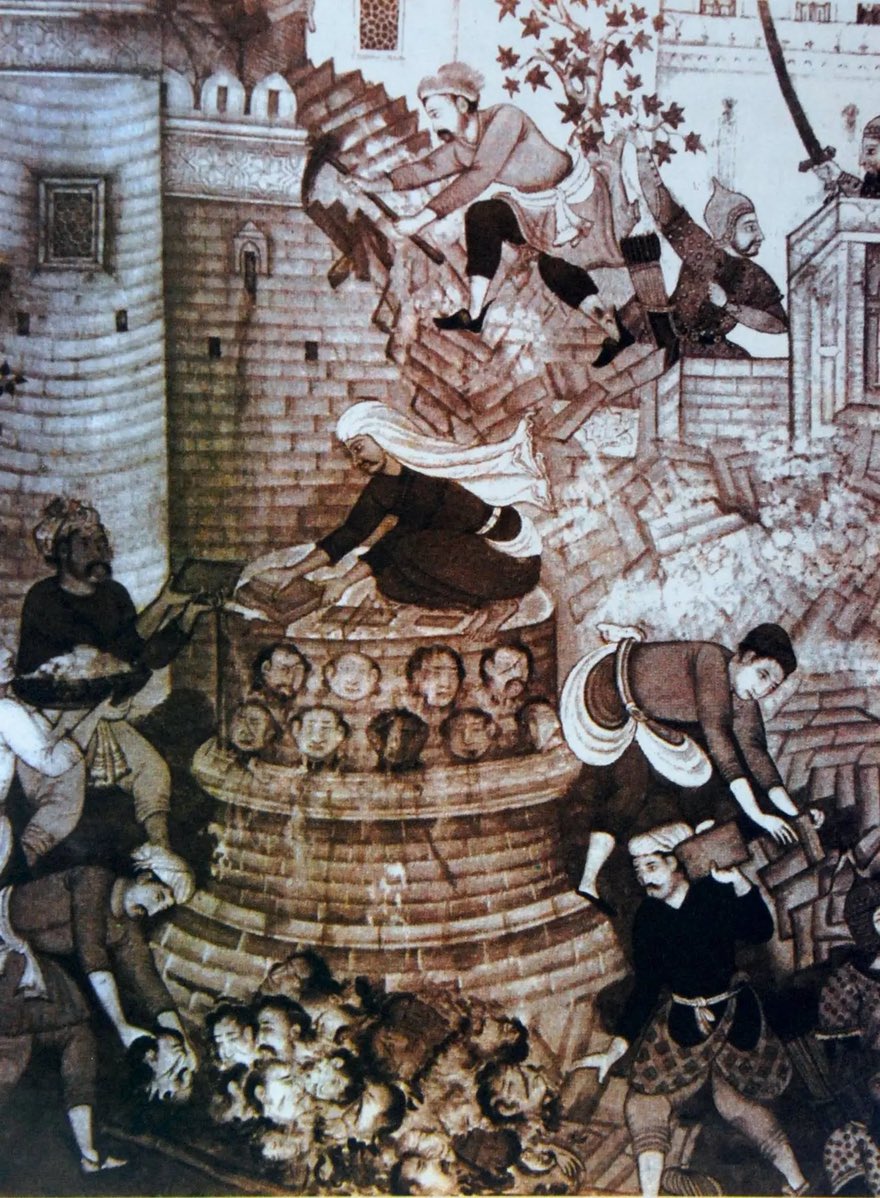
A painting of the Minaret of Human Heads, Panipat War Museum.
Akbar wasn't always as magnamious and tolerant, as our historians mark him to be. This Mughal miniature painting (circa 1590) depicts a tower of skulls being built with the remains of Hemu's soldiers and supporters.
Akbar’s first act after winning the Second Panipat War (1556) was to build a ‘Minaret of Human Heads’ using Hemu’s defeated soldiers. Muhammad Arif Qandhari who wrote the "Tarikh-i-Akbari" stated that Akbar took Bairam Khan's advice and beheaded Hemu with his own hands, after which took the title of ‘Ghazi.’ Hemu's head was then sent to Kabul, while his body was hung on a gate in Delhi.
Akbar wasn't always as magnamious and tolerant, as our historians mark him to be. This Mughal miniature painting (circa 1590) depicts a tower of skulls being built with the remains of Hemu's soldiers and supporters.
Akbar’s first act after winning the Second Panipat War (1556) was to build a ‘Minaret of Human Heads’ using Hemu’s defeated soldiers. Muhammad Arif Qandhari who wrote the "Tarikh-i-Akbari" stated that Akbar took Bairam Khan's advice and beheaded Hemu with his own hands, after which took the title of ‘Ghazi.’ Hemu's head was then sent to Kabul, while his body was hung on a gate in Delhi.
Another instance of a minar built of human skulls by a Muslim invader-ruler Alauddin Khilji👇🏼
Loading suggestions...