
Last year I was asked to give a talk at the NISIS Autumn School about the textual history of the Quran. Here's a thread summarizing the points of that presentation. Specifically the presentation addresses some of Shoemaker's new objections on the Uthmanic canonization.

Traditionally, the third caliph ʿUṯmān is believed to have standardized the text.
However, in critical scholarship of the '70s the historicity of this view came to be questioned.
How can we really be sure that what the tradition tells us is correct?
However, in critical scholarship of the '70s the historicity of this view came to be questioned.
How can we really be sure that what the tradition tells us is correct?


This skepticism wasn't wholly unwarranted at the time. The Uthmanic canonization really had been uncritically accepted, not based on any material evidence.
But we now have access to many manuscripts, beautifully digitized, we can test the historicity of these claims!
But we now have access to many manuscripts, beautifully digitized, we can test the historicity of these claims!

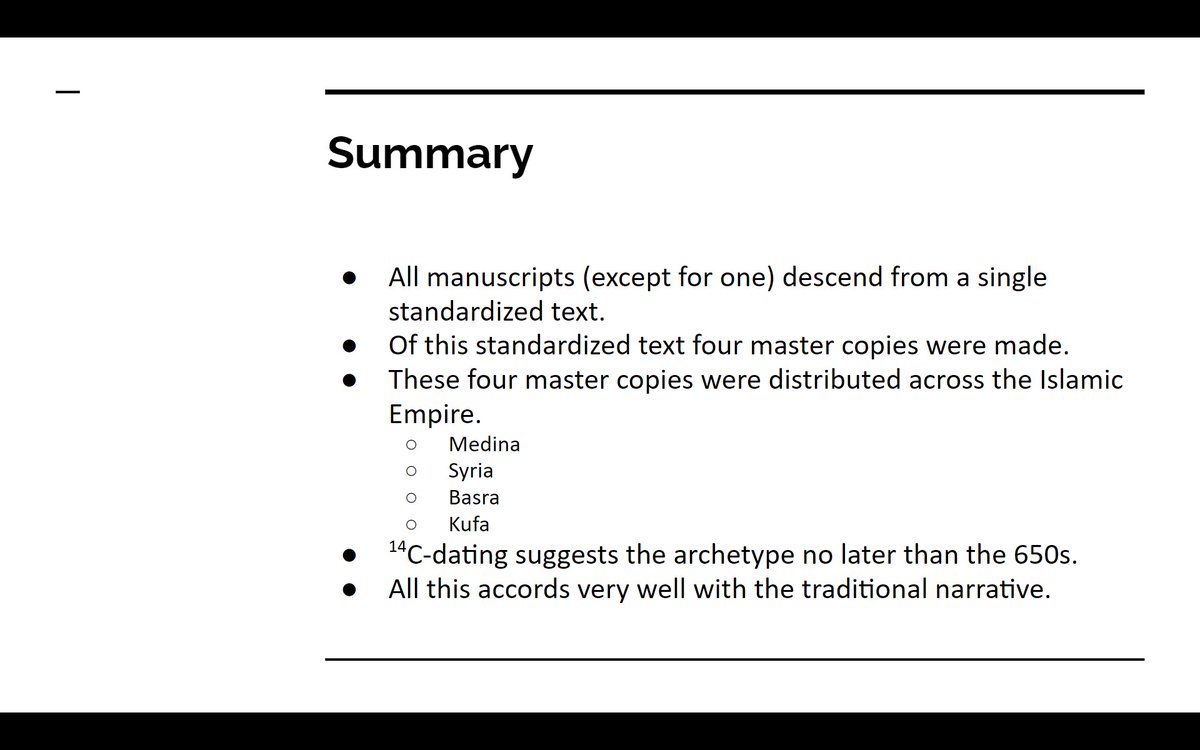
By looking at early manuscripts, we can show that virtually all manuscripts descend from a single archetype: there was a single standardization moment from which all known copies of the Quran (except for the Sanaa Palimpsest) descend.

That the text is highly stable is obvious from even casual observation of Quranic manuscripts. Take these two folios of the British Library manuscript and the Birmingham Fragment of approximately the same portion of text. They are letter-for-letter identical, except for one ʾalif
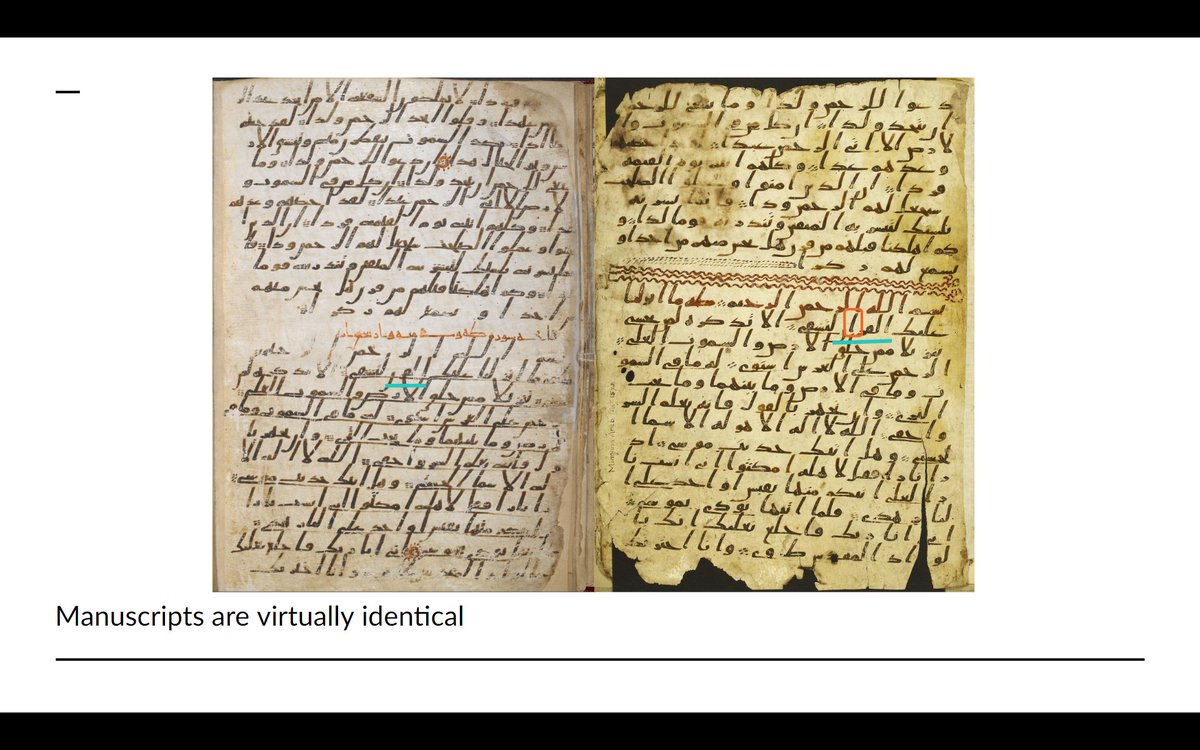
This is true not just for this page and just these two manuscripts. This is standard for any page of any 7th century manuscript: the deviations are extremely minimal.
To "intuit" this, you do need to look at a lot of manuscripts, in 2019 I tried to formalize this intuition.
To "intuit" this, you do need to look at a lot of manuscripts, in 2019 I tried to formalize this intuition.
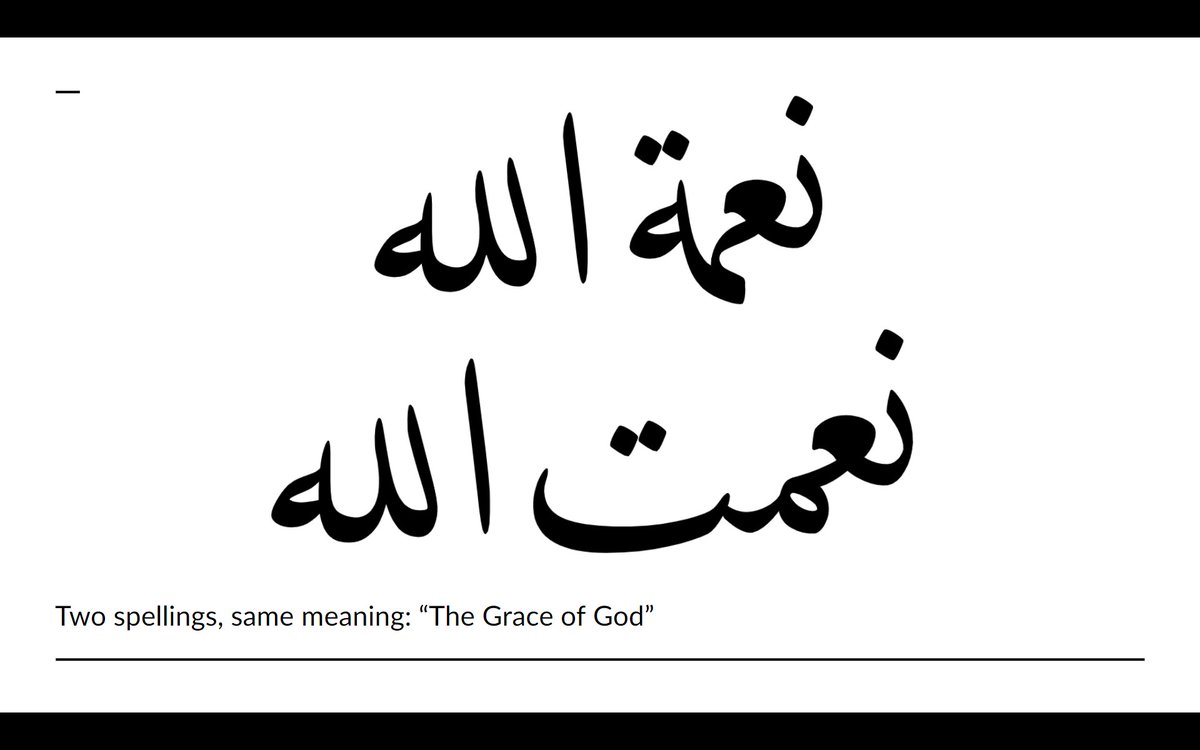
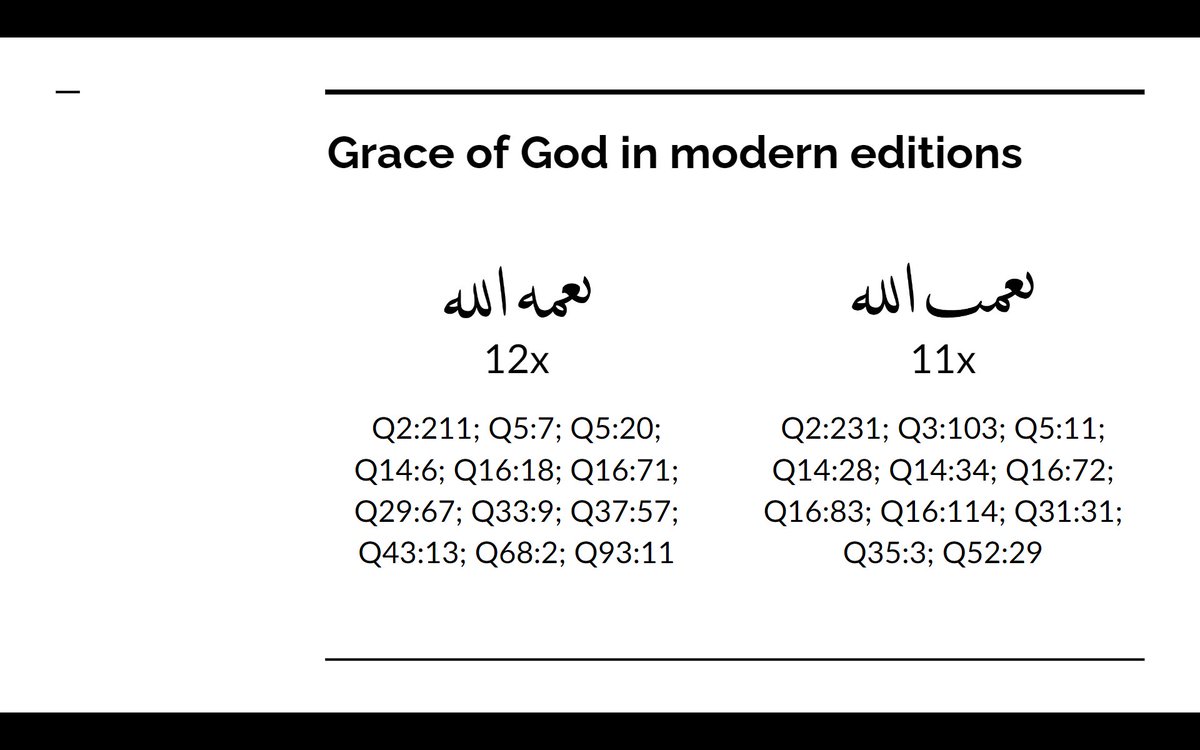
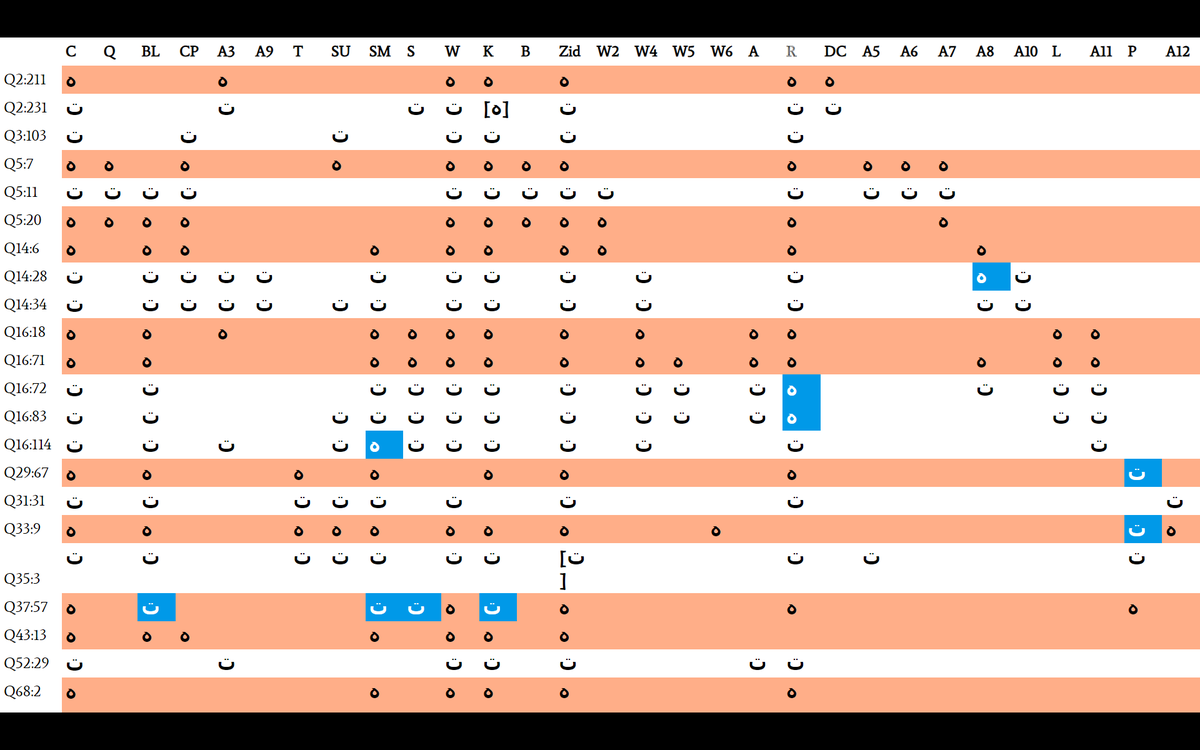
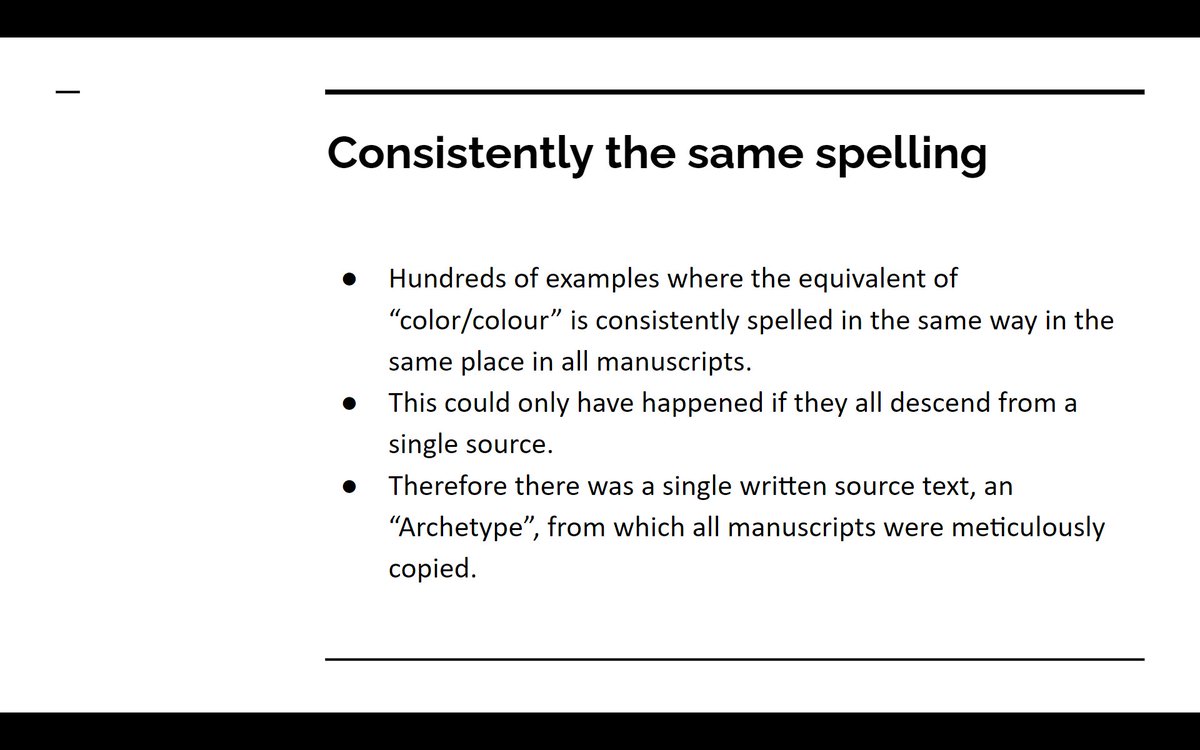
That is when I wrote my "Grace of God" article, where I show that the idiosyncratic spelling of the phrase niʿmat aḷḷāh is almost perfectly reproduced in all early manuscripts.
doi.org
All manuscripts descend from a single written archetype.
doi.org
All manuscripts descend from a single written archetype.

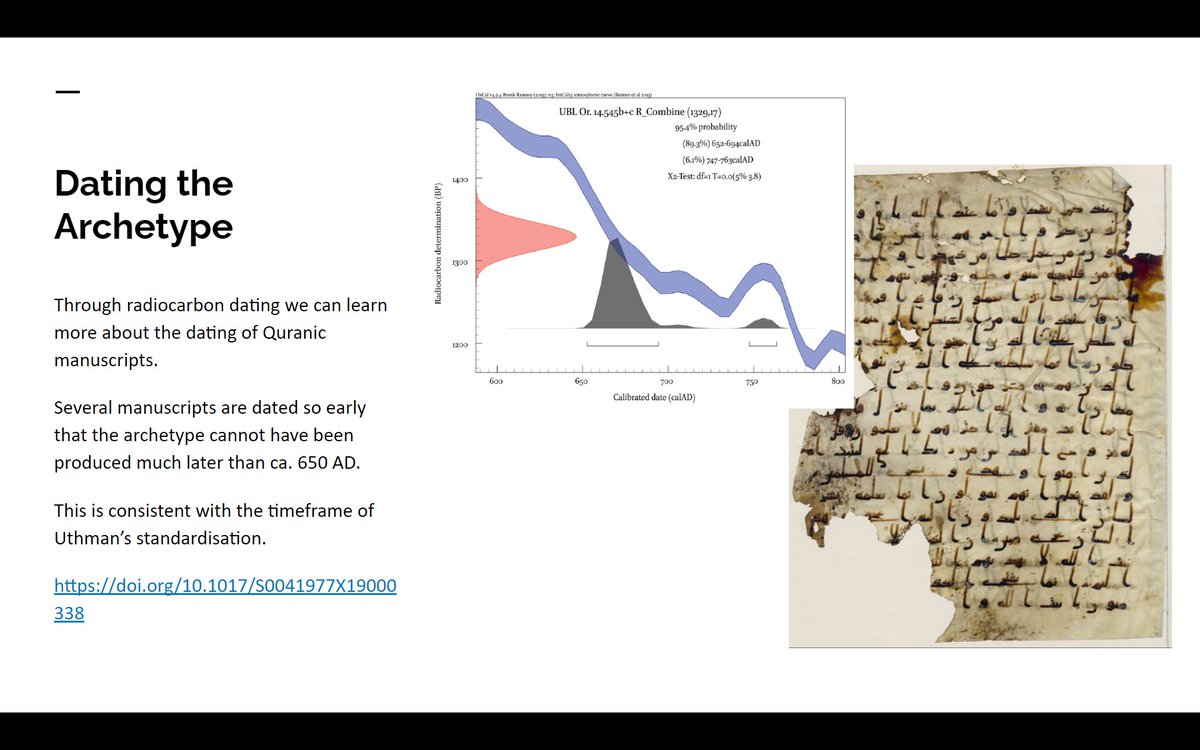
Radiocarbon dating of several of these manuscripts to the late seventh century prove quite conclusively that the archetype (which must necessarily predate these copies) must have been even earlier than that.
This is consistent with an Uthmanic canonization.
This is consistent with an Uthmanic canonization.
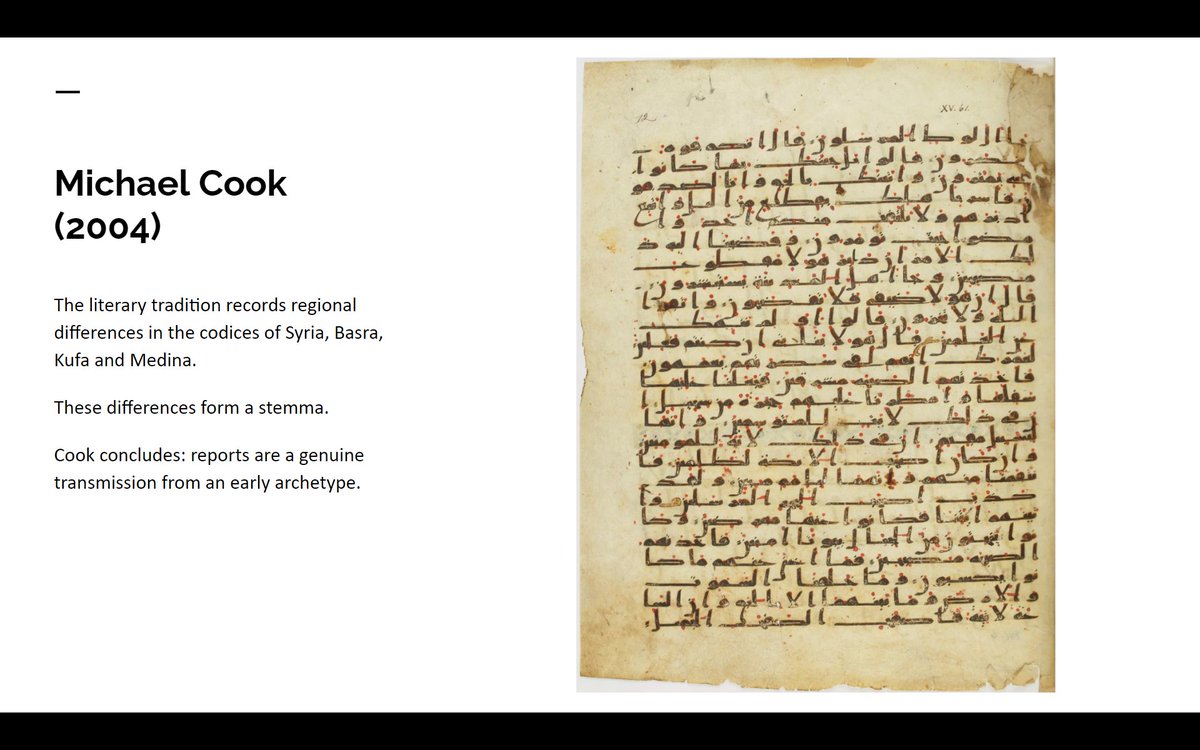
Another feature that similarly points to an early centralized canonization is found in the regionality.
By looking at the small differences between different manuscripts, we see that we can construct a stemma of four ancestral regional copies that descend from the archetype.
By looking at the small differences between different manuscripts, we see that we can construct a stemma of four ancestral regional copies that descend from the archetype.

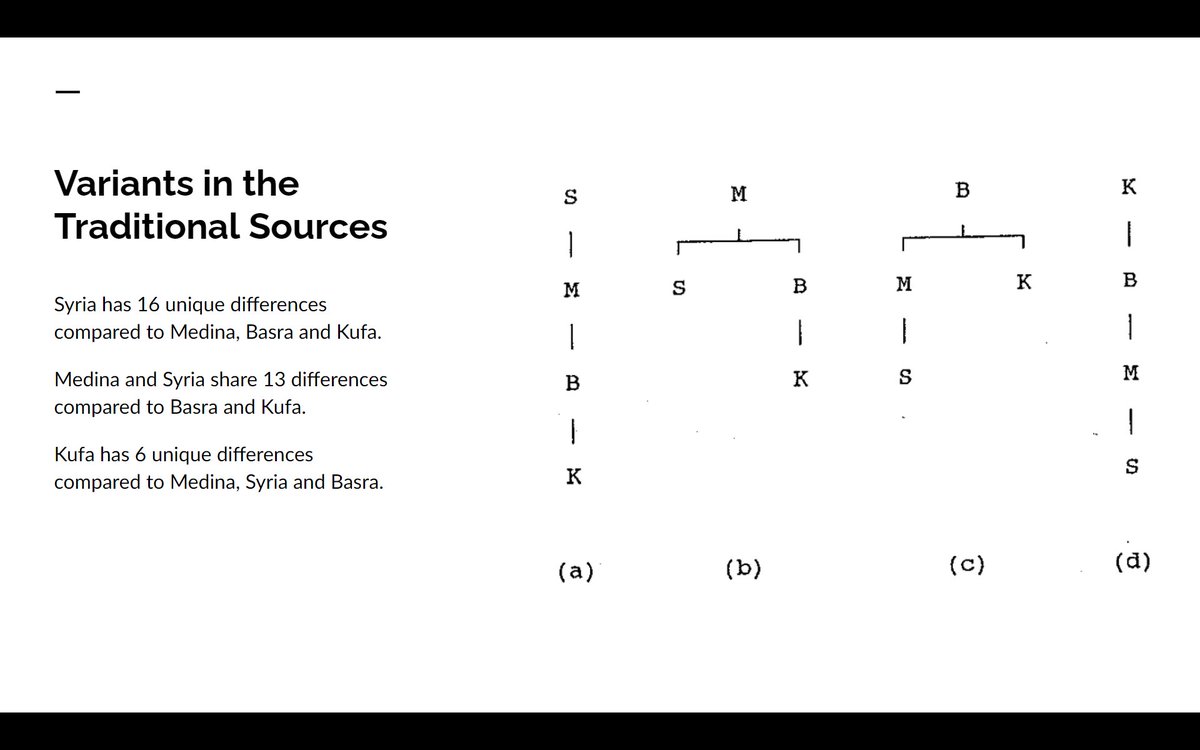
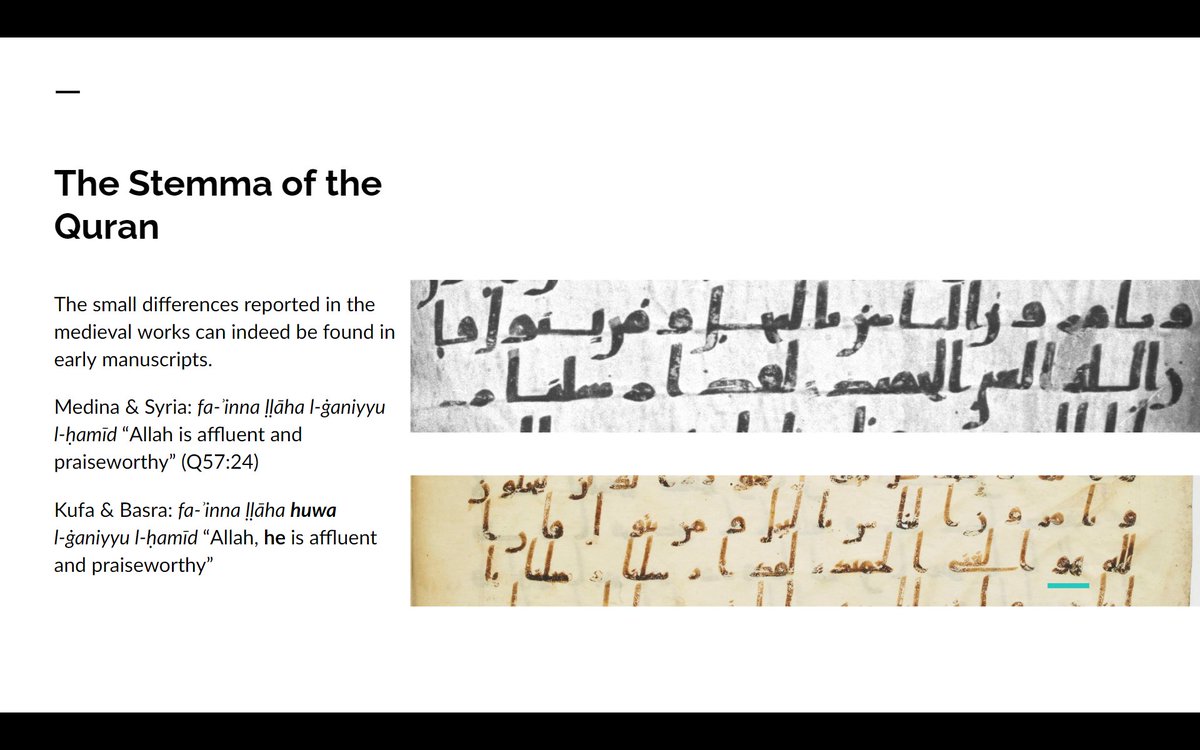
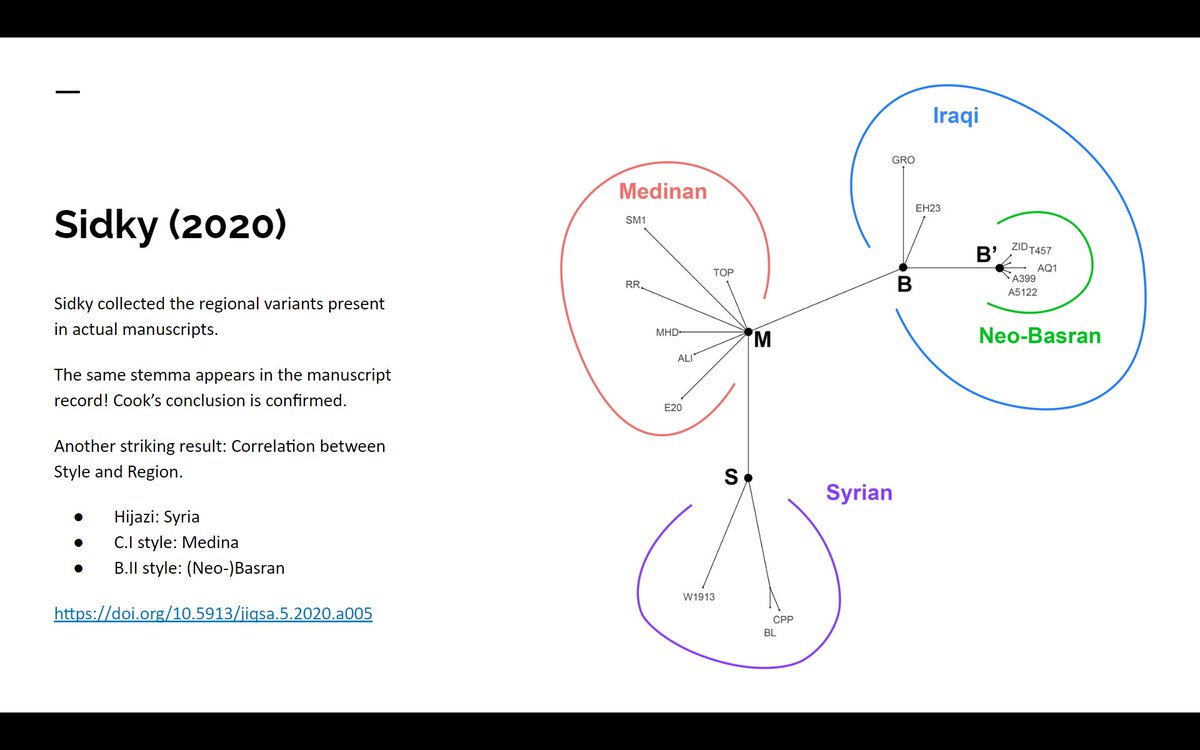
While some early papers already showed that manuscripts indeed show clear regionality, Hythem Sidky's 2020 paper went all the way and collected variant data for as many manuscripts as possible, and showed that a stemma of regional master copies appears from the data.
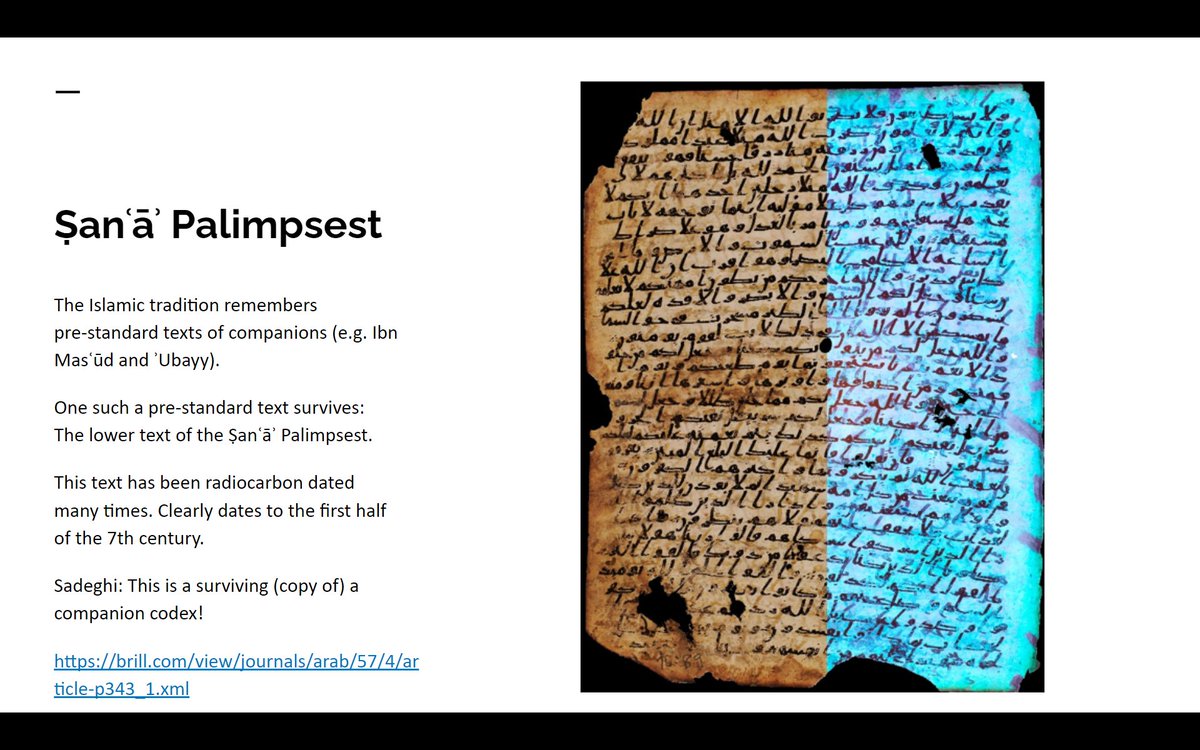
As I hinted at earlier: there is one manuscript that does not descend from this archetype. The Sanaa Palimpsest. The variants in the Sanaa Palimpsest are closely akin to what we find among companion codices. It is clear this text is a (copy of a) very early companion codex.
I think these arguments leave little reason to think anyone other than ʿUṯmān canonized the text.
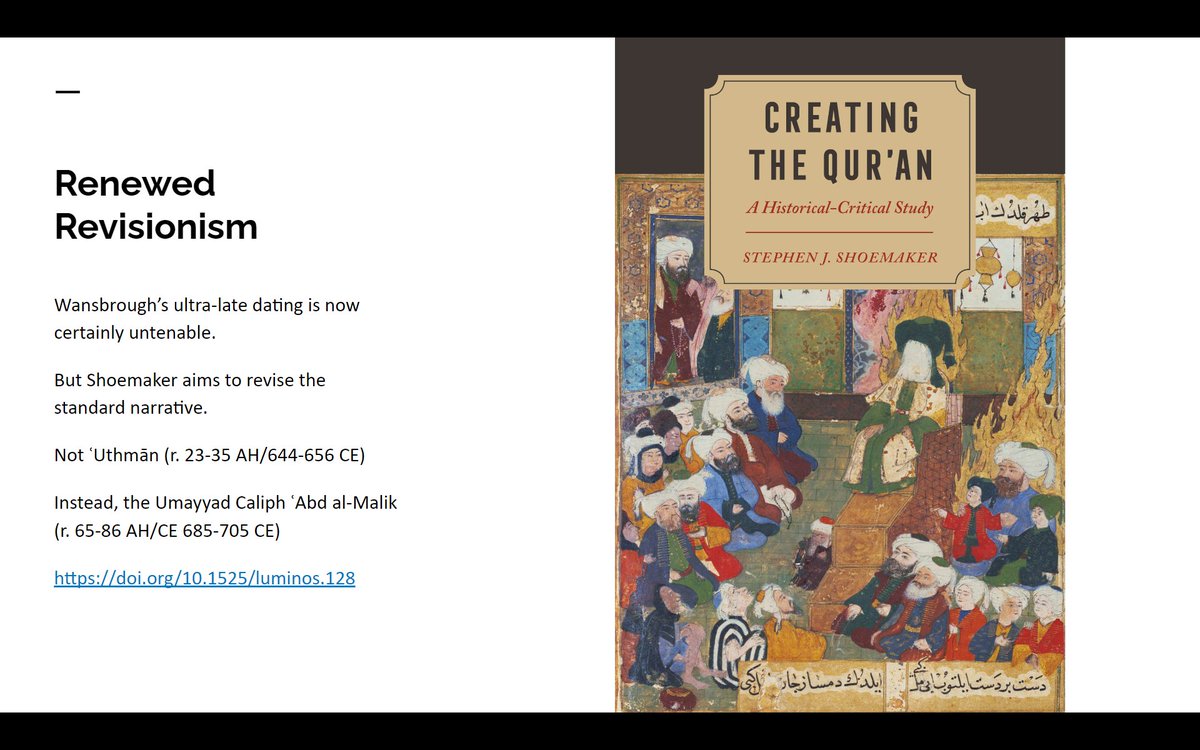
But recently Stephen Shoemaker has challenged this. He thinks the Umayyad caliph ʿAbd al-Malik (reign 685:705) standardized the text.
I disagree.
But recently Stephen Shoemaker has challenged this. He thinks the Umayyad caliph ʿAbd al-Malik (reign 685:705) standardized the text.
I disagree.
Shoemaker's argument:
1. There are many reports that suggest ʿAbd al-Malik (or his governor al-Ḥajjāj) did *something* to the Quran. This must be a historical memory. (fair enough)
2. Radiocarbon dating is not precise enough to distinguish ʿAbd al-Malik versus ʿUṯmān.
1. There are many reports that suggest ʿAbd al-Malik (or his governor al-Ḥajjāj) did *something* to the Quran. This must be a historical memory. (fair enough)
2. Radiocarbon dating is not precise enough to distinguish ʿAbd al-Malik versus ʿUṯmān.
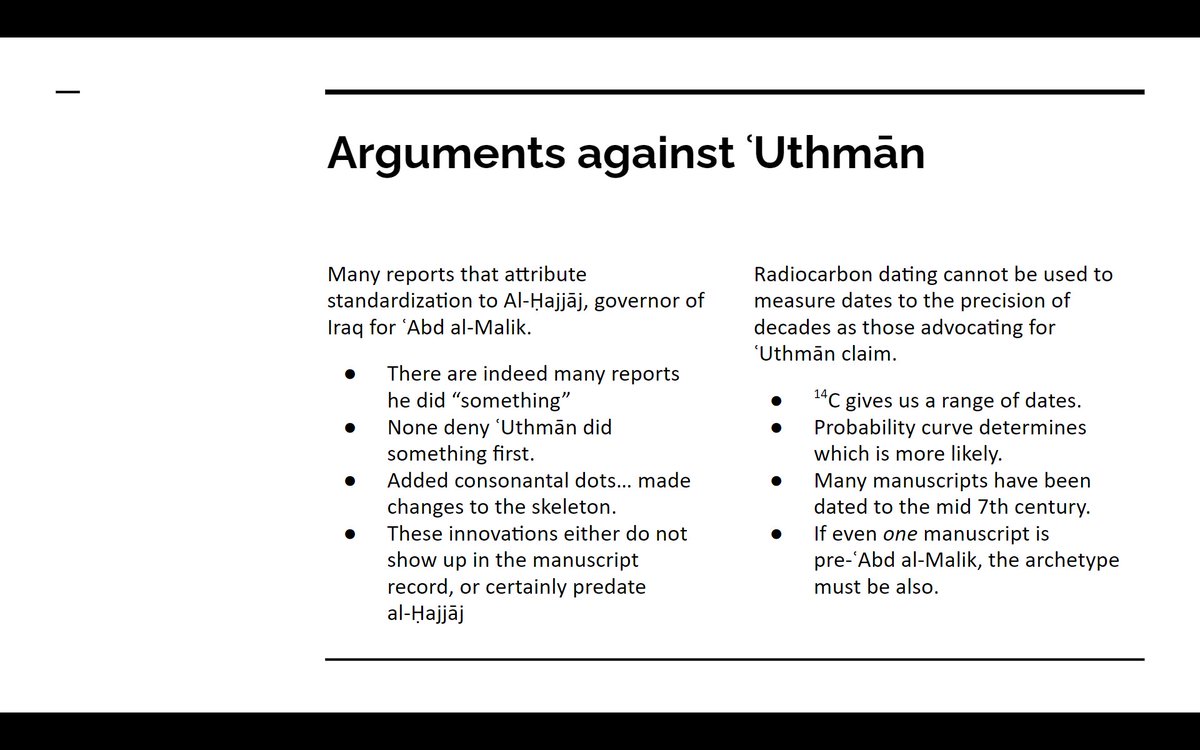
I personally do not think these two argument actually get you to ʿAbd al-Malik. At best they get you to a place where one decides the evidence is equivocal.
I don't believe the data to be equivocal though.
I don't believe the data to be equivocal though.
Because all manuscripts descend from a single archetype, we don't need to show all of the early radiocarbon dated manuscripts are definitely pre-ʿAbd al-Malik. We only need one. If one pre-dates ʿAbd al-Malik, the archetype must predate ʿAbd al-Malik and he can't be the canonizer
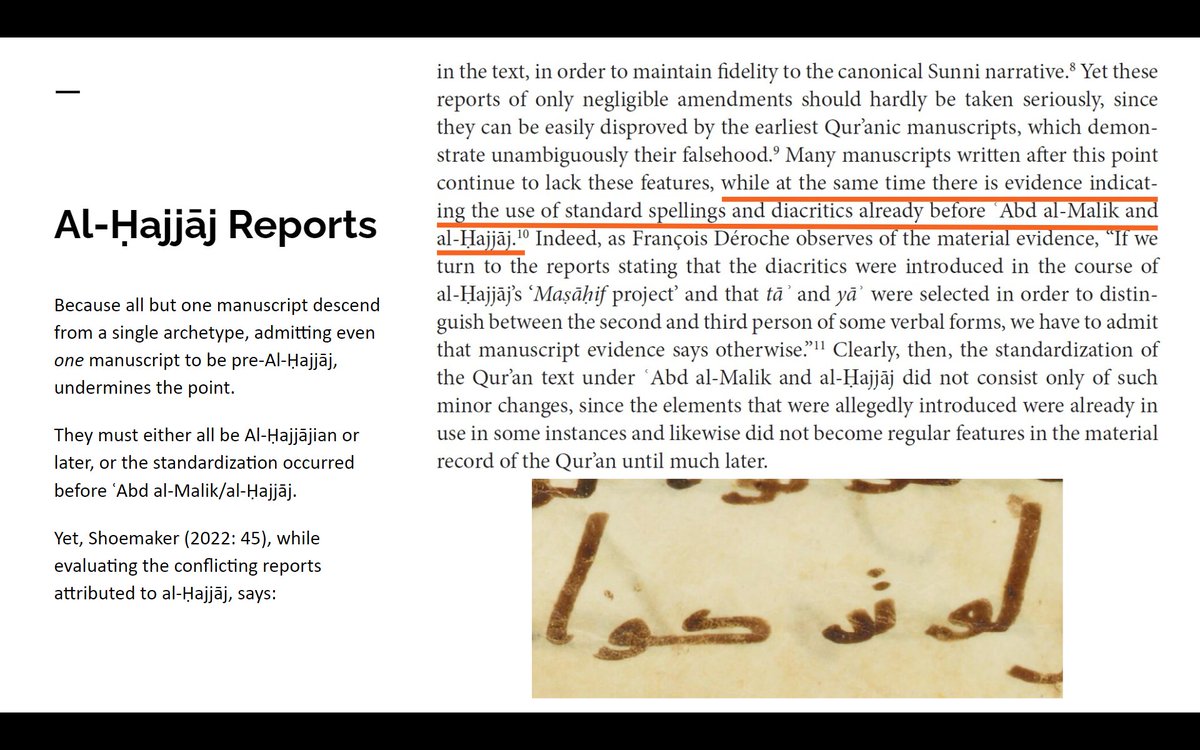
Shoemaker seems to be confused about this. He cites positively Déroche who dismissed the accuracy of the reports of what ʿAbd al-Malik did (Shoemaker imagines ʿAbd al-Malik did much more). But Déroche's argument ONLY works with the existence of pre-ʿAbd al-Malik manuscripts.
Déroche's argument:
1. ʿAbd al-Malik introduced consonantal dots.
2. We have pre-ʿAbd al-Malik manuscripts with consonantal dots.
3. Therefore ʿAbd al-Malik can't have introduced these.
Obviously you can't use that to dismiss the historicity of reports if you reject step 2.
1. ʿAbd al-Malik introduced consonantal dots.
2. We have pre-ʿAbd al-Malik manuscripts with consonantal dots.
3. Therefore ʿAbd al-Malik can't have introduced these.
Obviously you can't use that to dismiss the historicity of reports if you reject step 2.
The fact that we need just ONE pre-ʿAbd al-Malik manuscript really makes the carbon dating argument a lot stronger. We don't just have an isolated manuscript, we have MANY, multiple of which have an extremely high likelihood of being pre-ʿAbd al-Malik
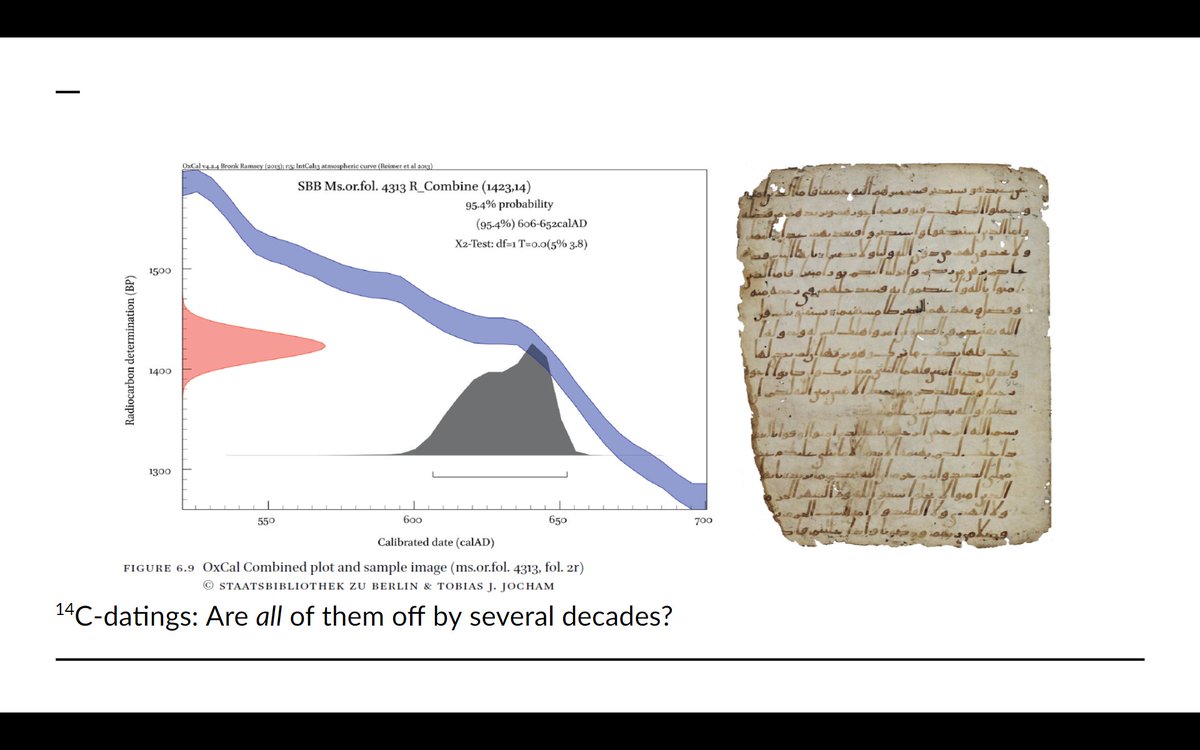
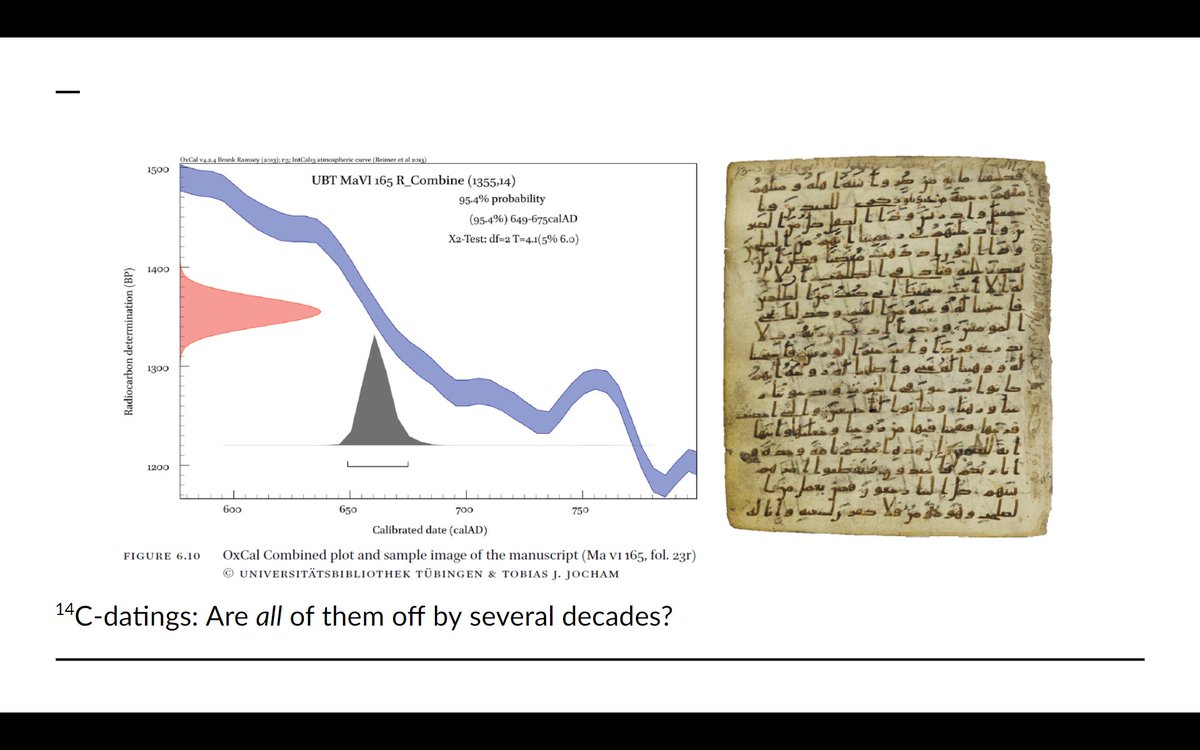
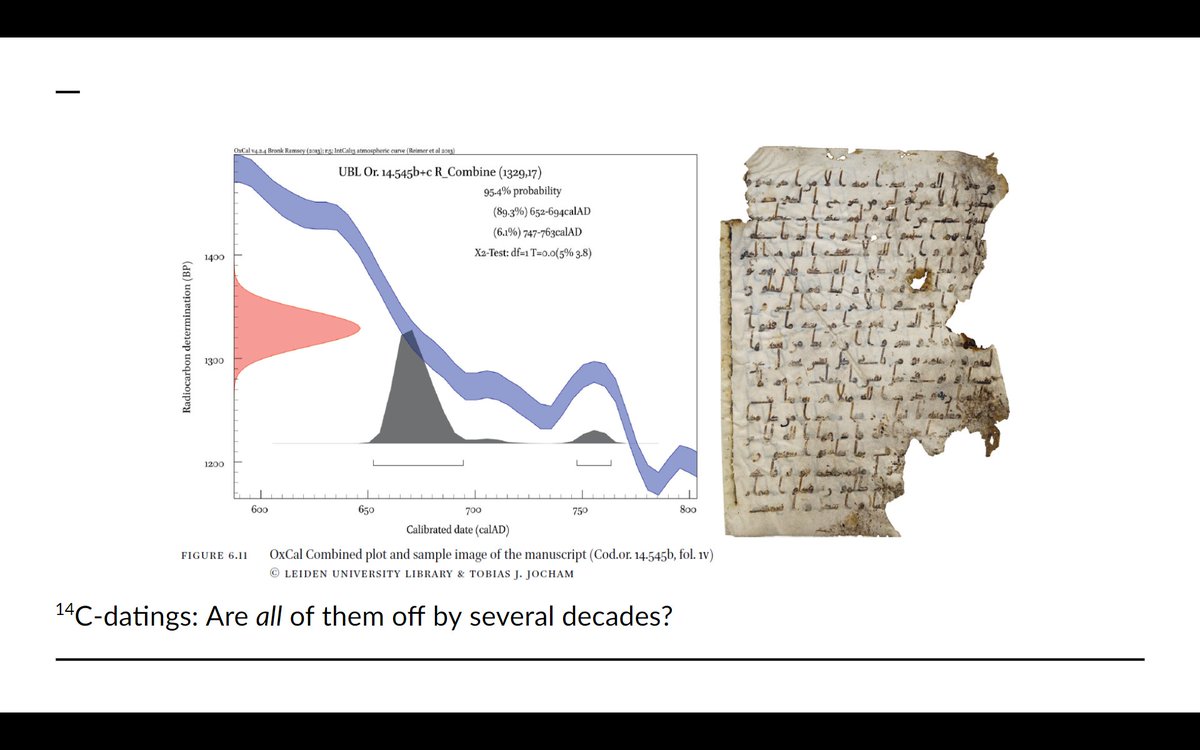
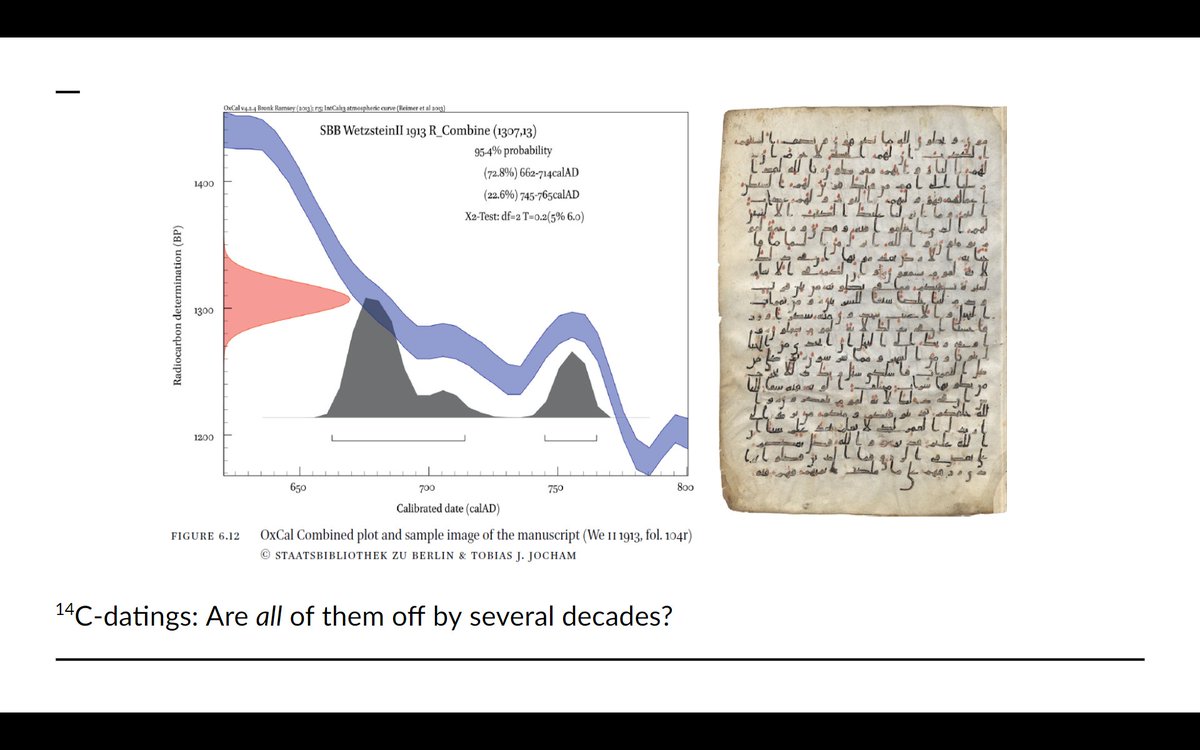
That one of them might be later than expected, or something went wrong. Sure. Possible. But are we seriously to believe *all* of them would be? The odds of this are astronomically low.
We've carbondated an obscene amount of manuscripts, all from a single archetype.
We've carbondated an obscene amount of manuscripts, all from a single archetype.
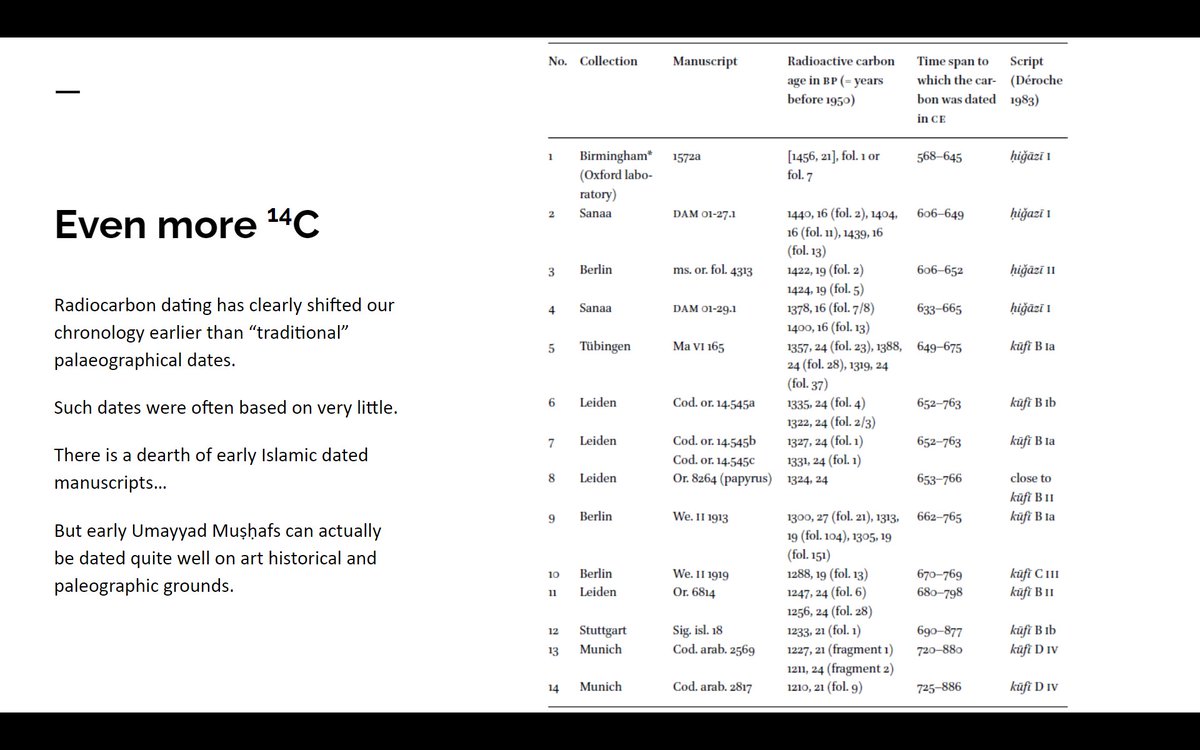
But hey, physics was broken irreparably because "Three body problem"-style aliens interfered, and we really can't trust the radiocarbon dating. Does the argument depend on that? Not at all! Déroche himself is quite skeptical of carbondating and still argues for ʿUṯmān.
In his "Qur'an of the Umayyad's" Déroche identifies a palaeographical progression from Hijazi, to styles that he calls "O.I" (and later O.II) and eventually to Kufi proper.
Déroche connects very convincingly, independent of radiocarbon dating that the O-styles are early Umayyad.
Déroche connects very convincingly, independent of radiocarbon dating that the O-styles are early Umayyad.
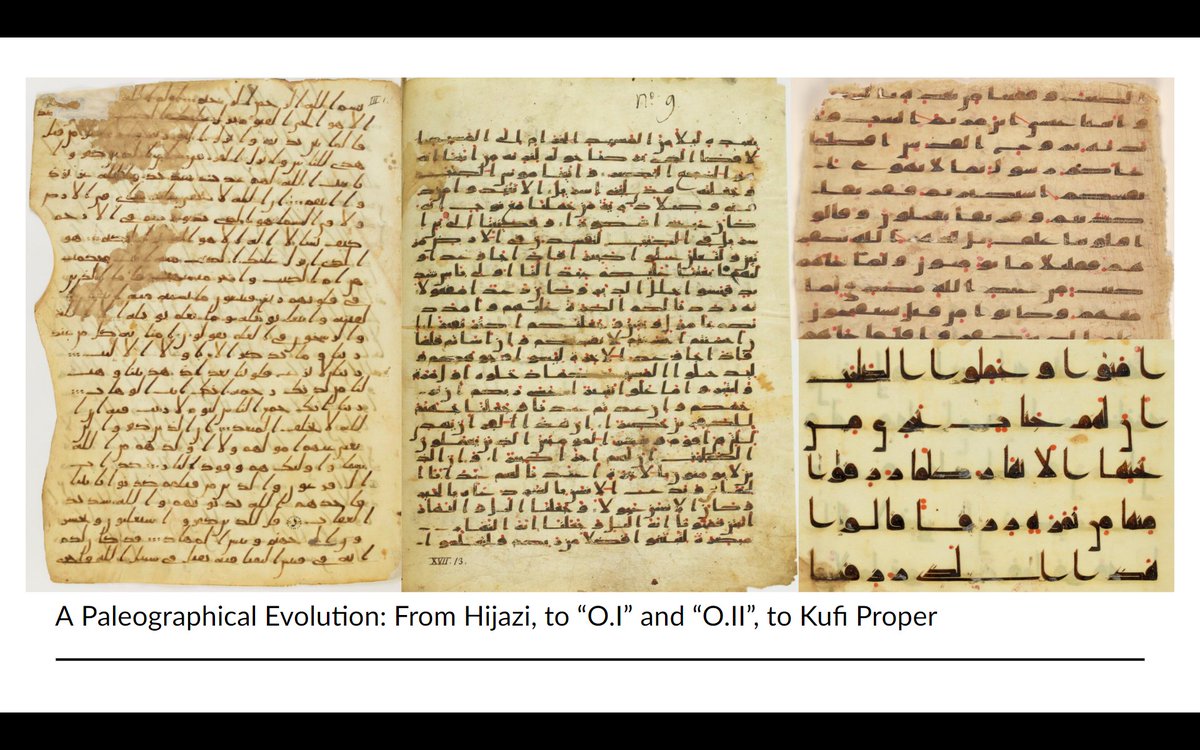
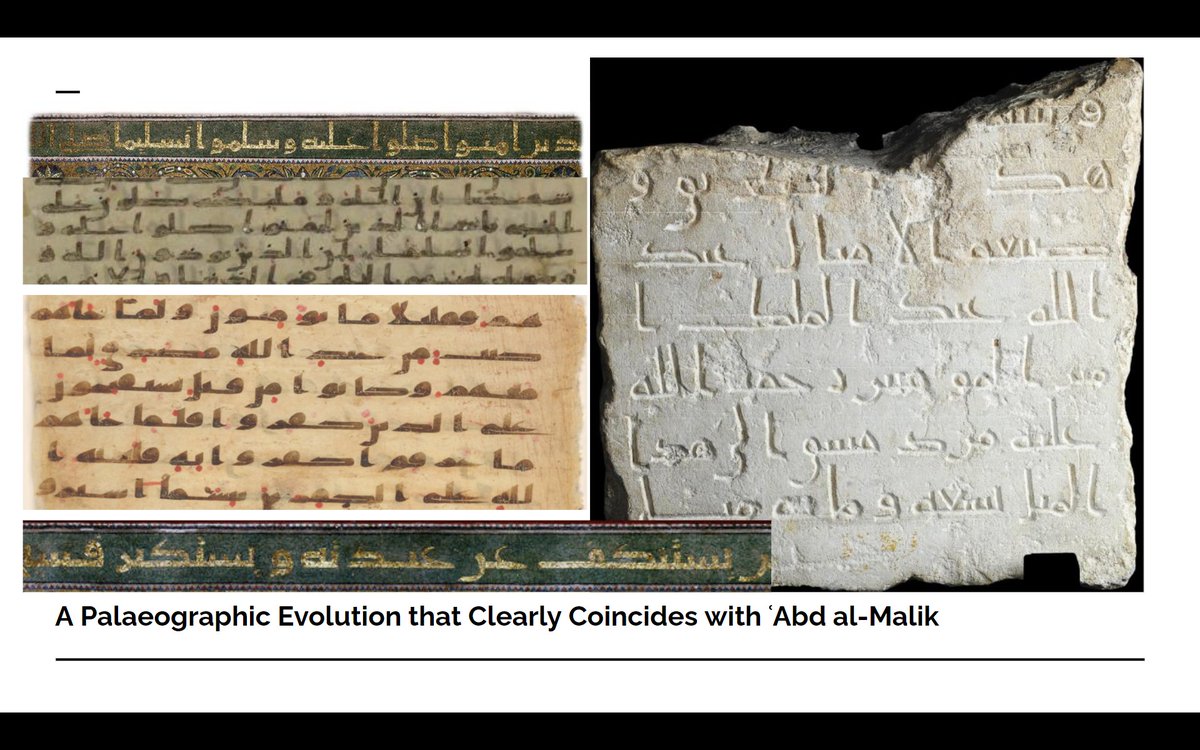
The O.I and O.II styles that we see in manuscripts are a highly regularized, and very beautiful calligraphic style. They have *clear* links with a notable palaeographic evolution that we can link directly with ʿAbd al-Malik: his dome of the rock inscription and his milestones.
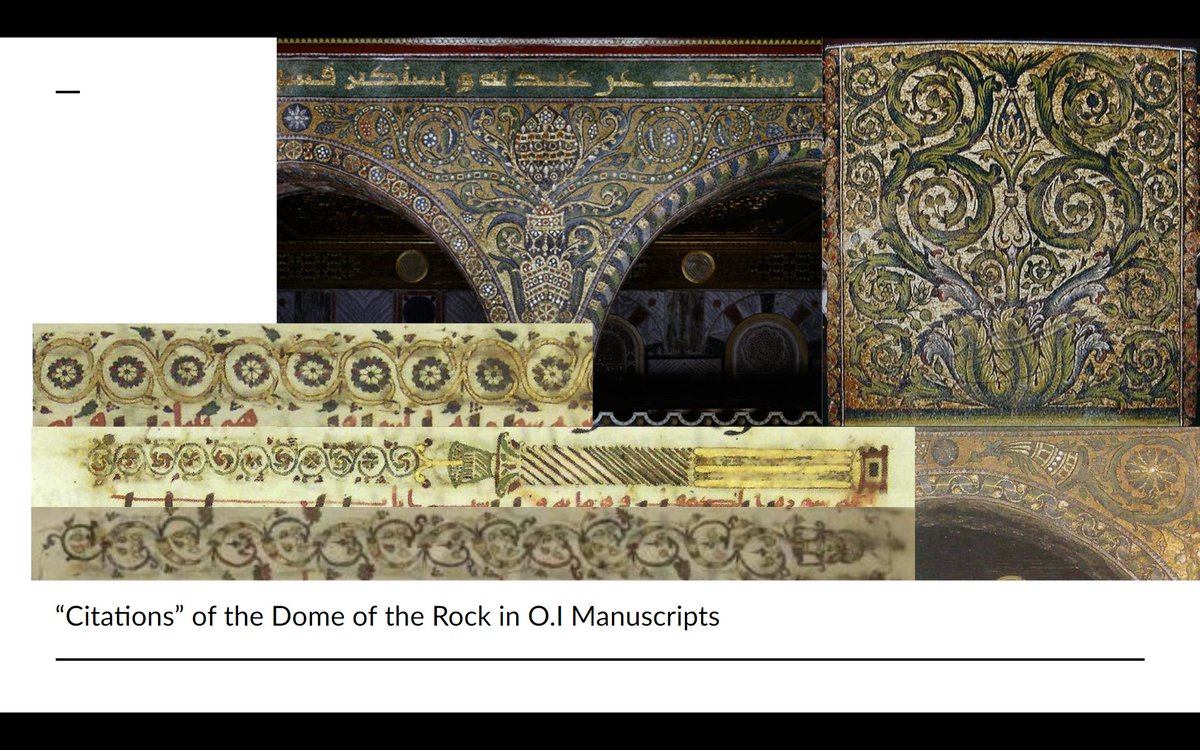
But even on art historical grounds these O.I/O.II manuscripts appear to be clearly Umayyad. They are notable for their very beautiful and intricate floral ornamentation which are direct citations of the mosaic's of the Dome of the Rock (which was built by ʿAbd al-Malik).
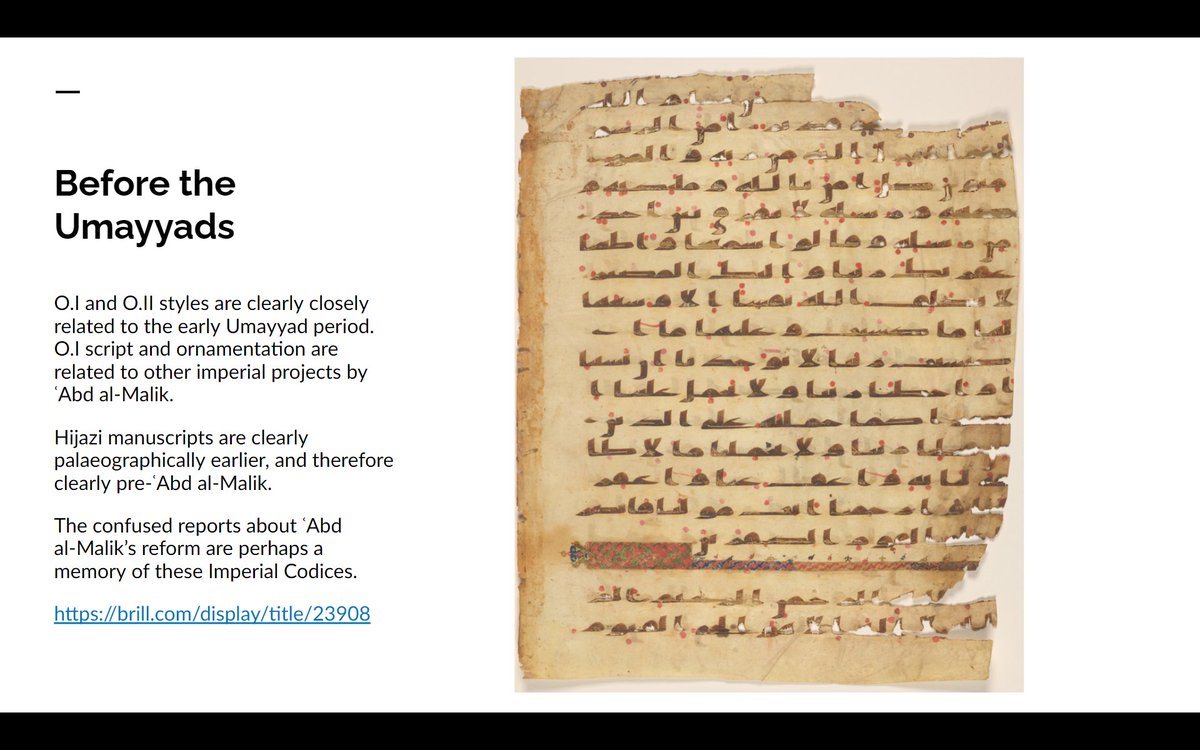
If the O.I and O.II manuscripts are quite obviously to be dated close to ʿAbd al-Malik, the obviously the earlier Hijazi manuscripts predate these reforms and must be pre-ʿAbd al-Malik. There are quite a lot of these, and their radiocarbondating agrees with such a progression.
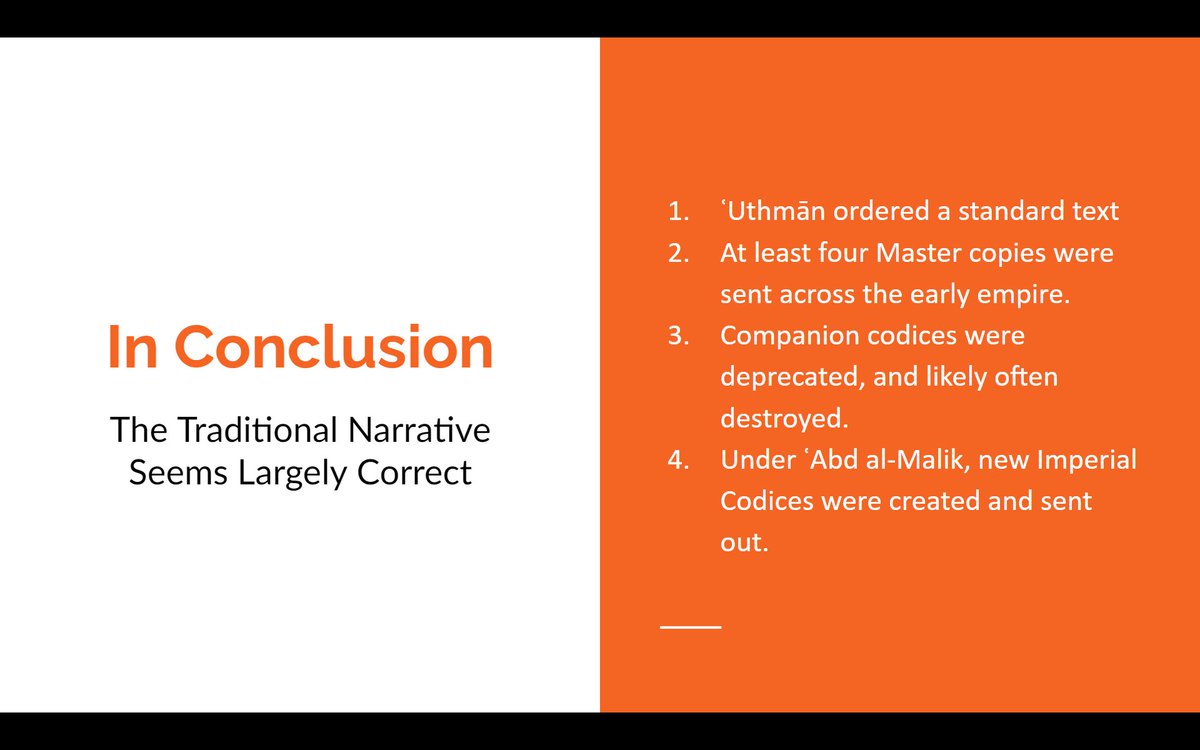
The traditional narrative about the standardization of the text really seem correct. Uthman ordered a standard text, made four master copies and sent them out to four important regions, companion copies were often destroyed. ʿAbd al-Malik ordered the creation of imperial codices.
If you think these kinds topics are cool, and the critical investigation into the history of the Quran and the Bible in a comparative way is worthwhile make sure to check out my friend @DrJavadTHashmi's course together with @BartEhrman.
ehrman.thrivecart.com
ehrman.thrivecart.com

I'm sure they will touch on several of these topics together, and I am interesting to see how Ehrman reacts to it. Incidentally Ehrman was one of Shomaker's teachers and "Creating the Qur'an" was clearly (and by his own admission) inspired from Ehrman's Jesus Before the Gospels.
Loading suggestions...