

So as promised. Thread no. 1. on the dreaded LT1.
I will try and keep these pretty brief, address some common misconceptions and give some practical points (I hope)
So, LT1, or Lactate Threshold 1. Sometimes called the Aerobic Threshold (although I think that is a bad name)
1/
I will try and keep these pretty brief, address some common misconceptions and give some practical points (I hope)
So, LT1, or Lactate Threshold 1. Sometimes called the Aerobic Threshold (although I think that is a bad name)
1/
Firstly, I am not sure LT1 even satisfies the definition of a threshold:
1. the point at which a physiological or psychological effect begins to be produced
OR
2. a level, point, or value above which something is true or will take place and below which it is not or will not
2/
1. the point at which a physiological or psychological effect begins to be produced
OR
2. a level, point, or value above which something is true or will take place and below which it is not or will not
2/
What LT1 actually is is the first rise above baseline lactate, which indicates that APPEARANCE of lactate in the blood exceeds CLEARANCE.
Rather than a threshold it is more a result of an equation, have a read of this -
ncbi.nlm.nih.gov
3/
Rather than a threshold it is more a result of an equation, have a read of this -
ncbi.nlm.nih.gov
3/

Why do you have lactate at rest (baseline)? Because some tissues, Red Blood Cells (RBCs) for example, can only produce energy ANaerobically. So most of us have 1 or so mmol of lactate in our blood at rest.
This goes DOWN at the start of easy exercise, why?
4/
This goes DOWN at the start of easy exercise, why?
4/
Go back to the equation.
And then go back to my other thread about lactate.
Here -
x.com
Lots of tissues (including muscle) can use lactate as a fuel. So it is taken up and clearance exceeds production.
5/
And then go back to my other thread about lactate.
Here -
x.com
Lots of tissues (including muscle) can use lactate as a fuel. So it is taken up and clearance exceeds production.
5/
As intensity increases the equation starts to change.
And IF we capture this rise back above the baseline level we term the intensity (power, speed) as LT1. And sometimes it is linked to a HR measure.
So, as you can now see, it isn't a simple on/off switch. It's a flux.
6/
And IF we capture this rise back above the baseline level we term the intensity (power, speed) as LT1. And sometimes it is linked to a HR measure.
So, as you can now see, it isn't a simple on/off switch. It's a flux.
6/
Which is why I don't even think it is a 'threshold'. It is the result of a carefully balanced equation, now moving towards appearance and away from clearance
Why does this all matter?
Well, endurance training *should* increase the intensity at which this unbalancing happens.
7/
Why does this all matter?
Well, endurance training *should* increase the intensity at which this unbalancing happens.
7/
So question 1.
How do you INCREASE LT1?
You get fitter! Aerobically speaking.
You get better at reducing rate of appearance in blood (for a given effort/energy output) and/or you get better at clearing it.
Thus, moving the balanced equation to a higher intensity.
8/
How do you INCREASE LT1?
You get fitter! Aerobically speaking.
You get better at reducing rate of appearance in blood (for a given effort/energy output) and/or you get better at clearing it.
Thus, moving the balanced equation to a higher intensity.
8/
Back to the first question/statement.
Do I need to train below LT1 to 'push' it up?
I hope you can see now that you don't. Because nothing magical happens at LT1, other than this equation moving to one side.
So, what do you need to move the intensity up?
9/
Do I need to train below LT1 to 'push' it up?
I hope you can see now that you don't. Because nothing magical happens at LT1, other than this equation moving to one side.
So, what do you need to move the intensity up?
9/
1. More mitochondria.
These powerhouses allow the oxygen using part of glycolysis (glucose breakdown) to occur, when lactate to be converted back to pyruvate and shuttled into the mitochondria (see pic)
2. More O2 transport to cells to allow this.
(probably most important)
10/
These powerhouses allow the oxygen using part of glycolysis (glucose breakdown) to occur, when lactate to be converted back to pyruvate and shuttled into the mitochondria (see pic)
2. More O2 transport to cells to allow this.
(probably most important)
10/
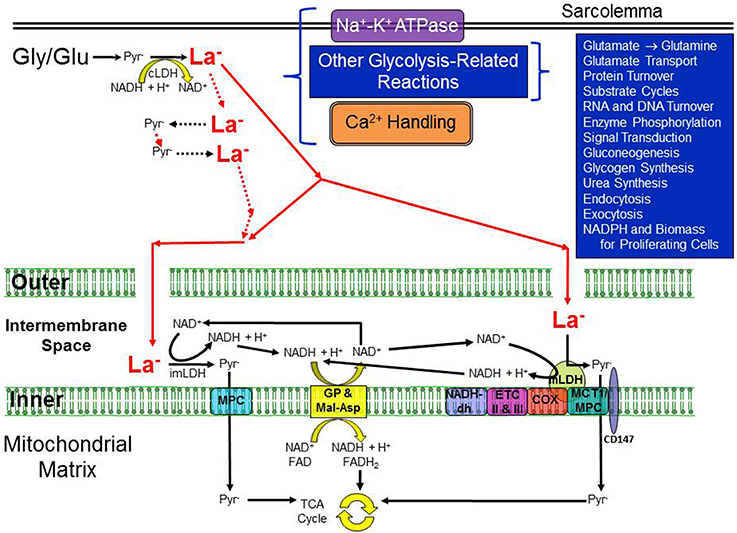
The general consensus is now that more mitochondria are better, but may not be the limiting step.
We need to get more O2 to them. For this we need.
1) A good heart - Cardiac output, lots of blood
2) Good lungs (only really a limiter in lung disease
11/
We need to get more O2 to them. For this we need.
1) A good heart - Cardiac output, lots of blood
2) Good lungs (only really a limiter in lung disease
11/
3. Good blood vessels, - less diseased the better.
4. Lots of capillaries in muscles. (could be the most important factor, and one which results from long-term endurance training.
12/
4. Lots of capillaries in muscles. (could be the most important factor, and one which results from long-term endurance training.
12/
*BONUS*
More O2 to cells means more lactate converted back to pyruvate to keep THAT in-cell equation balanced. Thus reducing the need to 'export' lactate (which increases rate of appearance).
I hope that makes sense!
More O2 to cells means more lactate converted back to pyruvate to keep THAT in-cell equation balanced. Thus reducing the need to 'export' lactate (which increases rate of appearance).
I hope that makes sense!
To get all these things you need to -
1) Train
2) Consistently
3) For a long time
Volume trumps intensity just about (hence Z2 hype), unless volume is limited then intensity wins.
But make is sustainable (another benefit to SOME people of Z2).
13/
1) Train
2) Consistently
3) For a long time
Volume trumps intensity just about (hence Z2 hype), unless volume is limited then intensity wins.
But make is sustainable (another benefit to SOME people of Z2).
13/
But high intensity stuff is good for the heart.
And all those grey zones in between? They do a bit of both. So *can* be very time efficient.
There are many ways to approach it.
So you don't need to live below LT1, you just need to get gradually fitter
14/
And all those grey zones in between? They do a bit of both. So *can* be very time efficient.
There are many ways to approach it.
So you don't need to live below LT1, you just need to get gradually fitter
14/
Then. On the other side. We have clearance.
For this we need to train the tissues to re-uptake lactate and reuse it.
This relies on MCT transporter (too geeky for here).
Some research suggests lactate is the stimulus for more MCTs.
So do some training that produces it!
15/
For this we need to train the tissues to re-uptake lactate and reuse it.
This relies on MCT transporter (too geeky for here).
Some research suggests lactate is the stimulus for more MCTs.
So do some training that produces it!
15/
But both reducing appearance and increasing clearance all happen at the same time.
This:
TRAIN -
1. Make is sustainable
2. Make it consistent
3. Make it enjoyable
4. Find YOUR rhythm
5. Keep at it if you can.
Come back in a few years (yes years!).
16/ end
This:
TRAIN -
1. Make is sustainable
2. Make it consistent
3. Make it enjoyable
4. Find YOUR rhythm
5. Keep at it if you can.
Come back in a few years (yes years!).
16/ end
P.s. I know I haven't addressed the fat oxidation side of things. That is also important and will be covered in the 'fat max' thread
Loading suggestions...