
1) I'm not sure how to make people remember or care that 15 years ago the United States invaded Iraq, setting off a war that continues to this day, with several hundred thousand Iraqis dead, millions turned into refugees. I covered the invasion for the New York Times Magazine.
2) Though I'm a writer, I shot photos during the invasion as I drove a rented Hyundai SUV from Kuwait into Iraq via Safwan, then up the spine of the country to Nasiriya, Diwaniya, Hilla, Kut and finally Baghdad. Here's the Hyundai on March 19, 2003. It's clean--that will change

3) The photographer I worked with, Laurent vander Stockt, drove his own SUV. After several failed attempts to get into Iraq, one time turned back at gunpoint by U.S. soldiers, we finally got through, via what we guessed was a minefield (I followed Lauren tracks). Here's Laurent.

4) Laurent was already a legend among photojournalists, and since the Iraq invasion he's continued to do amazing work in Syria (among other warzones). But that's another story for another day.
5) We arrived in Safwan on the afternoon of March 19, 2003, just as Marines were taking down a placard of Saddam Hussein.

6) Here's the placard before it got torn down. Marines as far as you could see, a parade of Humvees, self-propelled howitzers, trucks carrying pontoon bridges, Abrams tanks, fuel trucks -- everything you could imagine, and more.

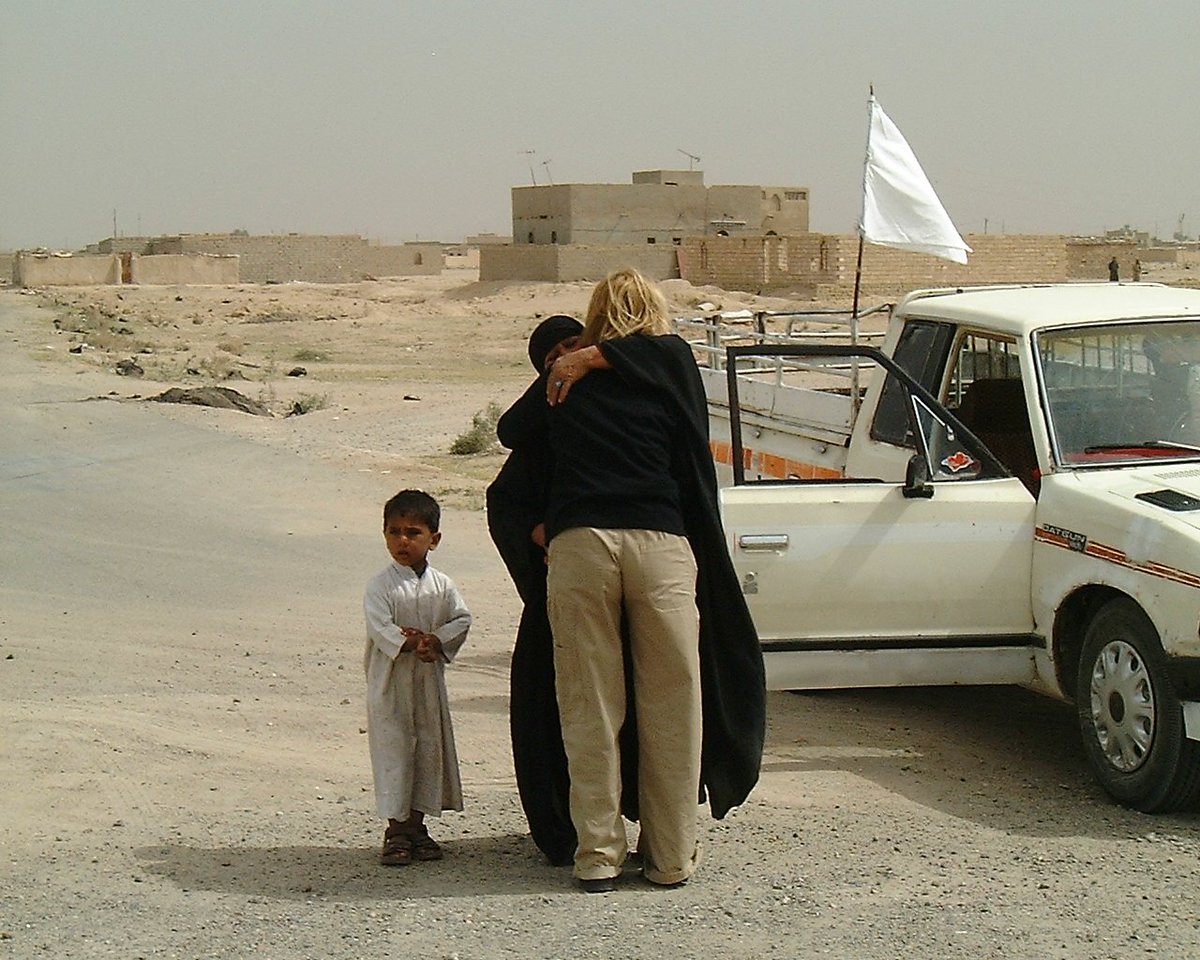
7) Iraqis in Safwan tended to keep their distance -- not many were outside. A guy drove up in a truck with a white flag. A woman and child got out and embraced Ellen Knickmeyer of the Associated Press. I think they were relieved they hadn't been shot.
8) From Safwan, it was about 45 kilometers to Basra. Soldiers told us (a group of about a dozen unembedded journalists who had managed to drive into Iraq) that the road was clear to Basra. So we headed down the road and nearly got killed.
9) We started driving to Basra, thinking U.S. forces were ahead or anti-Saddam forces had taken control (like in 1990-91). No. Laurent was the lead vehicle and he was the first to notice the Iraqi soldiers at the side of the road trying to surrender to us. That wasn't good.
10) We were heading into territory still held by Saddam's forces (some trying to surrender, but others not). We all did quick U-turns and sped back to Safwan. Thankfully we didn't get shot by jumpy U.S. troops as we returned (that happened to other journalists a day or so later).
11) So, as I said, I really don't know how to make people care that 15 years ago the U.S. started a war that still decimates Iraq & Iraqis. But I'll continue tweeting and posting photos in the days and weeks ahead, as the catastrophe began to unfold and I made my way to Baghdad.

12) On that first day in Safwan, the Marines took their first Iraqi prisoners. I've no idea what happened to those Iraqis, but there they were, about two dozen men surrounded by coils of barbed wire. Those small yellow bags are food rations they were given.

13) I think it's okay to say this is where the road to Abu Ghraib began. I didn't see these Iraqis mistreated, but later on, others were mistreated and tortured by the U.S. military. I saw some of it. Here's a better picture by Gary Knight, a photographer in my unembedded group.

14) The night of March 20, we slept in our cars along the road, not far from the prisoners. For the next three weeks, until reaching Baghdad, that's where I slept, in my car. I heard, overhead, the whine of drones. There was the sound of machine gun fire, but not too close.
15) Because we were just a few miles from Kuwait, my Kuwaiti cell phone still worked. I got a call in the evening. It was Hertz in Kuwait City, wanting to know when I would return my SUV. I told them it would be a while. They reminded me that I wasn't allowed to take it to Iraq.
16) March 21, 2003, 15 years ago today, was odd. We (the unembedded journalists, about six or seven vehicles of us, now banded together) realized we wouldn't be getting to Basra soon -- it was still held by Saddam's forces. Wait it out, or head north to Baghdad?
17) We had learned, from the previous day's mistake of driving on our own toward Iraqi frontlines outside Basra, that we had to travel with U.S. military, otherwise we might get captured or shot by Iraqis, or shot by Americans, thinking we were Iraqis.
18) I forget the details, but we inched around toward Zubayr, a Basra suburb, behind U.S. forces. At one point, we came across a unit where photographer Kuni Takahashi (aka @kuniphoto) was unhappily embedded with a unit whose commander wouldn't let him send out his photos.
19) "Can I come with you guys?" Kuni asked (I'm paraphrasing). He preferred the freedom and risk of being unembedded to hassling with an obstructive commander. I was driving alone, so Kuni embedded himself in my vehicle for the rest of the journey. Here's Kuni (a few days later).

20) Kuni would end up taking what I think was one of the best combat photos of the invasion. Here it is, but the crazy and graphic story behind it will come a few weeks later, when we're closer to Baghdad.

21) By the end of the day we realized Basra wasn't going to fall quickly. We could wait it out or head north to Baghdad. I had not thought of going to Baghdad -- my assignment was to cover what I and my editors thought would be the quick & happy liberation of Basra. Ha, I know.
22) The other journalists wanted to go to Baghdad, so that was it. I think it was the next morning that we made our way to Highway 1. The capital was 500 kilometers and three weeks away. It would pretty much be, as a Marine had written on his Humvee, No Sleep Till Baghdad.

23) One thing I don't like in American war reporting -- it is too often about us (our soldiers, our reporters). It will be hard to escape that vise in this thread; my contact w/Iraqis was limited. The grim truth is that a lot of Iraqis I saw were corpses. But they have stories.
24) This is a story I'll get to.

25) I hardly knew what was happening elsewhere. Had a Sony shortwave radio, so caught occasional BBC bulletins. Once or twice a day, connected my laptop to my Thuraya sat phone to send/receive emails. Bandwidth too small for web browsing. Here's NYT front page on March 21, 2003.

26) This day 15 years ago, I drove on highway 1 toward Nasiriya, skipping from one military convoy to another, whichever moved quickest. This was risky; convoys that didn't recognize us would aim their weapons as we neared. We sometimes stopped, got out to show we weren't Iraqis.
27) At dusk, we stopped to spend the night with a Marine unit on the roadside. Apache & Blackhawk helicopters flew overhead. Marines were shocked I was in a warzone without a gun. "You're not carrying any frigging weapons?" one of them asked. "Not even a nine-millimeter?"
28) Our satphones helped us make friends. Marines lined up to talk w/loved ones back home. In return, they gave us MRE's (military rations). I heard this many times: "Don't cry, babe, don't cry, I love you, I'll be home soon, don't worry." Here's Ellen Knickmeyer placing a call.
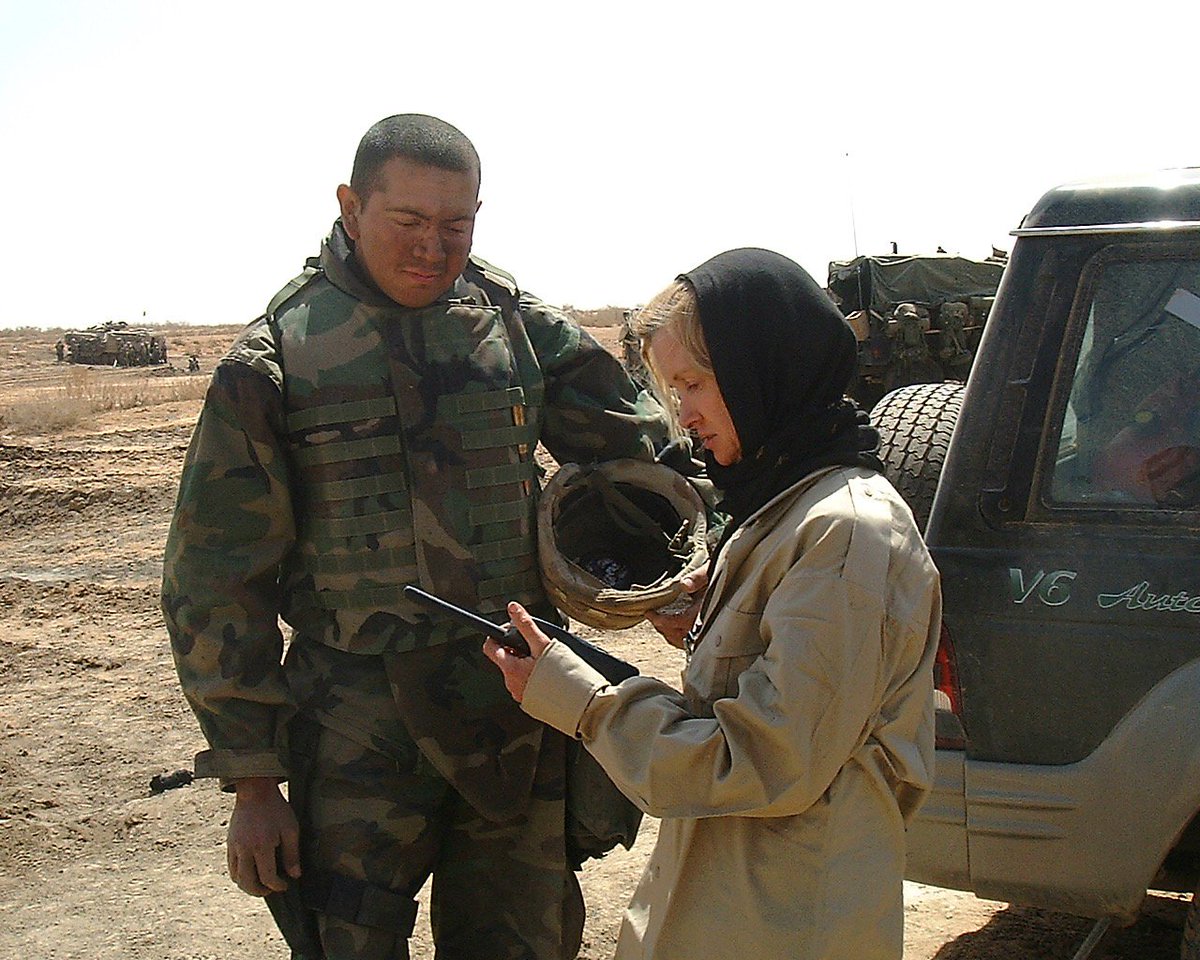
29) One day, soldiers are calling their mothers, the next day they're killing someone else's mother. Not a judgement, just a fact in Iraq and most warzones I've been to. This is Gary Knight's photo of a Marine using what I think is my Thuraya (I'm in the background with Kuni).

30) War is a set of collisions. People you've never met or imagined are suddenly at the center of your life. They save you, they try to kill you, they do or say something you can't forget -- and then they're gone (or maybe not). Lt. Tim McLaughlin was one of these people.
31) McLaughlin was a tank commander in the Third Battalion, Fourth Marine Regiment (aka 3/4), and exactly 15 years ago to this day, 3/4 was a few dozen miles from me, capturing the Basra airport. His battalion was a battering ram of the invasion. Our paths would soon cross.
32) McLaughlin took this picture from atop his Abrams tank as 3/4 saddled up to invade Iraq. They had no idea that in three weeks, after much bloodshed, they would topple the statue of Saddam Hussein in Firdos Square. And I had no idea I'd be with them.

33) Soldiers keep diaries. McLaughlin's was brutal & honest. His entry for March 21 was on the battle for Basra's airport. "Disorienting...disoriented...Cobras everywhere...first attack at night....disorienting...fell back for B52 strike... reattack/destroyed anti-armor ambush."
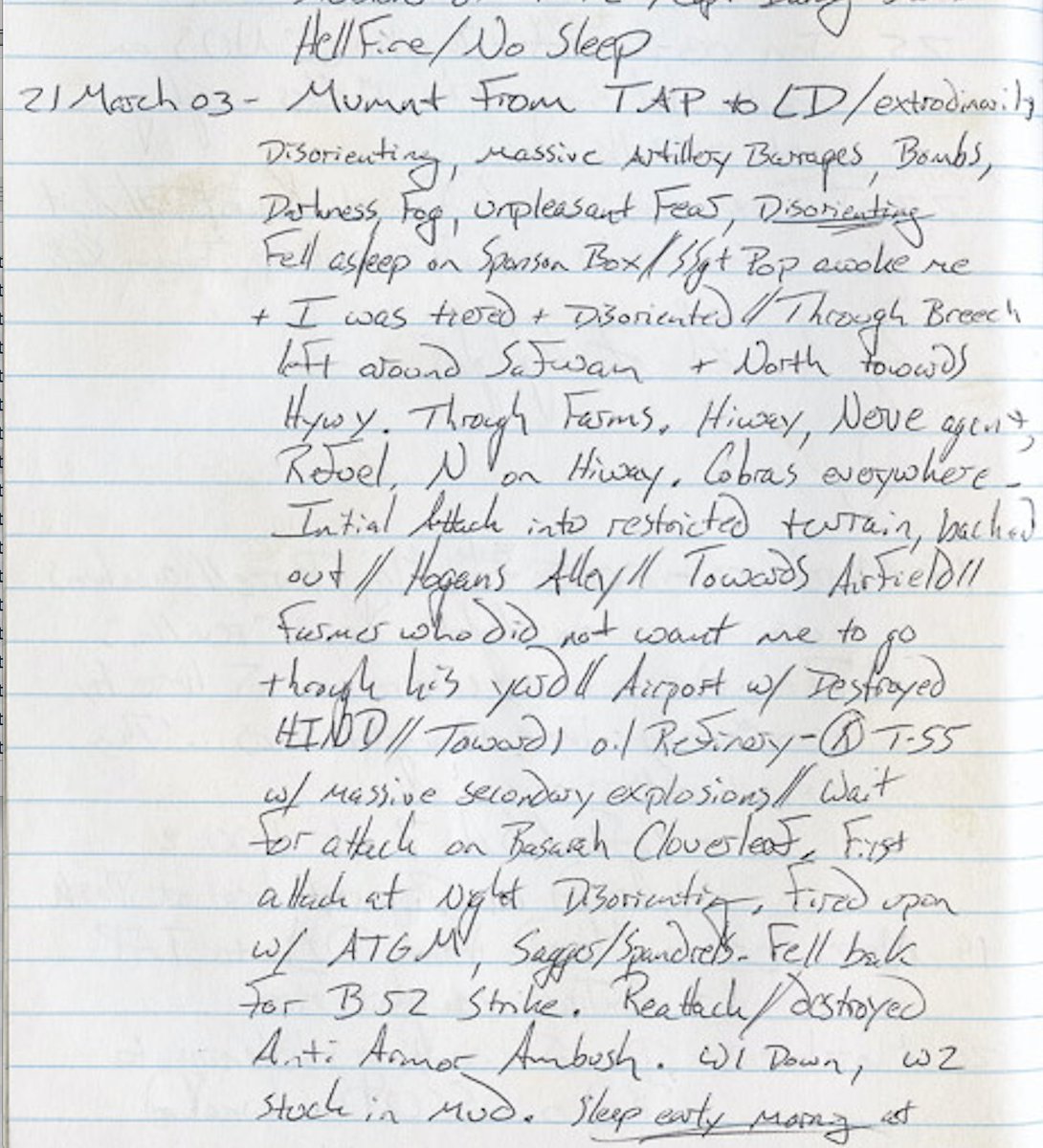
34) As I fell asleep along Highway 1 in my car that night, shivering in my sleeping bag (it was still cold), McLaughlin was mopping up at the Basra airport. In a few days, I would unexpectedly join his battalion's violent march to Baghdad, a collision that changed everyone.
35) A few more words about McLaughlin before moving on. He's going to come back to this thread at various points, and he's going to play a key role in one of the most well-known moments of the invasion. Here he is on his Abrams tank, photograph by Robert Nickelsberg.

36) McLaughlin was working at the Pentagon on 9/11. He was on a morning run when the plane hit. He sprinted back and ran inside as others were evacuating; he wanted to be sure his Marine colleagues had gotten out safely. In his diary, he drew a map of where he was that day.

37) Here's some of what he wrote: "It was like climbing a chimney with smoke filling in from top to bottom. I stopped, finally realizing that I was completely alone in the largest office building in the world. I could barely see my hand in front of me."
38) The only illumination inside was from blinking emergency lights. The only thing he heard was a recording that said, "There has been an emergency. Please exit the building immediately." When he got back outside, a corporal asked him, "What do we do now, sir?"
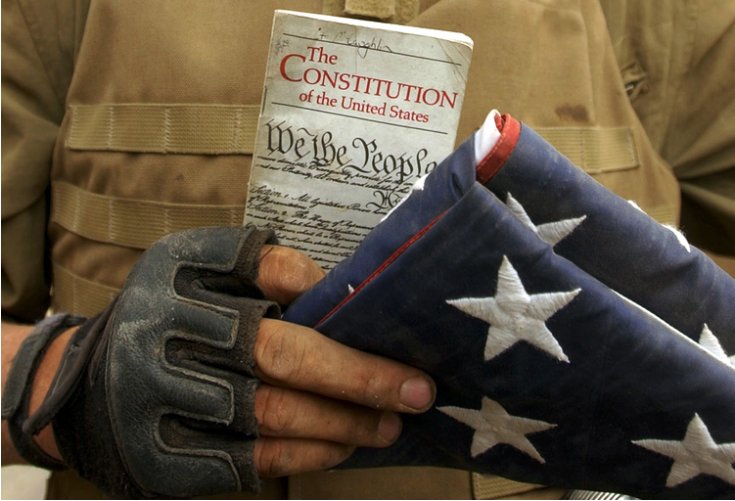
39) McLaughlin knew what to do. He transferred to a combat unit in Twentynine Palms, California. When it deployed to Kuwait in 2003, he made sure to bring a copy of the constitution that was in his Pentagon office on 9/11, and an American flag a friend gave him after the attack.
40) Here's the constitution and the flag in McLaughlin's hands in Iraq. Photo by Peter Nicholls.
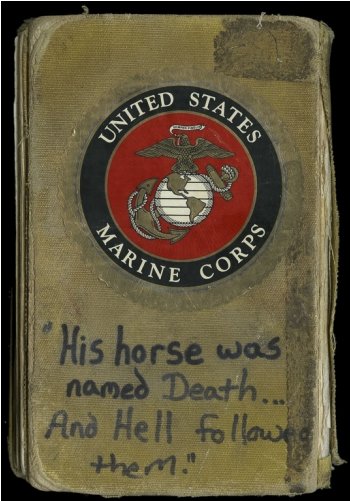
41) Last thing before moving on from McLaughlin for now. Here's the cover of one of his Iraq diaries. If you can't see the entire cover on the preview below this tweet, it's worth clicking to see the whole thing.
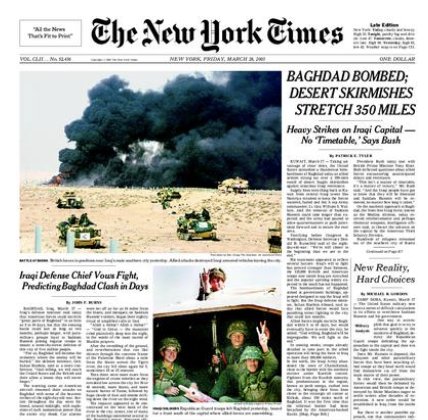
42) What did the outside world know about the invasion of Iraq, 15 years ago today? It was an odd day for me, but first, here's the front page of the March 22, 2003 edition of the New York Times.

43) We made our way to the western outskirts of Nasiriya, to a temporary bridge the Marines built over the Euphrates. The main road through Nasiriya was blocked due to fighting (the next day, Private Jessica Lynch, in a convoy that took a wrong turn, was captured there).
44) There was a traffic jam at the bridge -- just one narrow lane, if memory serves, behind which an invading army waited to cross. Our mini-convoy of six or seven SUVs of journalists was told to wait. We had the lowest priority to cross. It could be hours, it could be days.
45) In warzones, journalists depend on each other to stay safe. We travel together for safety, we exchange information with each other to stay safe, we share our food and water and risk our lives for each other. Sounds cliched, yes, but it's true. However...
46) ...rival journalists can be unkind with each other, too. During the Bosnia war, which I covered for the Washington Post, I nearly got in a fight with a New York Times reporter -- over who would sleep on the bed and who would sleep on the floor of a room we shared in Pale.
47) Covering a war involves all kinds of headaches, some inane. At the Nasiriya bridge, a TV journalist embedded with a passing unit told an officer, "These guys are not embedded. They're not supposed to be here." He was trying to get us kicked out of Iraq. We were competition.
48) Our status was indeed uncertain. We were not supposed to be in Iraq -- we had snuck in, after all. There was a hotel filled with journalists in Kuwait City whom the U.S. military wouldn't let into Iraq. At any moment, any officer could give an order and we'd be done.
49) But war is chaos and the military is not a monolith. On the ground, what Donald Rumsfeld had decreed was less important for us than what the control officer at the bridge outside Nasiriya was feeling. And he didn't mind us being in Iraq. Our jealous colleague was ignored.
50) Night fell. The only light came from tracer bullets and flares the U.S. dropped over Nasiriya. My eyes burned from diesel exhaust and dust. I fell asleep in my car. Hours later, in the middle of the night, we got the order -- wake up, it's your turn, drive over the bridge.
51) What were ordinary Iraqis making of this invasion? I spoke just a few words of Arabic, and the handful of Iraqis I was coming into contact with didn't speak English. Or if they did, they didn't want to let on. At the Nasiriya bridge, these young men were waiting to cross.

52) Their body language says a lot. I look at the photo and I suppose they were wishing I would go away, that what was happening in their country -- this invasion this liberation this occupation this disaster this waking from a nightmare this great uncertainty -- would be over.

53) I took these pictures 15 years ago today. What has happened to these young men who are no longer so young? I know what's happened to me -- I am doing fine, I am the fortunate American. But these men whose lives collided with mine for a moment 15 years ago, are they alive?
54) It's a measure of the chaos inflicted on Iraq that the possibilities are mostly terrible. Were they arrested? Joined the insurgency? Get injured/tortured/killed? Their mothers, fathers, children, sisters -- were they harmed? Did they flee the country? Are they alive?
55) After crossing the bridge, we followed a military convoy that soon left the paved road, heading into the desert. I was in a small Hyundai SUV that wasn't meant for lots of off-road work. Oh well. Kuni was driving and from the passenger seat I took this picture.

56) The convoy stopped for a bit, and suddenly Marines rushed out of their Humvees and APCs and hit the ground, spread-eagled; their weapons were pointing toward us. An ambush was about to happen, or so they thought. We rushed to get out of their line of fire.
57) After almost getting captured/killed outside Basra, we realized this was unlike any war we had covered. There were no frontlines behind which we were safe. U.S. troops were rushing to Baghdad in unconnected convoys, not bothering to secure their flanks or even the rear.
58) At this point, occupying Iraq was not the objective (though that would come soon enough). Getting to Baghdad & cutting off the head of the regime was the goal right now. Until we got to Baghdad, if we got to Baghdad, there would be no security or rest. Everything was hostile.
59) The ambush didn't happen. We moved on, into the tragically surreal. Every so often, we passed Iraqis rubbing their stomachs (they were hungry), or tilting back their heads (thirsty), or waving bank notes that bore the image of Saddam Hussein; maybe we would trade something?

60) That's how things were shaping up for me 15 years ago today. Back in America, here's what subscribers of the New York Times saw as they woke up on March 23, 2003.

61) I was uneasy. The journalists I was traveling with were mostly photographers -- war photographers. I had covered wars but as a writer I could hang back a bit, and was glad for that. Photographers had to be where the bullets were flying. Now, where they went, I was going.
62) There's a parlor game, "Six Word Memoir" -- in six words you describe your life. When someone asked for mine one day, I replied "Jewish war correspondent, what the fuck?" Every so often, helicopters landed near us. More than once I thought of hopping on one, just getting out.

63) But getting out wasn't in the cards. In a day, the war would have me collide with this Marine commander, in a way, 15 years later, I still can't quite believe. (Photo by Gilles Bassignac)

64) We drove into a minor sandstorm (more on sandstorms later). Near dusk, with impaired visibility, we literally bumped into 3/4. We needed to stop for the night, but also needed to attach ourselves to one battalion and stay with it, rather than skipping from one to the other.
65) Several journalists were embedded with 3/4 and unlike the TV guy at the bridge who tried to get us kicked out of Iraq, these were great & generous colleagues -- Simon Robinson, Robert Nickelsberg, John Koopman. They said 3/4 was going to Baghdad and we should try to follow.
66) We had to talk w/ the battalion commander, get his permission. It was far-fetched. Why would he allow a dozen journalists to come along, ones who drove their own vehicles, which could be a security nightmare for his unit? He was Lt. Col. Bryan McCoy (photo in previous tweet).
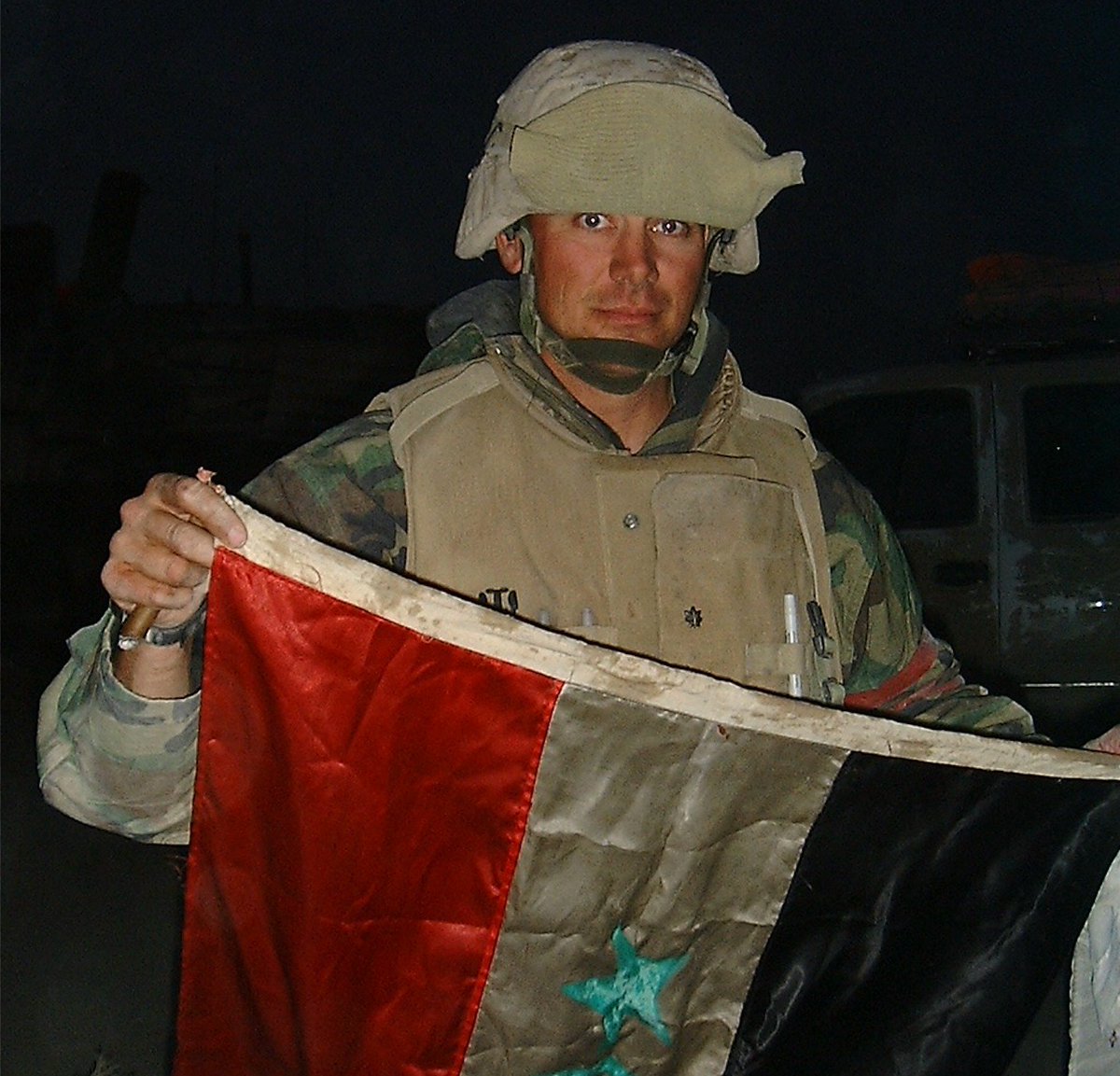
67) McCoy's battalion had attacked Basra's airport (reminder -- this is the battalion Lt. Tim McLaughlin, the tank commander, serves in). McCoy, it turns out, likes journalists, doesn't mind attention. He proudly showed us the Iraqi flag his battalion had captured in Basra.
66) He also spent a few minutes on one of our satphone-connected laptops to read the latest news about Pvt. Jessica Lynch getting captured in nearby Nasiriya. He finished, and I asked how he would prevent that from happening to the Marines in his unit.
67) "There are two kinds of people on this battlefield," he said. "Predators & prey. Don't be prey. Don't be an easy target. We'll do the ambushing. We'll do the killing. The best medicine is aggression & violent supremacy. After contact they will fear us more than they hate us."
68) As I would witness in weeks ahead, this wasn't just talk. There was a reason McCoy's battalion was a battering ram of the invasion -- McCoy. Just before the war began, he gave a speech to his battalion in the Kuwaiti desert. Robert Nickelsberg took this picture of the scene.

69) "Focus on the basics," McCoy said. "We're going to kill these guys like baby harp seals." His speech was described in the Command Chronology his battalion wrote up after they got back to America. It's a brutal passage but Marines tend to be blunt about their style of warfare.

70) McCoy added, "Make peace with your maker, and ask forgiveness for what you are about to do to the Iraqi army."
71) On March 24, 2003, in the frigid darkness of an Iraqi desert at night, Col. McCoy told me and the other unilateral journalists that we could follow his battalion into the war ahead. Here's what the New York Times was reporting on its front page that day.

72) War can kill you, horrify you, scare you in infinite ways. Bullets, bombs, disease, torture, landmines, thirst, knives, hunger (a partial list). Events that are unremarkable in peacetime turn frightening, like the onset of night, darkness. Even the weather becomes terrifying.
73) The defining event in Iraq on March 25, 2003 was a sandstorm that brought the invasion to a virtual halt. Driving north in the desert with 3/4, the sky turned hepatitis yellow, as though it were sick, then a Martian red. This photo is by Gilles Bassignac, who was in my group.

74) Outside, the winds had hurricane force, rocking the SUV from side to side. The sand seemed alive, molecular darts hitting us furiously. Even with windows shut, the air was filled with sand, in my eyes and mouth, even though I breathed through a bandana. Later, I wrote this--

75) I was fortunate, inside a car. Lots of Marines were in open-backed trucks (this photo is by James Hill, a NYT photographer with a nearby battalion). This was an invading army, so I'm not trying to elicit sympathy for their discomfort; just showing what the conditions were.

76) Tim McLaughlin was in his Abrams tank ahead of me in the 3/4 convoy. In his diary, he wrote of the sandstorm, "Officially Most Miserable Day of my Life. Forced to stop. Locked in turret. Complete blackness. 0 visibility, as in none."

77) Back in America, here's what the New York Times was reporting on this day 15 years ago. Sorry for the lo-res image, but I'm having trouble finding hi-res copies of NYT front pages from back then.

78) After midnight, the storm blew itself out and the convoy started up again, in darkness, no lights.
79) War is more than bang-bang combat. It is refugees, corpses, abandoned houses, collapsed bridges, cratered roads, lost dogs, raw sewage, a stillness that is not natural. 3/4 was a frontline battalion, so we began seeing and smelling these things.
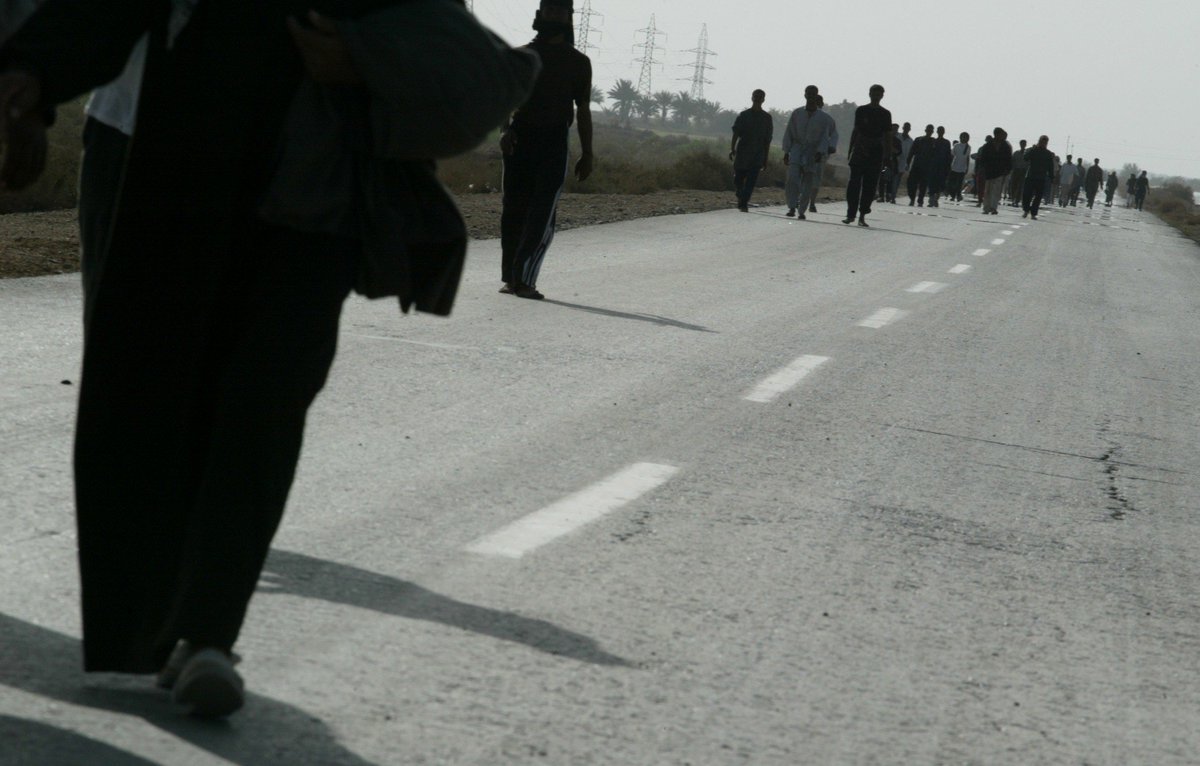
80) We'd drive along and there'd be a body by the road, or several, or many. Maybe there had been a ground battle, maybe the Apaches had done this from the sky. Usually you'd keep driving, but at one spot, 3/4 paused. Gilles Bassignac took this picture.

81) What you saw a lot of was people, walking, heading for safety wherever that might be, though I don't think they knew; they just had to move, get away. I took these photos in the early days of my journey with 3/4.

82) In the photo above, notice the woman on the right. In her right hand, there's a white fabric. She was waving it as they walked, and other women and children did the same, waving anything that was white, so they wouldn't get shot. It didn't always make a difference.
83) Where had they come from, where were they going, what were they thinking? This man and child -- they had nothing, the kid doesn't even have shoes, Maybe they were visiting a neighbor, but I don't speak Arabic, so I couldn't ask. I shot a photo. Odds are they were fleeing.

84) One day, we came across a ragtag column of men walking on a road in what seemed the middle of nowhere. We tried to ask questions but none wanted to talk. I'm 99% sure they were an army unit that had deserted; another side of the war. This photo is by (the great) Gary Knight.
85) Another thing that war is -- graffiti. In every conflict I've covered, there's been an abundance of it, profane, wry, malignant. Spray paint as a weapon of war.

86) On this day 15 years ago, here's what the New York Times was reporting on its front page.

87) Before I leave the topic of war graffiti, here's one more, which I shot beside a bridge on the Diyala canal outside Baghdad. 3/4 fought a major battle there (much more on it later) and a reminder of the American triumph was left by the battalion's tank company, Bravo company.

88) The cliche is true, that no battle plan survives 1st contact with the enemy. War demands improvisation; you can't control the chaos. The battles 3/4 would fight, the resistance it would meet, how it would react -- these things were largely figured out on the fly.
89) This revealed itself in ways that included the absurd. One day, I drove with the battalion's intel officer, Capt. Bryan Mangan, to the regimental HQ, five miles from 3/4's camp. Mangan brought me into an intel briefing but a higher officer quickly threw me out.
90) Afterwards, Mangan was supposed to lead a regimental psy-ops team back to 3/4's camp. As we got ready to leave the regimental HQ, Mangan saw the psy-ops Humvees drive out ahead of his Humvee.
91)
"Where are those idiots going?" Mangan asked his driver.
"They're following you," the driver said.
"But I'm here," Mangan noted.
"They think they're following you," the driver said.
"Why?"
"Because you're in a Humvee," the driver said, "and that's a Humvee they're following."
"Where are those idiots going?" Mangan asked his driver.
"They're following you," the driver said.
"But I'm here," Mangan noted.
"They think they're following you," the driver said.
"Why?"
"Because you're in a Humvee," the driver said, "and that's a Humvee they're following."
92)
Mangan was furious.
"Do they have a radio?" he asked.
"Yes," his driver replied.
"Can we call them on it and tell them to get their asses back here?"
"Let me check," his driver replied.
The driver ran to the communications tent. He returned in a minute.
"No, sir," he said.
Mangan was furious.
"Do they have a radio?" he asked.
"Yes," his driver replied.
"Can we call them on it and tell them to get their asses back here?"
"Let me check," his driver replied.
The driver ran to the communications tent. He returned in a minute.
"No, sir," he said.
93)
As Mangan tried to figure out what to do, I chatted with his driver.
"Why do you think you're here?" I asked.
"We're here to liberate these fucking eye-rackis," he replied.
As Mangan tried to figure out what to do, I chatted with his driver.
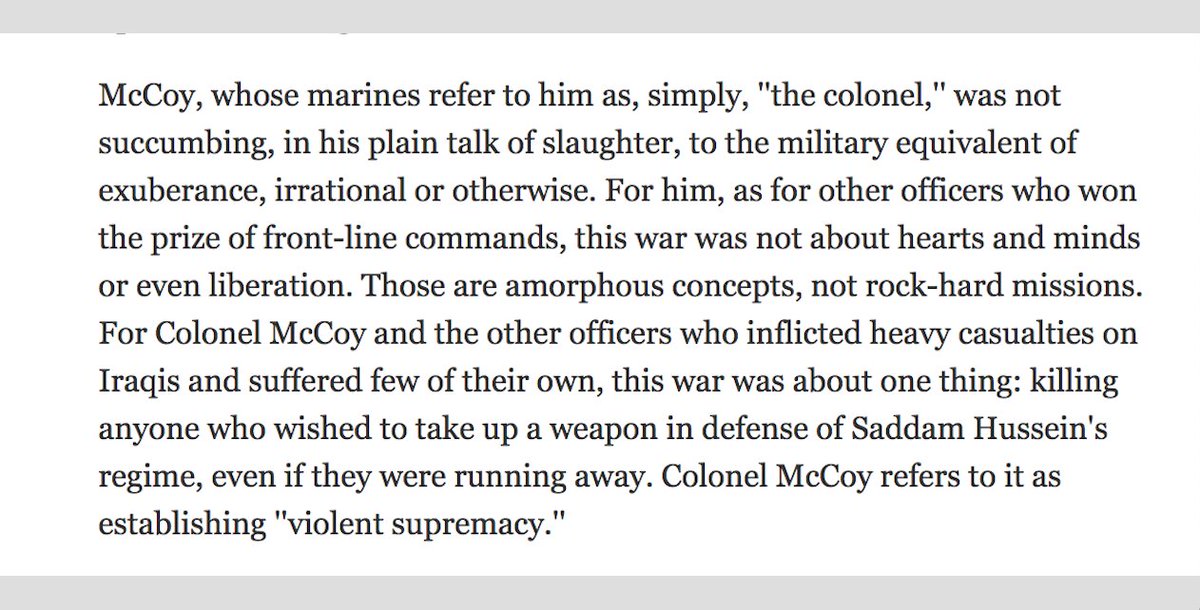
"Why do you think you're here?" I asked.
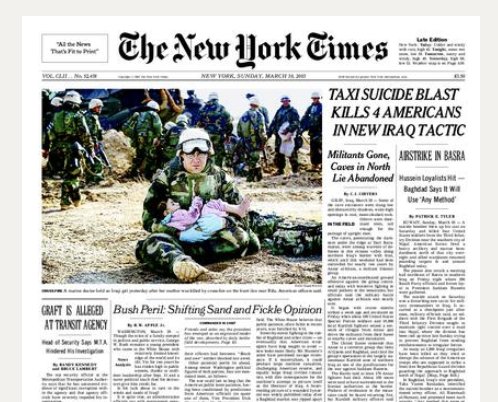
"We're here to liberate these fucking eye-rackis," he replied.
94) This episode, a bit amusing, hints at a serious truth -- the deadly chaos of an army at war. If two Humvees couldn't proceed in an orderly fashion behind the frontline, imagine what happens in the explosive mix of adrenaline and fear and exhaustion of battle. That's coming.
95) This thread is about remembering the Iraq war. What happened there 15 years ago today? Here's the front page of the New York Times on March 27, 2003.

96) Since Basra, 3/4 hadn't fought much -- it was moving north. On March 28, 2003, it prepared to attack Afak. Col. McCoy told his battalion, "Go in like you own the place. We're gonna kick the beehive and see what turns out." Here's the Command Chronology on that:

97) 3/4 was an attack machine. I want to take a moment to explain its firepower, because you can't understand the killing it was capable of inflicting in the coming days without knowing the weaponry it possessed. It would be hard to imagine a ground unit with more muscle.
98) For the invasion, the battalion had a company of Abrams tanks. An Abrams weighs more than 60 tons and has a 120 mm cannon and a smaller .50 caliber coaxial machine gun. The battalion had 15 of these tanks. Here's McLaughlin with his Abrams and crew.

99) The core is three infantry companies and a weapons company, most of them in armored personnel carriers, also in Humvees and trucks, equipped with assault rifles, grenade launchers, mortars, etc. Also a sniper team. Led by a commander, McCoy, whose call sign is Dark Side Six.
100) They were backed up by aviation assets -- from B-52 bombers to fighter jets, Apache attack helicopters, drones, etc. Artillery units that were miles behind them lobbed shells onto targets ahead of them. Here's one of those units on a break; Wesley Bocxe took this picture.

101) 3/4 was going into battle the next day, and Col. McCoy would not be shy about using force. He would establish, as he put it, "violent dominance." He told me and a few other journalists the following as the fighting got heavier, moving from the desert to towns and cities:
102) "If they're dug into a building, then I drop the building on them. My idea of a fair fight is clubbing baby harp seals. We're not in an open desert anymore. We're dealing with civilians and irregulars. It's blue collar warfare."
103) The invasion of Iraq happened a decade and a half ago, let's do our best to not forget it. Here's what the New York Times was reporting on this day 15 years ago, March 28, 2003.
104) 15 years ago today, 3/4 attacked Afak, 120 miles south of Baghdad. What happened there was standard for 3/4 and for Marines, in terms of their use of deadly force during the invasion and the deaths of civilians that occurred as a result. Afak is the red dot on this map.

105) The battalion's tanks, including McLaughlin's, went first; almost always they led 3/4's attacks and movements. In his diary, McLaughlin recorded the series of rapid firefights his Abrams had that day.
106) "Fire w/Coax at oncoming traffic to keep rt clear ... Car pops out on me, 200 meters. Sgt. Wellons coaxed it, vehicle slowed down, swerved left off road + hit tree. Civilian shot 5 times in back and legs. Continued progress to Afak."
107) "Pushed mostly through town until bridge at canal. Grove left front ... B6 opens fire on child in grove. We look + spot one man w/ red/white checkered headdress on w/RPG. Open up w .50 cal + 240. Massive fire into grove. People everywhere watching."
108) Here's that section of his diary.

109) The entry continues, "Fire at vehicles + people who get too close. One guy running at us from front left through field. Fired coax, he dropped then got up running the other way."

110) Here's a picture John Koopman shot of Marines in Afak crouching next to one of their tracked armored personnel carriers.

111) The battalion's command chronology of events, written after 3/4 returned home from the invasion, noted that in Afak "the desired endstate was a disorganized paramilitary force, reeling in confusion and badly bloodied. Suffice to say, the technique worked beautifully."

112) In war, whether you're a civilian or combatant, there's an infinite number of ways to die, an infinite number of possible tragedies. On March 29, 2003, one of the 3/4 Marines lost his life after his Humvee slipped into a canal and flipped over, trapping him.
113) He was Lance Corporal William White, 24, from Brooklyn, NY. It happened at night, when nobody could see what had happened. The other Marine in the Humvee, Lance Corporal Derrick Jensen, got out and tried to save his comrade. I talked to Jensen about it afterwards.
114) "We were underwater," Jensen told me. "You've got to stop and think, but you don't really have time to stop and think. You've got to be quick about it and decide, What do I need to do here, where do I need to go?"
115) "All at once, I was talking to God at the same time and screaming for White when he was still underwater. I was praying out loud, just hoping to God that I could get out of there. I was screaming his name, 'White, oh White, please no.'"
116) Jensen got White out but he wasn't breathing. After mouth-to-mouth resuscitation, White breathed again. It was night, darkness all around, no Marines to be seen. White was barely conscious, freezing from the cold water and night air. Their radio was in the submerged Humvee.
117) Jensen had to leave White to find help but he was disoriented, in enemy territory. "I had no idea where I was going," Jensen recalled. "I ran over a couple of hills and had some dogs chasing after me. I was just shouting 'Help, somebody help me.'"
118) He finally came upon other Marines, and they headed back to get White. But where was White? Somewhere along the canal, but it was night, so Jensen didn't know the exact location. They had to listen for White's labored breathing.
119) "The whole time when I was swimming with him, he would make a wheezing noise," Jensen said. "It was just a God-awful noise, wheezing just as loud as he could do it. I would stop the Marines every now and then and say 'Shhh, listen.' I could hear the noise as we got closer."
120) White was still alive when they found him, but he died soon after.

121) That was March 29, 2003, 15 years ago to this day. On that day, here's what was on the front page of the New York Times.

122) Col. McCoy, the battalion commander, often talked with us about his tactics. He would come to our vehicles, and if we were making coffee, he'd have a cup and chat. On March 30, 2003, camped outside Diwaniya, McCoy talked to us about the "Afak drill," as he called it.
123) "What we try to do is go in there and dominate the place by showing violent dominance and letting them know that we can do whatever it takes, escalate to any level," McCoy said. This wasn't an unusual remark. On another day, here's what he said about the invasion overall.
124) "We're here until Saddam and his henchmen are dead. It's over for us when the last guy who wants to fight for Saddam has flies crawling across his eyeballs...Sherman said that war is cruelty. There's no sense in trying to refine it. The crueler it is, the sooner it's over.''
125) McCoy was not an exception among frontline commanders of the invasion. His attitude and style was what the U.S. military wanted -- a leader who would not waste a second or a bullet getting his troops to Baghdad. After the invasion, I wrote the following in an article:
126) Tomorrow there would be another attack, and as the battalion closed on Baghdad, much more killing & many more bodies. That was ahead. But on this day 15 years ago, here's what the New York Times had on its front page.
127) Sorry, the attack I mentioned in prior tweet was on April 1 not March 31. On this day 15 years ago, 3/4 took a break outside Diwaniya. I don't want to get ahead of things but events flew by from April 1, and at the end of it all, McLaughlin wrote a "Kills" list in his diary.
128) The list includes the targets his tank destroyed during the invasion -- Iraqi tanks, trucks, technicals, anti-aircraft & artillery guns -- and the human toll, too. At the bottom, the list states "70 People Dead." Here's the diary page:

129) McLaughlin was carrying out the orders of his commander and his government. Before the invasion began, he wrote a set of orders for his own tank crew. His orders ended with these lines: "Remain flexible. Everything will change, except our final destination."
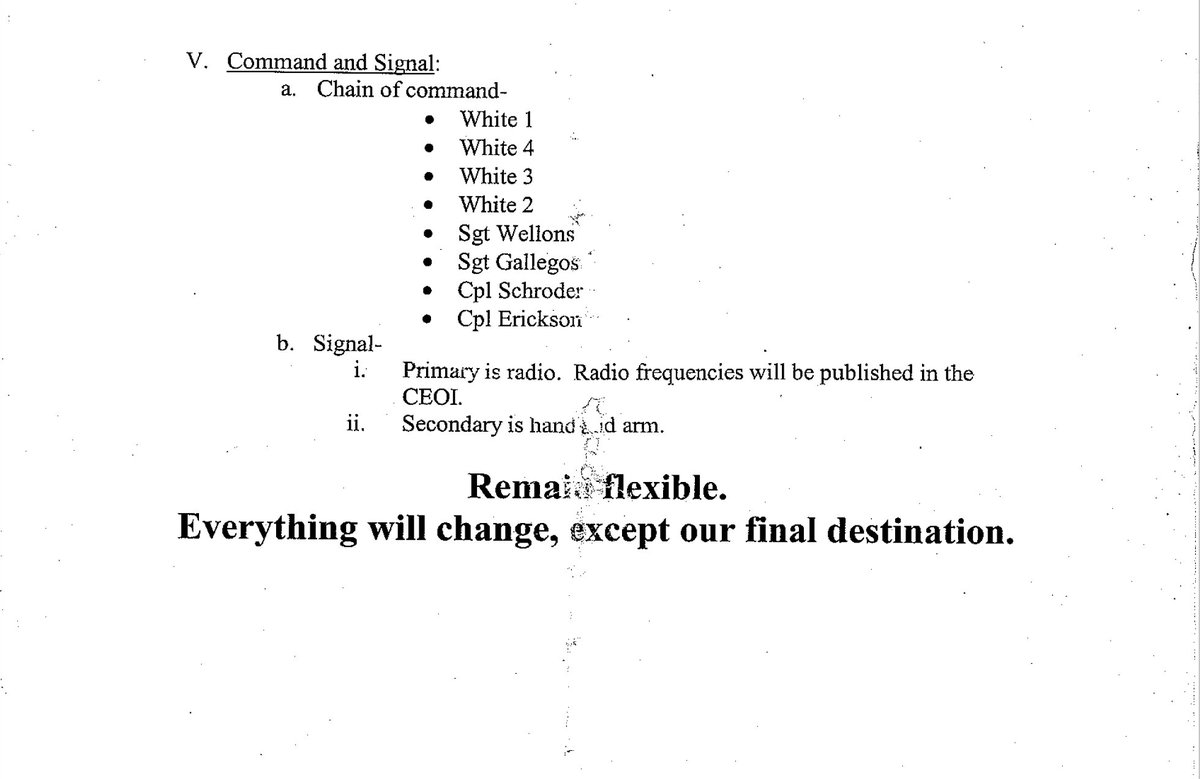
130) I read that now and his reference to "our final destination" gives me chills.
131) On March 31, 2003, this is what the front page of the New York Times looked like.

132) Fifteen years ago today, the attack on Diwaniya. McCoy had no intention to occupy the town – his destination was Baghdad. He just wanted to punch the Iraqi military forces there, so they’d stay put and not ambush the invading U.S. forces driving by on the nearby highway.
133) The unilateral journalists had to stay back; only the embedded journalists were allowed to join this attack. Simon Robinson of Time was with McCoy. “We’re going to throw some bait into the water and see if the sharks come out,” McCoy told him.
134) When 3/4's tanks and APCs moved into Diwaniya, Iraqis fired back with mortars, RPGs and small weapons. Robinson listened to the radio chatter. “Yeah baby,” one Marine said. Another boasted, apparently after machine-gunning an Iraqi, “He just ate coax for breakfast.”
135) McLaughlin was in his tank. “Enemy in fields + grove,” he wrote in his diary afterwards. “Machine guns on dismounts/main gun into bushes + vehicles. Killed 4 soldiers trying to run away. Let 1 run for a while then killed him, legs first, then as he tried to crawl.”
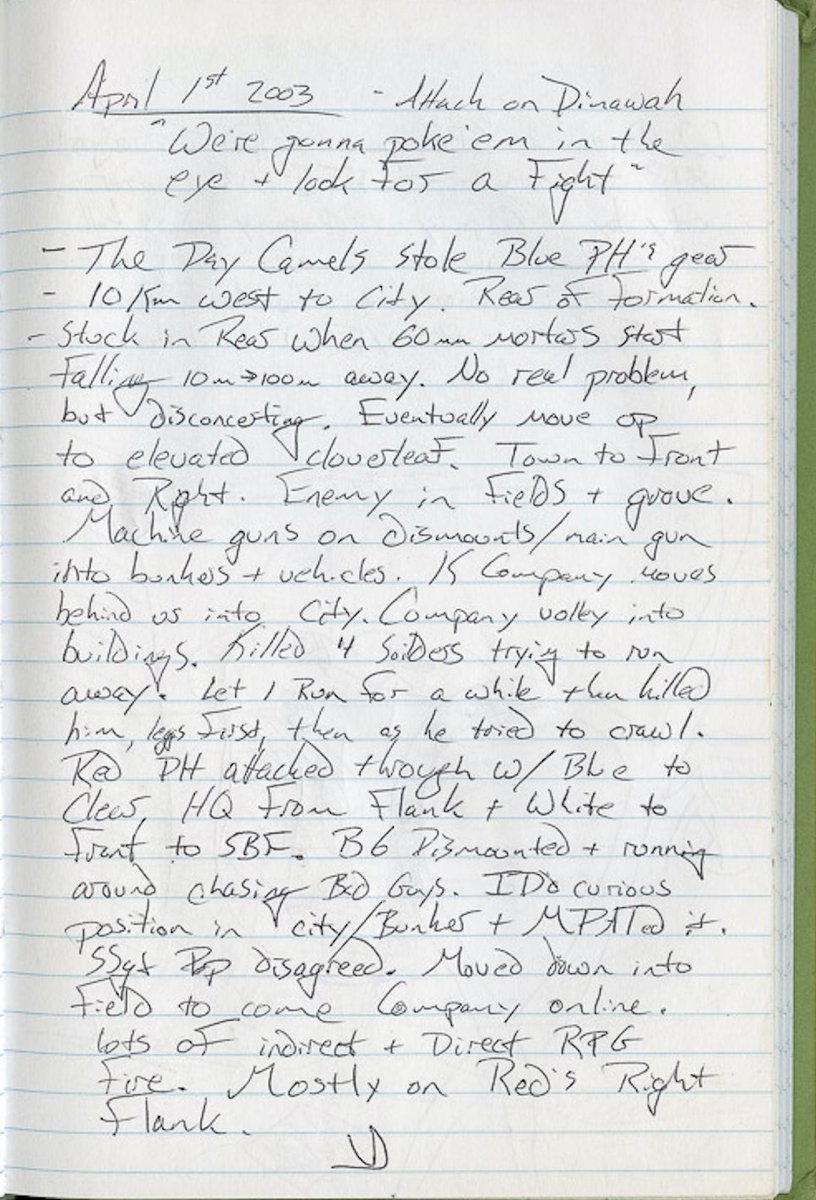
136) The battle was over before noon. The battalion’s command chronology claimed 92 Iraqi soldiers killed, 56 taken prisoner.

137) I watched as bound prisoners were unloaded from the back of a truck at 3/4’s camp outside town. Young Marines gathered to watch; I think they had not yet seen the people they were trying to kill. They were mostly silent. This was their first war, their first prisoners.

138) On this day 15 years ago, here's what the New York Times was reporting on its front page.

139) A civilian or a soldier dies in a war. Who gets to tell the story -- who has the right to tell it? I've spent much of my life telling stories of death. The ones from Iraq were among the most complicated. I don't mean the dodging-bullets part of it.
140) Imagine that your son or daughter or husband or wife is killed in a war. Someone tells you and the pain is instant. It hits you with the first words or maybe before that, when you see the expression of the person who has come to tell you and you realize what has happened.
141) The first news is usually minimal. How, why, where -- details tend to emerge slowly and chaotically from warzones. Some family members want to know everything, others don't, it's too painful. Do they want the public to know the details? Some do, some don't.
142) Journalists in warzones see people die, hear their final words, know how they died, whether they suffered. We know more than a grieving family might know, more than the grieving family might want to know -- more than it might want the world to know.
143) When my story was published about Lance Corp. William White dying after his Humvee slipped into a canal, his family was shocked. They contacted my editors to say they hadn't known the details we published -- the military had told them little. We should have notified them.
144) What if a family doesn't want some details published, because they are too graphic, too painful? The death of a loved one at war -- how much of the story belongs to the family, how much should a writer hold back in deference to their wishes?
145) As a writer of war stories, I want people to listen and learn from what I've seen and experienced. I want to write stories that are as powerful as they can be. But this can conflict with what a grieving family might wish to be written.
146) It was April 2, 2003, and 3/4 was preparing to attack al Kut on the next day. A Marine would be killed there. I would watch as medics tried to save him, listen as he spoke his last words, see him carried on a stretcher to a Chinook (Wesley Bocxe took this photo of it).

147) There would be strong and reasonable objections to what I would write about his last moments. That's tomorrow.
148) Fifteen years ago today, April 2, 2003, the front page of the New York Times.

149) At dawn on April 3, 2003, a row of 155mm howitzers started firing at Al Kut. I was 500 yards away and the ground shook and my ears popped from the air pressure change. Marines shouted "Bam! Bam!" when shells were fired. We were 110 miles from Baghdad (al Kut is the red dot).

150) We got into our vehicles and drove toward the city. On the road, a woman surrounded by her family waved a white flag (burlap bag, actually). Marines hovered over prisoners they'd taken. Iraqi military vehicles that had just been hit were smoldering.
151) We stopped near a medic station about 1,000 yards from the heaviest combat in al Kut. Marines near us lay on the ground, spread-eagled, occasionally firing. Laurent Rebours took this photo.

152) Tanks and APCs ahead of us were ambushed by a wave of Iraqi fighters. McLaughlin's tank shot back at them in a grove and killed a half dozen or so. While firing, McLaughlin's machine-gunner was yelling, "I got you, mother fucker."

153) Scores of Iraqis were killed. Robert Nickelsberg took these photos after the battle.


154) There were prisoners. One, lying on the ground, pleaded for his life with Simon Robinson, a Time reporter. "Don't kill me," the Iraqi asked in English. "Please, I can't fight. My arm, don't twist it left or right. It's broken."
155) Imagine you're a civilian trapped in a battle like this. Troops are shooting all around you, artillery shells are exploding. Stay or run? I've been in these situations -- you never know what to do. Fleeing is not just an impulse, it could save your life (or take it).
156) U.S. troops assumed that cars & trucks in battle zones were hostile. As combat wound down in al Kut, a dump truck drove toward McLaughlin's tank. He fired his rifle, another tank fired its .50 cal. The bullet-riddled truck stopped. 20 women, kids and men got out, screaming.
157) "By the grace of God," McLaughlin wrote in his diary, "no one died, although one guy had a new hole in him and tons of blood." A few days later, on the outskirts of Baghdad, it would be different -- civilians caught in 3/4's crosshairs would die.

158) A Marine was killed at al Kut. His name was Mark Evnin, a corporal from Vermont. He was firing a grenade launcher at Iraqi fighters when he was struck by two bullets. Evnin was put into a Humvee and rushed to the first-aid station where I was standing.
159) A doctor and medics, M-16s slung over their backs, worked on him. "Left lower abdomen...He's in urgent surgical...Wriggle your toes...Iodine...He needs medevac now...Keep talking to us." Evnin was stretchered to the medevac helicopter as soon as it landed. He died aboard it.
160) Hours later, as night fell in Burlington, the military notified Evnin's mother, Mindy. John Koopman, who was embedded with 3/4 and knew Mark, visited Mindy in Vermont after the invasion and wrote about the moment of notification.
161) Mindy Evnin was getting ready for bed when she heard the knock. She feared what it might be. She opened her front door, saw three men in military uniforms and said to them, "Just tell me if he's been wounded, dead or missing."
162) This was April 3, 2003, a long day. I'll write tomorrow about Mindy Evnin's objections to what I wrote about her son's death. For now, here's what the readers of the New York Times saw on its front page 15 years ago today.

163) War is chaos & war reporting is chaos. Not just the task of observing wild events, but how people recall them (you see just a sliver yourself). For some people, time slows down in a crisis, for others it speeds up. Little is synchronized -- time, perception, memories.
164) Part of the chaos of war reporting is the sensitivity of what you're investigating. You ask people what happened -- the killing they committed or witnessed, the torture they endured, the rape they survived. How do you ask these questions?
165) I was lucky in the invasion because more than a dozen journalists followed 3/4 (an anomaly -- I don't think any other battalion had as many). We shared what we knew. I still don't understand everything but part of what I understand is because of them, what they saw & heard.
166) The final bit of chaos is how much of what you know do you publish? You have seen and heard a lot -- words, corpses, grief, fear. Your choices are made in sub-optimal conditions; my workplace was my SUV, my physical state was near exhaustion.
167) When Mark Evnin died, I chose to use words, including some of his, that I thought would convey, most powerfully, what happens in war. After my story came out, his mother contacted my editors to object & wrote a letter published by the magazine. Here's some of what she wrote:
168) "I think Maass could have left out my son's mumbled last words. Those last moments with the chaplain, while my son faded away, did not need to be described for your readers. He gave his life. Isn't that enough?" Here's the letter in full:

169) I can't disagree with her. I might have been wrong to write as much as I did. I don't know. I wanted to fully describe the excruciating scene I had witnessed. Reporting on the chaos of war, sometimes you get it right, sometimes you don't, and sometimes you don't know.
170) This was the front page of the New York Times on April 4, 2003, fifteen years ago today. Five days later, the U.S. military would take control of central Baghdad. The invasion of Iraq is nearing its final destination.

171) On April 5, 2003, fifteen years ago today, the battalion raced toward Baghdad, almost literally, on Highway 6. The atmosphere seemed to loosen up a bit. Iraqis in cars and trucks on the highway waved at us. I shot this picture while driving (look in the side mirror).

172) Same with this one.

173) In four days, the invasion would climax with Marines entering Baghdad and toppling a statue of Saddam Hussein. The statue would be toppled by the Marines I was with. Things were already happening that laid the groundwork for this controversial event. (Photo below by me).

174) The toppling in Firdos Square -- a seemingly triumphant yet deceptive moment -- was caused and shaped by the media in crucial ways, sometimes intentionally, sometimes not. The process was started, unintentionally, many days before the statue came down.
175) The journalists with McCoy's battalion had satellite phones, mostly Thurayas. We used them to file our stories and photos, and talk to our editors, family and colleagues elsewhere in Iraq (to learn what was happening in the rest of the country).
176) Laurent Van der Stockt often called Remy Ourdan, a reporter for Le Monde who was in Baghdad at the Palestine Hotel. The Palestine was where foreign journalists stayed in the Iraqi capital during the invasion. (Photo of the Palestine by Ahmad Al-Rubaye)

177) Journalists at the Palestine faced a lot of pressure. They were under the constant threat of U.S. bombing as well as arrest or worse at the hands of the Mukhabarat. They weren't supposed to have satphones -- Remy hid his behind a ceiling panel & spoke to Laurent in whispers.
178) Laurent had a box of Cuban cigars and lit up from time to time with Col. McCoy, occasionally mentioning what he was hearing from Remy at the Palestine. Gary Knight, another photographer in our group, also mentioned to McCoy that journalists at the Palestine were in jeopardy.
179) In the desert, McCoy had a million other things to think about. But later on, as his battalion entered Baghdad, he received orders to secure the Palestine, which he eagerly did. The statue of Saddam Hussein that his battalion toppled -- it was outside the Palestine.
180) I apologize if this is confusing, I'm just trying to provide some context before that crazy day. And before it comes, there's more violence. Tomorrow, 3/4 will reach the Diyala Canal and kill civilians, lots. This photo by Laurent shows one of the vehicles that got drilled.
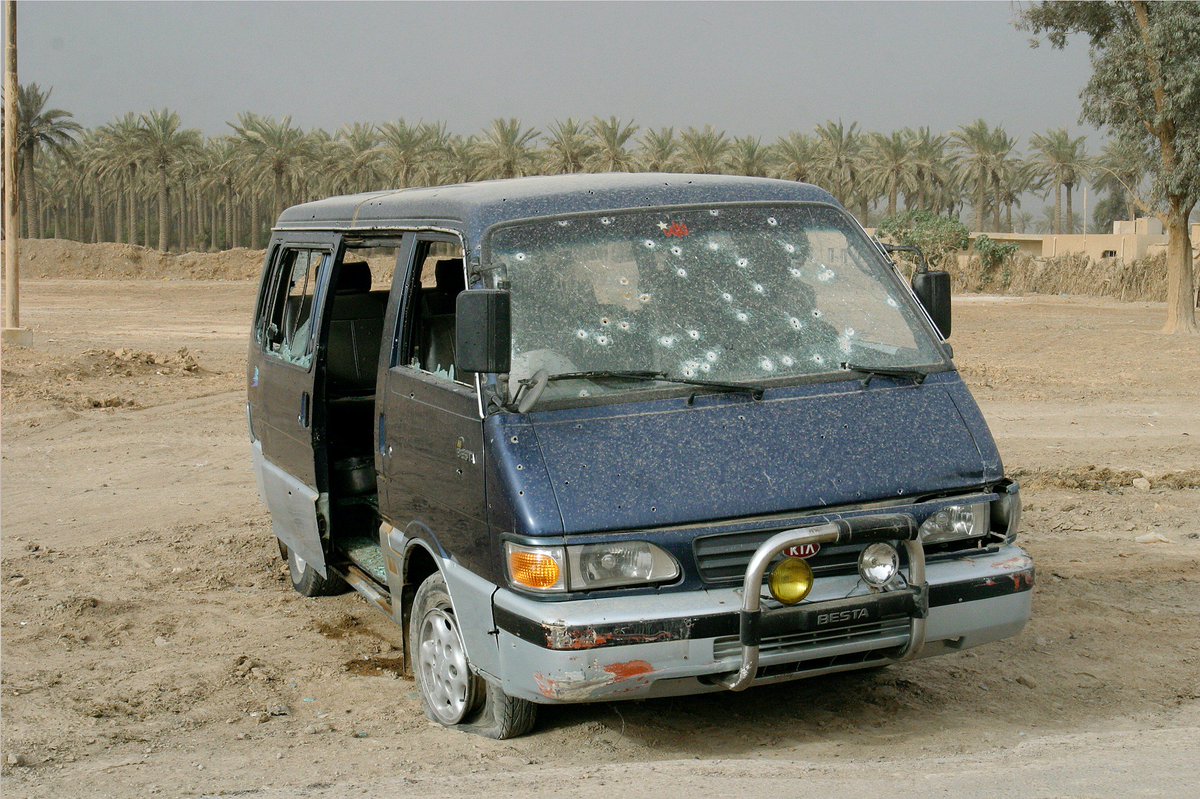
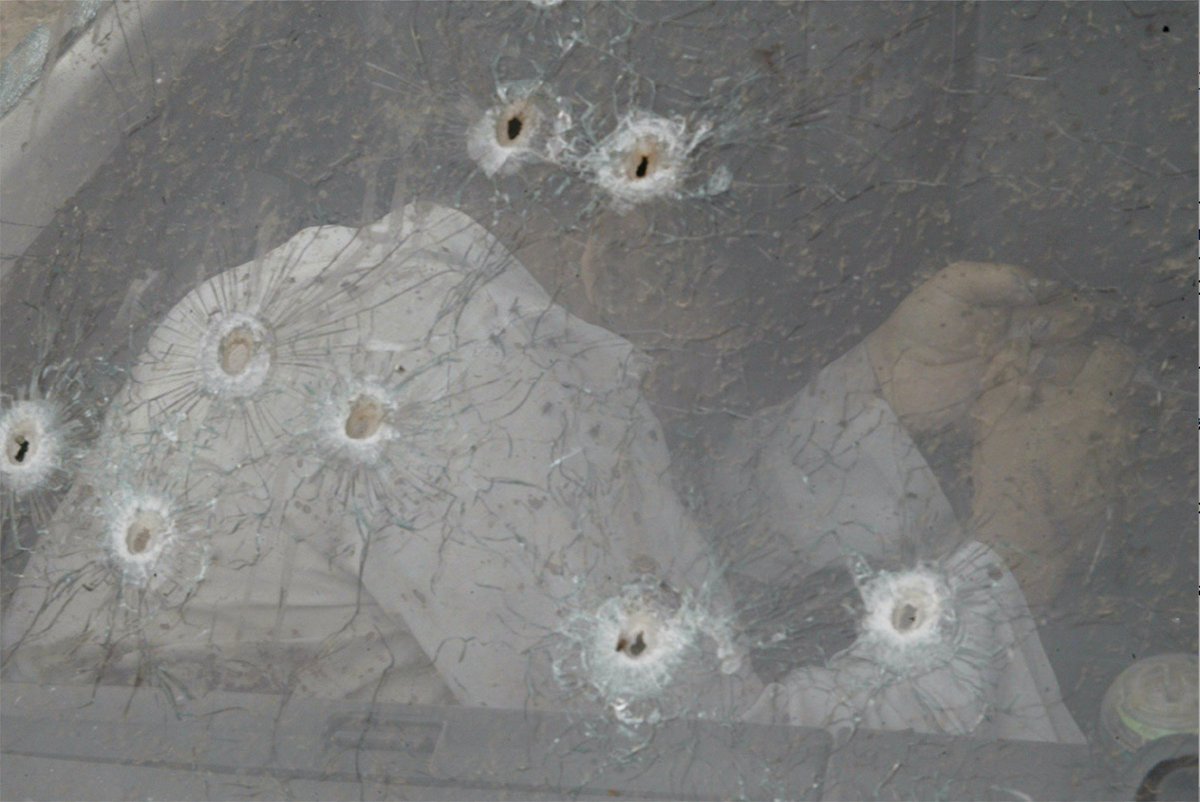
181) And this photo by Gary Knight is a haunting closeup of one of the bodies behind the bullet-riddled windshield. This was my war, our war.
182) April 5, 2003, fifteen years ago today, the front page of the New York Times reports that U.S. forces are circling the capital of Iraq.

183) The final four days of the invasion were monumental, politically and personally. Because of that, and because this thread is nearing Twitter's limit of 200 tweets, I'm continuing my narrative on a new thread. Just click the tweet below to keep going.
Loading suggestions...