
These medieval maps available online are not accurate. What is this map based upon? Kalhana says Lalitaditya conquered all territories upto Kaveri. So, the map is not based on Rajataramgini (which largely gives panegryical account of his conquests)
Curiously,there is another epic poem Gaudavaho written by Vakpati in praise of Yasovarman of Kannauj (who was an exact contemporary of Lalitaditya)which also gives a rather boastful account of his conquests of all of India from Kashmir to Dakshina.Which of these accounts is true?
Not one inscription of Lalitaditya has ever been found outside Kashmir. Yashovarman's inscription exists in Nalanda. Korean pilgrim Hui Chao writes in his account that Jalandhara in Punjab was a bone of contest between Yashovarman and Lalitaditya.
Kalhana was writing almost 450 years after the events took place. He made use of whatever he had at hand. i.e. prashasti like panegyric inscriptions of old rulers and faithfully reproduced them. Vakpati was a contemporary whose master (the king of Gauda) was killed by Yashovarman
At any rate, both Gaudavaho and Kalhana's description of Lalitaditya's conquests follow style of prashasti kavyas and describe their conquest from Himalaya to Dakshina.For a historical account of their territorial extent,one would have to rely on inscriptions and independent data
In Nalanda inscription, Yasovarman's minister is described as "ruler of north"(udicyapati) which perhaps indicates Yashovarman carried his armies to North. Jain text prabandhakosha says Yasovarman was the ruler of Gwalior.This shows Yashovarman ruled over a considerable territory
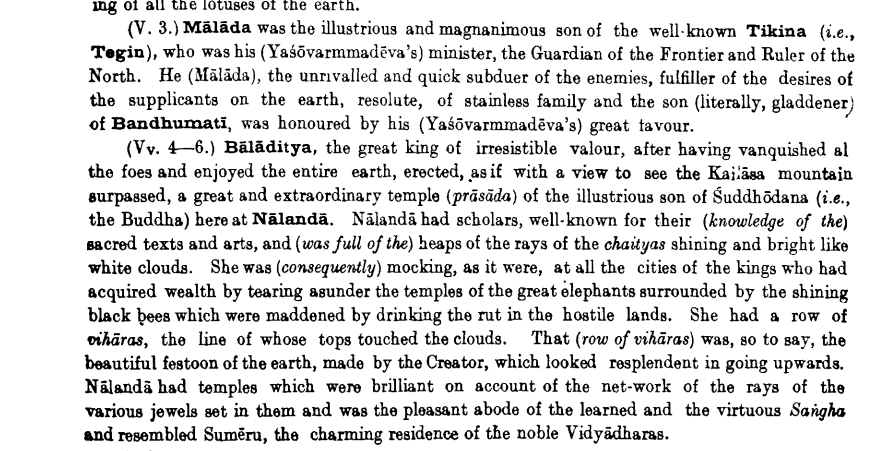
This shows Vakpati's account was largely true when it describes his conquests in northern India. However, coins of Lalitaditya have been discovered in Banda (UP). It is possible that Lalitaditya invaded and defeated Yashovarman as Kalhana writes in his chronicle.
Prashasti kavyas (in this case both gaudavaho and rajataramgini) are mostly based on truth.However, they are descriptive Kavyas and often engage in atishayokti which is one of accepted poetic Alankaras. The problem occurs when we take take them at face value and create maps
Loading suggestions...