


Part of what I discussed included "open access" - sharing information online freely and immediately. In that spirit, I'm creating a thread that outlines my presentation. I will be submitting an article for the journal linked to #SSLL2019 too. So here goes! CAUTION: LONG thread.

I started off introducing myself as a Deaf American woman with some discussion of my life experiences because as noted by many (e.g. @AnneliesKusters & @hildemh) the researcher's effect (including their lived experience, research training/goals, etc) is undeniable. I then

described the work that I do- language documentation which is similar to lang description in that the main concern is describing langs & patterns of use but different in there's perhaps more of a methodological focus on how that's done, esp digitally providing access to data

I was invited to present for my langdoc work & #SSLL2019 had a "language description" focus so I wanted to tie those two (which already overlap considerably-if they're even different today) together by doing a retrospective on the sign language description that has been done

While clearly that retrospective will be filtered thru my own experiences as a Deaf American woman, I also wanted to include other deaf perspectives like @linasigns who discusses deaf-led work, @jonhenner who doesn't trust any work that does not situate itself,
@gab_hodge who suggests that sign researchers be transparent about their signing experience, Ardavan Guity who often shares the traumatizing experiences of hearing non-signer scholars entering his life to collect data then leaving without any reciprocity, and
@jaceyhill who notes that deaf linguists [scholars] haven't been given enough credit for their work, and @ErinMoriartyH who reflects upon her place in the communities she researches. While I appreciate the work done by hearing scholars, I also wanted to #citedeafscholars more
![@jaceyhill who notes that deaf linguists [scholars] haven't been given enough credit for their work,...](https://pbs.twimg.com/media/ELORtr9U0AAfX46.jpg)
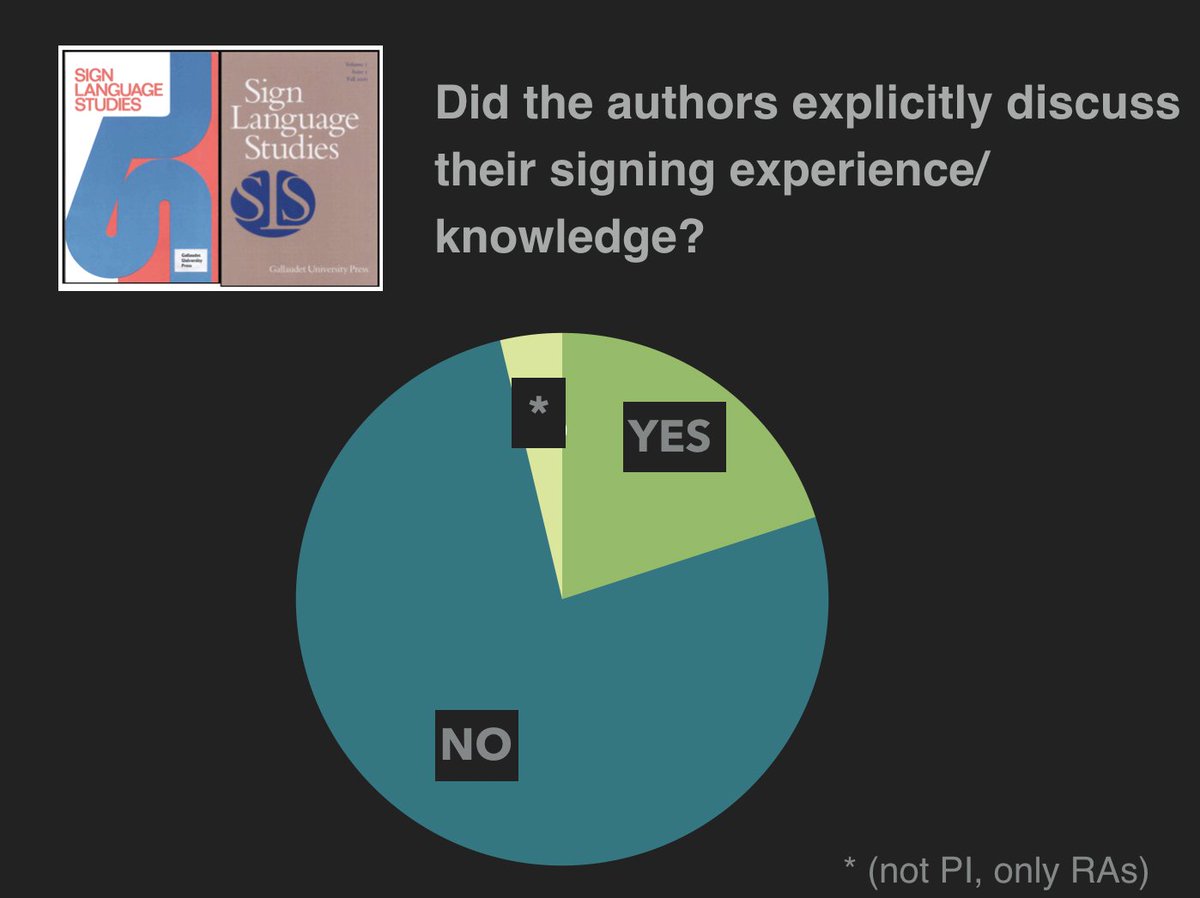
I used their work to help develop a meta lit review checklist like @superlinguo @AndreaBerez1, Kelly & Heston (2017) & @AdamCSchembri (2019) did in their survey of langdoc. I looked at 31 articles in Sign Language Studies from 1972-2019 to examine authors' research practices

E.g., Did authors discuss their relationship with the community they studied? 4 out of 31 did - e.g., Uiko Yano (2018) who stated that she was born and raised in one of the three deaf signing families she included in her work.

Did the authors explicitly discuss their signing experience/knowledge? 5 out of 31 did. e.g., Fred Peng (1974) studying kinship terms in Japanese Sign Language, said he learned JSL “to a considerable extent” after working on the project he reported on.
How are the data represented? (Note here I just collapsed all of the numbers. Some of the articles used more than one way of representation) For example, Sagara is pictured showing a name sign in JSL along with the gloss.


Are the primary data accessible (archived and linkable)? Unsurprisingly given tech limitations before 2000s, not many. 1 out of 31 said yes; 2 partially. 1 had a link but that link was broken when I tried it. A reminder to us all to preserve our online data as best as we can.

Did the authors state how deaf people were involved? If yes, how? (See chart). For the 4 articles where the authors stated the PI(s) were deaf, the research team, consultant(s) and research participant(s) were also deaf.

So overall there is little transparency or explicit reflection of positionalities, especially with sign language experience or connection with the deaf community, nor is our language data accessible. As you can see from work from deaf scholars, these are what we value

My intent isn't to criticize or shame anyone. 1 of the articles was my own! Instead, this is an opportunity to reflect on our practices and about how we can navigate our work with signed language communities. This could be a checklist of sorts of what to include in articles

There are plenty of things I’m still figuring out & am interested in a dialogue. To start that, I discussed three tools that I use in my langdoc work that I think honor the characteristics that diff deaf scholars would like to see in work about signed languages & deaf communities

First, it’s handy to consider ethical guidelines for working with signed language communities, e.g., jstor.org or slwmanual.info. For example, in working with Deaf Haitians, they were the main stakeholders in shaping knowledge about their own language

Another is thinking about how to represent signed language data in a way that's accessible to the community, and that one is easily summed up by #glossgesang

And finally, open access, which is prob least explored in our field. Austin Principles of Data Citation is a general push to make primary data (spoken, written & signed) accessible site.uit.no
<note gif sign is "open-minded" but signed by chest, that's open access!>
<note gif sign is "open-minded" but signed by chest, that's open access!>

So I don’t have it all figured out. But what I hoped to show was how to reflect on the work we do, which is important because we are working with communities that are traditionally marginalized and struggle to have a place in academia. /fin

p.s. much gratitude to my colleague @emilypshaw for brainstorming with me during development of this presentation

Loading suggestions...