

Ramadhān mubarak! It’s unlikely that I’ve been wrong this whole time, because unlike you, I have been studying Islam and philosophy extensively and alhamdulillāh the more I studied, the stronger my faith became. Let me address this issue inshāAllāh
Firstly, it is important to understand the way hadīths work in Islam. Like the Qur’an, where certain verses are revealed in response to an occurence (asbāb al-nuzūl), hadīths are formed in the same way (asbāb al-wurūd). Therefore, there are two main takeaways from this fact:
1) Rulings are rarely derived from the literal text of the Qur’an/Hadīth. It is to be understood contextually, taking into account other verses/hadīths, how the companions interpreted it, etc, and most importantly, the reason it was revealed. (asbāb al-nuzūl/al-wurūd).
2) Consequentially, laymen do not look at a hadīth and say, “yes that is what is prescribed for me, and I have to carry it out” unless it was explicitly given a ruling to be carried out by classical scholars, especially by the scholars of the mazhab we follow.
A simple example of this would be the hadīth in Bukhāri where the Prophet pbuh prohibited men wearing a garment that extended below the ankles. If taken literally, we would understand that it is haram for men to wear any pants that are not shorter than/cuffed above the ankles.
However, classical scholars have given their ruling that the hadīth needs to be understood in the context of the culture at that time. A long garment below the ankles in 7th century Arabia was a symbol of pride, and scholars have ruled that it is permissible for us nowadays.
Coming back to the hadīth about apostasy, you have to understand that the word “riddah” used in Arabic is not accurately translated to “apostasy” If understood in the context of the Prophet’s time, and the early scholars, riddah or murtad actually means “treason”.
The hadith you quoted, if you study the asbāb al-wurūd, is in the context of a group of Muslims who apostatised and began preaching and writing down heretical ideas, all with the intent to challenge the ruler at that time: Caliph Ali ra.
Therefore, riddah in hadīths actually refers to the secession from the Muslim community and the act of rebellion against the ruler. Proofs:
1) Another hadith mentioned in Bukhāri clarifies that the death punishment for the ‘murtad’ is he who leaves the religion and forsakes his..
1) Another hadith mentioned in Bukhāri clarifies that the death punishment for the ‘murtad’ is he who leaves the religion and forsakes his..
community. In another narration it is clarified that it is he who wages war against Allah and His Messenger.
2) There are multiple incidents of people during the Prophet’s time apostatising (without rebelling) but were never given the death punishment. Even Imam al-Shāfi’ī...
2) There are multiple incidents of people during the Prophet’s time apostatising (without rebelling) but were never given the death punishment. Even Imam al-Shāfi’ī...
himself noted this, as mentioned by al-Baihaqī, and noted by al-Tallā’ as well.
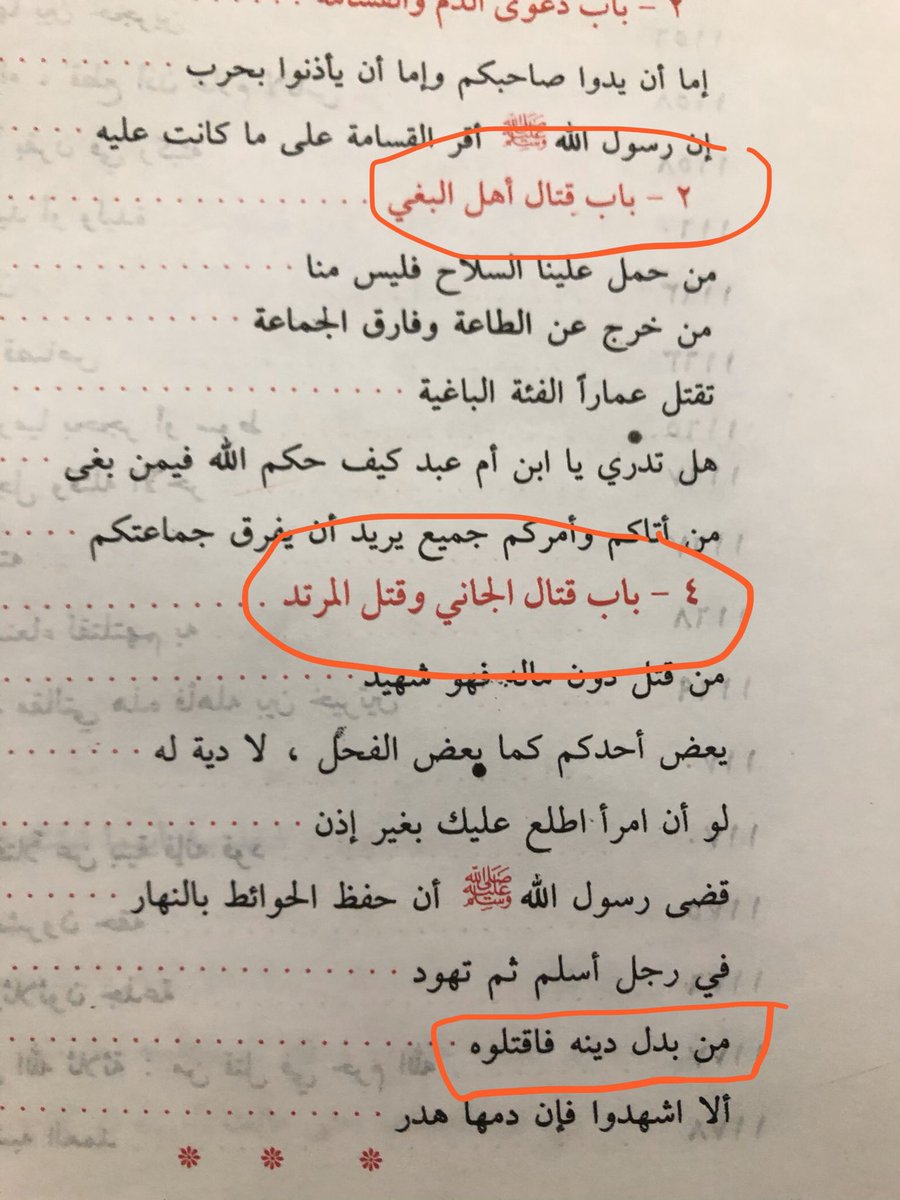
3) Classical scholars have put the rulings for ‘riddah’ under the chapter of al-Bughāt(rebellion) rather than al-Hudūd(criminal punishments)
3) Classical scholars have put the rulings for ‘riddah’ under the chapter of al-Bughāt(rebellion) rather than al-Hudūd(criminal punishments)
example: this is the hadīth index of a book called ‘Subul al-Salam’ volume 3 that I took the liberty of opening. The very same hadīth that was mentioned is under its own chapter of riddah right after rebellion. It was not put in volume 4 which is concerning hudud.
Wallāhu a’lam.
Loading suggestions...