

Let me start the story of Shahr-i naw (from now on the District) by the curious case of Malaka I’itizadi (1312/1933-?), who was an urban legend! Well almost. Some say she was Maj. Gen. Zahedi’s mistress. Others claim she fixed prostitutes for high rank military men. 1/jg
She had a network for trafficking networks. She had ties with the royal family. Rival rumours are rampant. Her name infamously pops up in popular accounts of the 1953 coup d’état, as the traitor who partook in the American operation AJAX through organizing ruffians and 2/jg
prostitutes from Qal’a, to overthrow Mosaddeq’s government. Malaka herself tells the story slightly differently! Here is the fancy cover of her autobiography (1956) that literally NOBODY ever reads! In it, she proudly announces herself as a monarchist, a feminist, and 3/jg
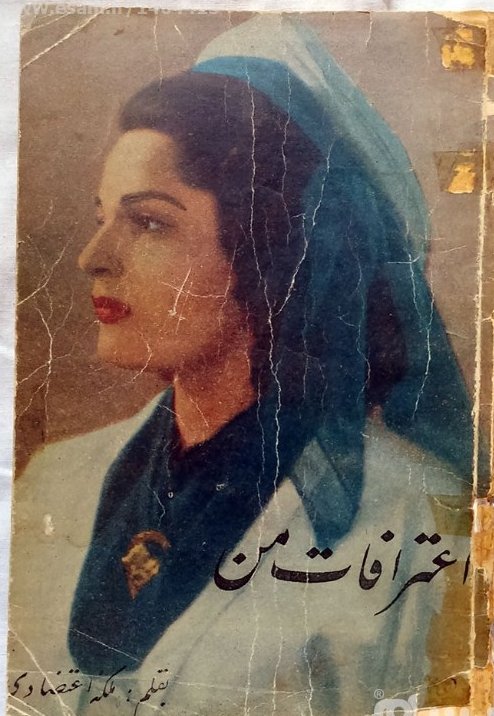
a descendant of a Qajar royal family with close ties with the Pahlavis. She claims to have led the anti-Mosaddeq “Zulfaqār” party that was actively involved in the coup. She denies however any relations to prostitution or the District. Could it not be that Malaka 4/jg
had conservative monarchist viewpoints, helped to orchestrate the coup, but had no ties with prostitution and women trafficking networks in Tehran?
Malaka is not the first crafted political-literal prostitute figure in the collective historical memory of Iranians. 5/jg
Malaka is not the first crafted political-literal prostitute figure in the collective historical memory of Iranians. 5/jg
Stories of intimate ties between prostitutes and political corruption circulate in a web of memoirs and popular historical accounts of 20th century Iran that build up on one another.
A lengthy list of political narratives highlight the role of hired prostitutes as 6/jg
A lengthy list of political narratives highlight the role of hired prostitutes as 6/jg
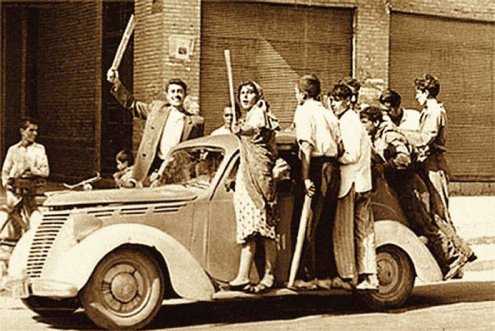
covert agents of the state in urban riots: the 1921 coup d’état, the 1932 protests against D‘arcy’s Oil concession, and indeed the 1953 coup d’état. Here’s a random photo of the coup that supposedly proves prostitutes’ corrupt engagement, ironically titled Malaka I’itizadi! 7/jg
The very inception of the District is assumed to be tied to foreign political intervention. The story goes as, in 1921, the power hungry Reza Khan-the then Commander in Chief- conspired with Mr. Howard-the British Council General-to relocate all the prostitutes in Tehran 8/jg
to Shahr-i naw, a green neighbourhood outside the city gates. This strategic move is said to have gained popularity for Reza Khan while rewarding Mr. Howard with monopoly over British power in Iran. The story is reiterated-reified in memoirs after memoirs blogs after blogs 9/jg
and so the legend persists: the inception of District in Tehran was a result of a political conspiracy. Why is it that the archives of Iran’s political memory are obsessed with prostitutes? Why is it that Mirzada Eshqi’s political poetics is saturated with them? 10/jg
If the figure of the prostitute is the counter-revolutionary subject par excellence and a part of the lumpenproletariat class in Iran's nationalist memory, then how does one begin to recover the buried history of the District and its residents? Curious? Stay tuned! 11/jg
Loading suggestions...