

Hello #medstudenttwitter, I was alerted to tweets expressing concern about spinal cord anatomy on step 1, so here’s a new #EndNeurophobia #tweetorial on
THE SPINAL CORD
#meded #Neurology
cc @MedTweetorials @DxRxEdu @CPSolvers @Tracey1milligan
THE SPINAL CORD
#meded #Neurology
cc @MedTweetorials @DxRxEdu @CPSolvers @Tracey1milligan
But first, a moment of silence for
#GeorgeFloyd
#AhmaudArbery
#BreonnaTaylor
and other lives lost to racism, structural violence, police brutality .
.
.
.
.
.
.
#GeorgeFloyd
#AhmaudArbery
#BreonnaTaylor
and other lives lost to racism, structural violence, police brutality .
.
.
.
.
.
.
Grateful for all the ❤️#EndNeurophobia has received but hope you check out the rest of my feed, which seeks to amplify voices I’m learning from in the path to being an antiracist ally. Want to learn more?
Follow some folks I follow
check out @thepraxispod
read #BlackInTheIvory
Follow some folks I follow
check out @thepraxispod
read #BlackInTheIvory
This tweetorial inspired by a tweet showing a complex overwhelming set of tracts in the spinal cord for step 1 review
Good news, you really just need to know 3 tracts for clinical neurology (and most step 1 ?s)!
Good news, you really just need to know 3 tracts for clinical neurology (and most step 1 ?s)!
1. Corticospinal tracts (CSTs): upper motor neurons descending form brain
2. Dorsal columns (DCs): carry vibration/proprioception from periphery to brain
3. Spinothalamic (anterolateral) tracts (STTs): carry pain/temperature from periphery to brain
2. Dorsal columns (DCs): carry vibration/proprioception from periphery to brain
3. Spinothalamic (anterolateral) tracts (STTs): carry pain/temperature from periphery to brain
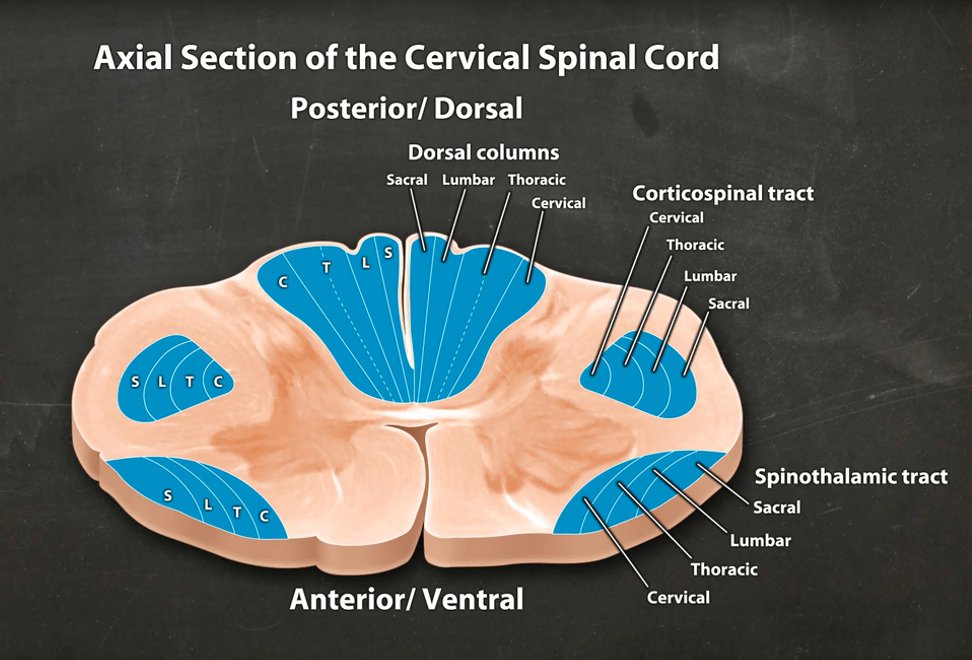
CSTs (motor): posterior/lateral
DCs (vib/prop): posterior
STTs (pain/temp): anterior/lateral
DCs (vib/prop): posterior
STTs (pain/temp): anterior/lateral
CSTs: crossed on way down, so motor deficits are
IPSILATERAL below level of lesion
DCs: cross in lower medullay, so vib/proprio deficits are IPSILATERAL below level of lesion
STTs: *cross immediately* in spinal cord so pain/temp deficits *CONTRALATERAL* below level of lesion
IPSILATERAL below level of lesion
DCs: cross in lower medullay, so vib/proprio deficits are IPSILATERAL below level of lesion
STTs: *cross immediately* in spinal cord so pain/temp deficits *CONTRALATERAL* below level of lesion
** NOTE **
*STTs (pain/temp) are the exception, deficits = CONTRALATERAL*
CSTs (motor) /DCs (vib/prop) deficits = ipsilateral
*STTs (pain/temp) are the exception, deficits = CONTRALATERAL*
CSTs (motor) /DCs (vib/prop) deficits = ipsilateral
Other important anatomic point=lamination
CSTs and STTs–upper extremities medial/lower extremities lateral
DCs–uppers lateral (fasciculus cuneatus)/lowers medial (fasciculus gracilis)
See mnemonic=2 bodies feet to feet on top, 4 diving hands first into spinal canal on sides
CSTs and STTs–upper extremities medial/lower extremities lateral
DCs–uppers lateral (fasciculus cuneatus)/lowers medial (fasciculus gracilis)
See mnemonic=2 bodies feet to feet on top, 4 diving hands first into spinal canal on sides

If you understand
- functions of these 3 tracts
- where they cross (STTs in cord, others in lower medulla)
- lamination (DCs feet to feet medial; CSTs/STTs hands medial)
then you can understand the 4 common spinal cord syndromes!
- functions of these 3 tracts
- where they cross (STTs in cord, others in lower medulla)
- lamination (DCs feet to feet medial; CSTs/STTs hands medial)
then you can understand the 4 common spinal cord syndromes!
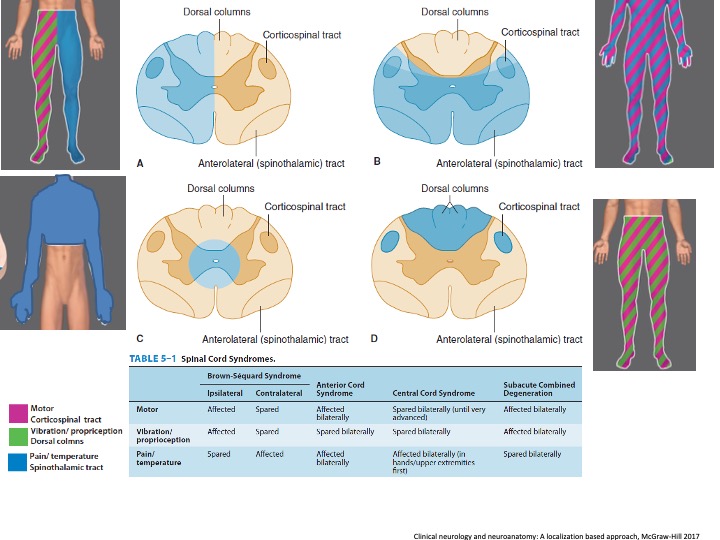
BROWN SEQUARD=half of cord:
*contralateral* pain/temperature
ipsilateral weakness and vib/prop loss
cause=usually penetrating trauma
ANTERIOR CORD=CSTs and STTs only=bilateral weakness/pain/temp
Dorsal columns (vib/prop) spared
cause=ant spinal artery infarct usually 2/2 AAA
*contralateral* pain/temperature
ipsilateral weakness and vib/prop loss
cause=usually penetrating trauma
ANTERIOR CORD=CSTs and STTs only=bilateral weakness/pain/temp
Dorsal columns (vib/prop) spared
cause=ant spinal artery infarct usually 2/2 AAA
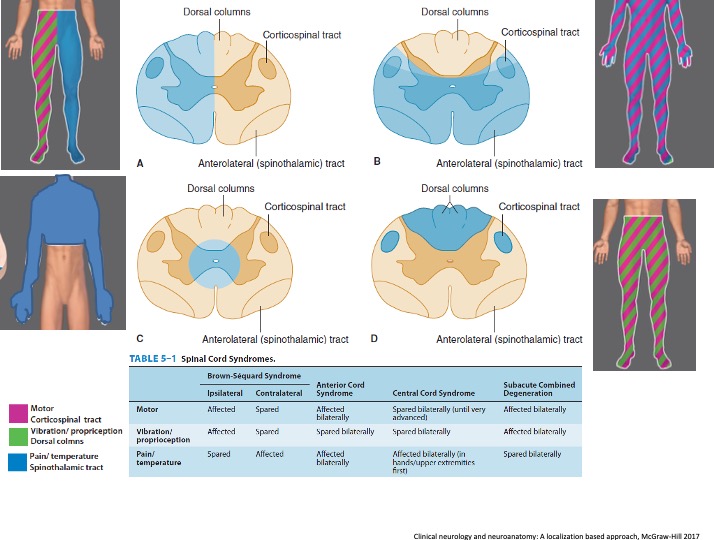
SYRINX/Central cord syndrome
Affects crossing fibers of STTs at cervical level=upper extremity fibers so loss of pain/temperature in hands with sparing motor/vib/prop
Subacute combined degeneration: DCs & SCTs= vib/prop/weakness with spared pain/temperature
Cause=B12 deficiency
Affects crossing fibers of STTs at cervical level=upper extremity fibers so loss of pain/temperature in hands with sparing motor/vib/prop
Subacute combined degeneration: DCs & SCTs= vib/prop/weakness with spared pain/temperature
Cause=B12 deficiency
Now that we have localization, just add time course = DDx:
HYPERACUTE (minutes to hours) myelopathy:
Trauma
Structural disease of the spine: acute central disc prolapse acute vertebral collapse
Vascular: stroke, epidural hemorrhage, or spinal cord hemorrhage (hematomyelia)
HYPERACUTE (minutes to hours) myelopathy:
Trauma
Structural disease of the spine: acute central disc prolapse acute vertebral collapse
Vascular: stroke, epidural hemorrhage, or spinal cord hemorrhage (hematomyelia)
ACUTE TO SUBACUTE-onset (hours to days) myelopathy
Infxn: viral myelitis, epidural abscess, schistosomiasis
Inflamm: transverse myelitis, flare of multiple sclerosis, flare of neuromyelitis optica, lupus, Sjögren’s syndrome, sarcoidosis
Infxn: viral myelitis, epidural abscess, schistosomiasis
Inflamm: transverse myelitis, flare of multiple sclerosis, flare of neuromyelitis optica, lupus, Sjögren’s syndrome, sarcoidosis
SUBACUTE to CHRONIC-onset (days to months) myelopathy
Structural disease =cervical spondylosis
Tumor: primary or metastatic
Infections: tuberculosis of the spine
Vascular causes: spinal dural arteriovenous
fistula
Metabolic causes: vitamin B12 deficiency or copper deficiency
Structural disease =cervical spondylosis
Tumor: primary or metastatic
Infections: tuberculosis of the spine
Vascular causes: spinal dural arteriovenous
fistula
Metabolic causes: vitamin B12 deficiency or copper deficiency
CHRONIC-onset (months to years) myelopathy:
Infections: human T-cell lymphocytic virus 1 (HTLV-1) and AIDS vacuolar myelopathy
Neurodegenerative myelopathies: hereditary spastic para- plegia, spinocerebellar ataxia, adre- nomyeloneuropathy
Radiation-induced myelopathy
Infections: human T-cell lymphocytic virus 1 (HTLV-1) and AIDS vacuolar myelopathy
Neurodegenerative myelopathies: hereditary spastic para- plegia, spinocerebellar ataxia, adre- nomyeloneuropathy
Radiation-induced myelopathy
Hope that helps! #EndNeurophobia 🧠❤️
Want to see this all animated!? Login into your school library's subscription to AccessMedicine and go to Ch 5, videos accessmedicine.mhmedical.com
Loading suggestions...