

#HematologyTweetstory 33: hemoglobin variants, often said to be the most common single-gene genetic disorders in humans. “Disorders” is not entirely accurate, as many variants are clinically silent. We’ll focus on hemoglobinopathies; thalassemias are a story for another time./1
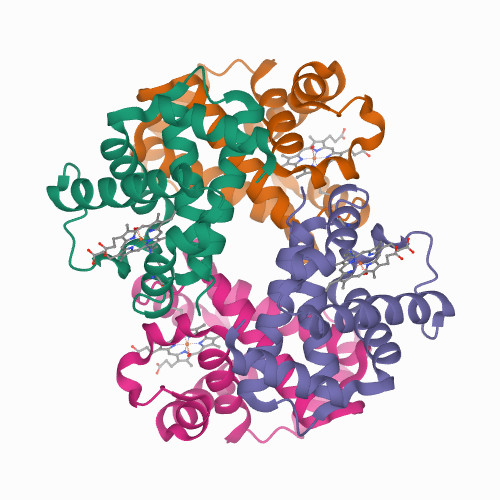

I got interested in this ~20 years ago & wrote a paper in 2001 @MayoProceedings about RBC disorders we'd incidentally noted in some of the many patients we saw @MayoClinic from the Middle East (esp. prior to 9/11). I then went to @MRC_WIMM in Oxford to a globin lab for 2 years./2


First, a quick run-through of the normal hemoglobins (image source: Hoffbrand and Steensma, Essential Haematology, 8th edition). Already in the 19th century it was recognized that there was more than one type of human hemoglobin. /3

Johnny Depp-lookalike Ernst Körber from Estonia wrote his dissertation at the University in Dorpat (old name for Tartu) in 1866. He found that umbilical cord blood had a unique form of Hb resistant to alkali denaturation: fetal hemoglobin. Körber died 3 years later from typhus./4


In 1955, Henry Kunkel (pictured) @RockefellerInst & visiting Swede G. Wallenius noticed a new slow-moving Hb on starch electrophoresis, comprising about 2% of normal Hb. They published @ScienceMagazine & it became known as hemoglobin A2 (Hb A2) - more on nomenclature below./5


Now to abnormal hemoglobins. A few months ago, I'd put together a tweetorial on the interesting life of Walter Clement Noel from Grenada, the first person clearly described with sickle cells circa 1910./7
The discovery that sickle cell disease resulted from an altered form of Hb with distinct physicochemical properties was published by Linus Pauling & colleagues 1949, and is often said to be the first ‘molecular disease”. But as with many “firsts” there was an earlier example!/8


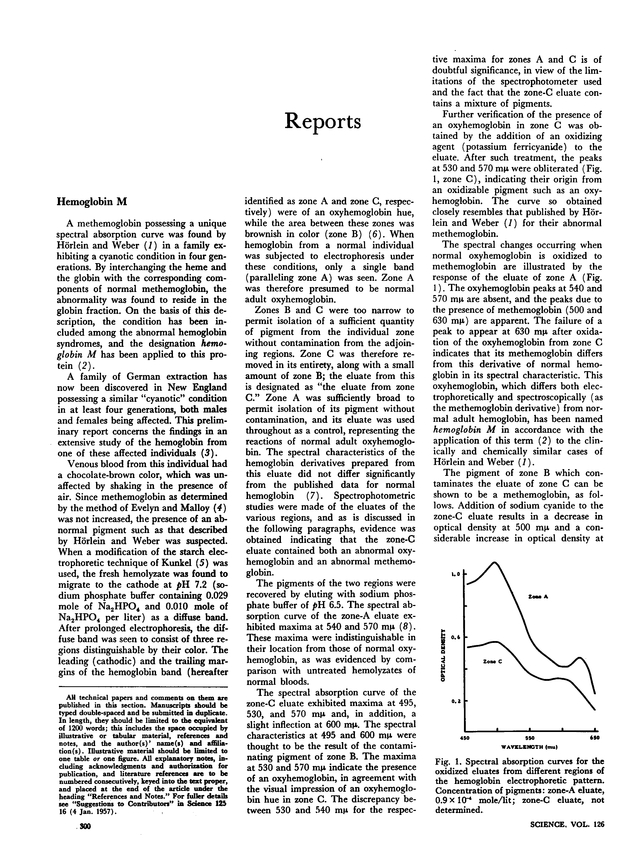
In 1947, at a meeting of the Westphalian Society for Internal Medicine in Düsseldorf, Heinrich Hörlein & a medical student named G. Weber from Wuppertal-Elberfeld presented a 4-generation family with "Chronic familial methemoglobinemia and a new modification of methemoglobin"./9
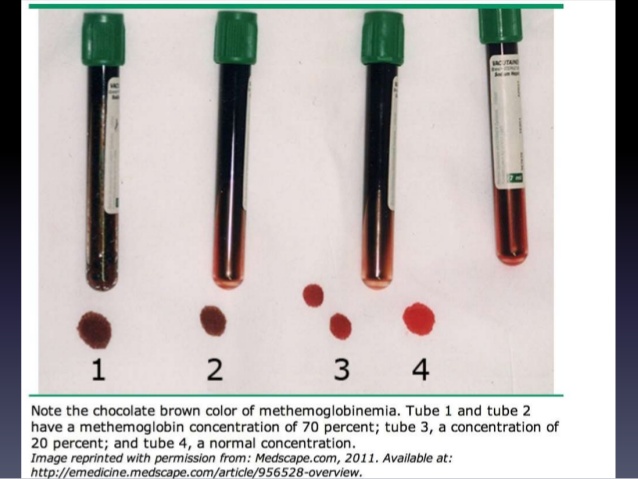

Hörlein, who died in 1954, developed phenobarbitol. He had been an exec of notorious IG Farben & joined the Nazi party in 1934 along with most other executives. He was tried after the War, somehow acquitted. He has a street named after him in Leverkusen./10


Harvey Akio Itano (1920–2010), a Japanese-American biochemist who spent part of WW2 in Tule Lake internment camp @GeorgeTakei & missed his 1942 @UCBerkeley graduation (valedictorian!), collaborated with Pauling @Caltech to isolate sickle Hb via moving boundary electrophoresis./11

In 1950, Itano and James V. Neel (who founded @UMich Department of Human Genetics) reported a family with chronic hemolysis with some sickling, but a milder clinical course. They found a new hemoglobin in some family members, which they called Hb C (normal: A, sickle: B.)./12


Weirdly, Hb C was the second hematologic disorder that was first described in Detroit, but which is much more common elsewhere in the world (in this case, West Africa). The other was Cooley’s anemia, also known as beta thalassemia./13

Next, in 1951, Itano assessed a mixed-heritage California family who had previously been described in a 1934 paper as a “white family with sickle cell anemia”. They turned out to have yet another different hemoglobin – the 3rd described - later to be known as Hemoglobin D./14


In 1955, Hb D was reported by George William Gregory Bird in an apparently healthy 19 y/o Sikh soldier at the Armed Forces Medical College in Pune, India. This became known as “Hb D Punjab” - it was the same thing as what Itano had described, termed "Hb D Los Angeles."/15


I remember there being a question about Hb D being the most common Hb variant in the Xinjiang Uyghur Region of China on the heme boards, back when the boards were "trivial pursuit". I got it wrong & I would argue it had no bearing on my competence to practice hematology.😜/16

This illustrates how messy nomenclature got. In 1962, Corrado Baglioni, the @MIT, analyzed the molecular structure of five Hb Ds: Hb Chicago, Hb North Carolina, Hb Punjab, Hb Portugal and Hb Oak Ridge and found they were all the same thing: β121 Glu→Gln./17


In January 1953, the Hematology Study Section @NIH held a 6-person conference to standardize nomenclature. They decided to call the most common type of adult hemoglobin Hb A, fetal hemoglobin Hb F. Sickle hemoglobin became Hb S since "Hb B" could be confused with beta globin./18
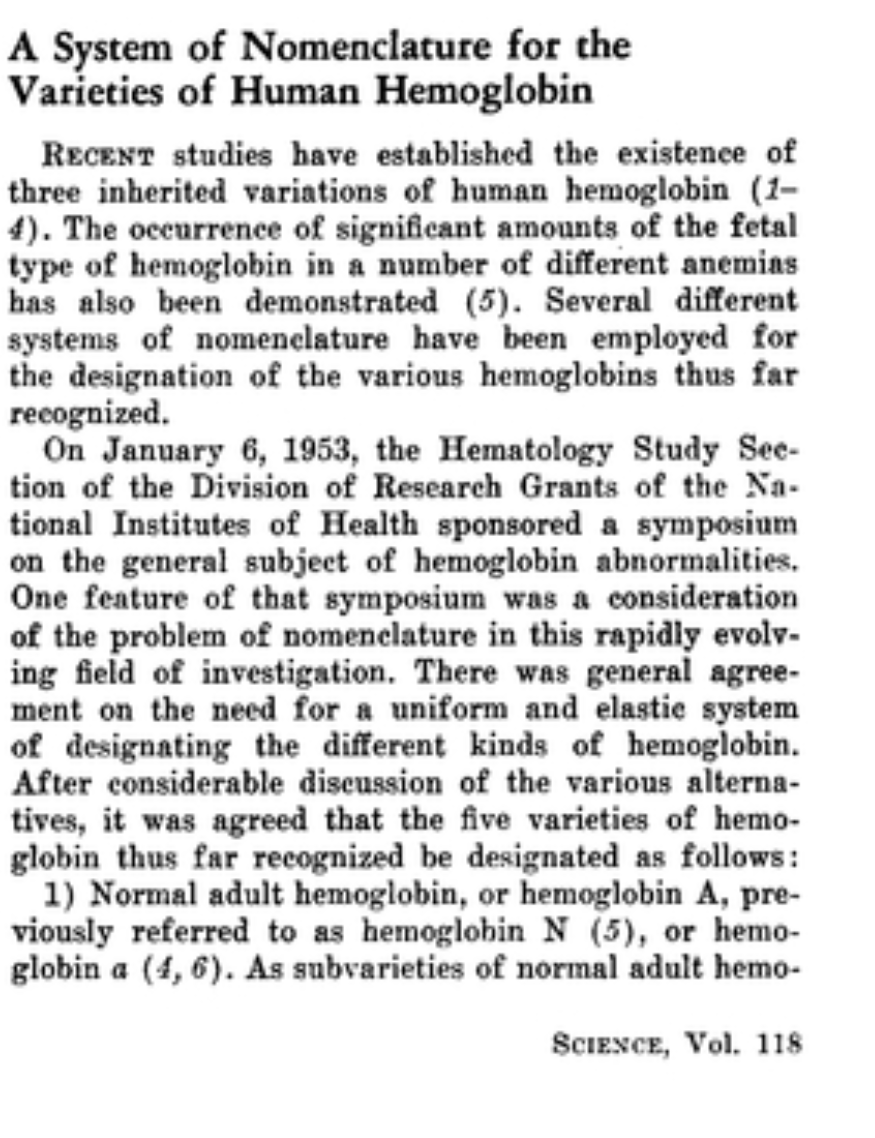


The NIH workshop proposed that subsequent variants should be described with separate letters. But not everyone accepted that - and soon so many variant hemoglobins would be described that they ran out of letters, like @NOAA did with names in the 2020 Atlantic hurricane season./19

The most common method of naming new hemoglobins soon became the city/hospital/region in which the Hb was discovered or where the first recognized patient/family originated. Not as creative as Drosophila geneticists…/20

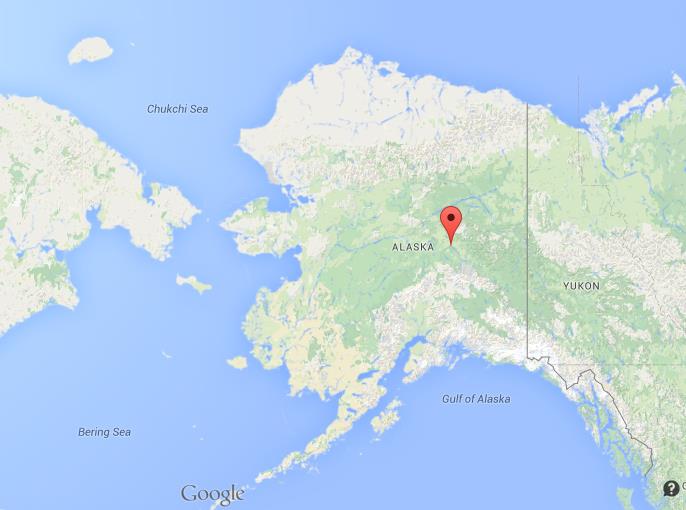
I remember when Virgil Fairbanks, a hemoglobin guru @MayoClinic, got excited when he found what initially appeared to be a new Hb in a patient from Fairbanks, Alaska. He was envisioning “Hb Fairbanks.”🙂 But it turned out to be the same as a previously described variant./21

One of the stranger Hb names: Hemoglobin “Sunshine Seth”, named after a little boy named Seth with apparently a sunny disposition. Hey, it was the '70s, man.😀 Those "Sunshine People" toys in the Sears-Roebuck Christmas catalog - most '70s thing ever./22


Hb E was first reported in California in 1954 - by Itano again - and independently in Thailand by Chernoff et al. E is exceptionally common in SE Asia; with immigration from Laos/Vietnam/Cambodia in the 1970s, it outstripped Hb S as the most common Hb variant in California./23


The technique Pauling and Itano and their colleagues initially used to isolate to sickle hemoglobin was cumbersome and technically challenging; it used a modification of Arne Tiselius’ apparatus./24


Once Theodore Spaet @Stanford & C. Lockard “Lock” Conley & his assistant Ernest W. Smith @johnshopkins figured out how to do electrophoresis more simply with paper and inexpensive supplies (in 1953), population surveys could be conducted easily almost anywhere on the planet./25


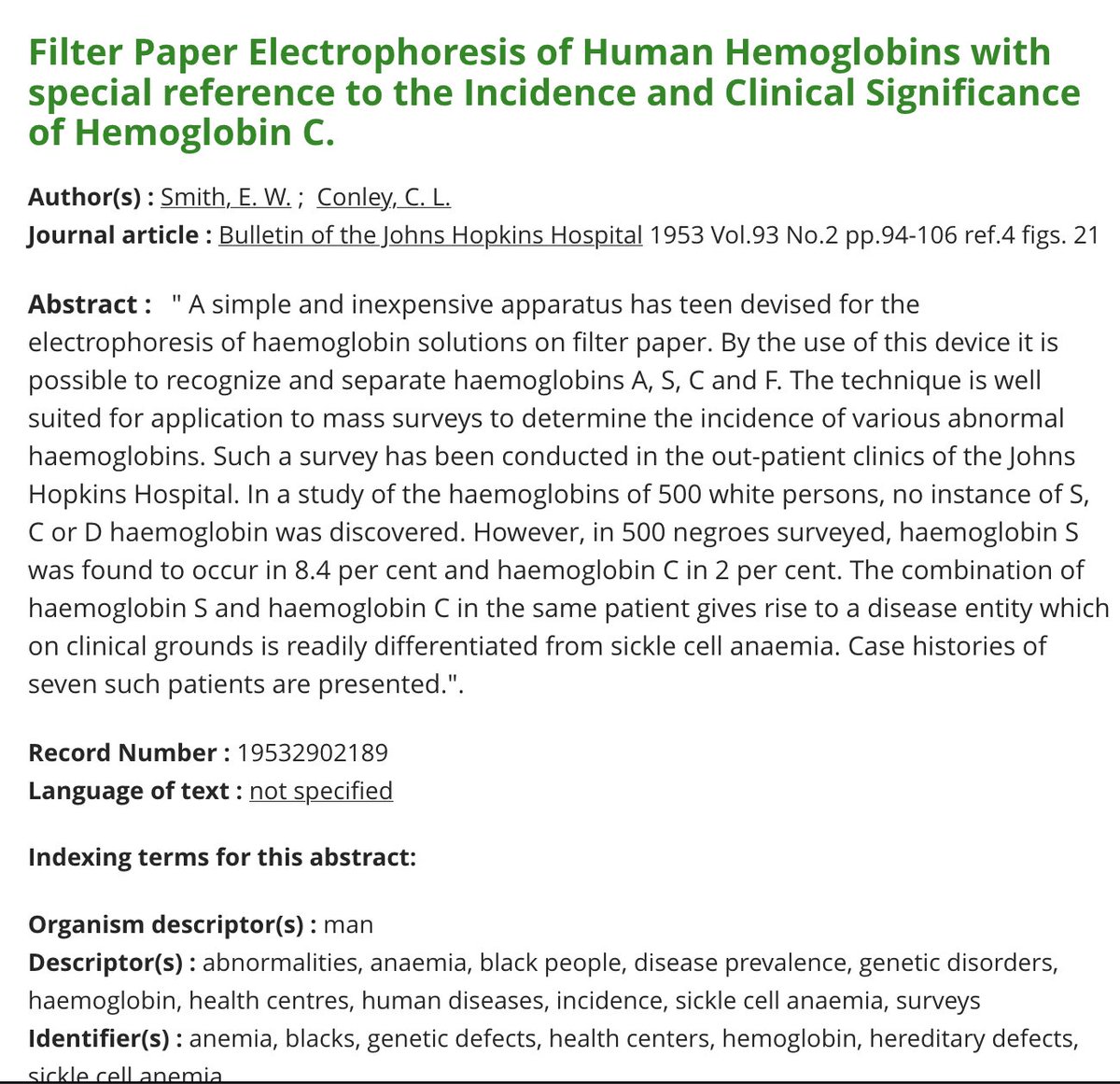
One of the first population hemoglobin surveys was by Smith and Conley in Baltimore, in which *no* Hb variants were found in 500 white people (they only knew about 3 at the time - C,D,S - so not surprising), but 8.4% of 500 Black study subjects had Hb S, while 2% had Hb C. /26
One of the big questions was why these variants are so common, especially in tropical/subtropical regios. The brilliant JBS Haldane (1892-1964) popularized the idea in 1948 that Hb variants protect against severe malaria. Some details remain unclear./27


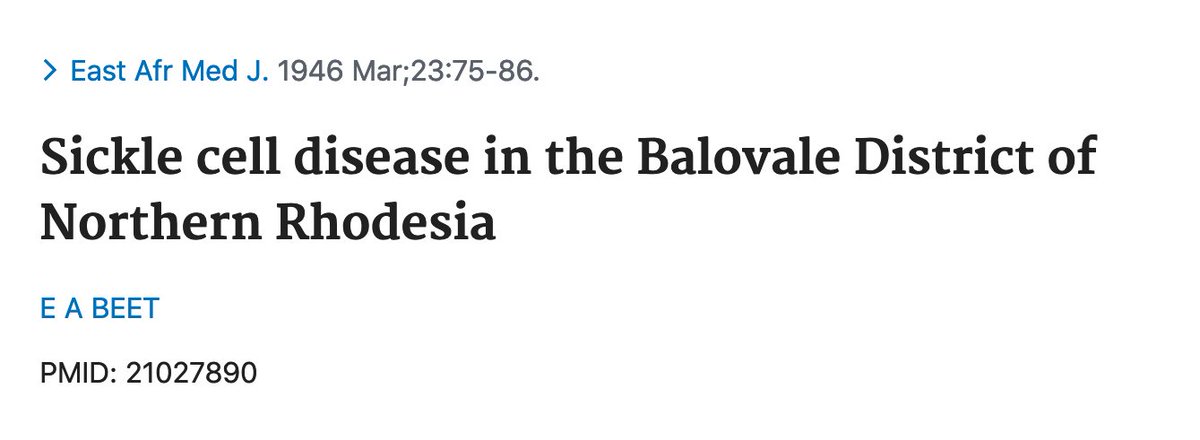
In 1946, a British colonial medical officer, E.A. Beet, working in what is now Zambia noticed that the parasite burden was lower in blood smears from people with sickled cells. He communicated with Haldane and correspondence is held by the @ExploreWellcome./28


Many hemoglobins were subsequently discovered; most were like polymorphisms, with no clinical effect. But some held on to oxygen more or less avidly than Hb A, resulting in cyanosis or compensatory polycythemia. So far, 159 altered-O2 affinity variants have been described./29

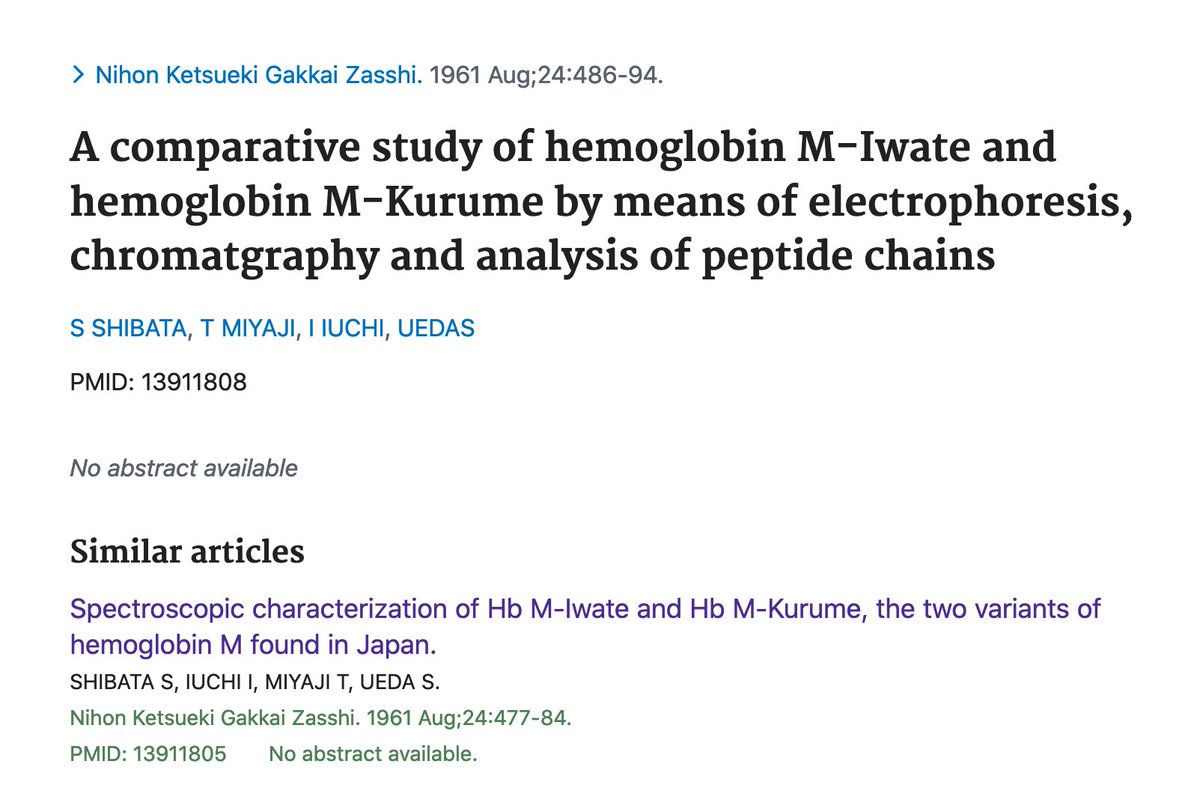
Others cause methemoglobinemia, like the German one above from 1947; these are usually called Hb M and are one of several ways to get methemoglobin. Hb Ms were described in Northern Japan in an area where some families had a condition, “kuroi kuchi" (black mouth, 黒い口)./30


Yet other hemoglobin variants are unstable and precipitate in red cells, causing chronic hemolysis. More than 150 of these have been described. Precipitation can be provoked by drugs like sulfonamides (desc.1962) or rasburicase. (Image: ASH Image bank, rasburcase treated pt.)/31


There are Hb variants that don’t alter the electrophoretic mobility. These would not be discovered until other techniques such as isoelectric focusing and HPLC became available, or DNA sequencing techniques became routine. R image: Nanthasurasak, Analytica Chimica Acta 2017/32


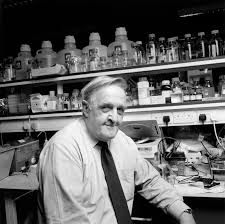
The hemoglobin variant database "HbVar" (globin.bx.psu.edu) began in 2001. It succeeded Titus HJ Huisman’s (1923-1999; pictured) @AUG_University and colleagues' databases, “Syllabus of Human Hemoglobin Variants” and "Syllabus of Thalassemia Variants"./32


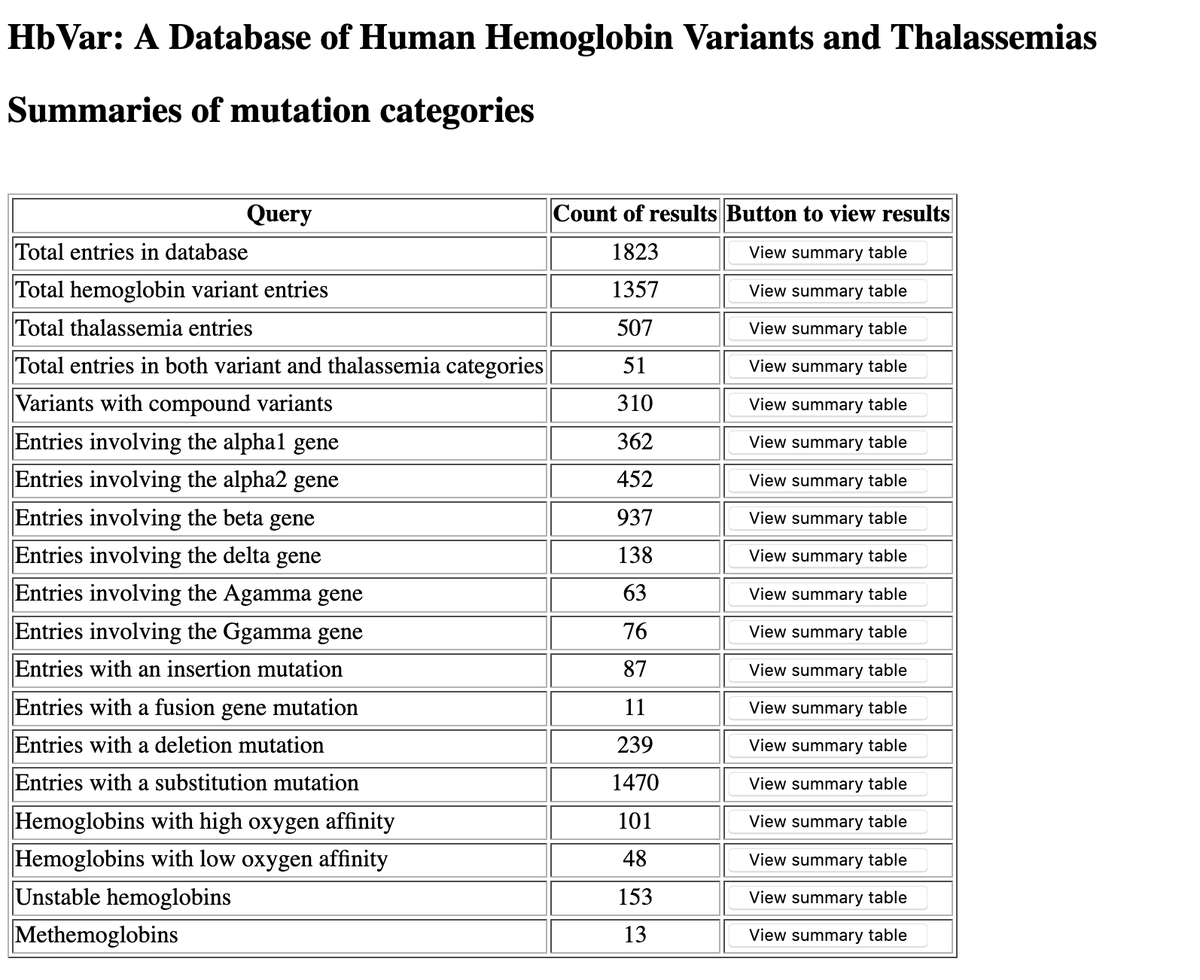
Currently there are 1,823 (!) entries in the HbVar database: 1357 hemoglobin variants and 507 thalassemia entries (51 are both). Most involve beta globin (937), followed by alpha2 (452), alpha1 (362) and delta (138). Substitutions (1470) are more common than deletions (237)./33
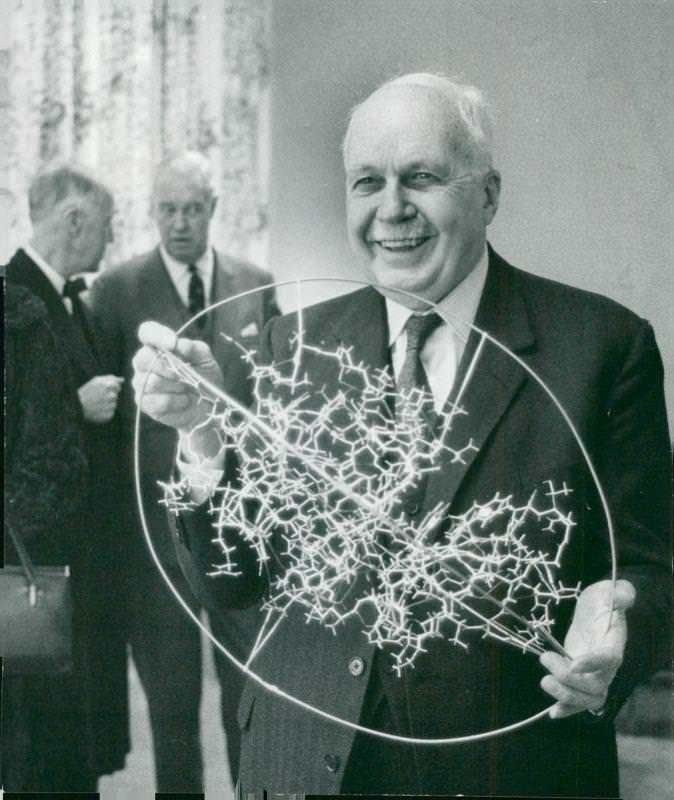
In 1960, Max Perutz @Cambridge_Uni solved the crystal structure of hemoglobin - a heroic effort and major protein structure/crystallography milestone - and it became possible to understand how these newly discovered variants altered structure./34


Odd fact: Perutz had anxiety-induced psychogenic dysphonia, and Prof Weatherall @MRC_WIMM was often called on to speak in his place on short notice at conferences./35
Perutz himself is worth a full tweetorial someday. He got so upset & envious reading Linus Pauling's alpha helix structure solution that he worked long hours until he solved Hb. Anger can be a powerful motivator. His mentor W.L. Bragg said, "I wish I'd made you angry earlier."/36

This reminds me of the late Michael Perry (1945-2011). He was a stand-out fellow @MayoClinic. However, when he completed fellowship in 1975, Mayo decided not to hire him, since he had polycystic kidney disease. It was a different era (Mike spoke about this publicly.)/37

The Clinic leaders worried Perry's career would be short and perhaps didn’t want to pay for his inevitable medical care. This slight angered him, and he resolved to become prominent make them regret it. He went to @mumedicine and had a great & productive career./38

If you recognize Perry's name, it is probably because of "The Chemotherapy Source Book” which many of us used as oncology fellows, and is now in its 5th edition. That's all for hemoglobinopathies - and may you be motivated by emotions other than anger.😀/39End

Loading suggestions...