
Health
Science
Medicine
Neuroscience
Limbic System
Pattern Recognition
Emotional Behavior
MRI
Neuroanatomy
Hippocampal Formation
Memory Encoding
Working Memory
Spatial Navigation
Conscious Knowledge

Neuroanatomy TOTD #8🧵
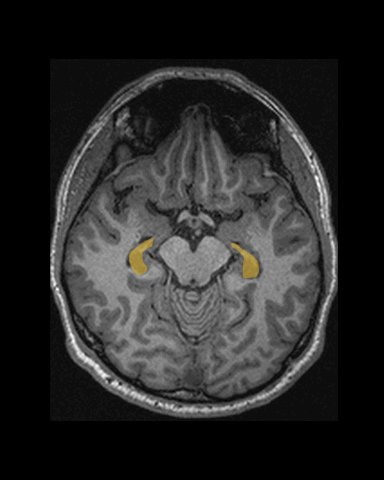
1/8 MRI shows the hippocampal formation; the hippocampus(HC) is a ridge of archicortex gray matter at floor of lat ventricle, in the med temp lobe #FOAMed #FOAMrad #radres #neurorad #neuroscience #medtwitter #radiology #neurology #neurosurgery #neuroanatomy
1/8 MRI shows the hippocampal formation; the hippocampus(HC) is a ridge of archicortex gray matter at floor of lat ventricle, in the med temp lobe #FOAMed #FOAMrad #radres #neurorad #neuroscience #medtwitter #radiology #neurology #neurosurgery #neuroanatomy

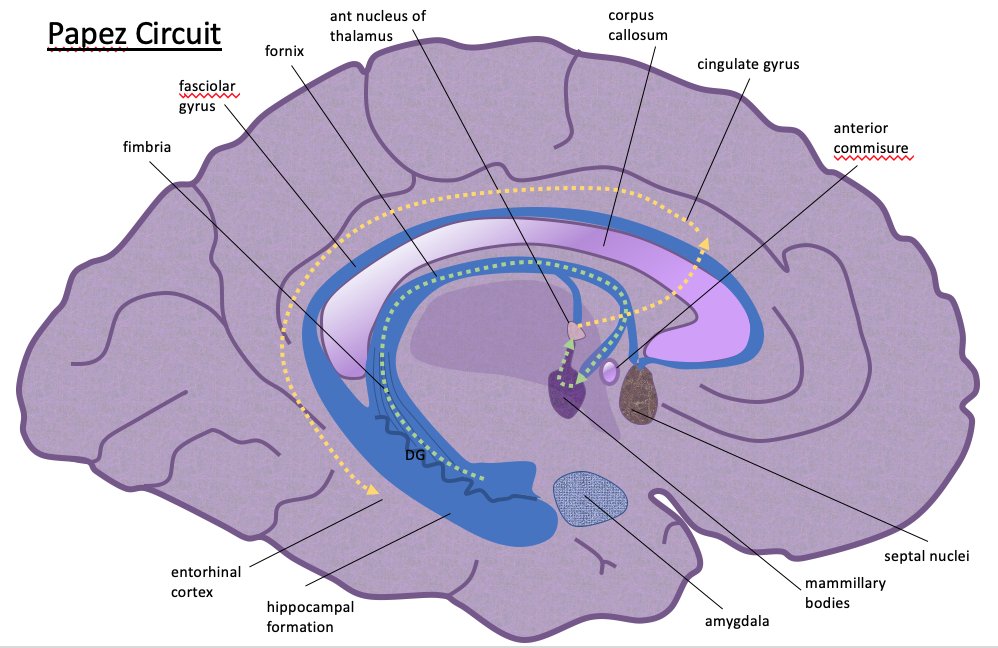
2/8..The HC: complex structure of limbic system; encodes memories from short->long term (also involved in pattern recognition,memory encoding & association, working memory,spatial nav, emotional behavior,awareness of conscious knowledge). Am I missing anything neuroscientists?
3/8...Anatomically: the HC is made of the cornu ammonis (CA) and dentate gyrus (DG); hippocampal formation also includes the subiculum and entorhinal cortex (EC). Can also be divided into head/body/tail. Supplied primarily by the PCA, and variably by anterior choroidal artery.

4/8...The entorhinal cortex acts as the hub connecting multiple areas of cortex to the hippocampus (both inputs and outputs); it’s histologically distinct (6 layers), and located along the anteromedial margin of the parahippocampal gyrus.

5/8...EC inputs go both to the dentate gyrus and CA1 cells of the CA. EC gets output from the subiculum (which is the main output hub of the hippocampus). The CA and DG curve into each other, and are separated by the hippocampal sulcus.

6/8...The CA is divided into CA1,CA2,CA3,CA4 cells. Circuits through HC are involved in encoding semantic (polysynaptic) & episodic & spatial (direct intra-hippocampal) memory. The HC is thought to alter the strength of networks via long term potentiation—a separate discussion!)


7/8..Note the hippocampus is somewhat fragile and easily damaged by toxic, oxidative, or glucocorticoid stress. This is a case of medial temporal sclerosis, commonly assoc/w intractable temporal lobe seizures. MRI shows HC atrophy, increased T2 signal, and loss of architecture.

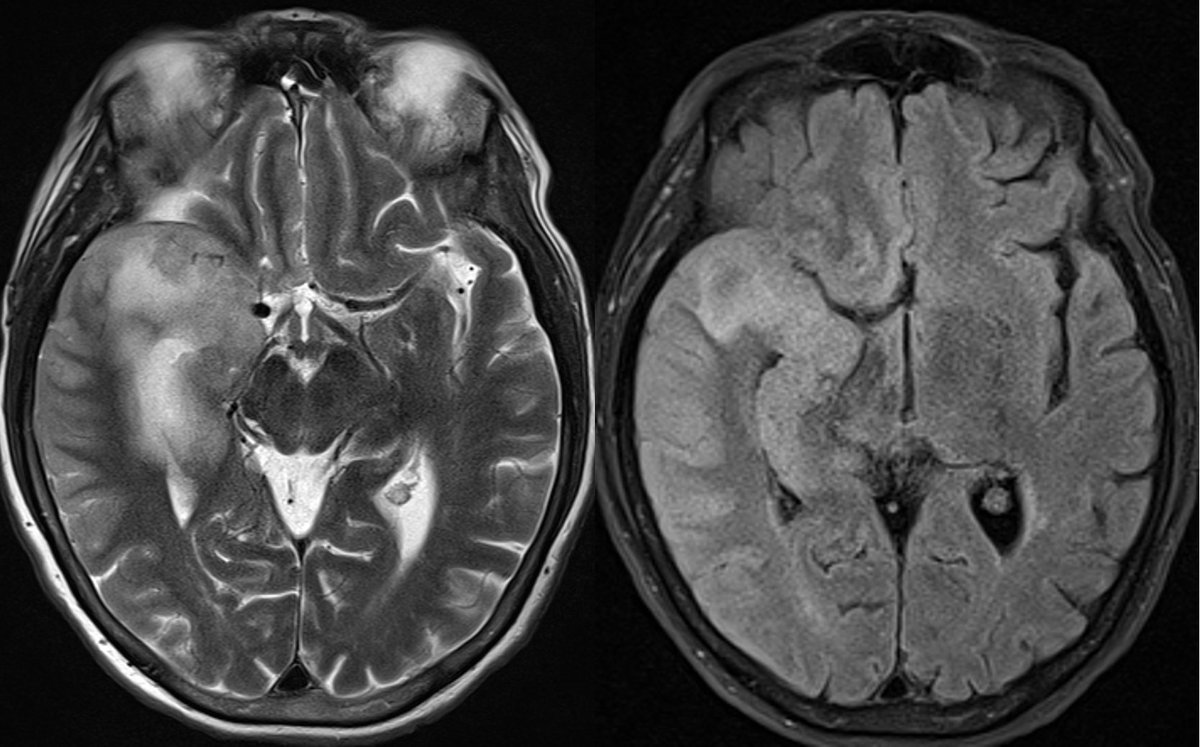
8/8...Another relatively common pathology affecting the MTL/hippocampus--HSV encephalitis--caused by reactivation of latent HSV within the trigeminal ganglion. HSV has a particular affinity for the limbic system. T2 signal abnormality and cortical expansion of the temporal lobe.
9/8
Loading suggestions...