


A) Abdur Razzak (ambassador of Timur’s son, Mirza Shah Rukh, to the Vijayanagar court in 1442) recorded the following practise of Polyandry in Calicut :-
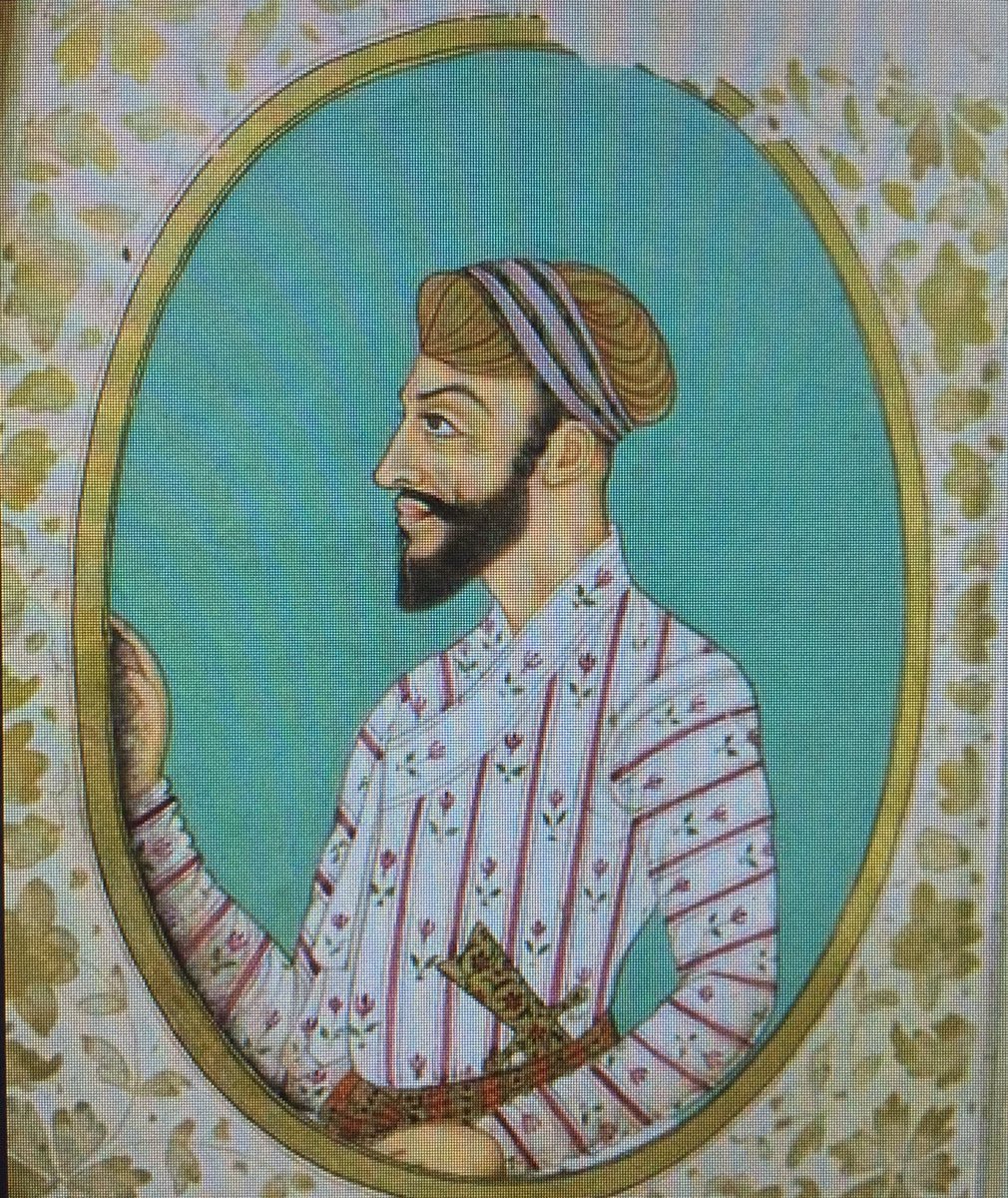
...Amongst them there is a class of men, with whom it is the practice for one woman to have a great number of husbands, each of whom undertakes a special duty and fulfils it.

.. The hours of the day and of the night are divided between them; each of them for a certain period takes up his abode in the house, and while he remains there no other is allowed to enter. The Sameri [the Zamorin] belongs to this sect.”
B) Nicolo Di Conti, the famous Venetian merchant spent considerable time in the great city of Vijayanagar, in mid-15th century CE. He observed Polyandry as follows in Calicut and neighbouring areas :-


“Women are allowed to have many husbands In this district alone the women are allowed to take several husbands, so that some have ten and more.

..The husbands contribute amongst themselves to the maintenance of the wife, who lives apart from her husbands. When one visits her he leaves a mark at the door of the house, which being seen by another coming afterwards, he goes away without entering. ..

.. The children are allotted to the husbands at the will of the wife. The inheritance of the father does not descend to the children, but to the grandchildren.”

C) Geronimo de Santo Stefano, a Genoese explorer, visited South India retracing the route of Nicolo Di Conti, in beginning of 16th century CE, and observed the following on Polyandry in Malabar region :-


“... Every lady may take to herself seven or eight husbands, according to her inclination.

The men never marry any woman who is a virgin; but if one, being a virgin, is betrothed, she is delivered over before the nuptials to some other person for fifteen or twenty days in order that she may be deflowered.”


D) Ma Huan, Chinese Muslim interpreter, who visited South India in 1412-1413 CE, noticed the following on rule of succession to throne in Malabar due to Polyandry which is reiterated too by Ibn Batuta, Moroccan traveler & Abdur Razak, Ambassador to court of Vijayanagara Empire :-


“:....The succession to the throne is settled in a somewhat curious manner. The king is not succeeded by his son, but by his sister’s son, because his nephew, being born of his sister’s body is considered nearer to him by blood.
..If the king has no sister the succession goes to his brother; if he has no brother it goes to a man of ability and worth. Such has been the rule for many generations.”


E) Friar Jordanus, a French Dominican monk, who visited India in 1321 CE, too reconfirms the rule of succession in some regions of South India as follows:-
“... In this India never do (even) the legitimate sons of great kings, or princes, or barons, inherit the goods of their parents, but only the sons of their sisters; for they say that they have no surety that those are their own sons..:

..because wives and mistresses may conceive and generate by some one else; but ’tis not so with the sister, for whatever man may be the father they are certain that the offspring is from the womb of their sister, and is consequently thus truly of their blood.”

Disclaimer : This thread is for presenting certain customs and social practices prevalent in certain regions of Medieval and Ancient India...
.. Readers may use their their intellect in comprehending the fact that Hindu customs and life style are smriti based and thus, evolve with time and need of the contemporary society...
.. So, we should refrain from judging such practices of past through the lens of the present social scenario or by comparing them with Vedic compliant scriptures...
.. Our society has many a times in past and in present too, deviated from what our scriptures recommend ideally, for to err is human.
The compiler of this thread neither endorses Polygamy, nor Polyandry, under any circumstances, for they not only violate the spirit of our divine, infallible Vedas, but also of the present law of the land for Sanatan Dharma followers.
Credit and Sources :-
1)THE INDIA THEY SAW (VOL-2) by MEENAKSHI JAIN
2)Major RH, pp.5, 17 and 20 of India In The Fifteenth Century Being A Collection of Narratives of Voyages To India, Asian Educational Services, 1992, first published 1858.
1)THE INDIA THEY SAW (VOL-2) by MEENAKSHI JAIN
2)Major RH, pp.5, 17 and 20 of India In The Fifteenth Century Being A Collection of Narratives of Voyages To India, Asian Educational Services, 1992, first published 1858.


3)Sastri, Nilakanta K. A., pp. 209, 306-307 of Foreign Notices of South India. From Megasthenes To Ma Huan, University of Madras, 1972.
Loading suggestions...