
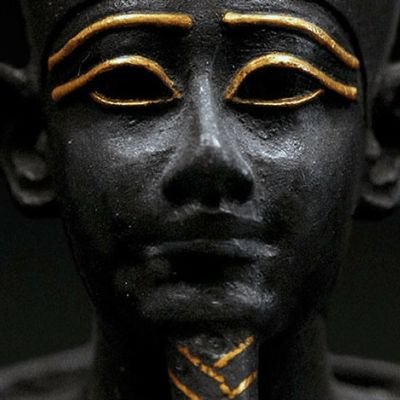
The Kushite-Kemetic name of the energy of God, Ra, continues on by the Oromo of Ethiopia, who changed the "r" to the similar "w" and called Him Wa, which later evolved into Waaqa.
The name Ra means energy.
The name Ra means energy.
Ra is not the sun (which was called Aten) but the energy of the sun and all energy in the universe, i.e., the Life Force. In West Africa, this same concept exists and is called Ase (pronounced ah-shay).
As it is that Ra is synonymous with Amen (hence the name Amen-Ra) it is the reason that after any prayer is made for action, people say Amen and in Yoruba people say Ase. It is the same concept of calling on the energy of the universe to make things happen.
Ra is a very ancient name for the Creator and is still used by the Oromo people of Ethiopia, the largest population in Ethiopia.
As explained before in another thread, the Oromo are the descendants of Kemetic people who moved to Ethiopia during the 18th-dynasty's (1550 bc-1300 bc) annexation of the horn of Africa.
After time, the "r" sound of Ra was pronounced "w," which is a common correlation in many languages. In fact, the Kemetic Ra might actually have originally been pronounced "Wa."
The Oromo of Ethiopia practiced pre-Christian monotheism and refer to the Supreme Being as Waaqa, who is none other than Ra/Raa.
In Oromo, Wa(Ra)aqa is also associated with the sun (though He is not the sun) and the energy of the universe.
In Oromo, Wa(Ra)aqa is also associated with the sun (though He is not the sun) and the energy of the universe.
In the pre-Aksummite civilization of Ethiopia, Waaqa (Ra) was the central divinity and often symbolized by the sun.
This is made clear in the later Ethiopic Christian text, the Kebra Nagast, which acknowledges that they use to worship a deity symbolized by the sun and which the mythical Queen of Sheba (Makeda, who symbolized Auset in Ethiopia), abandoned.
Though the Queen of Sheba legend is a fabrication used to explain the transition from a matriarchal Ethiopian Oromo empire (called in antiquity, Da'amat) to the patriarchal Christian Ge'ez, it exposes some of the pre-Christian culture that remains practiced by some Oromo…
…people, as well as the Kushite Omotic people of the Omo Valley.
It is also important that you understand that the Oromo racially identify as pure Afrakans, unlike the Amhara-Tigray people that most identify Ethiopia with.
It is also important that you understand that the Oromo racially identify as pure Afrakans, unlike the Amhara-Tigray people that most identify Ethiopia with.
The Amhara-Tigray (the founders of Christian Ethiopia) are actually a minority that oppress the rest of Ethiopia. Though Islam has been embraced by many Oromo as a resistance to the tan image of god pushed by Amhara-Tigray people, many Oromo still worship Waaqa (Ra).
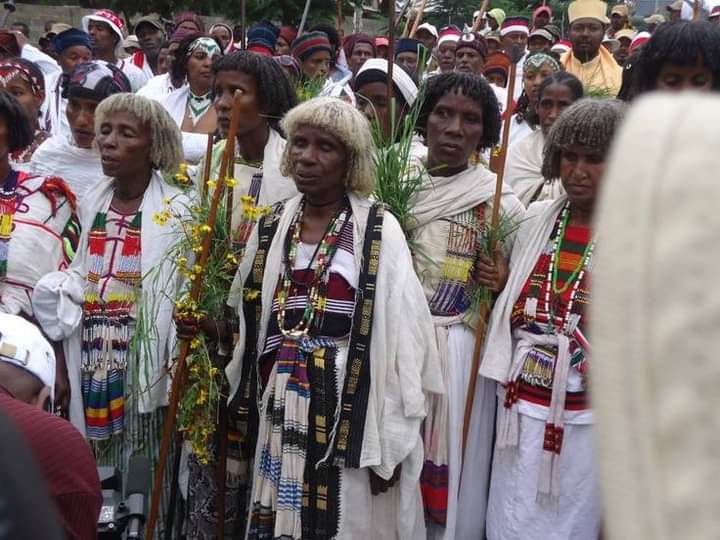
Above is the Irreechaa festival of the Ethiopian Oromo which is an explicit celebration of thanks to Waaqa (Ra). Notice the hairstyles are identical to those found in Kemetic murals. Let us give thanks to Wa(Ra)aqa.
The Kushite-Kemetic lives!
The Kushite-Kemetic lives!
Loading suggestions...