

The distinction of measuring the time in a scientific manner is achieved only by Bhāratīyas. Time has been measured from the smallest dimension to infiniteness. Even Time is envisioned as God and venerated. Paramēśvara was extolled as ‘Mahākāla’, the very embodiment of Time.
Nārāyaṇa Upaniṣad envisages Nārāyaṇa as ‘Kālaśca Nārāyaṇa:’, the very embodiment of Time, ages ago. The measurement of Time by Bhāratīyas is as ancient as the very God Himself. Count of many future ages has also been done even from very ancient times.
Since these calculations aren't dependent upon the birth & death of any individual, but are done based on astronomical science, they are thoroughly scientific. Unfortunately, during the British rule, the Bhāratīya way of Time measurement was casted as an illusion...
...with an evil intention to establish their command. Though it is 70+ years since independence, blindly time is still measured as BC & AD or CE in this religion-less land without even making any attempt to comprehend the magnanimity of Bhāratīya Time measurement methods.
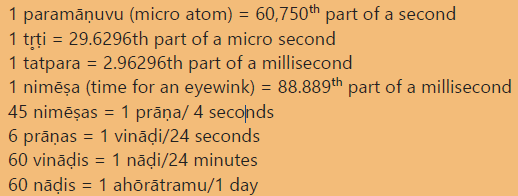
Time measurement based on inhalation and exhalation : (image)
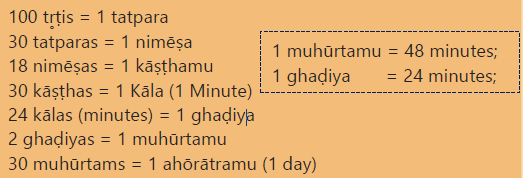
Time measurement based on Sūrya Siddhānta : (image)
Varāhamihira, an astronomical scientist, distinguished ‘Hōra’ from the above mentioned ahōrātramu and designed the measurement of Time based on ‘Hōra Paddhati’.
1 day is divided into 24 hōras. Based on this only, later a day is divided into 24 hours.
1 day is divided into 24 hōras. Based on this only, later a day is divided into 24 hours.
Time was measured as days, weeks, fortnights, months & so forth.
आरुणो अरोचनो मासक्रिन् - मासानां चन्द्र मासानां च कर्ता भवति !!
Fortnights, months, and years are counted based upon the movement of Sun and Moon.
Coz it is hard to count fortnights based on Sūrya Siddhānta,
आरुणो अरोचनो मासक्रिन् - मासानां चन्द्र मासानां च कर्ता भवति !!
Fortnights, months, and years are counted based upon the movement of Sun and Moon.
Coz it is hard to count fortnights based on Sūrya Siddhānta,
it’s easy to count fortnights, months, & years based on candra kaḷas which are directly visible to the human eye.
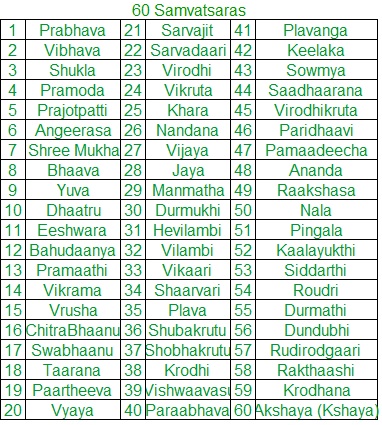
Time is divided giving names to twelve months & 60 years.
Once the cycle of sixty years is complete, they repeat themselves.
Time is divided giving names to twelve months & 60 years.
Once the cycle of sixty years is complete, they repeat themselves.
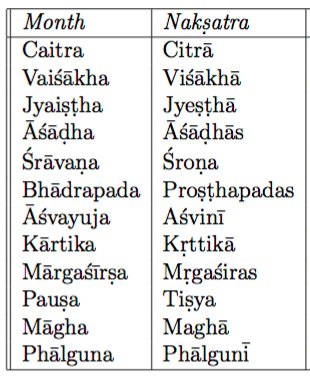
Based on the star that is close on the full moon day, the month is named accordingly. For example, the month is named ‘Chaitra’, as the star chitta is present on the full moon day of that month.
Seasons - Ritu:
Based on the transformations in nature, one-year time is divided into 6 seasons.
Vasanta - chaitra, vaisākha
Grīṣma - jyēṣṭha, āṣāḍha
Varṣa - śrāvaṇa, bhādrapada
Śarad – āśvīyuja, kārtīkamu
Hēmanta – mārgaśira, puṣya
Śiśira – māgha, phālguṇa
Based on the transformations in nature, one-year time is divided into 6 seasons.
Vasanta - chaitra, vaisākha
Grīṣma - jyēṣṭha, āṣāḍha
Varṣa - śrāvaṇa, bhādrapada
Śarad – āśvīyuja, kārtīkamu
Hēmanta – mārgaśira, puṣya
Śiśira – māgha, phālguṇa

Vasanta is that time of the year when fallen leaves sprout into tenders making nature very pleasurable. New year begins in this season & ends with leaf falling śiśira season.
Indian scriptures scientifically detail how to carve out one’s lifestyle based on seasonal changes.
Indian scriptures scientifically detail how to carve out one’s lifestyle based on seasonal changes.
Saṅkramaṇa :
Based on the arrangement of stars in the celestial sphere, the twelve zodiacs starting from Aries to Pisces formed. During the rotation of earth around Sun, Saṅkramaṇa is formed whenever Sun enters into that specific zodiac.
Based on the arrangement of stars in the celestial sphere, the twelve zodiacs starting from Aries to Pisces formed. During the rotation of earth around Sun, Saṅkramaṇa is formed whenever Sun enters into that specific zodiac.
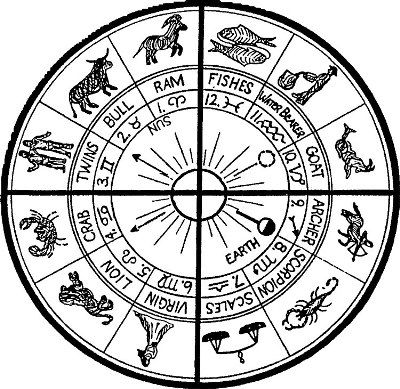
For ex: whenever Sun enters into mēṣa & vr̥ṣabha zodiacs respectively, it is called ‘mēṣa saṅkramaṇa’ & ‘vr̥ṣabha saṅkramaṇa’. These saṅkramaṇa days are very sacred.
Two among them are very prominent –
1. Makara saṅkramaṇa day when Sun enters into Capricorn
Two among them are very prominent –
1. Makara saṅkramaṇa day when Sun enters into Capricorn
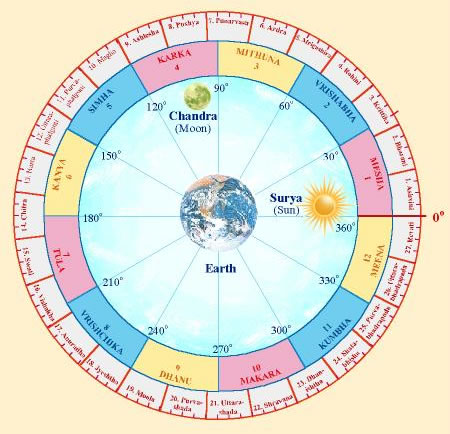
2. Karkāṭaka saṅkramaṇa day when Sun enters into Cancer.
Makara Sankranti is celebrated as ‘Sankranti’ festival (Pongal).
āyana:
‘āyana’ means journey. One year is divided into two āyanas –
1. Uttarāyana and
2. Dakṣināyana.
Makara Sankranti is celebrated as ‘Sankranti’ festival (Pongal).
āyana:
‘āyana’ means journey. One year is divided into two āyanas –
1. Uttarāyana and
2. Dakṣināyana.
These āyanas are formed based on time taken by earth to rotate around Sun. While Uttarāyana begins with Makara saṅkramaṇa day, Dakṣināyana begins with Karkāṭaka saṅkramaṇa day.
The Indian Time measurement didn't stop with years, but went forward to calculate the Yugas.
The Indian Time measurement didn't stop with years, but went forward to calculate the Yugas.
In Indian astronomy, yuga starting from 5 years to Mahā Yugas has been calculated. The word ‘Yuga’ is derived from the word ‘Yōga’ (union). According to Vedic astrology, names are given for every 5 years such as parivatsaramu, iḍāvatsaramu, anuvatsaramu, & idvatvatsaramu.
Br̥haspati (Guru or Jupiter) takes twelve years to complete on full cycle of moving across in all the twelve zodiacs. Based on this, the yuga that occurs every twelve years is called ‘bārhaspatya yuga’. Kumbhamelas occur every twelve years based on this yuga.

The union of Moon, Sun, dhaniṣṭha star, & Br̥haspati in the zodiac of Capricorn occurs once in every 60 years. This is also termed as one yuga.
Four yugas are mentioned taking the above yugas as parts within them. They are – Kr̥ta, trētā, Dvāpara & Kali.
Four yugas are mentioned taking the above yugas as parts within them. They are – Kr̥ta, trētā, Dvāpara & Kali.
1. Kr̥ta – 17,28,000 years
2. trētā – 12,96,000 years
3. Dvāpara – 8,64,000 years
4. Kali – 4,32,000 years.
Combined, all these four yugas is called one ‘Mahā yuga’ = 43,20,000 years
Time is relative.
2. trētā – 12,96,000 years
3. Dvāpara – 8,64,000 years
4. Kali – 4,32,000 years.
Combined, all these four yugas is called one ‘Mahā yuga’ = 43,20,000 years
Time is relative.
There is diff between the time measurement of gods living in divine planes & humans living in earthly planes.
1 yr on earth is equal to 1 day for gods.
71 mahā yugas is 1 manvantara.
14 manvantaras are mentioned in our scriptures & each has diff Indra as head of gods.
1 yr on earth is equal to 1 day for gods.
71 mahā yugas is 1 manvantara.
14 manvantaras are mentioned in our scriptures & each has diff Indra as head of gods.
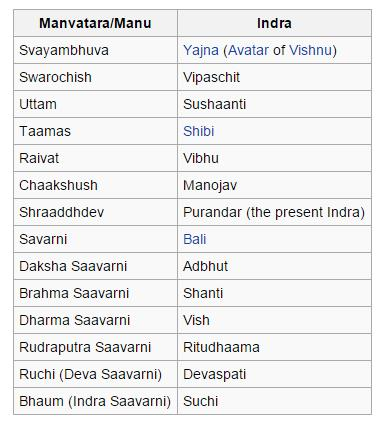
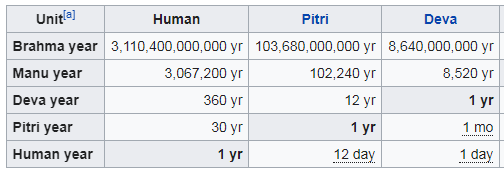
Between manvantaras, a sub praḷaya (small scale dissolution) occurs.
1,000 mahā yugas is called 1 kalpa.
1 kalpa is day & another kalpa is night for Brahma.
Lifetime of Brahma, the Creator 1Mahā Kalpa – 311,040,000,000,000 years
1,000 mahā yugas is called 1 kalpa.
1 kalpa is day & another kalpa is night for Brahma.
Lifetime of Brahma, the Creator 1Mahā Kalpa – 311,040,000,000,000 years
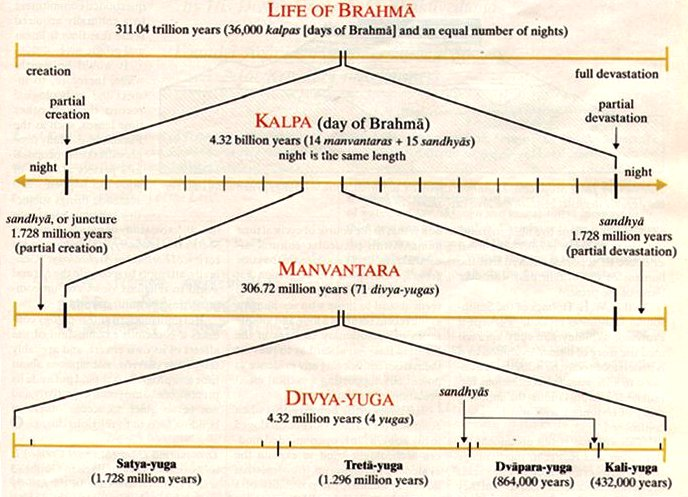

Present Time :
Current Manvantara – Vaivasvata, the 7th manvantara
Kalpa – Nighttime of Brahma
Mahā Yuga – 28th Mahā Yuga
Current Yuga – Kali Yuga
Current Year – 5121 year in Kali Yuga
Current Manvantara – Vaivasvata, the 7th manvantara
Kalpa – Nighttime of Brahma
Mahā Yuga – 28th Mahā Yuga
Current Yuga – Kali Yuga
Current Year – 5121 year in Kali Yuga
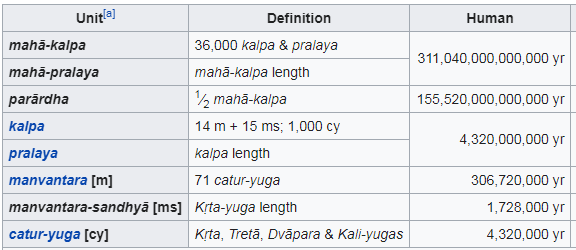
At the completion of one Mahā Kalpa, Brahma
and the entire universe present at that time
dissolves into the Supreme. Again, creation
starts.
This is the ‘Cycle of Time’.
Details of Śakas :
Derived from the rule of great emperors, (not based on Christ),
and the entire universe present at that time
dissolves into the Supreme. Again, creation
starts.
This is the ‘Cycle of Time’.
Details of Śakas :
Derived from the rule of great emperors, (not based on Christ),
Śakas are determined for Bhāratīyas. For the Kali yuga, total six emperors are mentioned as Śakakarta i.e. the beginner of an era.
1. Yudhiṣṭhira śakamu – Began in 3102 B.C. & continued for 3044 years
2. Vikrama śakamu – Began in 57 B.C. & continued for 135 years
1. Yudhiṣṭhira śakamu – Began in 3102 B.C. & continued for 3044 years
2. Vikrama śakamu – Began in 57 B.C. & continued for 135 years
3. Śālivāhana śakamu – Began in 78 A.D. & continued for 18,000 years.
Future śakas are also determined.
4. Vijayābhinandana śakamu – Duration is 10,000 years
5. Nāgārjuna śakamu – Duration is 400,000 years
6. Kalki śakamu – 821 years before the end of kali yuga.
Future śakas are also determined.
4. Vijayābhinandana śakamu – Duration is 10,000 years
5. Nāgārjuna śakamu – Duration is 400,000 years
6. Kalki śakamu – 821 years before the end of kali yuga.
Currently, it is 1938th year in Śālivāhana śaka.
Further scientific explorations of Bhāratīyas enabled them to establish the relationship between timelines of people living on this earth in relationship with stars & planets present in space.
Further scientific explorations of Bhāratīyas enabled them to establish the relationship between timelines of people living on this earth in relationship with stars & planets present in space.
That knowledge is nothing but the science of astrology. Their discoveries helped to determine the influence of specific star and planet on an individual present on earth at a specific time. Many intellectuals, domestic & foreign, are conducting scientific researches on these..
.. aspects and thereby unfolding many secrets. Based on the specific time of birth of an individual & influence of distinct stars & planets with respect to corresponding places, there are scriptures that help determine to initiate what kind of work to achieve definitive success.
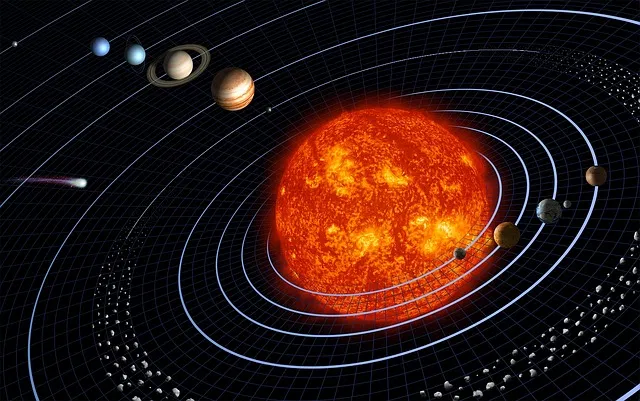
Bhāratīyas are habituated to look for auspicious times even to wear new clothes & use new items. This is not an orthodox belief, but the ultimate scientific knowledge.
Even from the times of Newton, Physics proposed many theories such as Multiverse theory, which states ..
Even from the times of Newton, Physics proposed many theories such as Multiverse theory, which states ..
that there are many worlds which are interlinked through time called the ‘Time of Relativity’. It also stated that there is possibility of reaching of those worlds thru practices, one can travel into the future to know future happenings & similarly 1 can travel into the past too.
All the above have been postulated by Bhāratīya Maharṣis (scientists) ages ago. Let’s realize this truth and take pride as a Bhāratīya.
*** End ***
*** End ***
Loading suggestions...