
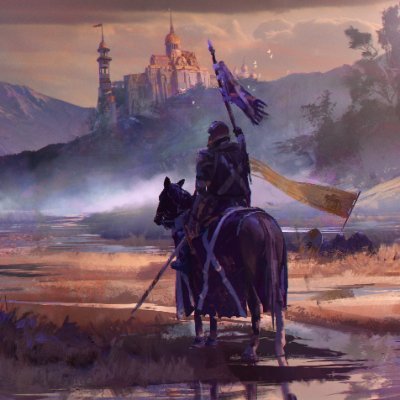
When the common unarmed citizens of Jaipur gave the rapacious Marathi hordes a taste of Righteous Dharmic Justice...
(Thread because of autistic screetching by the Mongols of the Deccan whose histories only exist as abuses on others)
(Thread because of autistic screetching by the Mongols of the Deccan whose histories only exist as abuses on others)
In 1743, Maharaja Sawai Jai Singh II, arguably the greatest statesman, scholar and ruler of 18th century India passed away. His older son Ishwari Singh (b. 1721) took the reins from his father, however to the ire of his younger son Madho Singh's supporters.
Madho Singh was the son of a Mewari Queen of Jai Singh's and hence he was supported by many. To the East, Marathas had encroached upon lands to the North of Narmada after the setting of the decay of the Mughal Empire triggered by several events after the death of Aurangzeb.
This included Holkars, the most infamous of the lot, a known clan of reckless, rapacious and depraved thugs that possibly haven't existed in recorded history.
When Madho Singh reached adulthood, he laid claim to the throne of Jaipur against his 8 years older brother, triggering the succession crisis which was taken advantage of by several Deccani opportunist scavengers whose only life purpose was to loot the fairer races of the North.
They not only salivated over the wealth of the Northern Hindu Kingdoms but also the women, who they were ever so eager to either procure or violate. Many children and women were raped, abducted and supplied to Poona's sex markets, a city built on the plunder of the North.
While the largest of India's red light districts were built by the British, Poona's Budhwar Peth held this notorious distinction before the British took it from them. Even today it is the 3rd largest red light district after Sonagachi and Kamathipura.
Of course the Peshwa's capital was to the Peshwa's designs.
It won't be incorrect to say that the native Marathi political party Shivsena inherits its obsession with Bollywood heroines, from 3 century old criminal heritage, starting in the 1600s.
It won't be incorrect to say that the native Marathi political party Shivsena inherits its obsession with Bollywood heroines, from 3 century old criminal heritage, starting in the 1600s.
Coming back to Jaipur. As Marathas and the enemies of Jaipur poisoned the mind of a young Madho Singh against his older step-brother, two primary battles were fought, Ishwari Singh was successful in defeating them in Battle of Rajamahal but was defeated in the Battle of Bagru.
Ishwari Singh knew that neither Madho Singh nor his supporters would be in control of the Maratha hordes if a hostile capture of Jaipur occured. He also knew that a surrender would mean worse would happen to Jaipur than what happened to Delhi after Nadir Shah's invasion.
On December 12, 1750, Ishwari Singh committed suicide by drinking poison, to everyone's surprise, and Madho Singh, who had just turned 22 was given the throne of Jaipur. Ishwari thus saved Jaipur from the horrors that befell Tanjore, Goa and Bengal under the Marathi scourge.
On January 10th, 1751, the Marathis entered Jaipur on the pretext of pilgrimage and shopping, knowing that Madho Singh was not yet accepted by Jaipur's nobles for his actions, and didn't have full control as he was crowned only days prior.
Now Deccani apologists and historical revisionists say the Marathi Armies entered unarmed. One only has to ask them, when have they ever entered a city unarmed? They were fighting Jaipur just days prior and had threatened the city's and Rajputana's citizens for decades by then.
Northerners despised and hated them more than anything, and the Deccanis knew it. In fact if one looks at actual history, and not what is written by later revisionists like Savarkar who have written only fiction, one may find that Mughals were infinitesimally more respected.
Historians say that upon entering, the Marathis took the city of Jaipur as a 'city taken by storm', but historians also say that, 'there is no more terrible spectacle than a city taken by storm'.
Source: Fall of the Mughal Empire (Vol. 1) ~ Jadunath Sarkar, P. 188-189.
Source: Fall of the Mughal Empire (Vol. 1) ~ Jadunath Sarkar, P. 188-189.
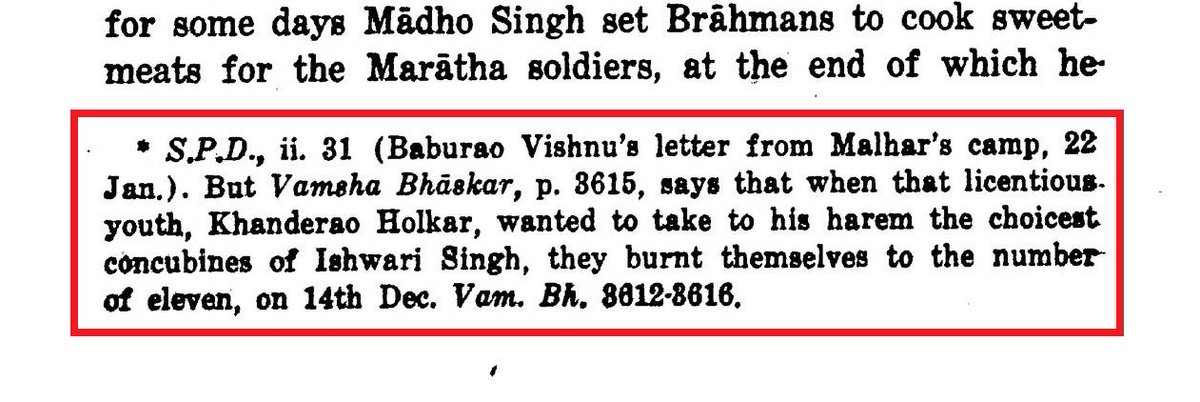
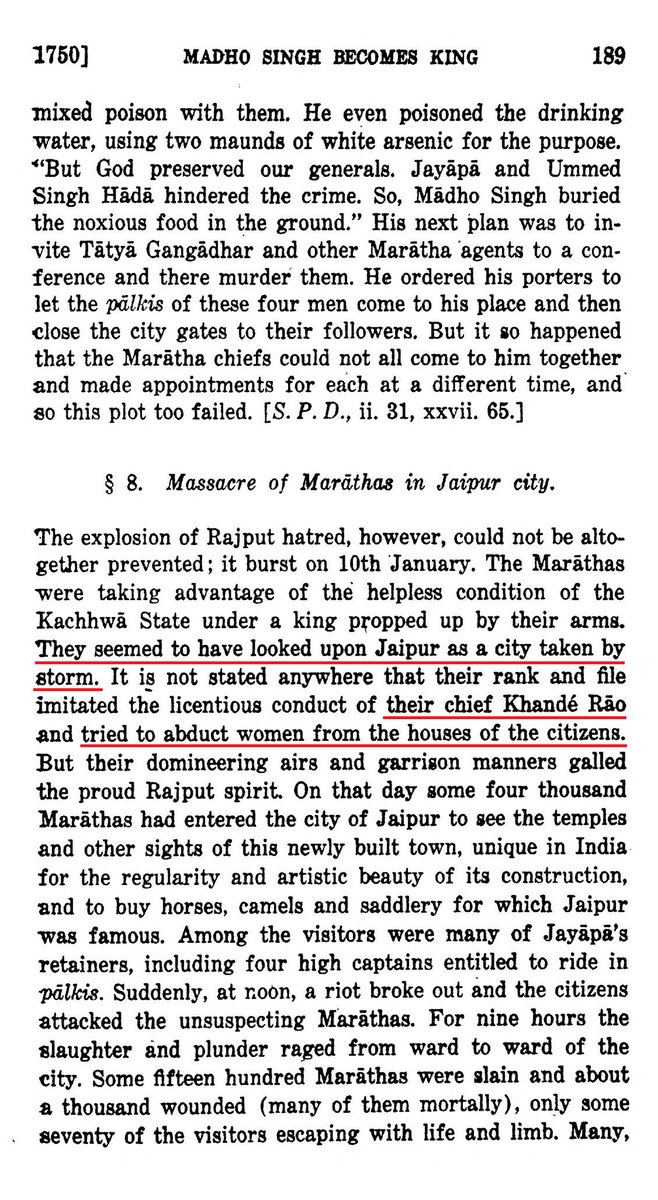
Their leader Khande Rao Holkar had already attacked the Zenana of Ishwari Singh just 2 days after the latter's death, and caused the women there to self immolate themselves (Jauhar). He and his trope also attacked the civilians and dragged highborn women of from their houses.
Holkars being Dhangars by caste and of a lowly birth, had a certain twisted drive to violate highborn women of Brahmin, Kshatriya and Vaishya birth. They mirrored the sentiments of Black Panthers of USA and of Dalit Panthers of India and allied present day leftist ideologies.
Coming back to January 10, 1751, the retaliation came from the unsuspected. As the Deccanis were engaging in plundering, the patience of the citizens of Jaipur achieved a breaking point and they hit back.
The Marathis who had never before seen the riches of a city like Jaipur thought of it as a plundering heaven, but it turned out to be retributive hell for them. Soon the Rajputs whose hands had been tied by their kings too lost their cool and joined in with the citizens.
Under righteous dharmic vengeance unleashed by the henchmen of the Mother Goddess herself, the mlecchas had little chance. As Madho Singh watched, the Mongols of the Deccan turned the Mangled of the Deccan. He now inherited his brother's enemies who he thought as his friends.
The Rajas changed, but Jaipur's enemies remained the same. Across Dhundhar, the Maratha posts, couriers, and agents were destroyed/killed. Hostilities would continue until the Afghans under Ahmad Shah Abdali would deliver the Deccanis a taste of their own medicine in 1761.
Nadir Shah's invasion in 1739 caused their rise, and Nadir Shah's self appointed loyal successor Ahmad Shah's invasion brought their fall.
History may not always repeat itself, but it does rhyme, more often than not, poetically...
#End
History may not always repeat itself, but it does rhyme, more often than not, poetically...
#End
Loading suggestions...