

Ruthless Time Management: The Decision Making Framework of Day 1 Mentality
– Thread
(requested by followers)
– Thread
(requested by followers)
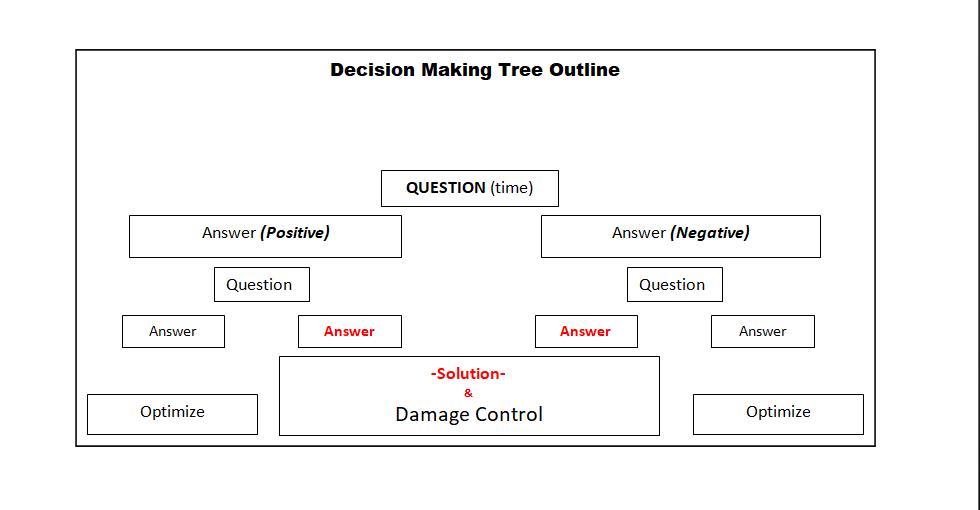
This is an explanation of how to employ damage control and avoid the slippery slope fallacy using a 2-5 minute mental map to assess daily progress,
and measure it against the day’s target.
and measure it against the day’s target.
A decision-making framework is a structural method for evaluating daily progress. It is instantaneous and formulaic.
The main purpose of this framework is to assess the damage and employ damage control where necessary.
The main purpose of this framework is to assess the damage and employ damage control where necessary.
We’ll be using a 12-hour workday for this example.
Step 1: Time Constraint Question
The first thing you need to do is assess the time.
Do you have more than 6 hours till the end of the workday? The positive answer is YES. The negative answer is NO.
Step 1: Time Constraint Question
The first thing you need to do is assess the time.
Do you have more than 6 hours till the end of the workday? The positive answer is YES. The negative answer is NO.
Step 2: Positive Answer
If your answer is YES, gauge it against the number of work hours you have left as scheduled for the day.
This means if you planned to work 12 hours and have worked 7, you have 5 hours left.
If your answer is YES, gauge it against the number of work hours you have left as scheduled for the day.
This means if you planned to work 12 hours and have worked 7, you have 5 hours left.
If the number is less than 6 (as in our example), then you’re in the safe zone and can proceed to get back to work.
If the number is more than 6, you’re in the RED zone. You need to employ damage control.
If the number is more than 6, you’re in the RED zone. You need to employ damage control.
Note: work hours should be measured by hourly milestones.
For example, for a typist at 80 wpm, 4800 words typed = 1 hour.
You determine what your milestones will be based on the kind of work you do.
For example, for a typist at 80 wpm, 4800 words typed = 1 hour.
You determine what your milestones will be based on the kind of work you do.
Step 2: Negative Answer
From step 1, if your answer is negative (you have less than 6 hours) you’re in the red zone.
The next question is how many hours you’ve worked (assuming a 12-hour workday).
From step 1, if your answer is negative (you have less than 6 hours) you’re in the red zone.
The next question is how many hours you’ve worked (assuming a 12-hour workday).
If It is less than 6 (half of 12) that means the rest of the hours you need to work exceeds the hours you have left.
You need to employ damage control.
If it is more than 6, then optimization is needed to hit the day’s target.
You need to employ damage control.
If it is more than 6, then optimization is needed to hit the day’s target.
Step 3: Damage Control
Damage control requires you to eliminate all distractions, and swiftly introduce punishment. You could add an hour to your workday and then turn off your cell phone.
If you planned to treat yourself, then you no longer will.
Damage control requires you to eliminate all distractions, and swiftly introduce punishment. You could add an hour to your workday and then turn off your cell phone.
If you planned to treat yourself, then you no longer will.
You’re basically trying to save the day.
For the rest of the day, you will work like you’re under strict supervision (which is how you should be working in the first place).
In the case where you can’t hit your daily target, you reassign the target a bit below the original.
For the rest of the day, you will work like you’re under strict supervision (which is how you should be working in the first place).
In the case where you can’t hit your daily target, you reassign the target a bit below the original.
Step 4: Optimization
Optimization requires you to stay ahead of schedule.
If you’ve worked 6 hours out of 6 and have 6 hours left for the day as well as 6 hours of work left,
then you optimize so you can get ahead of schedule.
Optimization requires you to stay ahead of schedule.
If you’ve worked 6 hours out of 6 and have 6 hours left for the day as well as 6 hours of work left,
then you optimize so you can get ahead of schedule.
The main purpose of a decision-making framework is to evaluate progress and know whether to employ damage control or optimize.
Most times we go through the day not knowing how we ended up not achieving anything for the day.
Most times we go through the day not knowing how we ended up not achieving anything for the day.
It will take you less than 2 minutes to evaluate and know what to do.
Setting up two to three evaluation times in the day will help to pull your mind back on track to ensure you optimize performance and achieve as much as possible for the day.
Setting up two to three evaluation times in the day will help to pull your mind back on track to ensure you optimize performance and achieve as much as possible for the day.
As for damage control, you need to set the parameters beforehand so you can employ it immediately when necessary.
It is not something you start thinking about once you evaluate progress, it needs to be defined at the beginning of the day.
It is not something you start thinking about once you evaluate progress, it needs to be defined at the beginning of the day.
As simple as this is, many people don't do it.
Again, this takes less than 2 minutes to run through in your head and know what to do, but most people don't do it.
Again, this takes less than 2 minutes to run through in your head and know what to do, but most people don't do it.
Loading suggestions...