

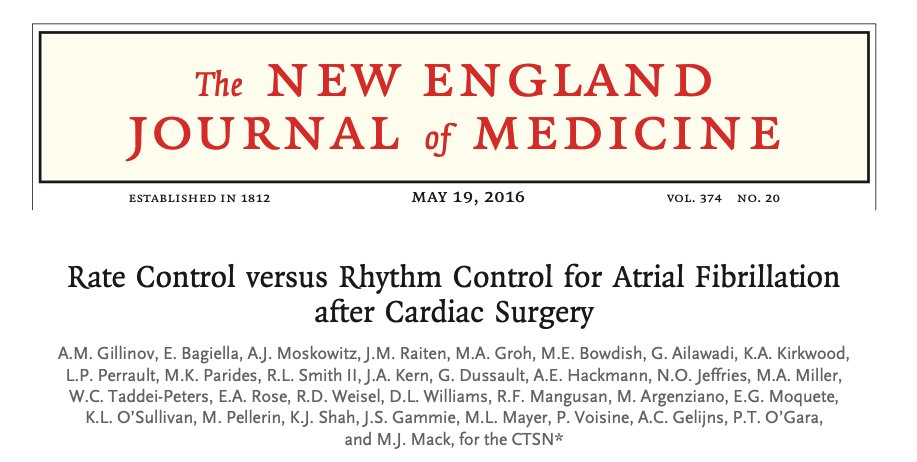
Rate Control versus Rhythm Control for Atrial Fibrillation (AF) after Cardiac Surgery. Which strategy is better for new post-operative AF? An interesting study published @NEJM @XavierPrida @USFIMres
#cardiotwitter #CardioEd #MedTwitter #arrhythmia
#cardiotwitter #CardioEd #MedTwitter #arrhythmia
Background:
- Post-op AF remains most common complication after cardiac surgery, incidence ~20-50%
- Annual cost of treating post-op AF and its sequelae ~$1 billion/year
- Complications on patients/healthcare system: increased rates of death, hospitalizations, inflated costs
- Post-op AF remains most common complication after cardiac surgery, incidence ~20-50%
- Annual cost of treating post-op AF and its sequelae ~$1 billion/year
- Complications on patients/healthcare system: increased rates of death, hospitalizations, inflated costs
Background:
- 2 strategies: rate-control / rhythm-control
- AFFIRM trial: conducted in non-surgical patients, rhythm control with no survival advantage, but more frequent hospitalizations w/ adverse drug effects
- Limited studies in post-cardiac surgery patients w/ new-onset AF
- 2 strategies: rate-control / rhythm-control
- AFFIRM trial: conducted in non-surgical patients, rhythm control with no survival advantage, but more frequent hospitalizations w/ adverse drug effects
- Limited studies in post-cardiac surgery patients w/ new-onset AF

Methods:
- Adults w/o history of AF undergoing elective cardiac surgery for CAD or valvular disease
- Randomized if developed post-op AF persisted ≥ 60 minutes or recurrent AF episodes during index hospitalization (≤ 7 days post-op)
- AF ≥48 hours, AC w/ warfarin (INR 2-3)
- Adults w/o history of AF undergoing elective cardiac surgery for CAD or valvular disease
- Randomized if developed post-op AF persisted ≥ 60 minutes or recurrent AF episodes during index hospitalization (≤ 7 days post-op)
- AF ≥48 hours, AC w/ warfarin (INR 2-3)

End-Points:
-Primary: Total number of days in hospital (including ER visits) within 60 days of randomization
- Secondary: length of index hospitalization, readmission, need for permanent placement of pacemaker, rates of death/adverse events, eligibility for d/c based on AF
-Primary: Total number of days in hospital (including ER visits) within 60 days of randomization
- Secondary: length of index hospitalization, readmission, need for permanent placement of pacemaker, rates of death/adverse events, eligibility for d/c based on AF
Results:
- Post-op AF in 695/2109 patients (33%), 523 randomization
- AF: 28.1% isolated CABG, 33.7% isolated valve surgery, 47.3% both procedures
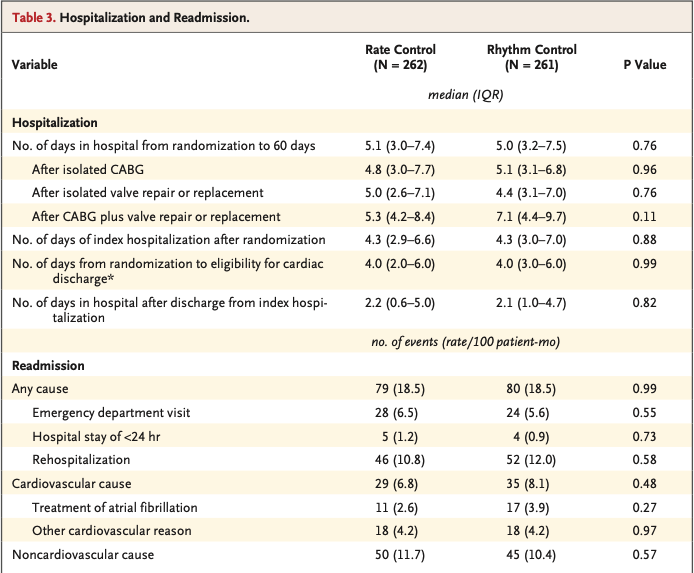
- Mean number of hospital days in rate/rhythm control: 5.1 vs. 5.0 days (p=0.76)
- Similar 30-day re-admission rates (p=0.71)
- Post-op AF in 695/2109 patients (33%), 523 randomization
- AF: 28.1% isolated CABG, 33.7% isolated valve surgery, 47.3% both procedures
- Mean number of hospital days in rate/rhythm control: 5.1 vs. 5.0 days (p=0.76)
- Similar 30-day re-admission rates (p=0.71)
Results:
- Average time to onset of post-op AF: 2.4 days
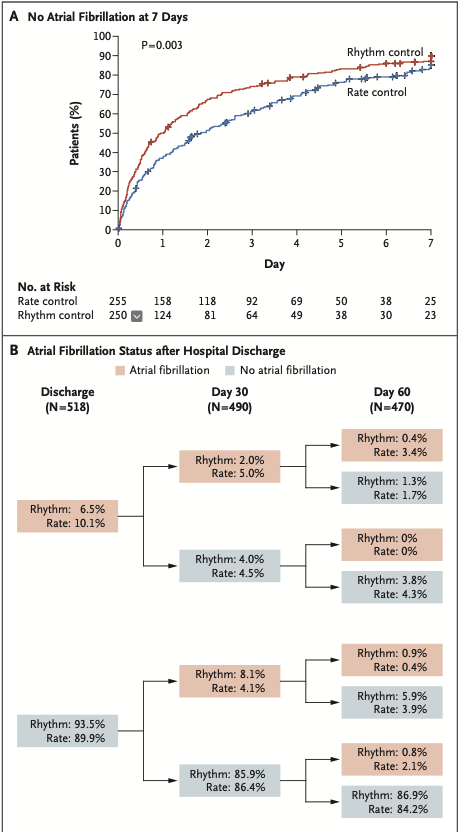
- At 60 days, stable heart rhythm without AF in 93.8% in rate-control group vs. 97.9% in rhythm-control group for previous 30 days (p=0.02)
- No significant differences in death (p=0.64)/ serious adverse effects (p=0.61)
- Average time to onset of post-op AF: 2.4 days
- At 60 days, stable heart rhythm without AF in 93.8% in rate-control group vs. 97.9% in rhythm-control group for previous 30 days (p=0.02)
- No significant differences in death (p=0.64)/ serious adverse effects (p=0.61)
Conclusion:
- No overall significant difference b/w treatment strategies w/ respect to primary end-point
- @ACCinTouch @American_Heart @HRSonline support beta-blockers for AF as first-line therapy in stable patients
- Similar rates of post-op AF ≥ 60 days in rate/rhythm control
- No overall significant difference b/w treatment strategies w/ respect to primary end-point
- @ACCinTouch @American_Heart @HRSonline support beta-blockers for AF as first-line therapy in stable patients
- Similar rates of post-op AF ≥ 60 days in rate/rhythm control
Loading suggestions...