
1.
#Thread on the history of Firearms & Gunpowder Use in Indian subcontinent
This is the first of the 3-thread-series on Gunpowder Use in India. It'll focus on the period upto Mughal Empire.
#MilitaryHistory #Hindutva #Gunpowder
#Thread on the history of Firearms & Gunpowder Use in Indian subcontinent
This is the first of the 3-thread-series on Gunpowder Use in India. It'll focus on the period upto Mughal Empire.
#MilitaryHistory #Hindutva #Gunpowder

2.
The earliest recipes of burning mixtures are from ~800 CE China, India. The first explosives made their appearance ~1200 CE.
The Mongol invasions of China carried this technology west across the Steppe into Central Asia and north India.
The earliest recipes of burning mixtures are from ~800 CE China, India. The first explosives made their appearance ~1200 CE.
The Mongol invasions of China carried this technology west across the Steppe into Central Asia and north India.

3.
We have a record from the time of the Delhi sultan Jalaludin Khilji (late 1200s) about the ‘hawai’, a rocket that could only be powered by gunpowder.
The other route into India is seaborne. Chinese were using cannons on ships since the early 1400s & traded with Indian ports.
We have a record from the time of the Delhi sultan Jalaludin Khilji (late 1200s) about the ‘hawai’, a rocket that could only be powered by gunpowder.
The other route into India is seaborne. Chinese were using cannons on ships since the early 1400s & traded with Indian ports.
4.
The 'Kautuk Chintamani', compiled by Gajapati king of Odisha - Prataparudra Deva in early 1500s, contains textual recipes for gunpowder which closely resemble Chinese recipes from 1400s.
The 'Kautuk Chintamani', compiled by Gajapati king of Odisha - Prataparudra Deva in early 1500s, contains textual recipes for gunpowder which closely resemble Chinese recipes from 1400s.

5.
Before cannons made their appearance, gunpowder was already being used- in the form of rockets and mines.
Unlike China, where the rockets were made of wood or bamboo, the Indian rocket (ban) was made from iron & had a longer range - almost a kilometer!
Before cannons made their appearance, gunpowder was already being used- in the form of rockets and mines.
Unlike China, where the rockets were made of wood or bamboo, the Indian rocket (ban) was made from iron & had a longer range - almost a kilometer!
6.
An exploding iron tube packed with gunpowder could create havoc in an enemy formation at a long range. It could also be carried easily- a cavalryman could carry a dozen rockets.
These were used from 1400s onwards in the Deccan, and by the Mughal emperor Akbar extensively.
An exploding iron tube packed with gunpowder could create havoc in an enemy formation at a long range. It could also be carried easily- a cavalryman could carry a dozen rockets.
These were used from 1400s onwards in the Deccan, and by the Mughal emperor Akbar extensively.

7.
Mines were used by digging a trench under fortifications, and planting mines. When these detonated, they brought down the walls by the force of the explosion.
This was used by Tamerlane during his capture of Delhi (1398).
Mines were used by digging a trench under fortifications, and planting mines. When these detonated, they brought down the walls by the force of the explosion.
This was used by Tamerlane during his capture of Delhi (1398).

8.
The first cannons emerged in late 1300s in Europe and China in parallel. The earliest known uses of cannon in India is early 1400s, but were not used extensively in pitched battles by armies on the field until early 1500s.
#cannon
The first cannons emerged in late 1300s in Europe and China in parallel. The earliest known uses of cannon in India is early 1400s, but were not used extensively in pitched battles by armies on the field until early 1500s.
#cannon
9.
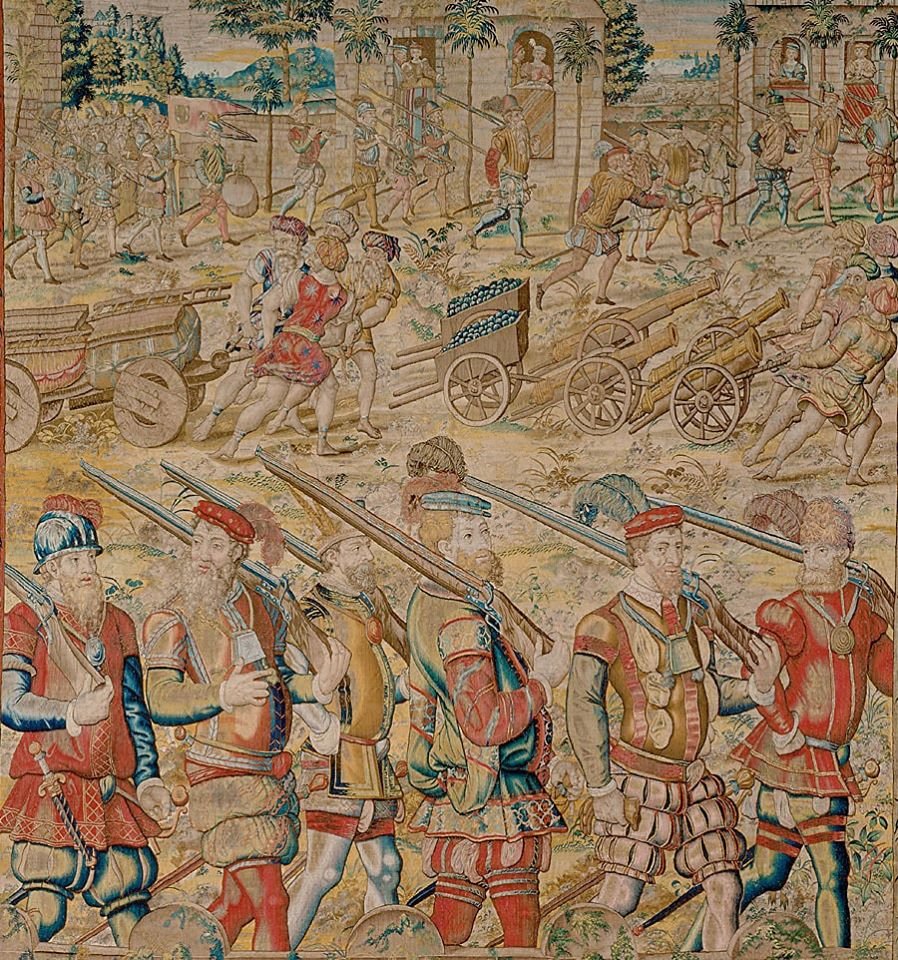
A major battle that saw use of cannons and musketeers by both sides was the battle of Raichur (1520) between the Bijapur Sultanate & Vijayanagar Empire.
The Adilshah of Bijapur had a massive artillery train, but they had not yet mastered its tactics.
A major battle that saw use of cannons and musketeers by both sides was the battle of Raichur (1520) between the Bijapur Sultanate & Vijayanagar Empire.
The Adilshah of Bijapur had a massive artillery train, but they had not yet mastered its tactics.
10.
Krishnadevaraya of Vijaynagar was able to use a cavalry charge to destroy the artillery before they could reload after the first volley.
The battle, however, led to a large scale increase in use of cannons and muskets.
Krishnadevaraya of Vijaynagar was able to use a cavalry charge to destroy the artillery before they could reload after the first volley.
The battle, however, led to a large scale increase in use of cannons and muskets.
11.
The first cannons could be fired only several times a day to allow the metal to cool; or it would crack and explode.
One of the major ingredients for gunpowder was niter - abundant in India but not in Europe. They set up factories, to make gunpowder from niter for export. 👇
The first cannons could be fired only several times a day to allow the metal to cool; or it would crack and explode.
One of the major ingredients for gunpowder was niter - abundant in India but not in Europe. They set up factories, to make gunpowder from niter for export. 👇

12.
Europe innovated on cannons & came up with a miniature- the hand cannon.
By making this even smaller, & adding a trigger + match to it, it became the first handgun as we know it- the Arquebus. Kept on a stand, a burning match lit the gunpowder when the trigger was pressed.
Europe innovated on cannons & came up with a miniature- the hand cannon.
By making this even smaller, & adding a trigger + match to it, it became the first handgun as we know it- the Arquebus. Kept on a stand, a burning match lit the gunpowder when the trigger was pressed.

13.
Firearms were expensive. Cannons required elephants to move, and were very slow.
Trained artillery crews were needed. This started a push to unify states. Strong rulers now had enough firepower to conquer neighbors. Gunpowder led to large centralized states across the world.
Firearms were expensive. Cannons required elephants to move, and were very slow.
Trained artillery crews were needed. This started a push to unify states. Strong rulers now had enough firepower to conquer neighbors. Gunpowder led to large centralized states across the world.
14.
In the next part of the thread-series on gunpowder, we look at the development of gunpowder & firearms during the Mughal-Maratha period of Indian History.
#MilitaryHistory #Hindutva #India
In the next part of the thread-series on gunpowder, we look at the development of gunpowder & firearms during the Mughal-Maratha period of Indian History.
#MilitaryHistory #Hindutva #India
Loading suggestions...