

You might have heard about buzzwords like artificial intelligence, machine learning, data science, and deep learning.
But, what exactly do they mean and how are they different from each other?
🧵 👇🏻
But, what exactly do they mean and how are they different from each other?
🧵 👇🏻

What you'll read in this thread is an answer to the best of my capacity, someone who has been self-learning about computer vision and machine learning for about a year.
Let's begin with Artificial Intelligence (or AI for short).
AI has existed as a concept since the 1950s and as its name suggests, it basically refers to "artificial" intelligence.
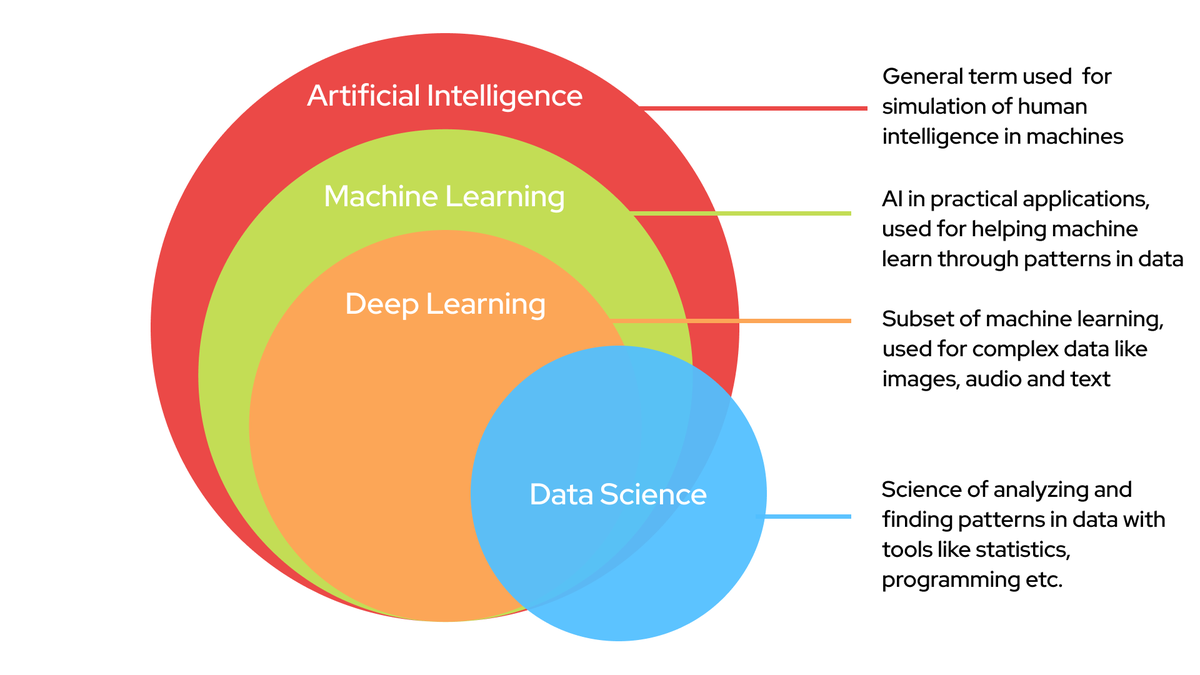
It is a very general term typically used for talking about intelligence in computers.
AI has existed as a concept since the 1950s and as its name suggests, it basically refers to "artificial" intelligence.
It is a very general term typically used for talking about intelligence in computers.
For example, the code that controls NPCs (Non-player characters like pedestrians) in a game like GTA V or Cyberpunk is Artificial Intelligence.

Machine learning
This a subset of Artificial Intelligence, and I like to describe machine learning as AI in practice.
Machine learning is a way of helping machines(computers) to learn through patterns in data.
This a subset of Artificial Intelligence, and I like to describe machine learning as AI in practice.
Machine learning is a way of helping machines(computers) to learn through patterns in data.
An example of machine learning:
We train a "machine learning model" on data of house prices with metrics like area, proximity to main road etc.
This machine learning model can be used to predict the prices of new houses and this can help us make better buying decisions.
We train a "machine learning model" on data of house prices with metrics like area, proximity to main road etc.
This machine learning model can be used to predict the prices of new houses and this can help us make better buying decisions.

Deep learning
This is a subset of machine learning and achieves similar goals. Machine learning is used for 'simple' applications like predicting the price of a house where patterns are clearly visible.
This is a subset of machine learning and achieves similar goals. Machine learning is used for 'simple' applications like predicting the price of a house where patterns are clearly visible.
Deep learning is used in places where patterns in data less clearly visible, like predicting whether a cat or dog is in an image.

Simply put, machine learning is used for 'simple' data like data of pricing of houses, and deep learning is used for more 'complex' data like those in images, audio, etc.
The end goal of both is the same, helping computers learn through data.
The end goal of both is the same, helping computers learn through data.
Now let's talk about data science.
Data science is about analyzing and finding patterns in data.
One can use several tools for this, like statistics, programming, and even machine/deep learning.
Data science is about analyzing and finding patterns in data.
One can use several tools for this, like statistics, programming, and even machine/deep learning.
A common misconception is that machine learning is necessary for data science.
It is possible to perfectly possible to analyze data without machine learning.
It is possible to perfectly possible to analyze data without machine learning.
If you're a beginner, you probably have questions like:
- How can I learn machine learning, data science, or deep learning?
There is nothing wrong with this question but a better form of this question would be:
- How can I write code that can identify an object in an image?
- How can I learn machine learning, data science, or deep learning?
There is nothing wrong with this question but a better form of this question would be:
- How can I write code that can identify an object in an image?
The reason why I say this is a better question because machine learning, data science, etc. are just tools to solve problems.
Focus on solving problems and find the tools accordingly, a much better approach in my opinion.
Focus on solving problems and find the tools accordingly, a much better approach in my opinion.
I am working on making another thread that goes more in-depth on this, but for now, that's the end of this thread.
If you liked it then follow me for more content like this.
And before you leave, here's a recap 👇🏻
If you liked it then follow me for more content like this.
And before you leave, here's a recap 👇🏻
You will never be done learning data science, machine learning, or deep learning, these are vast fields.
I find it better to learn things as I need them:
- Want to visualise data?
Learn to use matplotlib
-Want to solve an NLP problem?
Learn TensorFlow
I find it better to learn things as I need them:
- Want to visualise data?
Learn to use matplotlib
-Want to solve an NLP problem?
Learn TensorFlow
Loading suggestions...