
Let's talk about YEAST!
🤔What are they
🤒Which ones cause human disease
🧫How do we ID them in the lab
💊What are the treatment options (including mechanisms & resistance to anti-fungals)
#IDtwitter #MicroMedEd
🤔What are they
🤒Which ones cause human disease
🧫How do we ID them in the lab
💊What are the treatment options (including mechanisms & resistance to anti-fungals)
#IDtwitter #MicroMedEd

Yeast are a type of fungi (so are moulds&🍄).
"Yeast" isn't a taxonomic group, it describes how they appear. Single-celled like bacteria, but eukaryotic. (More here
Thanks Saccharomyces for your sourdough bread. (And my beer🍻)
nature.com
"Yeast" isn't a taxonomic group, it describes how they appear. Single-celled like bacteria, but eukaryotic. (More here
Thanks Saccharomyces for your sourdough bread. (And my beer🍻)
nature.com


Yeast come in many shapes & sizes, and there are mimics that can look like yeast on microscopy.
🔬The CLSI M54 categorizes yeast by size, and I love their approach, expanded here:
🔬The CLSI M54 categorizes yeast by size, and I love their approach, expanded here:

So what are the important yeast to know in medicine?
Start with:
🍄Candida
🍄Cryptococcus
🍄Pneumocystis
⭐️For expert level, add the full table here.
⚡️Please note the disease associations & buzzwords listed here, hope this table can be high value for you!
Start with:
🍄Candida
🍄Cryptococcus
🍄Pneumocystis
⭐️For expert level, add the full table here.
⚡️Please note the disease associations & buzzwords listed here, hope this table can be high value for you!

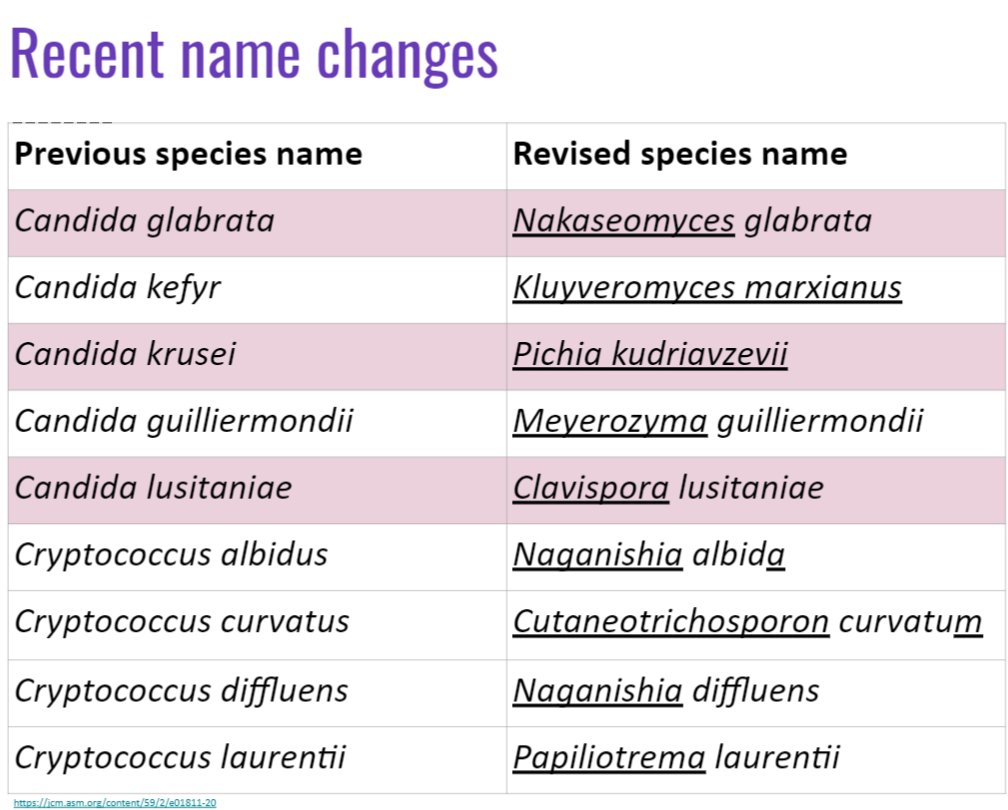
🏆For EXPERT EXPERT level, check out all these new name changes!
jcm.asm.org
(Just kidding, no one is using these.)
jcm.asm.org
(Just kidding, no one is using these.)
Let's look at
🍄Candida🍄
Sounds like my home country🇨🇦 but way meaner.
This is a common member of our microbiome, but an opportunistic pathogen.
🩸It's one of the most common causes of bacteremia, with nasty possible complications. 🛑Candida in blood: NEVER a contaminant!
🍄Candida🍄
Sounds like my home country🇨🇦 but way meaner.
This is a common member of our microbiome, but an opportunistic pathogen.
🩸It's one of the most common causes of bacteremia, with nasty possible complications. 🛑Candida in blood: NEVER a contaminant!

Candidemia can progress to invasive candidiasis, leading to infections at several body sites.
Good reminder of why our immune systems are so, so important: These infections are much more likely to happen when the immune system is weakened.
Great article:
nejm.org
Good reminder of why our immune systems are so, so important: These infections are much more likely to happen when the immune system is weakened.
Great article:
nejm.org

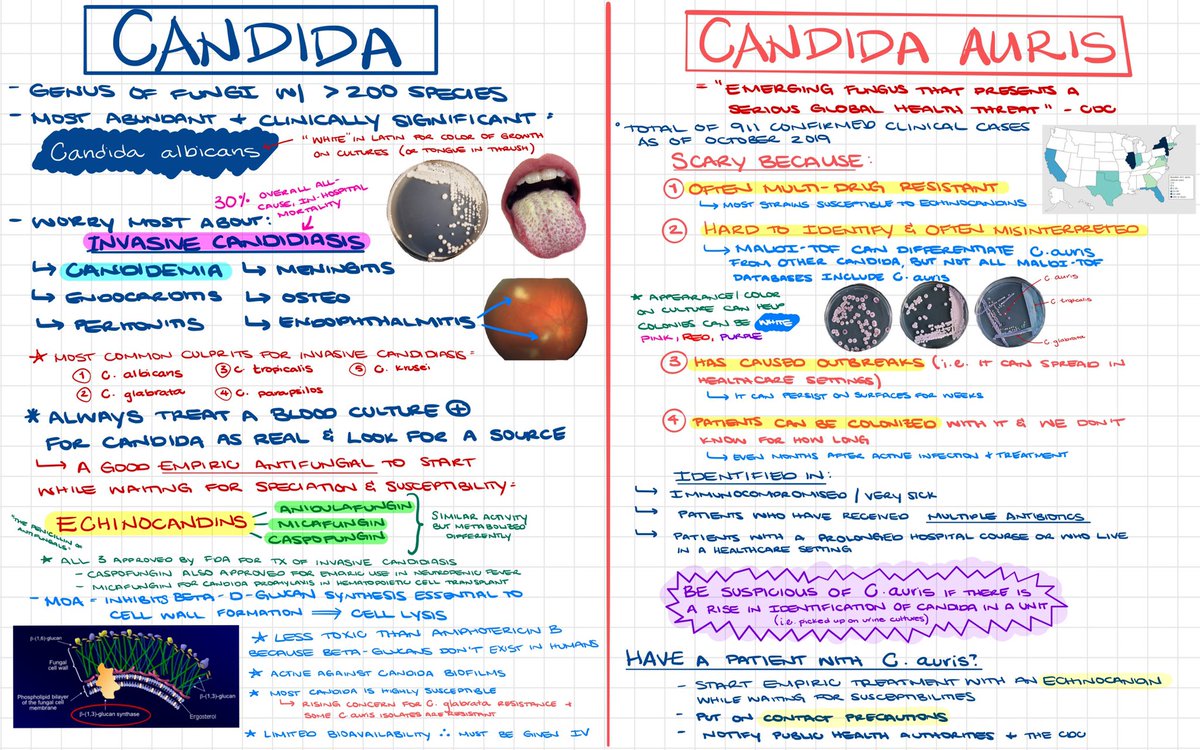
And you can't talk about Candida without talking about C. auris:
🍄C. auris is an emerging pathogen with a propensity for biofilms, hospital spread, and antifungal resistance.😱
.@LizzyHastie made a great overview on this pathogen!
🍄C. auris is an emerging pathogen with a propensity for biofilms, hospital spread, and antifungal resistance.😱
.@LizzyHastie made a great overview on this pathogen!
Next in line?
🍄Cryptococcus🍄
Cryptococcus is known for its huge capsule that makes it much harder for macrophages to engulf (compare sizes in tweet 2!).
Your Cryptococcus buzzords:
⚡️bats
⚡️HIV
⚡️capsule
⚡️Vancouver Island
⚡️Australia
🍄Cryptococcus🍄
Cryptococcus is known for its huge capsule that makes it much harder for macrophages to engulf (compare sizes in tweet 2!).
Your Cryptococcus buzzords:
⚡️bats
⚡️HIV
⚡️capsule
⚡️Vancouver Island
⚡️Australia

C. neoformans only affects certain people (weak immune system).
C. gattii only affects certain regions.
Both cause pneumonia +/- meningitis.
Here's the most incredible image of Cryptococcus I've ever seen:🤯
🔬
And C.gattii epidemiology from the CDC.
C. gattii only affects certain regions.
Both cause pneumonia +/- meningitis.
Here's the most incredible image of Cryptococcus I've ever seen:🤯
🔬
And C.gattii epidemiology from the CDC.


Next up:
🍄Pneumocystis🍄
Not a classical yeast. In fact, 'we' thought it was a parasite for a long time. But it causes severe pneumonia in immunocompromised individuals.
Fortunately, there's effective prophylaxis.💊
🍄Pneumocystis🍄
Not a classical yeast. In fact, 'we' thought it was a parasite for a long time. But it causes severe pneumonia in immunocompromised individuals.
Fortunately, there's effective prophylaxis.💊
For a quick overview of pneumocystis pneumonia (risk factors, symptoms, and appearance on chest x-ray), peek at
Your PJP buzzords:
⚡️honeycombing
⚡️bat-winging
🧐Remember, PJP = P.jirovecii pneumonia, not the organism.
Your PJP buzzords:
⚡️honeycombing
⚡️bat-winging
🧐Remember, PJP = P.jirovecii pneumonia, not the organism.
So let's go over to the Microbiology Lab now.
(ahem,🥼+🧤)
You think your patient might have one of these 'bugs' & you want to diagnose it.
We have a few tools for you:
🩸Biomarkers
🔬Microscopy + Pathology
🧫Culture
🧪Various other tests
(ahem,🥼+🧤)
You think your patient might have one of these 'bugs' & you want to diagnose it.
We have a few tools for you:
🩸Biomarkers
🔬Microscopy + Pathology
🧫Culture
🧪Various other tests

To start, here are some ⚡️buzzwords for diagnostic clues for each genus:

🩸Biomarkers🩸
.@swinndong &.@febrilepodcast made this WONDERFUL infographic on fungal biomarkers. 👏
It sits next to a quick overview of genera each are useful for.
.@swinndong &.@febrilepodcast made this WONDERFUL infographic on fungal biomarkers. 👏
It sits next to a quick overview of genera each are useful for.

🔬Pathology🔬
Kudos to the same .@swinndong &.@febrilepodcast, who was on a roll for high-yield fungal resources!
This beautiful adaptation demonstrates the key differences (& similarities) between yeast & moulds on pathology. 🔬
Kudos to the same .@swinndong &.@febrilepodcast, who was on a roll for high-yield fungal resources!
This beautiful adaptation demonstrates the key differences (& similarities) between yeast & moulds on pathology. 🔬

🧫Culture🧫 + 🧪Other tests🧪
Everyone's favourite 9,000 page book has this great algorithm to start winnowing down what genus you might be looking at.
👏Clin Micro Procedures "Handbook"😂
Everyone's favourite 9,000 page book has this great algorithm to start winnowing down what genus you might be looking at.
👏Clin Micro Procedures "Handbook"😂

🧫Culture🧫 + 🧪Other tests🧪
Beyond that, important to know your Candida! At least small vs. large, germ tube, and pseudohyphae.
Hope this table helps.
Beyond that, important to know your Candida! At least small vs. large, germ tube, and pseudohyphae.
Hope this table helps.

Cryptococci are VERY cool beasties, and a variety of tests help in their diagnosis & identification.
Writing your exams? Remember urease + caffeic acid.
🛑careful with CrAg - not all manufacturers promise to detect C.gattii! If it's on your DDx, call your lab.👩🔬
Writing your exams? Remember urease + caffeic acid.
🛑careful with CrAg - not all manufacturers promise to detect C.gattii! If it's on your DDx, call your lab.👩🔬

Our next & final topic:
💊Antifungals for the treatment of infections by yeast💊
💊Antifungals for the treatment of infections by yeast💊

To understand antifungals, important to understand the fungal cell wall. These are my two favourite graphics for this.
Hat-tip to .@cullen_lilley & .@PathElective for their straightforward & effective graphics.
nature.com
Hat-tip to .@cullen_lilley & .@PathElective for their straightforward & effective graphics.
nature.com


✅Now antifungals make sense.
Here are the common classes, and a broad overview of their spectra from: mayoclinicproceedings.org
💊
as well as some quick insight into their mechanism:
Here are the common classes, and a broad overview of their spectra from: mayoclinicproceedings.org
💊
as well as some quick insight into their mechanism:


Put that all together and you can build a little antibiogram for which antifungals are typically effective vs. ineffective against certain yeast.
💊💊💊💊💊💊💊💊💊💊💊💊
💊💊💊💊💊💊💊💊💊💊💊💊


All together, that's a quick overview of monomorphic yeast. 🍄
There's much to learn for these tiny beasties, so hope that those resources are helpful.
I'll post a resource list next if you want to keep reading, & expect an update soon with new guidelines on other yeast.
📚📚
There's much to learn for these tiny beasties, so hope that those resources are helpful.
I'll post a resource list next if you want to keep reading, & expect an update soon with new guidelines on other yeast.
📚📚

📚IDSA guidelines for Candidiasis: idsociety.org
📚About Candida auris: cmaj.ca
📚CDC guidance for identifying C.auris: cdc.gov
📚Rhodotorula: #t3" target="_blank" rel="noopener" onclick="event.stopPropagation()">antimicrobe.org
📚Pseudozyma infections: pubmed.ncbi.nlm.nih.gov
📚About Candida auris: cmaj.ca
📚CDC guidance for identifying C.auris: cdc.gov
📚Rhodotorula: #t3" target="_blank" rel="noopener" onclick="event.stopPropagation()">antimicrobe.org
📚Pseudozyma infections: pubmed.ncbi.nlm.nih.gov

I forgot my favourite Cryptococcus slide! Here's how our names for different #Cryptococcus species & types has 'evolved'.
CLSI shows why sub-typing or sub-'speciation' is important for cryptococci: Different type = different ECV (the closest we have to 💊breakpoints for crypto).
CLSI shows why sub-typing or sub-'speciation' is important for cryptococci: Different type = different ECV (the closest we have to 💊breakpoints for crypto).

Loading suggestions...