
Technology
Business
Artificial Intelligence
Data Science
Retail
Machine Learning
Accuracy in Predictive Models
Shoplifting Prevention

A store owner recently noticed an alarmingly high rate of shoplifting.
He develops a machine learning model that predicts if a customer has shoplifted or not and it is 95% accurate!
He deploys the model but a month later catches no shoplifters...
Why?
🧵 👇🏻
He develops a machine learning model that predicts if a customer has shoplifted or not and it is 95% accurate!
He deploys the model but a month later catches no shoplifters...
Why?
🧵 👇🏻

Before we get into this problem it is important to understand what accuracy is.
Accuracy is the number of times you predicted something correctly divided by how many times you actually predicted it.
Accuracy is the number of times you predicted something correctly divided by how many times you actually predicted it.

If you closely look at the dataset, you will notice that out of the 10,000 customers that entered the store, only 500 were shoplifters in that month.
Some quick math will tell you that 95% of customers are not shoplifters and the other 5% are.
Some quick math will tell you that 95% of customers are not shoplifters and the other 5% are.

If you basically said that everyone was not a shoplifter, you'd be correct in 95 out of 100 cases, which is what the model did.
You would be wrong in the other 5 cases, but who cares?
We're still 95% accurate, but this is clearly not what we are looking for.
You would be wrong in the other 5 cases, but who cares?
We're still 95% accurate, but this is clearly not what we are looking for.
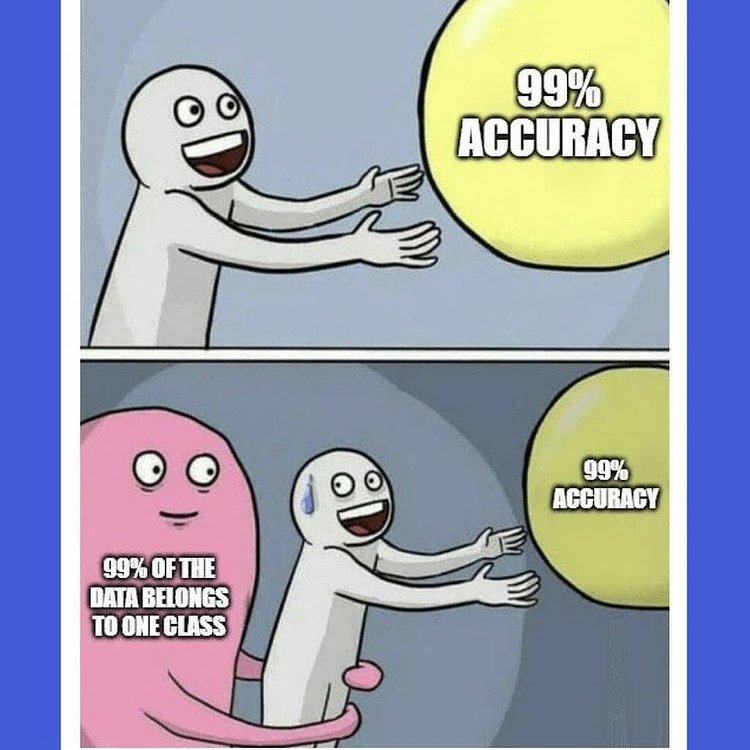
This problem happens in 'imbalanced' datasets where the data is heavily skewed.
You're either a shoplifter, or you're not, and the former is significantly more present in the dataset.
Our model finds a shortcut to increase accuracy.
You're either a shoplifter, or you're not, and the former is significantly more present in the dataset.
Our model finds a shortcut to increase accuracy.

Moral of the story: Accuracy is not a suitable metric to use in situations where the data is skewed.
Then, how do we solve this problem?
👇🏻
Then, how do we solve this problem?
👇🏻
S̶t̶o̶p̶ ̶u̶s̶i̶n̶g̶ ̶m̶a̶c̶h̶i̶n̶e̶ ̶l̶e̶a̶r̶n̶i̶n̶g̶ ̶a̶n̶d̶ ̶j̶u̶s̶t̶ ̶i̶n̶v̶e̶s̶t̶i̶g̶a̶t̶e̶ ̶e̶v̶e̶r̶y̶ ̶c̶u̶s̶t̶o̶m̶e̶r̶.
Evaluate your model using a different metric, let us take a look at recall and precision, but first, it is important to understand some terminology.
Evaluate your model using a different metric, let us take a look at recall and precision, but first, it is important to understand some terminology.
This is a confusion matrix, it shows you all the possible scenarios of the predictions of a model Vs the ground truth.
Pretty confusing right?
(No pun intended)
Let me simplify it.
Pretty confusing right?
(No pun intended)
Let me simplify it.
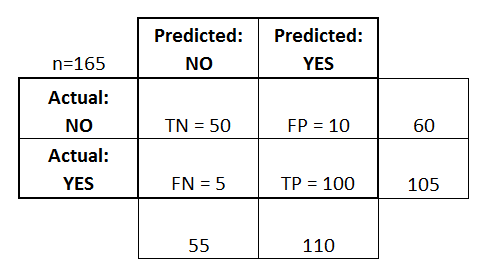
This meme explains is better, the confusion matrix shows us the predictions of a model Vs the ground truth.
Consider the doctor to be the model and the patient to be the ground truth.
Consider the doctor to be the model and the patient to be the ground truth.

Let's co-relate this to our case of shoplifting.
Case 1: Our model predicts someone shoplifted when they actually did (TP - True Positive)
Case 2: Our model predicts someone shoplifted when they didn't (FP - False Positive)
Case 1: Our model predicts someone shoplifted when they actually did (TP - True Positive)
Case 2: Our model predicts someone shoplifted when they didn't (FP - False Positive)
Case 3: Our model predicts someone did not shoplift when they did (FN - False Negative)
Case 4: Our model predicts someone did not shoplift when they didn't (TN - True Negative)
Whenever you're confused, just refer to the above meme.
Case 4: Our model predicts someone did not shoplift when they didn't (TN - True Negative)
Whenever you're confused, just refer to the above meme.
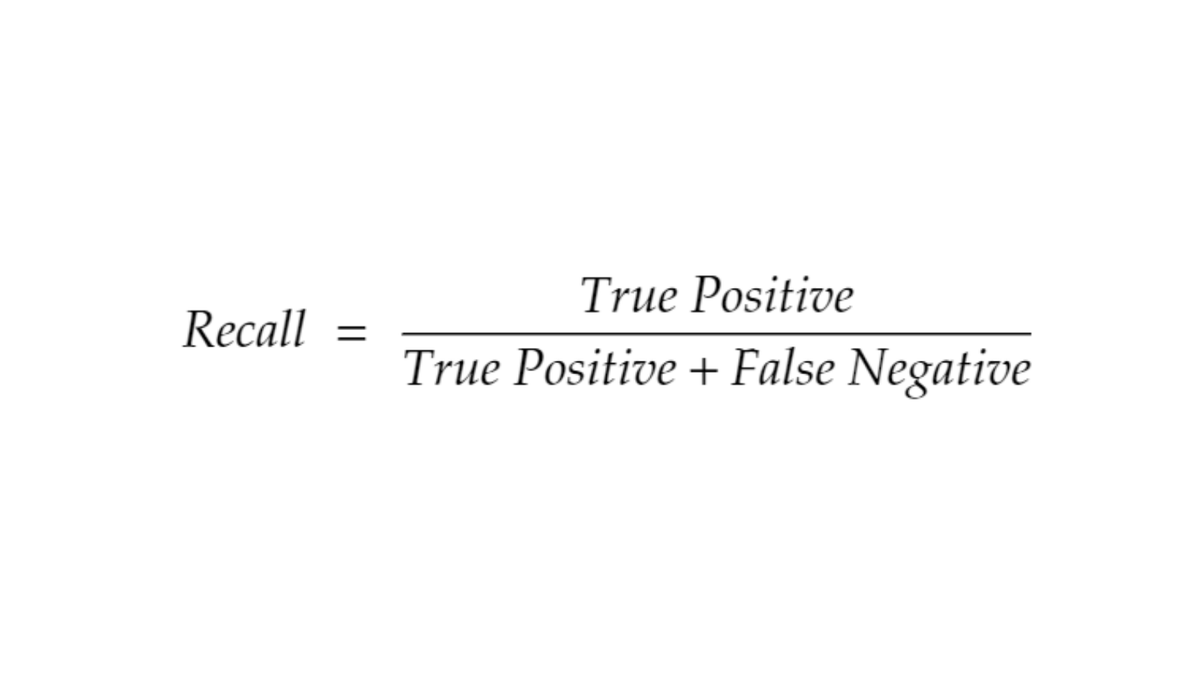
In formal terms, 'recall' is defined using this formula 👇🏻
What this metric basically does is tells us how good our model is at identifying relevant samples.
Or
How good is our model at catching actual shoplifters?
TP: Shoplifters correctly identified
FN: Shoplifters missed
What this metric basically does is tells us how good our model is at identifying relevant samples.
Or
How good is our model at catching actual shoplifters?
TP: Shoplifters correctly identified
FN: Shoplifters missed
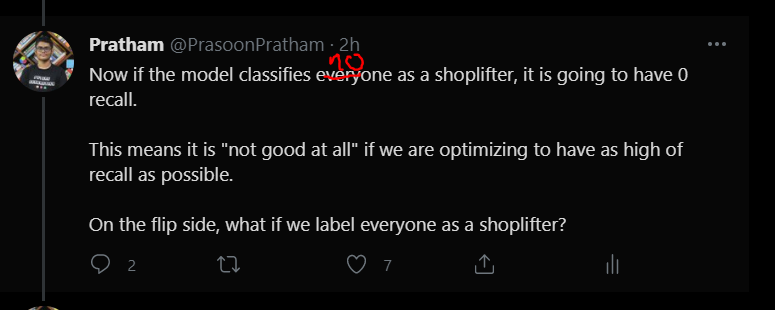
Now if the model classifies everyone as a shoplifter, it is going to have 0 recall.
This means it is "not good at all" if we are optimizing to have as high of recall as possible.
On the flip side, what if we label everyone as a shoplifter?
This means it is "not good at all" if we are optimizing to have as high of recall as possible.
On the flip side, what if we label everyone as a shoplifter?
We'll have a recall of 100%, after all, recall just cares about not missing shoplifters, not about false accusations on customers (False Positive).
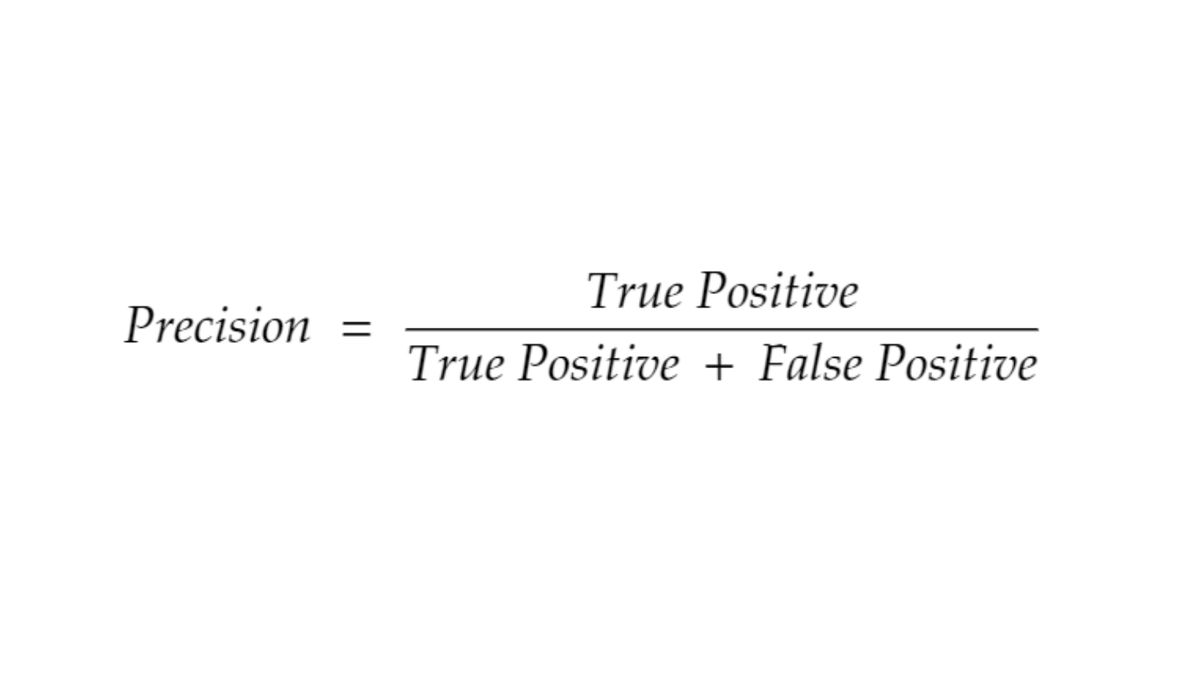
But there is a metric that does care about false accusations on customers, precision.
But there is a metric that does care about false accusations on customers, precision.
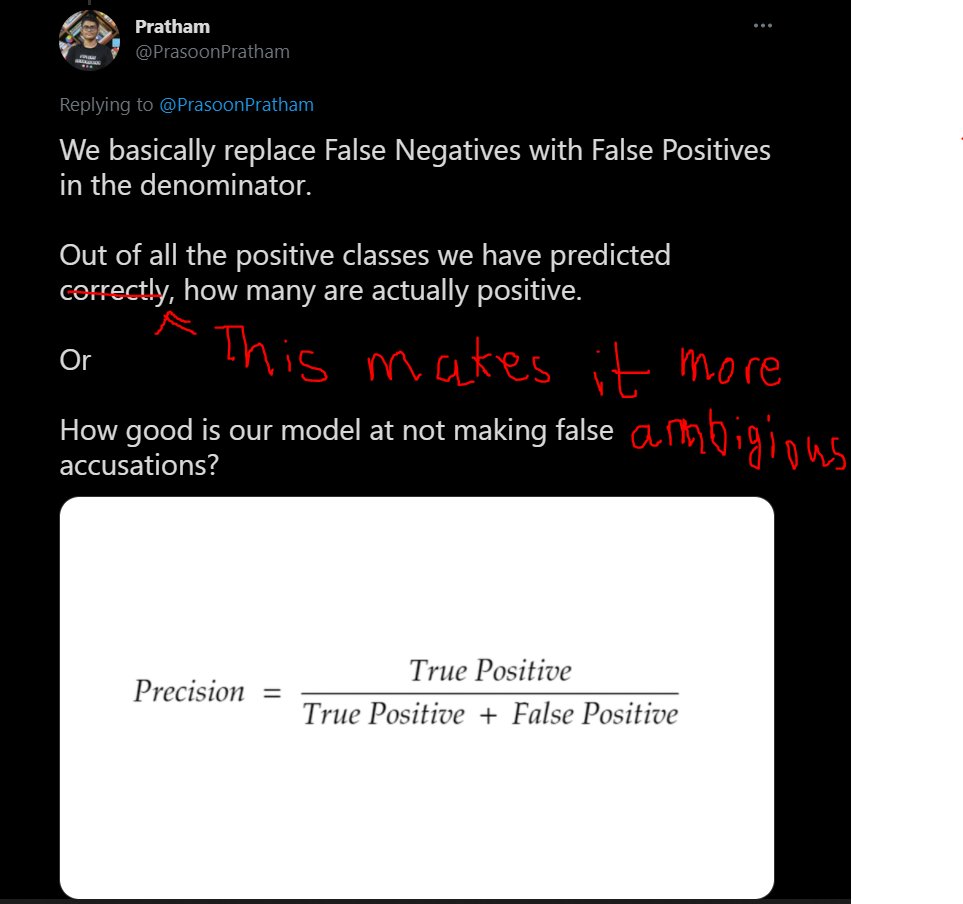
We basically replace False Negatives with False Positives in the denominator.
Out of all the positive classes we have predicted correctly, how many are actually positive.
Or
How good is our model at not making false accusations?
Out of all the positive classes we have predicted correctly, how many are actually positive.
Or
How good is our model at not making false accusations?
By this point, you might've guessed what problem we will encounter if we only optimize for high precision in our model.
The model can just call everyone not a shoplifter and have high precision.
The model can just call everyone not a shoplifter and have high precision.
Recall and precision are related such that high precision leads to low recall, and low precision leads to high recall.
We obviously want both to as high as possible, is there any metric that combines both precision and recall?
Say hello to the F₁ score 👋🏻
We obviously want both to as high as possible, is there any metric that combines both precision and recall?
Say hello to the F₁ score 👋🏻
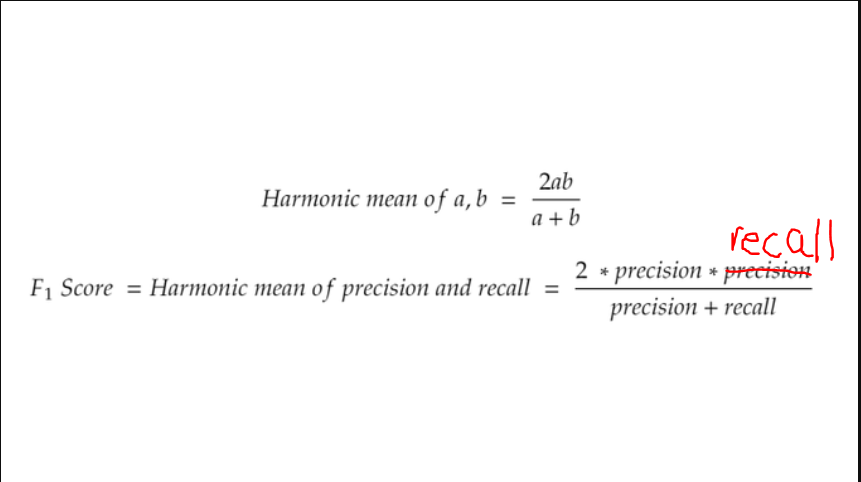
The F₁ score is the harmonic mean of precision and recall.
The harmonic mean is a special type of mean(average) which is explained by this formula. 👇🏻
We use this mean instead of the normal mean because the normal punishes extreme values.
The harmonic mean is a special type of mean(average) which is explained by this formula. 👇🏻
We use this mean instead of the normal mean because the normal punishes extreme values.

Now if we optimize our model to have an F₁ score, we can have high precision and recall.
This translates to our model being able to catch shoplifters and at the same time not falsely accuse innocent customers.
This translates to our model being able to catch shoplifters and at the same time not falsely accuse innocent customers.
The model will be sure when it catches a shoplifter that it is actually a shoplifter and that brings this story to an end.
Over the next few months, I will be explaining even more evaluation metrics like the F₁ score.
If you enjoy such content, make sure to follow me.
Over the next few months, I will be explaining even more evaluation metrics like the F₁ score.
If you enjoy such content, make sure to follow me.
3 typos in the thread:
- Everyone -> no one
- Ambiguity in the statement ( Correct: Out of all the cases we predicted as positive, how many are actually positive )
- The formula for f1
Thanks for catching this! @JREB1990 @notnotAmine
- Everyone -> no one
- Ambiguity in the statement ( Correct: Out of all the cases we predicted as positive, how many are actually positive )
- The formula for f1
Thanks for catching this! @JREB1990 @notnotAmine
If you'd like to read this thread later, you can save it as a blog post.
prathamprasoon.codes
prathamprasoon.codes
This example was chosen just to illustrate a point.
There are many complex ethical issues that arise when collecting data for such issues which I do not know much about.
Maybe a thread for another day...
There are many complex ethical issues that arise when collecting data for such issues which I do not know much about.
Maybe a thread for another day...
Loading suggestions...