

1/ Had some fun today on rounds with these! The Rinne and Weber tests stress out a lot of folks, so let's tackle them today.
#MedTwitter #MedEd #EndNeurophobia @MedTweetorials
#MedTwitter #MedEd #EndNeurophobia @MedTweetorials
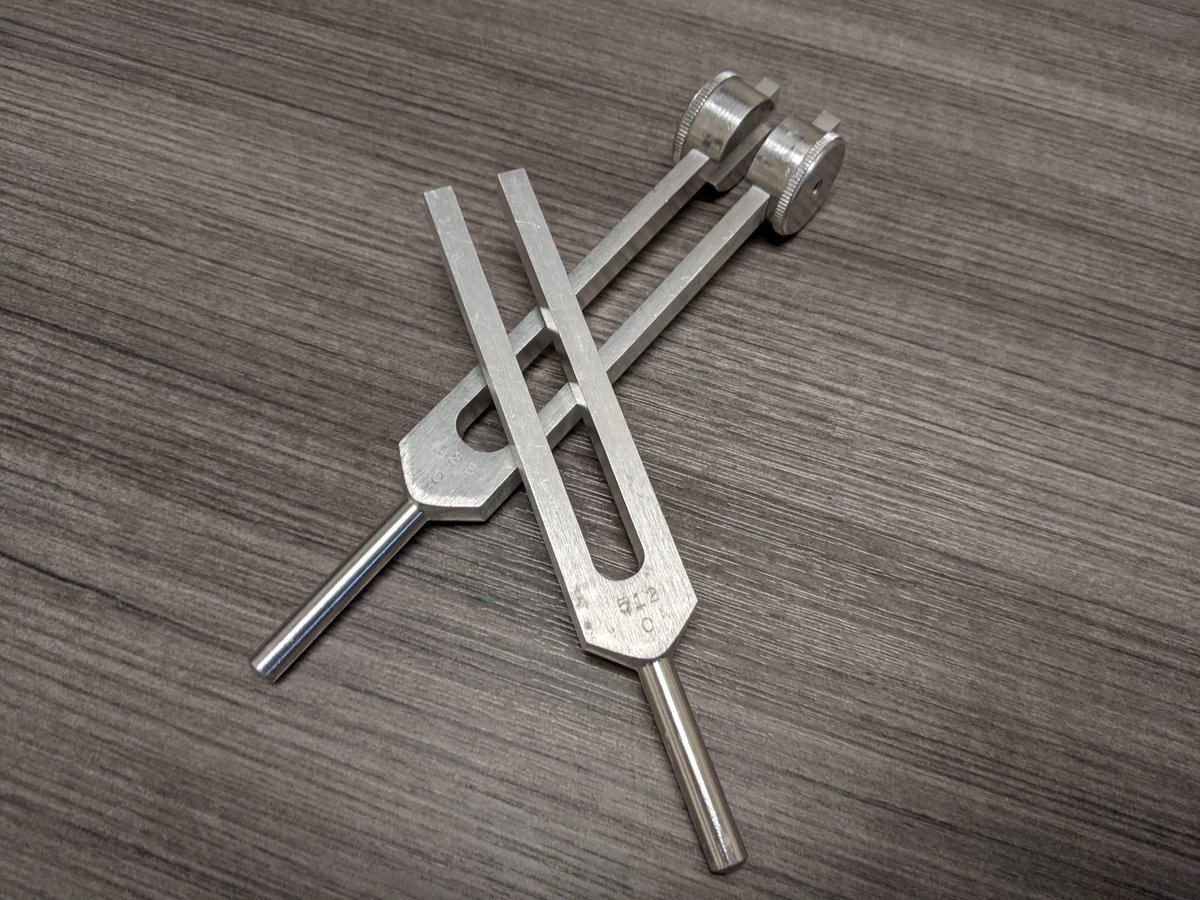
2/ What are the Weber and Rinne tests used to help identify?
3/ The answer is both! Remember that the most useful exams are hypothesis-driven so you need to do a history to begin suspecting if a patient has either type of hearing loss. This will help you generate a pre-test probability for disease (this will become relevant later).
4/ When doing these tests, which tuning fork should you use?
5/ The answer is 512 Hz (although 256 Hz might actually be better for the Rinne)!
ncbi.nlm.nih.gov
ncbi.nlm.nih.gov
6/ Now let's figure out how to do the Weber. After you tap the tuning fork on a hard surface, put the it on the top of the patient's head.

7/ Let's focus on the Rinne. Test bone conduction (BC) by tapping on the tuning fork and placing the base on the mastoid process. For air conduction (AC), the tuning fork should be in the position relative to the ear as shown below. Test BC then test AC. Normally, AC > BC.

8/ It is best if you start with the Weber and the proceed to the Rinne.
Here is a wonderful table from Evidence-Based Physical Diagnosis 4th edition by Steven McGee that helps you tease out the possible pathology.
Here is a wonderful table from Evidence-Based Physical Diagnosis 4th edition by Steven McGee that helps you tease out the possible pathology.

9/ Let's take a patient where have an intermediate (50% pre-test probability) that the patient has sensorineural hearing loss. You then do the following tests and get these results.
Weber - louder in the LEFT ear
Rinne - AC > BC in BOTH ears
What is the likely pathology?
Weber - louder in the LEFT ear
Rinne - AC > BC in BOTH ears
What is the likely pathology?
10/ Another great table from the same book goes over the sensitivities, specificity, and LRs of particular findings.

11/ So we have a 50% pre-test probability of sensorineural hearing loss and a test that has an LR of 2.7. Let's plug it into a calculator like this one: sample-size.net

12/ Because of this test, we have gone from an intermediate (50%) pre-test probability to an intermediate-high (73%) post-test probability of sensorineural hearing loss!
13/ In summary
- Use the 512 Hz tuning fork to do the Weber and Rinne tests
- Do the Weber before doing the Rinne
- AC is normally better than BC
- Use a history to guide your exam and then use LRs to help modify your probability of identifying pathology
- Use the 512 Hz tuning fork to do the Weber and Rinne tests
- Do the Weber before doing the Rinne
- AC is normally better than BC
- Use a history to guide your exam and then use LRs to help modify your probability of identifying pathology
Loading suggestions...