
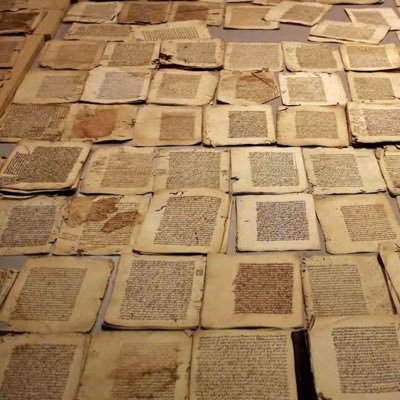
1/Recent days have shown that the origins and development of ḥadīth studies in the secular, western academy is misunderstood by the laity, mischaracterised or misconstrued by traditional voices in the academy, and worst of all, misrepresented by some academics. A thread.
2/In what follows I summarise the origins and major developments of ḥadīth studies in orientalist scholarship since the nineteenth century. It's hardly surprising that critics of academia get a number of things wrong about ḥadīth studies in the west, for it seems clear that
3/none of them have read the original works of European scholars writing on the subject (and most likely based their assessment on inaccurate summaries of academic ḥadith studies). One does not have to agree with the findings of academic studies on ḥadīth, but there is still
4/an obligation to represent those with whom you disagree fairly and accurately. Regrettable is the fact that even those who hold PhDs in academic Islamic studies prefer to fall back on unrefined and polemic characterisations of western hadīth studies.
5/One thing is certain, those traditional voices in academia have acted unfairly and dishonestly in their erroneous and misleading presentations of ḥadīth studies. I say dishonestly because, if you have anything less than a solid grasp of academic German
6/you should hesitate before proffering scathing views of orientalist writings on ḥadīth, or admit that you're falling back on the limited number of available English translations. This isn't a claim to linguistic chauvinism, but the basics of academic decorum and integrity.
7/Now, onto the issue at hand. In what follows I summarise a great survey of ḥadīth studies written by one of the doyens in the field, namely Harald Motzki. I will also provide brief summaries of Goldziher's famous treatise, Über die Entwicklung des Hadith, inter alia.
8/There's evidence that European scholars took interest in Muslim ḥadīth studies since the seventeenth century. However, the field of western ḥadīth studies began in earnest two centuries later, around the 1800s.
9/It has been postulated -- correctly, in my view -- that the nineteenth century historical-critical studies on the life of Jesus and source-critical historiography in Biblical studies spurred a number of Europeans to turn to Muslim sources such as the ḥadīth.
10/The ḥadīth corpora were indeed recognised as significant material that could help shed light on the life of the Prophet Muḥammad and the early Muslim community. Moreover, ḥadīth were also believed to be important carriers of legal traditions that date back to early Islam.
11/The first significant Western studies on ḥadīth came in the late 1800s (around 1860s). The opinion of these early western studies were as follows: they accepted the reliability of the ḥadīth corpus and believed them genuine words of the Prophet and his Companions.
12/The 19th century studies took these reports to be sound because they found the Muslim isnād & isnād criticism convincing and capable of generating epistemological certainty. In other words, the earliest orientalists believed ḥadīths do in fact go back to 7th and 8th centuries
13/But, and this is an important caveat, the same 19th C appraisers averred that it was probable that ḥadīth were also distorted during the transmission process. Keeping with this skepticism, another strand of European scholars held that the vast majority of ḥadīth from the
14/ninth century onwards were forgeries and pious inventions. The reason being, ḥadīths were circulated in oral transmission for more than a century before they were collected and codified. During the oral phase of transmission, it is likely that mutations took place, for it is
15/only natural for human memory to fade over time. Another reason for the belief in forgeries and mutations is, political and religious rents in the nascent Muslim community polarised the believers into camps and sectarian factions, raising the possibility of ḥadīths serving
16/religious and political propaganda (which was demonstrated with several examples of ḥadīths picking up political and sectarian colourings). The nineteenth century orientalists critical of ḥadīth did not claim their views were avant garde and earth shattering discoveries,
17/rather they based themselves, to a large extent, on the writings of medieval Muslim authorities who too cast aspersions on the reliability of ḥadīths, and who went on to formulate historical methods to help them distinguish genuine ḥadīths from spurious ones.
18/That said, orientalists writing in the 19th century felt the Muslim standard of evaluating the authenticity of ḥadīth was insufficient and needed to move beyond isnād-criticism alone. It was often argued that Muslim ḥadīth critics paid insufficient attention of the matn,
19/that is, internal content of the ḥadīth (which is made up of a chain of transmission and body of text or speech). A representative example is Aloys Sprenger 1856 article, "Ueber das Traditionswesen bei den Arabern".
20/Slapping labels like authentic on ḥadīth simply because the isnād was unbroken or whether the transmitters were deemed reliable was, in the view of orientalists, child's play and amateurish historical inquiry. In addition, the ḥadīth critics had a blind spot in their method
21/the assigned collective immunity to the Prophet's Companions shielding them from criticisms and rational investigations that exposed their dogma and bias, as argued, for example, by Reinhart Dozy.
22/Contrary to Muslim claims, orientalists argued that the number of genuine ḥadīths was significantly lower than claimed. Alfred von Kremer, for instance, in his Geschichte der herrschenden Ideen des Islams estimated that at best only half of the ḥadīth corpora were genuine.
23/The chief motivation spurring orientalist scholarship on ḥadīth was the question of historicity and origins. To what extent can ḥadīth pass as sound historical sources? At the end of the nineteenth century orientalist skepticism towards ḥadīth became more pronounced.
24/This marks the period when the great Hungarian orientalist Ignaz Goldziher (1850-1921) entered the scene. In his Über die Entwicklung des Ḥadīth (1890), Goldziher maintained that ḥadīths began circulating during the Prophet's lifetime, and
25/the Companions were responsible for forming the main body of ḥadīth reports, followed by the next generation, the Successors. However, Goldziher noted, it was difficult to make assertive judgments about the early ḥadīth corpus since its historical veracity is problematic.
26/Goldziher searched for forged ḥadīths. He showed that spurious reports could not be trusted as sources reflective of seventh century Islam, rather they served as windows in the later periods from which they purport to report back to the time of the Prophet.
27/Goldziher examined case studies to make his point. He looked at numerous sources and ḥadīths showing the gulf between Umayyad rulers and the ʿulemāʾ. Both camps, in order to underscore their worldview, invented ḥadīths and attributed them to the Prophet.
28/Political rulers found scholars ready to put new spins on old ḥadīths or invent new ones to suit their political ideology, such as ḥadīths warning against rebellion against the incumbent authorities (which were matched by ḥadīths in favour of rebellions).
29/Goldziher's writings (including his Vorlesungen über den Islam) exerted profound influence on the later trajectory of ḥadīth studies. Some orientalists agreed with his results, others disagreed and mounted challenges.
30/Those who agreed, found that Goldziher's findings corroborated the supposition that the bulk of the ḥadīths from the ninth century were spurious. As for before the ninth century, Goldziher and his admirers stated that it was impossible to separate the wheat from the chaff,
31/largely because ḥadīths that emerged in the seventh and eights centuries sprang from a tumultuous world of religious, social, and political upheavals (civil war, assassinations, rebellions, etc.). How could one trust ḥadīths relayed by people who
32/played an integral part in the fractious epochs that defined early Islam? Goldziher's view noted that, if Companions were prepared to kill each other, wage war against one another, and vilify to the worst degree, why wouldn't they invent ḥadīths that suited their worldview?
33/In Goldziher's eyes, no serious historian worth his salt would use ḥadīths to learn about the time of Muḥammad and the origins of Islam. He avoided using ḥadīths to learn about the life of the Prophet. Goldziher did not doubt that genuine ḥadīths do exist, but the criteria
34/of arriving at sound reports is not certain and marred by difficulties. This view of Goldziher was rejected by Johann Fueck in his 1939 article, Die Rolle des Traditionalismus im Islam. This was a minority position, however.
35/Some sixty or so years after Goldziher, ḥadīth skepticism gained a new impetus thanks to the writings of Joseph Schacht, a British-German orientalist (1902-1969). In his groundbreaking work, Origins of Muhammadan Jurisprudence, Schacht went beyond the Golziherian thesis.
36/He argued that a great many ḥadīths were put into circulation after al-Shāfiʿī's time (that is, during the ninth century). Schacht saw a close nexus between ḥadīth and Muslim legal culture. Legal doctrines of later Muslims (after 800s AD)
37/were passed off as ḥadīths in order to sprinkle them with legitimacy. In others words, Muslim legalists invented ḥadīths that purport to carry legal opinions of the Prophet in agreement with their local legal doctrines. He famous wrote, every legal tradition attributed to
38/the prophet must be treated as inauthentic until proven otherwise, because legal traditions are fictitious expressions of legal doctrines formulated as a later date. Schacht was not without his critics and detractors. Among them was the British orientalist John Burton.
39/Burton opined that Schacht did not sufficiently differentiate between the form and content of the ḥadīth. In the post-Schachtian era of ḥadīth studies, we can identify three scholarly attitudes towards ḥadīth.
40/First, scholars who flatly rejected Schacht. Two, scholars who in the main agreed with Schacht. And three, scholars who went on to modify Schacht. The critics of Schacht (group 1) included Muslim and Western scholars (e.g., Johann Fueck, Nabia Abbot, Fuat Sezgin,
41/Muḥammad Ḥamīdullāh, Muṣṭafā Sibāʿī, Muḥammad Khaṭīb, et al). In their view, ḥadīths were transmitted shortly after the Prophet's death in 7th C, became fixed in collections, and codified. This written material was then passed down down the generations, in aural form.
42/The bulk of codified and collected material form the bedrock of the collections of the eighth century, and so on, as Sezgin noted in his Geschichte des arabischen Schrifttums. This became known as theory of continuous transmission.
43/The primary evidence that underpinned the thesis of group 1 was Muslim biographical & bibliographical literature (drawn from ninth to fifteenth century sources). These scholars took the reliability of their sources for granted. Motzki notes that group 1 method was not critical
44/and lacking in rigorous examinations of historical material. Their main motivation was to "refute" Goldziher and Schacht. In other words, Motzki finds their source criticism less than satisfactory.
45/As for group 2, the supporters of Schacht, they dismissed the method of group 1 as weak historical criticism that terminated in unconvincing results. Group 3 is in my view the most interesting. These were scholars in broad agreement with Schacht, albeit with some modifications
46/Group 3 contain two currents: those who differentiated between form and content of ḥadīth. The form of ḥadīths were late and mutations of early content that can be traced back to earlier periods. They include the likes of Noel Coulson, G.H.A Juynboll, John Burton and
47/David Powers. The other current employed a modified version of Schacht method and developed his source-critical approach further, with the aim of bringing more precise dating of the material. In this group were Josef van Ess, Gregor Schoeler, and Harald Motzki.
48/This brings us to the middle decades of the twentieth century. I will analyse the methods of Van ess, Scholer, and Motzki in another thread (including the isnad-cum-matn analysis). So I will stop here for now. FIN.
Loading suggestions...