

#100DaysOfWeb3
Assuming you already what makes up the blockchain technology,different consensus mechanisms and smart contracts.Lets dive into blockchain development.
Lemme highlight the first 7 days of the challenge since I'm already on week 2.
Assuming you already what makes up the blockchain technology,different consensus mechanisms and smart contracts.Lets dive into blockchain development.
Lemme highlight the first 7 days of the challenge since I'm already on week 2.
Day 1: DApps
-How DApps are developed.
-Learnt that DApps can be written in an OOP language (solidity) in the Ethereum blockchain.
-Differences between web3.0 and web2.0
-The DApp you want to build will determine what type of blockchain you opt for private or public.
-How DApps are developed.
-Learnt that DApps can be written in an OOP language (solidity) in the Ethereum blockchain.
-Differences between web3.0 and web2.0
-The DApp you want to build will determine what type of blockchain you opt for private or public.
Day 2:Contracts
-Solidity is a contract oriented language highly influenced by Python,C++ & JavaScript.
-Wrote my first contract code,you first specify the version of solidity using terms
Pragma solidity (and the version)
-All the variables live in the contract braces.
-Solidity is a contract oriented language highly influenced by Python,C++ & JavaScript.
-Wrote my first contract code,you first specify the version of solidity using terms
Pragma solidity (and the version)
-All the variables live in the contract braces.
Day 3:Contracts continuation...
-In other OOP languages a class is a blueprint for creating objects,in solidity a contract is like a class.
-You can inherit from a contract to share a common interface ,I'll discuss this in the coming days.
-contract example:
-In other OOP languages a class is a blueprint for creating objects,in solidity a contract is like a class.
-You can inherit from a contract to share a common interface ,I'll discuss this in the coming days.
-contract example:

Day 4: IDEs & Smart Contracts
-Learnt how to use the Remix ide( for the 50th time🤣) it's the best IDE for writing,compiling and deploying smart contracts. You can also use VScode save your file with a .sol extension
-How IPFS can be used to store files.
-Learnt how to use the Remix ide( for the 50th time🤣) it's the best IDE for writing,compiling and deploying smart contracts. You can also use VScode save your file with a .sol extension
-How IPFS can be used to store files.
...day4
-IPFS to search for files in a specific node
-Datatypes(string,uint,uint8,byte32,int,and address)Structs,Arrays.
-IPFS to search for files in a specific node
-Datatypes(string,uint,uint8,byte32,int,and address)Structs,Arrays.
Day 5: Data types in-depth and DataStructures
-Differences between uint8,uint and uint256
✓uint256 is used if the number needs to be big.
✓uint8 is used to optimize performance.uint example:
uint count = 0;
-Structs are custom data structures.
-Differences between uint8,uint and uint256
✓uint256 is used if the number needs to be big.
✓uint8 is used to optimize performance.uint example:
uint count = 0;
-Structs are custom data structures.
...day5
Struct example
you start with the keyword struct.
struct person{
uint ID;
string name;
}
Struct example
you start with the keyword struct.
struct person{
uint ID;
string name;
}
Day 6: Arrays,Mapping and functions
-There are two types of arrays in solidity fixed and dynamic.A dynamic array has no fixed size.
uint[] myArray;
You can also declare an array as public so other contracts can read from it but not write to.
-There are two types of arrays in solidity fixed and dynamic.A dynamic array has no fixed size.
uint[] myArray;
You can also declare an array as public so other contracts can read from it but not write to.
...day 6
#100DaysOfWeb3
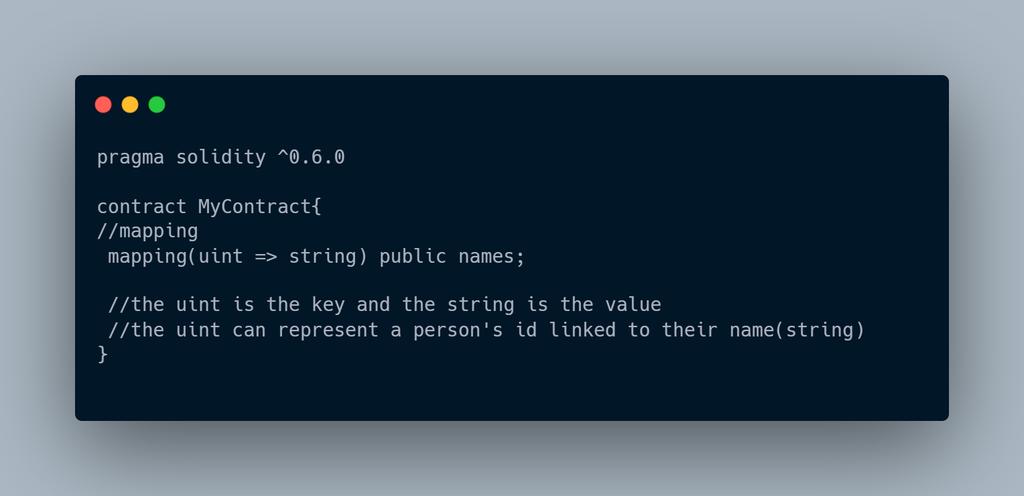
Mappings are DataStructures like arrays but better than arrays because they store items with IDs that start with 1 unlike arrays with indices starting with 0.They store data in key-value pairs
#100DaysOfWeb3
Mappings are DataStructures like arrays but better than arrays because they store items with IDs that start with 1 unlike arrays with indices starting with 0.They store data in key-value pairs
Day 7: More on Functions and DeFi
-I became confident in writing smart contracts.I wrote a counter DApp and more small projects.
-Solidity functions are public by default meaning anyone can call your contract's function .The best approach is to declare your functions private
-I became confident in writing smart contracts.I wrote a counter DApp and more small projects.
-Solidity functions are public by default meaning anyone can call your contract's function .The best approach is to declare your functions private

...day 7 #100DaysOfWeb3
#100DaysOfCode
-Learnt the differences between traditional finance and DeFi
-How DeFi works
#100DaysOfCode
-Learnt the differences between traditional finance and DeFi
-How DeFi works
Loading suggestions...