

This article pops up here and there on both leftist and housing Twitter and every time I'm so infuriated by all the wrong tankie takes I decided to write a short thread about housing construction in socialist Poland
Myth 1: Everyone got free housing in socialism.
There are two claims here: everyone got housing and the housing was free. Both are wrong.
Let's start with the second one. You absolutely paid for the apartment - and you paid upfront!
There are two claims here: everyone got housing and the housing was free. Both are wrong.
Let's start with the second one. You absolutely paid for the apartment - and you paid upfront!
To get state-built apt, you had to join a spółdzielnia (co-op) and pay. But even if you paid, you had to wait for the apt to get built. For example in '88, 1.4M co-op members paid down-payment in full, and additional 862k paid it in full but were not even members of co-op yet!

Over half a million of co-op members already paid the down-payment in full but were waiting for an apartment for at least 7 years. And 1.7M people started paying their co-op deeds but did not pay it in full yet, so were the last to receive an apt. In a country of 12M households!
How much was the down-payment? Depending on the type of co-op. Some co-ops had big state companies starting them for their workers (especially coal mines); there 10% was enough. Usually though, 20% of the cost of the apartment was required.
Now, moving on to the "everyone" part.
In '88, Poland had 37.9M people and 10.7M housing units, 3.5 people per HU and 16.7 sqm per person (180 sqft). A lot of that was substandard - 40% had no bathroom. Avg household size in '88 was 3.1 ppl, so 1.3M households did not have a HU
In '88, Poland had 37.9M people and 10.7M housing units, 3.5 people per HU and 16.7 sqm per person (180 sqft). A lot of that was substandard - 40% had no bathroom. Avg household size in '88 was 3.1 ppl, so 1.3M households did not have a HU
Today, Poland has 38.2M people and 14.8M housing units, 2.6 people per HU and 28.8 sqm per person (310 sqft). Very little is substandard. Avg household size is 2.61, meaning just a few households do not have their own housing units.
Between 1945 and 1988, the socialist state built 7.3M housing units, ~170k a year. The other 2.1M already existed before 1945. Impressive, but in that time Polish population grew from 24M to 38M, 14M people.
By contrast, between 1989 and 2019, in capitalist Poland, 4.1M housing units were built - not as impressive, checkmate, you capitalist pig! Yeah, but that growth happened with the population basically stagnating (it grew to 38.5M in late 1990s but since fell to 38.2M).
In other words, in socialist Poland you paid for your apt upfront to wait years to never receive it in the end, and if you received it, it was never yours. In capitalist Poland things are not perfect but if you have the down-payment, you get a mortgage and own it in 30 years.
Now:
Myth 2: These were nice, comfortable two and three bedrooms!
This is only half wrong but still shows the fundamental misunderstanding of the socialist system Western leftists have.
Myth 2: These were nice, comfortable two and three bedrooms!
This is only half wrong but still shows the fundamental misunderstanding of the socialist system Western leftists have.
Let's start with some background: the normatyw. It was basically a norm that restricted how big the apartment can be, based on who (theoretically) is supposed to live there. There were different types of apts, M-1 (studio w/o a kitchen), M-2 (studio), M-3 (1 bed) etc.

These table shows sqm allocated for each M-type. If you were a couple, after 1974 you got a 30-35 sqm (323-377 sqft) studio with a kitchen. To get a 1-bed, you needed a child (or an elderly parent). You and your SO were supposed to sleep in the living room on a pull-out coach.

Before 1974, it was even worse. Here's a plan for a 5-person family flat in Sady Żoliborskie, an innovating and prestigious estate in Warsaw designed in 1960s by a star architect Halina Skibniewska. Notice parents don't even have a double bed because it wouldn't fit in any room.

It's hard to estimate how many apts built in socialist Poland were 2- or 3-beds because 1) Census doesn't distinguish between privately-built houses and state-built apartments and 2) It only looks at number of izbas (rooms) - but a kitchen is also a room if it has a window
But assuming all kitchens had windows (which is fair in post-1970s apartments), in 1970s only a half of new housing units were 2-beds or more, and in the 1980s their share grew to 56%. Like I said, though, this includes privately-built SFH which were always larger.
I want to come back to the normatyw, though. In theory, once your family grows, you should be getting larger and larger apartments, right? Yeah, totally.
In reality, the apartment you got at any stage of your life was the apartment you were stuck with.
In reality, the apartment you got at any stage of your life was the apartment you were stuck with.
Because of that, typically people lived with their parents until marriage. Once married, they'd continue to live with one of the parents, usually until they have a child. Only then they'd apply for an apartment - because it meant they were able to apply for a 1-bed.
When they got a 1-bed, they'd typically try for a second child (having children was a currency in the socialist system; childless couples were denied many benefits, and single people had to pay special tax) and squeeze 4 people on 35 sqm (377 sqft).
To be fair to the socialists, they at least recognized the housing problem they were presiding over and offered partial solutions. For example, furniture was designed to be multi-functional and fit as much stuff as possible. See: meblościanka (literally: furniture wall).


It was a huge-ass piece of furniture meant to host all your clothes, books, booze, china and anything else you could think of (apartments did not have closets like the ones in America). Later on, there was a place for a (black and white) TV as well.
Another example: tapczan. It's kinda like a Murphy bed but opens up on the longer end instead of the shorter one and it doubles as a sofa (because you'd have that in your living room).


Later on, wersalka got way more popular than tapczan. It also doubles as a sofa during the day but when the night comes, you can pull it out and two people can sleep on it. In America, that's what you reserve for guests, in Poland that's the master bedroom bed


Ok, moving on to Myth 3 (last one): These apartment complexes actually look super dope, unlike the hellscape of nearly identical American suburbs!
Yeah, that's because @WIRED showcases literally the most unusual and interesting ones. Most of them look more like this:
Yeah, that's because @WIRED showcases literally the most unusual and interesting ones. Most of them look more like this:
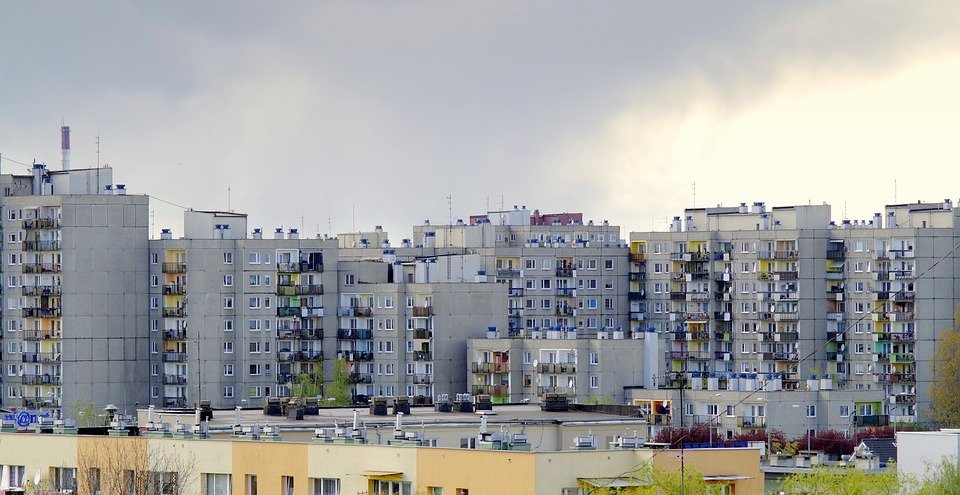


@WIRED There were a bit of variation because of different technologies used and their consequences (e.g. some did not have balconies, some did; buildings over 7 floors had to have elevators etc.) but overall most of them look very similar.
@WIRED I'll do a thread of my favorite socialist-era housing estates in Poland this week, though! I think that could be interesting
One small addition someone in comments mentioned and I forgot to disclose here. Apart from getting an apartment, you also had to secure a zameldowanie (residence permit) which was a whole different deal. Attractive cities limited how many ppl can live there.
For example Warsaw issued an annual quota of zameldowanies for in-country migrants. As a result, it wasn't until 1970s and a few annexations of nearby municipalities that Warsaw exceeded its pre-1939 population level.
So while in capitalist countries you can move freely around the country, in socialist Poland you had to gain permission from the government to move outside the municipality where you were born. It was easier to get one to e.g. a mining town but harder to get one to top cities.
... and in case you've missed it, here they are:
Loading suggestions...