

10 mental models to master marketing:
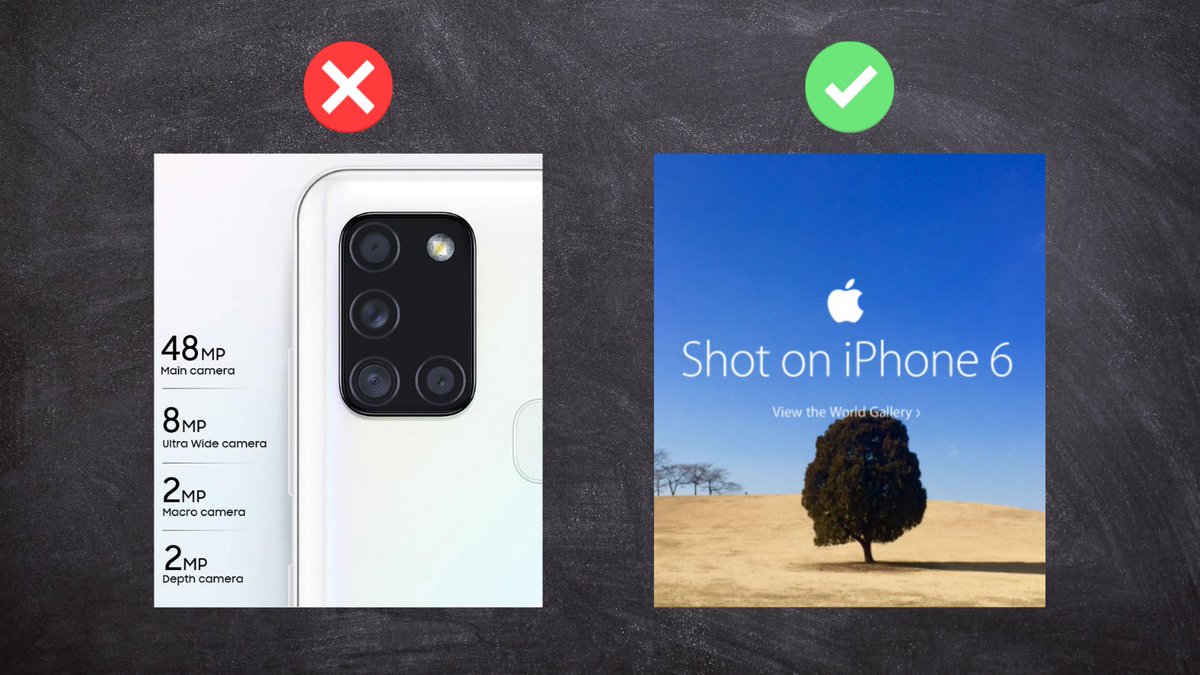
1. Jobs-to-be-done framework:
What job is the customer trying to achieve with your product?
Use the answer to create marketing that communicates that outcome.
What job is the customer trying to achieve with your product?
Use the answer to create marketing that communicates that outcome.
2. Activation energy:
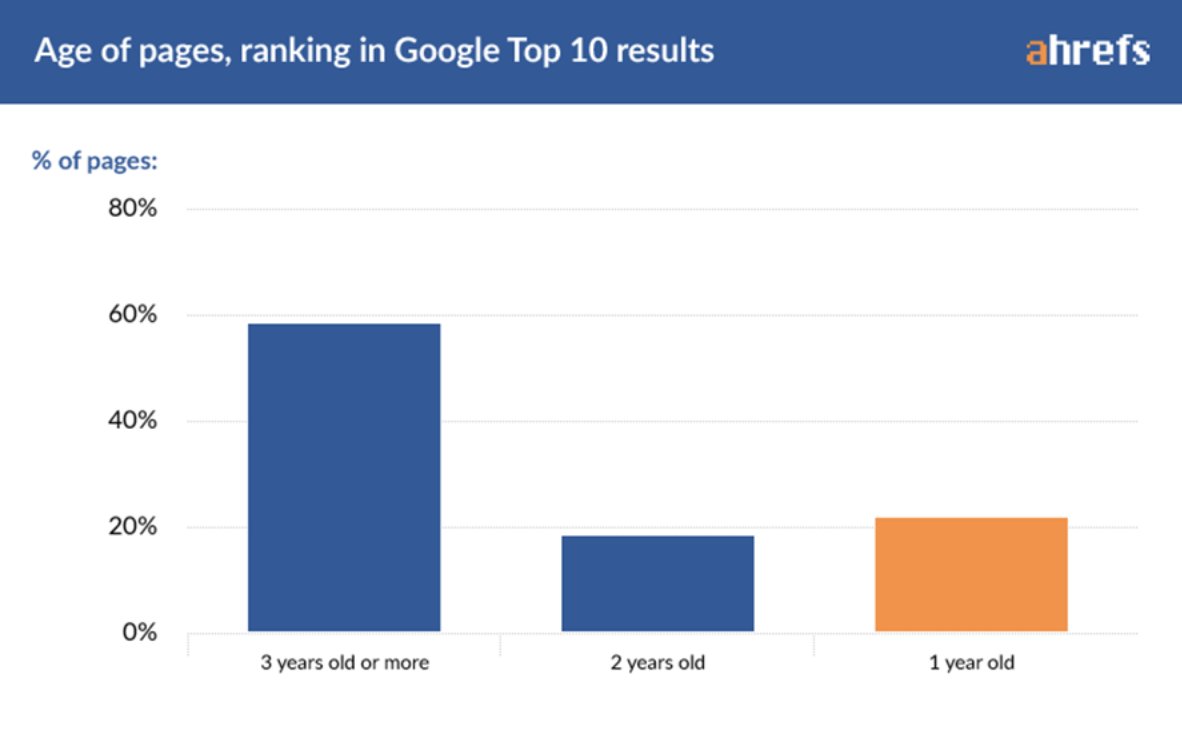
What is the minimum amount of time and effort required to see a desired result?
Example: It usually takes at least 1 year for content to rank on Google.
What is the minimum amount of time and effort required to see a desired result?
Example: It usually takes at least 1 year for content to rank on Google.
3. Hick's Law
The effort it takes to make a decision increases with the number of options.
The more options you offer, the harder it is for customers to decide.
Help your customers convert by keeping it simple and narrowing the options.
The effort it takes to make a decision increases with the number of options.
The more options you offer, the harder it is for customers to decide.
Help your customers convert by keeping it simple and narrowing the options.
4. Decoy Effect:
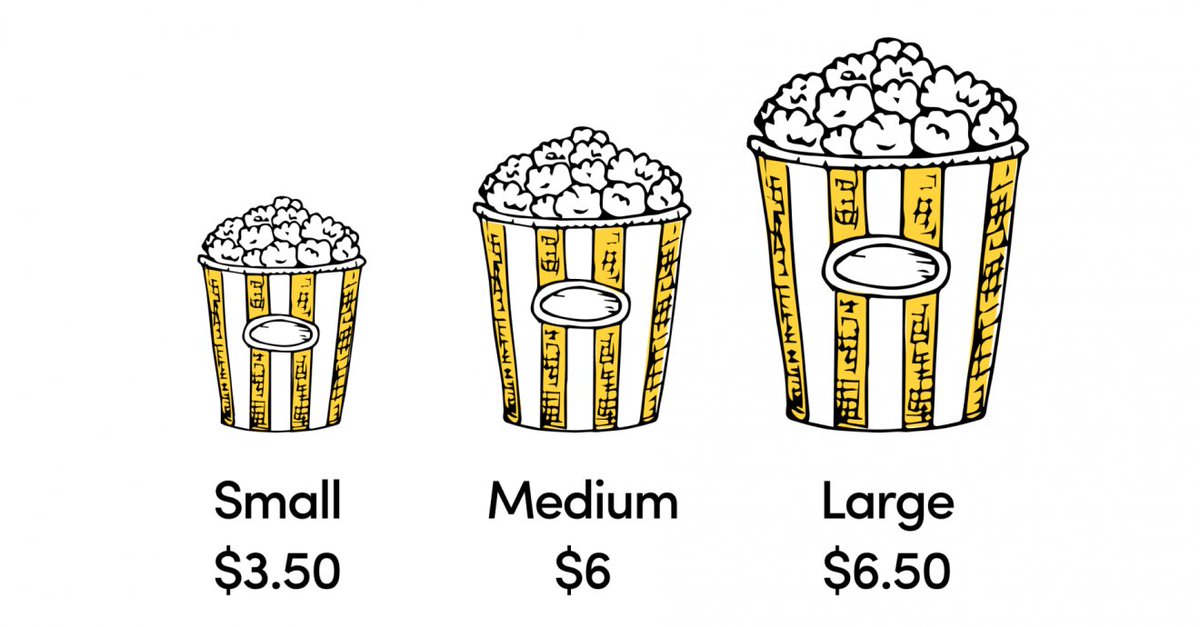
Asymmetric numbers can influence our perception.
This is how cinemas sell more popcorn.
By artificially increasing the price of the smallest option, they make the largest option the most attractive.
Asymmetric numbers can influence our perception.
This is how cinemas sell more popcorn.
By artificially increasing the price of the smallest option, they make the largest option the most attractive.
5. The map is not the territory:
Reality is constantly changing.
Even the best maps are imperfect.
Don't confuse your map for reality.
Example: your customer persona from 2 years ago might have assumptions that are no longer true today.
Reality is constantly changing.
Even the best maps are imperfect.
Don't confuse your map for reality.
Example: your customer persona from 2 years ago might have assumptions that are no longer true today.
6. Second-order thinking:
Map out the subsequent and long-term effects of your actions.
Example:
First-order thinkers will only produce content that generates website traffic.
Second-order thinkers will produce content that generates traffic AND conversions.
Map out the subsequent and long-term effects of your actions.
Example:
First-order thinkers will only produce content that generates website traffic.
Second-order thinkers will produce content that generates traffic AND conversions.
7. Circle of competence:
What you know is different from what you *think* you know.
Be clear on where your competence lies and stay within it.
Example: Just because someone reads a few blogs on SEO doesn't mean they're qualified to build a website.
h/t @farnamstreet
What you know is different from what you *think* you know.
Be clear on where your competence lies and stay within it.
Example: Just because someone reads a few blogs on SEO doesn't mean they're qualified to build a website.
h/t @farnamstreet

8. First Principles Thinking:
Identify the facts and the assumptions.
Separate the two to identify the core building blocks.
Then use the building blocks to create new solutions.
Identify the facts and the assumptions.
Separate the two to identify the core building blocks.
Then use the building blocks to create new solutions.
9. Inversion:
Having trouble finding a solution?
Start from the opposite end of the problem to find a novel solution.
Example:
Instead of asking how your marketing campaign can succeed..
Ask how it might fail.
Use the answer to both questions to create the best strategy.
Having trouble finding a solution?
Start from the opposite end of the problem to find a novel solution.
Example:
Instead of asking how your marketing campaign can succeed..
Ask how it might fail.
Use the answer to both questions to create the best strategy.
10. Bias from incentives:
Incentives influence behaviour.
Example:
Many paid marketing efforts fail because teams get compensated for generating traffic instead of revenue.
Incentives influence behaviour.
Example:
Many paid marketing efforts fail because teams get compensated for generating traffic instead of revenue.
Bonus: Recency heuristic:
We tend to recall whatever is most recent in our brains.
This is how branding works.
Example:
UberEats will show their ads during big sporting events so that you think of them instantly when it's time to order food.
We tend to recall whatever is most recent in our brains.
This is how branding works.
Example:
UberEats will show their ads during big sporting events so that you think of them instantly when it's time to order food.
If you found this thread helpful, please:
- Retweet the first tweet and help others find this thread
- Follow me at @heykahn
I write and share insights about marketing, tech, and psychology.
- Retweet the first tweet and help others find this thread
- Follow me at @heykahn
I write and share insights about marketing, tech, and psychology.
Loading suggestions...