

#WeekendLecture
#GeneticsAndStroke
#Genetics is involved in several #stroke related conditions, such as small vessel disease #SVD, aneurysms, dissections, cavernomas, and intracranial #hemorrhages
Check this 🧵!
Prepared by @J_Rosales_MD
Edited by @interneurona
#GeneticsAndStroke
#Genetics is involved in several #stroke related conditions, such as small vessel disease #SVD, aneurysms, dissections, cavernomas, and intracranial #hemorrhages
Check this 🧵!
Prepared by @J_Rosales_MD
Edited by @interneurona

#Weekendlecture
#Genetic & #SVD
🧬🧠
✅1,5% of cerebral #SVD are #monogenic disorders
✅AR, AD or X-linked
☝🏼Absence of family history doesn't rule out diagnosis because of
👉de novo mutation
👉reduced expression or
👉incomplete penetrance
✅ahajournals.org
#Genetic & #SVD
🧬🧠
✅1,5% of cerebral #SVD are #monogenic disorders
✅AR, AD or X-linked
☝🏼Absence of family history doesn't rule out diagnosis because of
👉de novo mutation
👉reduced expression or
👉incomplete penetrance
✅ahajournals.org
#Weekendlecture
#Genetic & #SVD
When to #suspect?🕵️♀️
✅early onset stroke without vascular RFs
✅systemic features and neuroimaging of an specific monogenic disorder
✅consanguinity
✅negative work up for other causes of SVD
👉ahajournals.org
#Genetic & #SVD
When to #suspect?🕵️♀️
✅early onset stroke without vascular RFs
✅systemic features and neuroimaging of an specific monogenic disorder
✅consanguinity
✅negative work up for other causes of SVD
👉ahajournals.org

#Weekendlecture
#Genetic & #SVD
👉#CADASIL most common SVD caused by single gene mutation
✅Autosomal dominant
✅Prevalence 2-4/100 000
☝️#NOTCH3 mutation, most frequent in hot spot,3-4 exons
🚬 and HTN are associated with earlier age of stroke onset
👉thelancet.com
#Genetic & #SVD
👉#CADASIL most common SVD caused by single gene mutation
✅Autosomal dominant
✅Prevalence 2-4/100 000
☝️#NOTCH3 mutation, most frequent in hot spot,3-4 exons
🚬 and HTN are associated with earlier age of stroke onset
👉thelancet.com


#Weekendlecture
#Genetic & #CCM
☝️Genes👉Functional loss, CCM1 (KRIT1)/CCM2 (MGC4607)/CCM3, most agressive (PDCD10)
👉Prev: 1/3300 to 1/3800
👉20% of all CCMs are familial:
✅AD with incomplete penetrance
✅Multiple CCM
bit.ly
#Genetic & #CCM
☝️Genes👉Functional loss, CCM1 (KRIT1)/CCM2 (MGC4607)/CCM3, most agressive (PDCD10)
👉Prev: 1/3300 to 1/3800
👉20% of all CCMs are familial:
✅AD with incomplete penetrance
✅Multiple CCM
bit.ly


#Weekendlecture
#Genetic & #CCM
✅Extra neurological manifestations:
~5% #retinal cavernomas, choroidal hemangiomas,
~9% hyperkeratotic #cutaneous lesions
✅Diagnosis: sequencing analysis if negative deletion/duplication analysis for the 3 genes
bit.ly
#Genetic & #CCM
✅Extra neurological manifestations:
~5% #retinal cavernomas, choroidal hemangiomas,
~9% hyperkeratotic #cutaneous lesions
✅Diagnosis: sequencing analysis if negative deletion/duplication analysis for the 3 genes
bit.ly

#Weekendlecture
#Genetic & #Dissections
✅60% of sCAD had abnormalities in skin connective tissue, but
👉#CAD occurs in pts w/ known CTD ~2%, mainly Ehlers-Danlos bit.ly
👉Most studies looking for mutations/genetics associations are (-)ve bit.ly
#Genetic & #Dissections
✅60% of sCAD had abnormalities in skin connective tissue, but
👉#CAD occurs in pts w/ known CTD ~2%, mainly Ehlers-Danlos bit.ly
👉Most studies looking for mutations/genetics associations are (-)ve bit.ly

#Weekendlecture
#Genetic & #Dissections #CAD
Syndromic vs nonsyndromic
👉#Ehlers_Danlos type IV, #Marfan #Loeys_Dietz vs isolated dissection
🕵️Extraneuro signs, multiple dissection, joint hypermobility, pectus excavatum, aorta disorders
👉Diagnosis: gene panel or exome sequence
#Genetic & #Dissections #CAD
Syndromic vs nonsyndromic
👉#Ehlers_Danlos type IV, #Marfan #Loeys_Dietz vs isolated dissection
🕵️Extraneuro signs, multiple dissection, joint hypermobility, pectus excavatum, aorta disorders
👉Diagnosis: gene panel or exome sequence
#Weekendlecture
#Genetic & #Aneurysm
👉If 1-2 family members have IA, risk of 1st degree relatives >30yo is ~9.8%
👉Pts w/familial history of SAH (~10%)
✅SAH at younger age
✅⬆️risk of multiple IA vs sporadics
☝️Majority of IA heritability is polygenic.
bit.ly
#Genetic & #Aneurysm
👉If 1-2 family members have IA, risk of 1st degree relatives >30yo is ~9.8%
👉Pts w/familial history of SAH (~10%)
✅SAH at younger age
✅⬆️risk of multiple IA vs sporadics
☝️Majority of IA heritability is polygenic.
bit.ly
#Weekendlecture
#Genetic & #Aneurysm
#Endothelial cell appear to be the target
✅Genetic predisposition for HBP and 🚬 are independent genetic causes of IA
☝️In recent #GWA 17 loci were found and 11 potential genes go.nature.com
#Genetic & #Aneurysm
#Endothelial cell appear to be the target
✅Genetic predisposition for HBP and 🚬 are independent genetic causes of IA
☝️In recent #GWA 17 loci were found and 11 potential genes go.nature.com

#Weekendlecture
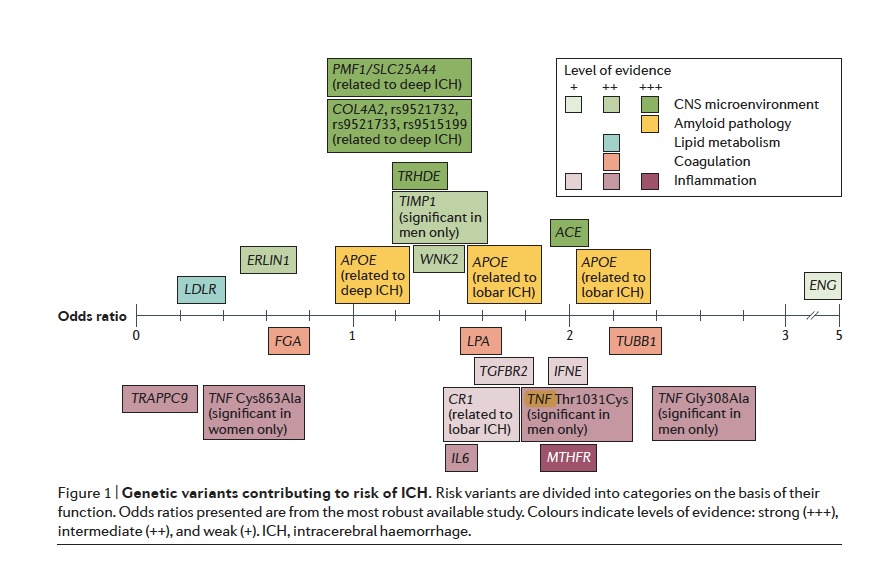
#Genetic & #ICH
✅APOE Ɛ 2- 4 ⬆️risk of first and recurrent lobar ICH
#Familial CAA: APP, CST3, BRI, TTR, ITM2B, GSN, PRNP, and ITM2B genes
#Lobar ICH: APOE Ɛ2, Ɛ4, GPX1. Deep APOE Ɛ4, 1q22, COL4A2, TIMP-1, TIMP-2, MMP-2, MMP-9, ACE
nature.com
#Genetic & #ICH
✅APOE Ɛ 2- 4 ⬆️risk of first and recurrent lobar ICH
#Familial CAA: APP, CST3, BRI, TTR, ITM2B, GSN, PRNP, and ITM2B genes
#Lobar ICH: APOE Ɛ2, Ɛ4, GPX1. Deep APOE Ɛ4, 1q22, COL4A2, TIMP-1, TIMP-2, MMP-2, MMP-9, ACE
nature.com
#WeekendLecture
#GeneticsAndStroke
Thank you for reading!!
And thanks again to @J_Rosales_MD for preparing this weekend material
#GeneticsAndStroke
Thank you for reading!!
And thanks again to @J_Rosales_MD for preparing this weekend material

Loading suggestions...