

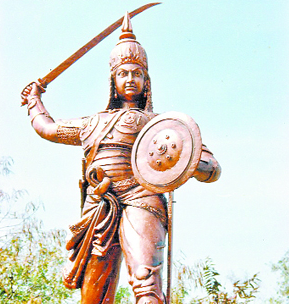
Rani Durgavati, queen of the Gonds, who resisted Akbar and the Mughal empire, killed herself than surrender. A real life Durga.
Thread on her Jayanti today.
Thread on her Jayanti today.
Gondwana, a region that covers eastern Vidarbha, some parts of Western Chattisgarh, and Southern part of Madhya Pradesh. It is so named after it’s rulers the Gonds, a predominantly forested region, inhabited by tribals.
One of the kingdoms of Gondwana was the Garha Mandla kingdom in it’s northern part. It’s most famous ruler was Sangram Shah, who captured the territories all the way up to the Narmada Valley, Sagar and Damoh.
Conquering 52 forts, the famous Chouragarh Fort at Narsinghpur was built in honor of this achievement. And the lady who would make his legacy even more distinguished was his daughter in law, Rani Durgavati, married to his son Dalpat Shah.
Dalpat Shah was rather the adopted son of Sangram Shah, a Kachwaha Rajput by birth, who would go on to become the legal heir of the Garha Mandla kingdom, a famed warrior.
Durgavati, the valiant queen of the Gonds who refused to surrender to Emperor Akbar and fought till the end. A true heroine, who took over the kingdom on her husband’s death, and defied the mighty Mughal army.
She was born on October 5, 1524 to Shalivahan, the Chandela Rajput ruler of Mahoba, famed for his bravery and courage . With her mother passing away early, she was bought up with great care by Shalivahan, and was trained like any Rajput prince.
Trained by her father at a young age in horse riding, hunting and usage of weapons. She was a skilled hunter, markswoman, who took pleasure in going on expeditions, also a skilled archer
Hearing about the valor of Dalpat Shah, and his exploits against the Mughals, Durgavati was impressed by him. He was one warrior, whom the Mughals feared, he controlled the territory that gave them passage to the South.
The other Rajput rulers knew very well that if Mughals were unable to advance to South, it was due to Dalpat Shah himself. Finally in 1524, Durgavati was married to Dalpat Shah, and this also bought the Gonds and Chandel dynasties in an alliance.
With the Chandelas, Gonds coming together, a new alliance was formed against the Mughal rulers that could keep them in check. Sadly Dalpat Shah died soon, in 1550 and it was left to Durgavati to handle the kingdom.
With her son, Bir Narayan, still a minor, Durgavati ruled as a regent, after her husband passed away. Assisted by 2 ministers, Adhar Kayastha and Man Thakur, she reigned over the Gond kingdom with wisdom and success.
As a ruler, she shifted her capital to Chauragarh, a strategically important fort on the Satpuras. Like her husband Dalpat Shah, Durgavati proved to be an able ruler, expanding the kingdom, looking after her subjects well
She had a large army with 20,000 cavalry, 1000 war elephants, large number of soldiers, which was well maintained. She also dug many reservoirs and tanks for the welfare of her people, one of the more well known one is near Jabalpur called Ranital.
When the Sultan of Malwa, Baz Bahadur, tried to attack her kingdom, she fought back and forced him to retreat. So heavy was the loss faced by Baz Bahadur at hands of Durgavati, that he dared not attack her kingdom again.
In 1562, Akbar defeated Baz Bahadur, and took over Malwa, which now meant that Mughal empire was touching her kingdom. Lured by the prosperity of Gondwana, Akbar’s subedar Abdul Majid Khan, wanted to invade and occupy it too.
Rewa too was captured and now only Gondwana was left. Though her Diwan warned her against taking on the mighty Mughal Army, Rani Durgavati said she wud prefer death to surrender.
She initially fought the Mughal Army at Narrai, flanked by the Narmada and Gaur rivers, and hilly ranges.hough the Mughal Army was superior to Durgavati’s she led the defense, and fought back fiercely, chasing them back in a fierce counter attack.
Buoyed by success, Durgavati wanted to attack the Mughal Army in night, but the suggestion was not accepted by her lieutenants. And this meant she had to face the Mughal Army in open combat, which would prove to be fatal to her
Durgavati however refused to surrender, and with her son Vir Narayan, counter attacked the Mughal forces strongly, riding on her elephant Sarman. Vir Narayan, himself led a fierce attack on the Mughals, making them retreat thrice, before he was wounded badly.
Hit by arrows, bleeding, she realized that defeat was imminent against the Mughals. Disregarding her mahout’s advice to flee from battle, Rani Durgavati, stabbed herself with a dagger, preferring death to surrender.
June 24, 1564- Rani Durgavati killed herself on the battlefield than surrender. A true heroine, who lived and died with honor.
Durgavati was also a patron of learning, respected scholars, encouraged building of temples, truly a great ruler. She was not just a brave warrior, but an able administrator too, who built lakes and reservoirs for benefit of her subjects
Her legacy lives on, especially in Jabalpur, where the University is named after her. She was a benevolent ruler, a caring mother, and a fierce warrior, who refused to surrender. A fiercely independent woman in every way, Rani Durgavati.
Rani Durgavati would be one of the great queens of Indian history on par with Rani of Jhansi, Ahilyabai Holkar, Tarabi, Kittur Rani Chennamma. #Naman to her on her Jayanti today.
4 great queens who resisted the Mughal Empire
Rani Durgavati- Refused to surrender to Akbar,fought to the end.
Rani Karnavati of Garhwal- Fought back forces of Shahjahan, cut off noses of Mughal soldiers.
Rani Chenamma of Keladi- Sheltered Rajaram in exile, beat back Aurangzeb.
Rani Durgavati- Refused to surrender to Akbar,fought to the end.
Rani Karnavati of Garhwal- Fought back forces of Shahjahan, cut off noses of Mughal soldiers.
Rani Chenamma of Keladi- Sheltered Rajaram in exile, beat back Aurangzeb.
And finally Tarabai Bhonsle, daughter in law of Shivaji Maharaj, who gave such a defeat to the Mughal Army, that Aurangzeb died a lonely, broken in spirit, exhausted after his Deccan campaign failed.
Loading suggestions...