
Those who complain that women have no right to perform sacrifices on their own must remember that men too have no right to the same without a wife.
If they know this truth they would not make the allegation that Hindu shaastras looked down upon women.
If they know this truth they would not make the allegation that Hindu shaastras looked down upon women.
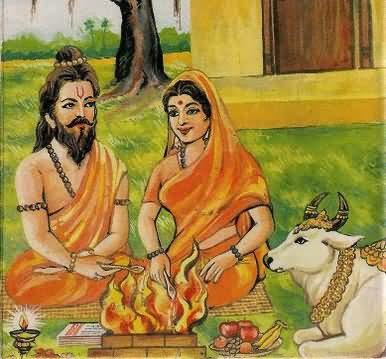
A man can perform sacrifices only with his wife. He does them for the well-being of all mankind and for his own inner purity.
It is for this purpose that, after the samavartana following the completion of his student-bachelorhood, he goes through the samskaar called marriage.
It is for this purpose that, after the samavartana following the completion of his student-bachelorhood, he goes through the samskaar called marriage.
Marriage or vivaaha is known as "सहधर्मचारिणीसमप्रयोग". It means (roughly) union with a wife together with whom a man practises dharma.
The clear implication is that carnal pleasure is not its chief purpose, but the pursuit of Dharma.
The clear implication is that carnal pleasure is not its chief purpose, but the pursuit of Dharma.
The shaastras do not ask a man to pursue dharma all by himself but require him to take a helpmate for it.
The wife is called "dharma-patni", "सहधर्मचारिणी", thus underlining her connection with dharma, and not with kama or sensual pleasure.
The wife is called "dharma-patni", "सहधर्मचारिणी", thus underlining her connection with dharma, and not with kama or sensual pleasure.
This is the proof of the high esteem in which the shaastras hold women. The celibate-student and the ascetic alike follow the dharma of their respective aashramas (stages of life) not in association with anyone else.
The householder has to conduct the karma as well as the dharma of domestic life with his wife as a companion, such being the rule laid down in the shaastras.
The dharma of domestic life is their common property.
The dharma of domestic life is their common property.
Only a householder with a wife may perform sacrifices, not student-bachelors or ascetics.
If the wife were meant only for sensual gratification, would the dharmashaastras have insisted that a man cannot perform sacrifices after her death.
If the wife were meant only for sensual gratification, would the dharmashaastras have insisted that a man cannot perform sacrifices after her death.
Women's libbers, who note that a woman cannot perform sacrifice on her own, must also recognise the fact that the husband loses the right for the same without the wife and this is according to the Vedas themselves.
A great man lamented thus at the time of his wife's death: "You have taken away all my sacrifices as well as other rituals."
Our shaastras have thus given a high place to women in the matter if duties and works.
Our shaastras have thus given a high place to women in the matter if duties and works.
Source: Taken from the discourses of Kanchi Parmacharya.
Loading suggestions...