

Dipavali & firecrackers
In this thread, I will debunk the MYTH that bursting firecrackers is a new innovation that was recently introduced into dīpāvali festivities.
It will be shown that bursting firecrackers has always been intergral and central part of dīpāvali .
[Thread]
In this thread, I will debunk the MYTH that bursting firecrackers is a new innovation that was recently introduced into dīpāvali festivities.
It will be shown that bursting firecrackers has always been intergral and central part of dīpāvali .
[Thread]
At the very core of this entire MYTH is the presumption that Gunpowder (cf. fireworks) was invented in China in 9th century and brought to India by Muslim rulers.
This THREAD debunks this widespread MYTH and throws light on the unknown/hidden history of dīpāvali & gunpowder.
This THREAD debunks this widespread MYTH and throws light on the unknown/hidden history of dīpāvali & gunpowder.
Indeed, so widespread is this myth that gunpowder is popularly known as one of “ the "Four Great Inventions" of China”.
However, this myth starts falling apart when we examine Chinese sources themselves for the origin of Gunpowder.
However, this myth starts falling apart when we examine Chinese sources themselves for the origin of Gunpowder.
According to Chinese sources themselves, an Indian Buddhist monk who brought gunpowder technology to China
In 664 CE, he discovered soils in China containing Saltpetre (primary constituent of gunpowder).
Chinese studies of Chemistry of saltpetre show evidence of Indian origin.
In 664 CE, he discovered soils in China containing Saltpetre (primary constituent of gunpowder).
Chinese studies of Chemistry of saltpetre show evidence of Indian origin.

Of course, this is not to say that Chinese have no contribution to Gunpowder technology. They improvised it & made innovations.
However, the initial knowledge of Gunpowder came to China from India.
Even Scholar Roger Pauly, a hardcore Sinophile, admits "Indian inspiration"
However, the initial knowledge of Gunpowder came to China from India.
Even Scholar Roger Pauly, a hardcore Sinophile, admits "Indian inspiration"
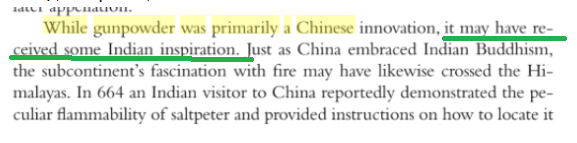
For those familiar with Indian literature, this should hardly come as a surprise. Indian literature contains ample references to what could be seen as an early form of Gunpowder
Let us examine these references before jumping into the discussion about Dipavali
Let us examine these references before jumping into the discussion about Dipavali
Vaisampayana, the narrator of Mahabharata, describes the manufacture of smoke balls by ancient Indians using what many scholars see as Gunpowder.
According to a medieval commentator of the verse, the aforementioned smoke balls were indeed made of Gunpowder.
According to a medieval commentator of the verse, the aforementioned smoke balls were indeed made of Gunpowder.

Atharvanarahasya mentions the use of charcoal, sulphur and saltpetre to make gunpowder, which are the same ingredients used even today to manufacture Gunpowder.
In-fact, workers at Sivakasi use these ingredients to make fireworks even today (more below)
In-fact, workers at Sivakasi use these ingredients to make fireworks even today (more below)

A look at how Diwali fireworks are manufactured by traditional makers to this day is very revealing.
This video shows traditional maker of fireworks from Andhra in action.
This is a simple form of crackers but use of such crackers is very widespread
youtube.com
This video shows traditional maker of fireworks from Andhra in action.
This is a simple form of crackers but use of such crackers is very widespread
youtube.com
In the above video, the Andhra maker uses basic ingredients to make simple fireworks.
1. Suryakara (सूर्यकार, Telugu సురేకారము)= Saltpetre
2. Gandhaka(गन्धक, గంధకము)= Sulphur.
3. Sand.
These were known in India since ancient age . Why would Indians borrow this from anywhere?
1. Suryakara (सूर्यकार, Telugu సురేకారము)= Saltpetre
2. Gandhaka(गन्धक, గంధకము)= Sulphur.
3. Sand.
These were known in India since ancient age . Why would Indians borrow this from anywhere?
The etymology of the ingredients tells us about their. origin
The Indian firecracker workers of Andhra and Sivakasi use the Indic Saltpetre (सूर्यकार) whose origin is Sanskritic. They do not use the word Shora (शोरा شورہ) which is Persian for Saltpetre imported in medieval age
The Indian firecracker workers of Andhra and Sivakasi use the Indic Saltpetre (सूर्यकार) whose origin is Sanskritic. They do not use the word Shora (शोरा شورہ) which is Persian for Saltpetre imported in medieval age
It takes an extremely colonized mindset to claim that Indians were incapable of making simple fireworks themselves when they had all basic ingredients since antiquity.
Did they have to wait for Muslims to come and teach them to put all these ingredients in a container?
Did they have to wait for Muslims to come and teach them to put all these ingredients in a container?
Uptil this point, we have seen that Indians had knowledge about use of Saltpetre/gunpowder & were perfectly capable of making fireworks themselves.
Now we shall come to Diwali.
Why are fireworks used in Diwali? What is the underlying theology?
These will be discussed further
Now we shall come to Diwali.
Why are fireworks used in Diwali? What is the underlying theology?
These will be discussed further
At the core of Dipavali is a belief that our departed ancestors would come back on this night.
It is believed that on the night of Chaturdashi & Amavasya, the Pitrs would come back.
It is the light & noise which shows them the path in the dark. Hence we illuminate our houses.
It is believed that on the night of Chaturdashi & Amavasya, the Pitrs would come back.
It is the light & noise which shows them the path in the dark. Hence we illuminate our houses.
The Skanda Purāṇa is largest of the 18 MahāPurāṇas.
It describes the rites to be performed on Dīpāvalī and it mentions this belief.
The Vaiṣṇava-khaṇḍa of Skanda Purāṇa says
उल्काहस्ता नराः कुर्युः पितॄणां मार्गदर्शनम्।
नरकस्थास्तु ये प्रेतास्ते मार्गं तु व्रतात्सदा ।।
It describes the rites to be performed on Dīpāvalī and it mentions this belief.
The Vaiṣṇava-khaṇḍa of Skanda Purāṇa says
उल्काहस्ता नराः कुर्युः पितॄणां मार्गदर्शनम्।
नरकस्थास्तु ये प्रेतास्ते मार्गं तु व्रतात्सदा ।।

The Skanda Purana says Diwali should be celebrated by holding Ulkas in our hands. This will show path to our ancestors.
What are "Ulkas"? The meaning of this word has changed with time. GV Tagare translates it as "firebrands".
[Firecrackers in their early form were firebrands]
What are "Ulkas"? The meaning of this word has changed with time. GV Tagare translates it as "firebrands".
[Firecrackers in their early form were firebrands]


Analysing such verses, professor of Sanskrit and historian Dr. GV Raghavan concludes that (an early form of) crackers have been a part of Dipavali celebrations since earliest times.
He says that their religious purpose was to illuminate & resonate the path of departed pitrs.
He says that their religious purpose was to illuminate & resonate the path of departed pitrs.


In her thesis, Indologist Tracy Pintchman says that the core of Diwali festivity is illuminating the path of deceased ancestors with firecrackers and lights

This is also corroborated in Ananda Ramayana.
Ananda Ramayana is an epic that has been traditionally been attributed to Valmiki.
It mentions that fireworks were burst during Lord Rama's homecoming.
It mentions crackers which burst and shine in the sky (gaganantarvirajitan)
Ananda Ramayana is an epic that has been traditionally been attributed to Valmiki.
It mentions that fireworks were burst during Lord Rama's homecoming.
It mentions crackers which burst and shine in the sky (gaganantarvirajitan)

As against this, it is objected that Ananda Rāmāyaṇa is a work of 15th century.
But these dates have been assigned by same Indologists who assigned a date of 500-100 BC (post Buddha) for Valmiki Rāmāyaṇa.
Clearly, this is at odds with tradition which puts both in Treta Yuga
But these dates have been assigned by same Indologists who assigned a date of 500-100 BC (post Buddha) for Valmiki Rāmāyaṇa.
Clearly, this is at odds with tradition which puts both in Treta Yuga
In Hinduism,date doesn't determine validity.
What does is acceptance of texts among Sampradayas . Ananda Ramayana easily qualifies such test and is accepted by most Sampradayas.
"This practice isn't old enough,ban it" is Abrahamic.This isnt really how Hindu tradition operates
What does is acceptance of texts among Sampradayas . Ananda Ramayana easily qualifies such test and is accepted by most Sampradayas.
"This practice isn't old enough,ban it" is Abrahamic.This isnt really how Hindu tradition operates
Such an idea could be seen in Medhātithi's 11th century commentary on Manusmriti 2.6.
He says that a practice (in our case bursting firecrackers), what is actually done with a view to invisible results, by persons learned in the Veda has the authority of Smriti.
He says that a practice (in our case bursting firecrackers), what is actually done with a view to invisible results, by persons learned in the Veda has the authority of Smriti.

Hard archaeological evidence for all festivals has been allusive in a tropical & frequently (re)populated civilization like India.
These are wall murals(of a possibly later date) on 9th century Tyagaraja temple in Tamilnadu.
They depict festival celebrations with firecrackers
These are wall murals(of a possibly later date) on 9th century Tyagaraja temple in Tamilnadu.
They depict festival celebrations with firecrackers


Bogar Sattakandam is a book attributed to Tamil Siddha Saint Bogar. He is traditional dated to 500 BC but some modern scholars have put him in 5-7th century CE.
Dipavali firecrackers are clearly described in this book.
Dipavali firecrackers are clearly described in this book.

Bogar describes the method of preparing the Saltpetre solution(Vediuppu Cheyanir) for all types of Sarakku Vaippu. Fireworks, gunpowder etc. are all described
From Sattakandam 415 to 418
From Sattakandam 415 to 418

Hindu tradition & Hindu civilizational memory has always remembered firecrackers as an integral part of Hindu tradition.
There are thousands of paintings made all over India which show Krishna celebrating Diwali by bursting firecrackers
Here is one from Rajasthan school
There are thousands of paintings made all over India which show Krishna celebrating Diwali by bursting firecrackers
Here is one from Rajasthan school

An objection is raised that these paintings are late.The earliest available of these Krishna-fireworks series of paintings comes from 16th century.
But that is precisely the point. Hindu art & tradition hasnt seen firecrackers as an alien custom that was absent in Krishna's era
But that is precisely the point. Hindu art & tradition hasnt seen firecrackers as an alien custom that was absent in Krishna's era

A painting of Krishna watching Dipavali fireworks. From Kishangarh(Rajasthan).
What to make of this? Were our ancestors such idiots that they made thousands of paintings depicting Krishna celebrating fireworks which may not have existed during his time? Or was it something else?
What to make of this? Were our ancestors such idiots that they made thousands of paintings depicting Krishna celebrating fireworks which may not have existed during his time? Or was it something else?

Is it possible they remembered these medieval fireworks as a successor of something which had ancient roots in India and in their memory had been integral part of Hindu culture?
Hindu civilizational memory DOES NOT see Dipavali firecrackers as alien import. Rather the opposite.
Hindu civilizational memory DOES NOT see Dipavali firecrackers as alien import. Rather the opposite.
As another example of civilizational memory, the great Marathi Saint Eknath (16th cent CE) describes firecracker celebrations in the wedding of Rukmini and Krishna.
He describes Agniyantra, Havai, Sumanmala, Chichundari, Bhuinala etc.
They can be found even today in Deccan
He describes Agniyantra, Havai, Sumanmala, Chichundari, Bhuinala etc.
They can be found even today in Deccan

The great Maharastrian saint & Shivaji Maharaj's Guru, Samarth Ramdas also describes various kinds of fireworks burst by Lord Rama's army in his Ramayana.
These firecrackers include havaiya, nala, phula(phuljhari), ghosha etc
These firecrackers include havaiya, nala, phula(phuljhari), ghosha etc


Let us pause and ask ourselves.What do we make of this?
If we assume firecrackers were imported in Muslim age, the inevitable conclusion is that all great Hindu painters, poets &scholars were collectively wrong & deluding themselves when they mentioned fireworks in ancient India
If we assume firecrackers were imported in Muslim age, the inevitable conclusion is that all great Hindu painters, poets &scholars were collectively wrong & deluding themselves when they mentioned fireworks in ancient India
But there is another,more plausible possibility which does not require denying every evidence.
Skanda Purana says Diwali should be celebrated by holding Ulkas in our hands.
These ulkas were mostly likely firebrands which served two purposes.
1) Made noise
2) Illuminated sky
Skanda Purana says Diwali should be celebrated by holding Ulkas in our hands.
These ulkas were mostly likely firebrands which served two purposes.
1) Made noise
2) Illuminated sky
Diwali celebration with firebrands was its earliest form and must date back to thousands of years.
Even today, such Diwali firebrands can be found.
Take Kaunriya Kathi of Odisha. It is a basic Diwali firebrand without gunpowder. But it illuminates and makes noise.
Even today, such Diwali firebrands can be found.
Take Kaunriya Kathi of Odisha. It is a basic Diwali firebrand without gunpowder. But it illuminates and makes noise.


Such firebrands illuminated sky which could explain why some commentators described उल्काहस्ता of Skanda Purana as दीप.
This was older, original form. Traces of it can be found in some medieval paintings.
This painting from Mir Kalan school depicts what is close to older form
This was older, original form. Traces of it can be found in some medieval paintings.
This painting from Mir Kalan school depicts what is close to older form

At one point(definitely before Muslim age), Saltpetre was incorporated into firebrands. While use of such crackers gradually became widespread, more conservative ones persisted with the older form of firebrands which explains why not many ancient texts describe this innovation
Crackers used in Ancient India were different from today's modern crackers. Just like chairs used in ancient India were different from today's modern chairs. Does that mean Chairs are not a part of Indian history? Almost everything used today is different from its predecessors.
If one goes by this logic, one could as well conclude that Ancient India had NOTHING in our culture because everything today is different from its yesteryear's predecessors. What is relevant is that the concept existed. And the concept was quite simple.
The concept was to use a combustible substance on the night of Dipavali to make a lot of noise, illuminate the sky and show the path to our departed ancestors. This is mentioned in the Skanda Purana itself & is true irrespective of whether or not Ulka means modern fire crackers.
What does it all show? With advancement of technology, everything changes. But the basic concept of using combustibles to make noise and illuminate the sky on the day of Dipavali existed since ancient times. This was not a foreign import or medieval 16th century concept.
In Sanskrit the original meaning of Ulkā (उल्का) was a "meteor". If the ancient combustibles used in Dipavali were just lamps, they would not have been given this name.
They are called Ulkās because of the similar visual appearance of crackers to meteors.
This is common sense.
They are called Ulkās because of the similar visual appearance of crackers to meteors.
This is common sense.
There is NO MENTION of Christmas in the Bible.
There is NO MENTION of Bakrid in Quran.
When are milords banning these festivals?
There is NO MENTION of Bakrid in Quran.
When are milords banning these festivals?
Loading suggestions...