

📌 Pep Guardiola’s Manchester City [Tactical Thread]:
How the Clarity of Player Roles Renders a Seemingly Complex Tactical Setup Simple and Efficient
How the Clarity of Player Roles Renders a Seemingly Complex Tactical Setup Simple and Efficient
![📌 Pep Guardiola’s Manchester City [Tactical Thread]:
How the Clarity of Player Roles Renders a Seem...](https://pbs.twimg.com/media/FHoC09wXMAkQTyx.jpg)
As I presented back in October, City like to build in the 2-3 structure, progressing in an in to out manner. Whether this is by design, or because opposition prioritise defending central areas, ushering City out wide, City often created the staggered possession funnel.
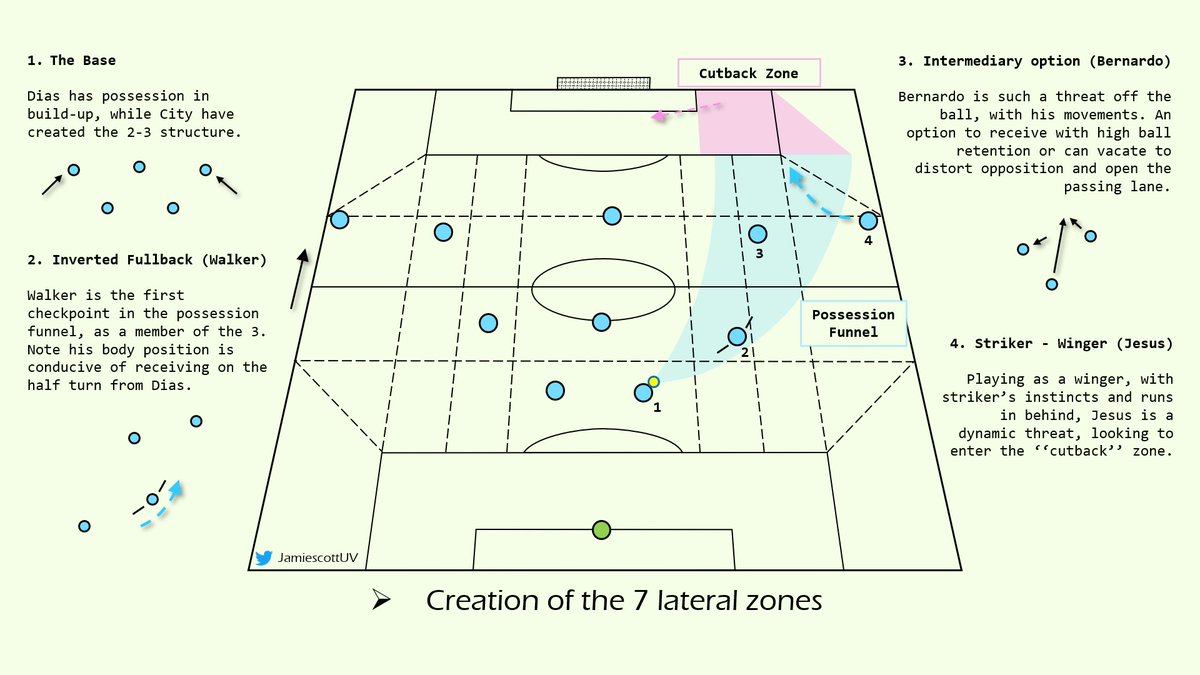
The perfect example of this funnel was against Norwich, where Bernardo Silva (the #8) made an off the ball movement opening the lane for Walker to make the vertical pass through to Jesus. City progressed and created in this manner for much of the early season.

But despite maintaining positional superiority and territorial dominance against deep blocks, City came up short in games such as Southampton at home (0-0) or Palace at home (0-2). The pressure did not equate to goals. The 235 alone isn’t fool-proof.
Leicester travelled to the Etihad yesterday, with Brendan Rodgers having set Leicester up to effectively stifle City’s progression in recent encounters. His 442 (/424) yesterday saw the front four have proclivity to City’s build-up five.

This could well have stifled City when attempting to progress from build-up to the middle third/final third. Leicester’s fullbacks went touch tight to City’s, while Leicester’s midfielder’s cover shadows prevented play into Gundogan/KDB.

This is where City have shown their ability to adapt. The clarity surrounding their player’s roles allows them to seamlessly find solutions. It may seem complex, to see players rotate, but these rotations are strategic, clinical, and actually quite simple.
Leicester cut off City’s #6, Fernandinho, in build-up. Rodri, who is the regular #6, experiences similar scenarios most weeks. But this isn’t such an issue; despite the classical expectation of a #6 to playmake, City don’t necessarily rely on the #6 to orchestrate play.
This notion is suggested by the fact that all three regular fullbacks rack up larger progressive passing numbers than Rodri (City’s usual #6) per 90. The lack of onus on Rodri to playmake is counterbalanced by the ability of the fullbacks to do so from inverted positions.

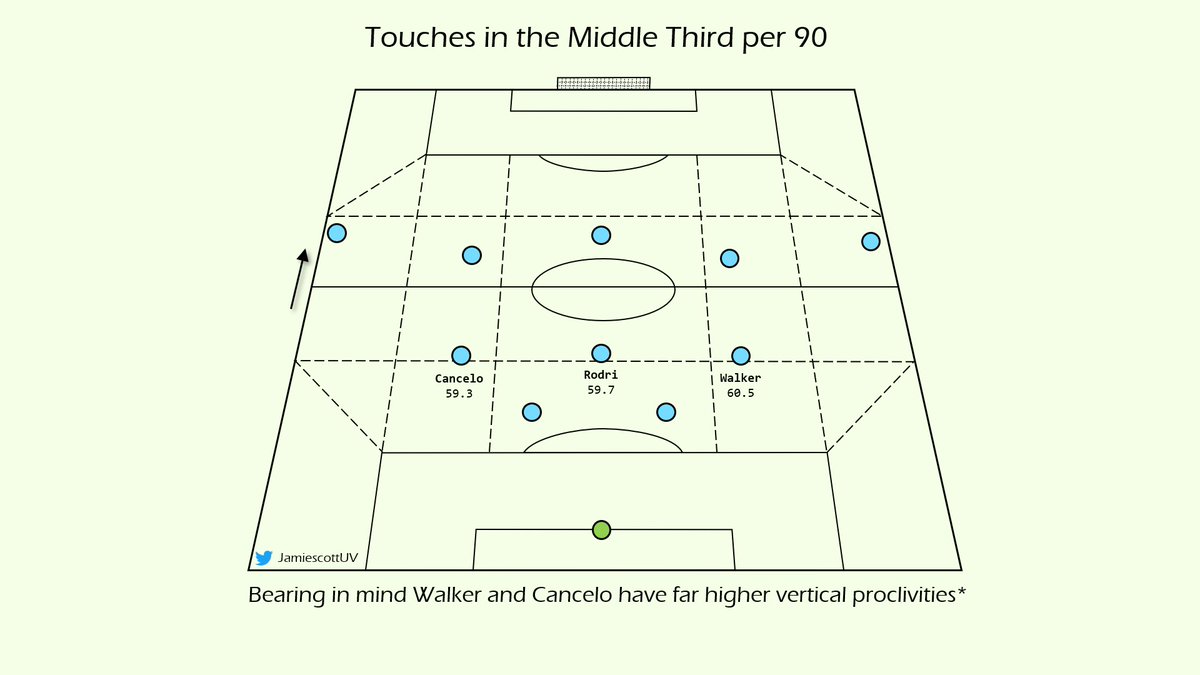
The role of the #6 is simple - that isn’t to say the #6 isn’t important, however. Rodri often pins the first line of opposition pressure to a narrower berth, as the opposition prioritises blocking central build-up/progression in the first instance.
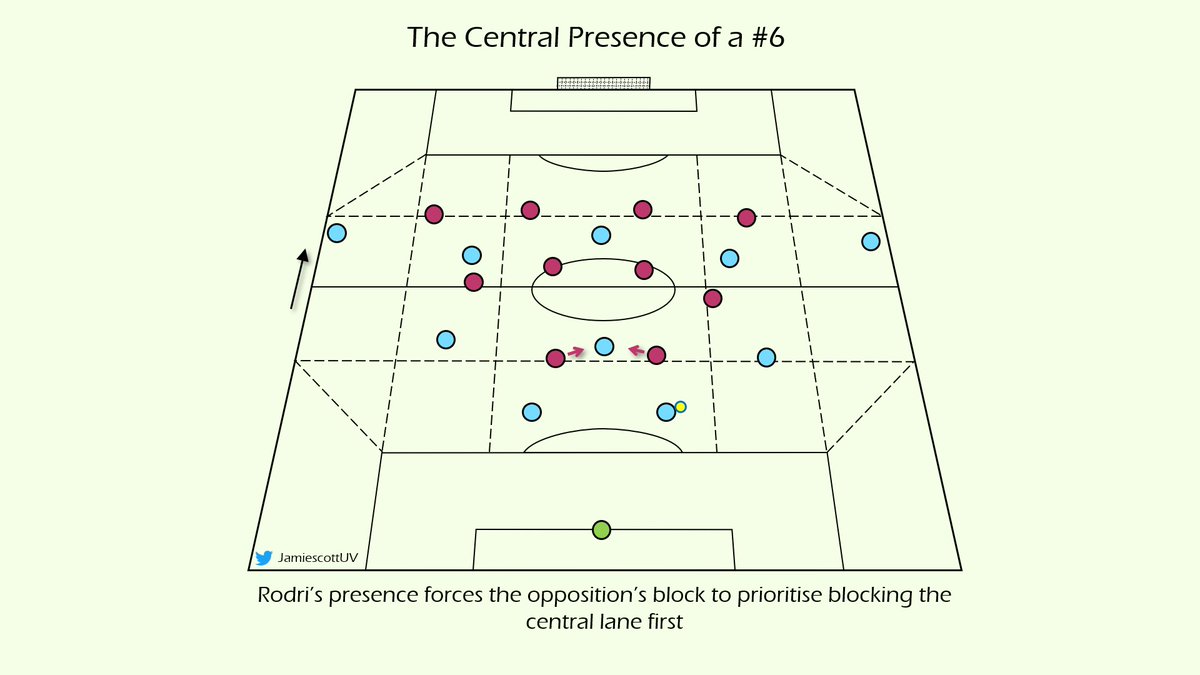
The net effect of Rodri’s presence, is more space for the inverted fullbacks to receive and distribute.
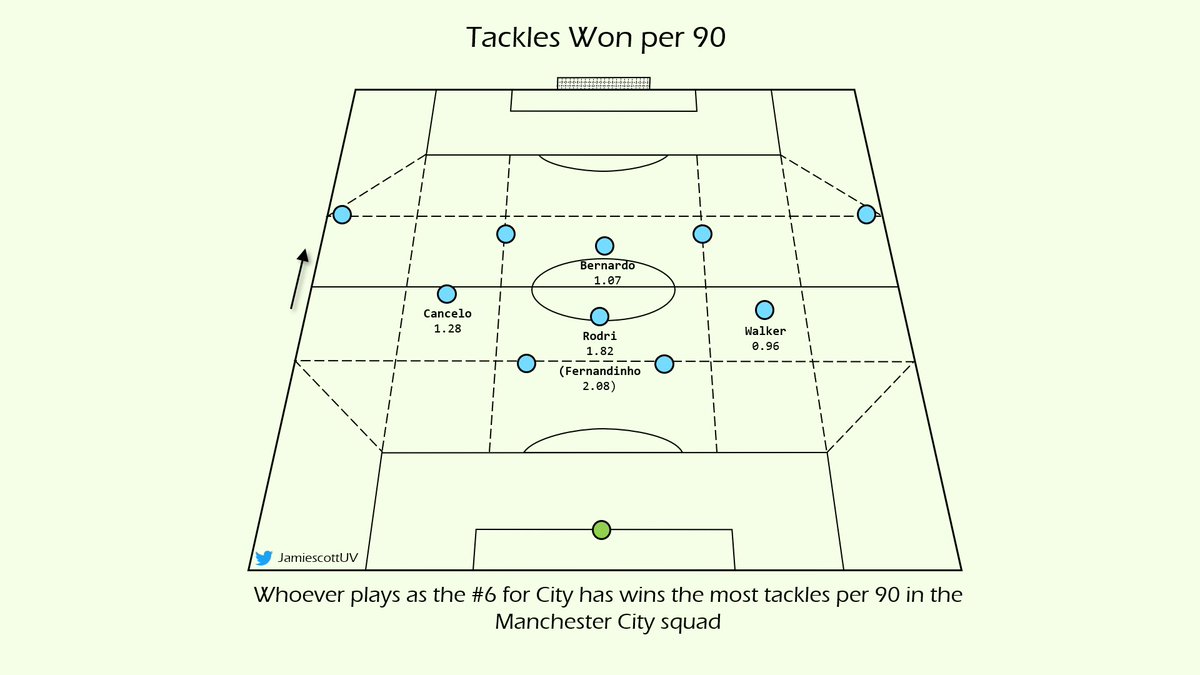
Whoever plays #6 for City wins the most tackles in the City side per 90 – due to positional discipline in rest defence. The role of the #6 can still loosely be described as controlling possession – but in this instance, the #6 themselves doesn’t actually get that much possession.

Having discussed the nuances of a modern #6, we’ll return to more of a systematic view. City rely on their inverted fullbacks getting space in the half spaces to progress play through progressive passes. But they also rely on central rotations using a key player: Bernardo.
As discussed, City sometimes struggled in the 2-3 build-up structure. A now commonly-seen structure is the 424 formation. Rodri will vacate the passing lane to allow Bernardo to collect. The fullbacks are able to drop deeper/wider as Bernardo has joined the rest defence.

In the 424, City can therefore play around the opposition’s first lines of pressure, with the fullbacks deeper/wider – but the fullbacks expanding the pitch also opens the lanes for Bernardo to receive.
Bernardo receives the ball many times a game in the double pivot area, consistently retaining possession. He can then make carries and dribbles to bypass the wave of pressure, having initially baited the pressure by dropping from a higher position.
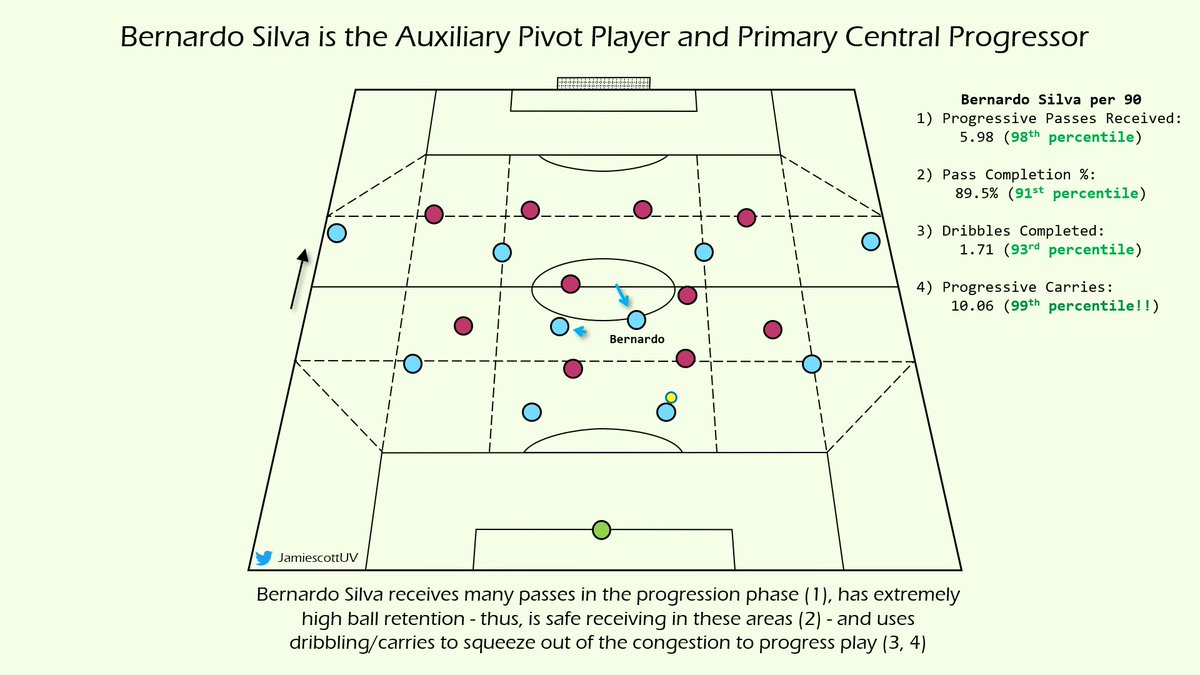
With Bernardo acting as the auxiliary pivot player, but the primary central progressor, City can spring the trap (so to speak) of opposition pressure. From there, City use rotations, quick interplay and third man runs to simply pick apart defences (see 3rd goal vs Leicester).

Ultimately, what makes City so effective is the clarity of player roles. In modern football, the #6 is so frequently marked or cover-shadowed out of build-up. The #6 receiving deep/centrally is also a frequent trigger for pressure, and relying on a #6 to playmake is risky.
Rodri (or Fernandinho) in Pep’s system have total clarity surrounding the lack of onus for them to be a typical #6, and this helps City stick to their fundamentals. All about minimising unnecessary risk. The dynamism between the 235 and 424 is how City progress play.
Pep Guardiola effectively gets his best players to do what they’re best at doing.
The tactical framework is conducive of this. Frailties in transition are masked by rest defence...
The tactical framework is conducive of this. Frailties in transition are masked by rest defence...
... and when risks are taken in possession, they’re done by high quality individuals and/or in space created by the system.
End of thread - thanks for reading.
Note: these slides are ultimately just how I view Pep's system and I am 100% open-minded to other explanations.
End of thread - thanks for reading.
Note: these slides are ultimately just how I view Pep's system and I am 100% open-minded to other explanations.
Loading suggestions...