

Is asking a dead person to make Du'a for you Shirk Akbar?
[A Summary of Wald Al Haj Muhammad Al Afriqi's refutation of Ayman Al Anqari]
[A Summary of Wald Al Haj Muhammad Al Afriqi's refutation of Ayman Al Anqari]
Point 1: Where is the exact point of contention?
First, the question says *asking* (سؤال) not *invoking* (دعاء)
Second, those who say "no it's Bid'ah/pathway to Shirk" from Ahl Al Sunnah don't just unrestrictedly say that.
Rather, they condition it with two important caveats:
First, the question says *asking* (سؤال) not *invoking* (دعاء)
Second, those who say "no it's Bid'ah/pathway to Shirk" from Ahl Al Sunnah don't just unrestrictedly say that.
Rather, they condition it with two important caveats:
Caveat 1:
That it is done at the grave.
This excludes those who ask from far away distances and have the belief that the dead person can hear them despite being far away and knows of their state despite being far away, as this is Shirk in Al Asmaa' Wal Sifaat.
That it is done at the grave.
This excludes those who ask from far away distances and have the belief that the dead person can hear them despite being far away and knows of their state despite being far away, as this is Shirk in Al Asmaa' Wal Sifaat.
Caveat 2:
That this is done free from any of the types of Shafa'ah prohibited in the Qur'an.
This excludes those who believe the intercessor can never have this intercession rejected i.e., Allah is basically compelled to answer it, as this is Shirk in Ruboobiyyah
That this is done free from any of the types of Shafa'ah prohibited in the Qur'an.
This excludes those who believe the intercessor can never have this intercession rejected i.e., Allah is basically compelled to answer it, as this is Shirk in Ruboobiyyah
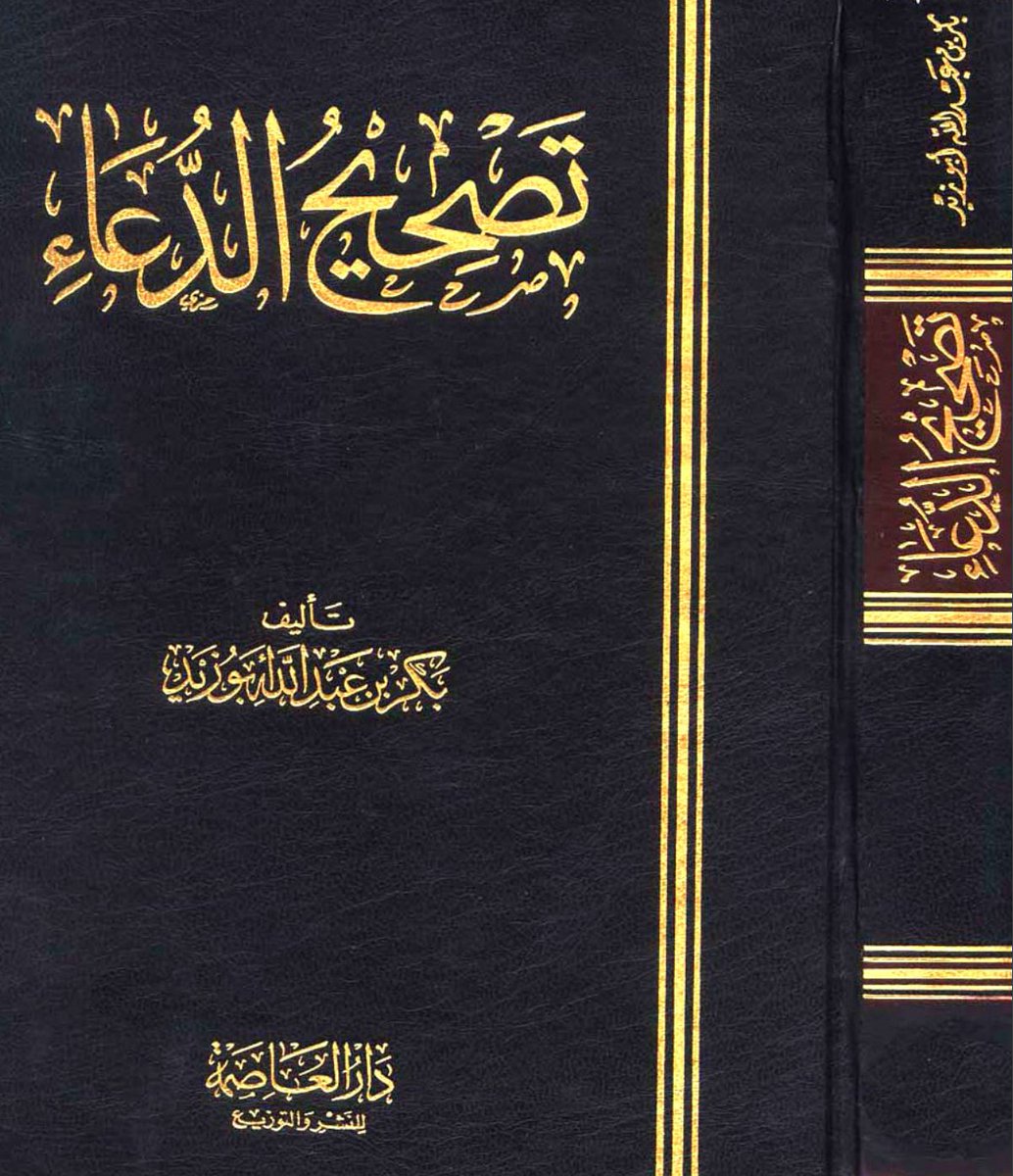
And these caveats are summed up by Bakr Abu Zayd (see Tasheeh Al Duaa' p.250-1) in the following quote:
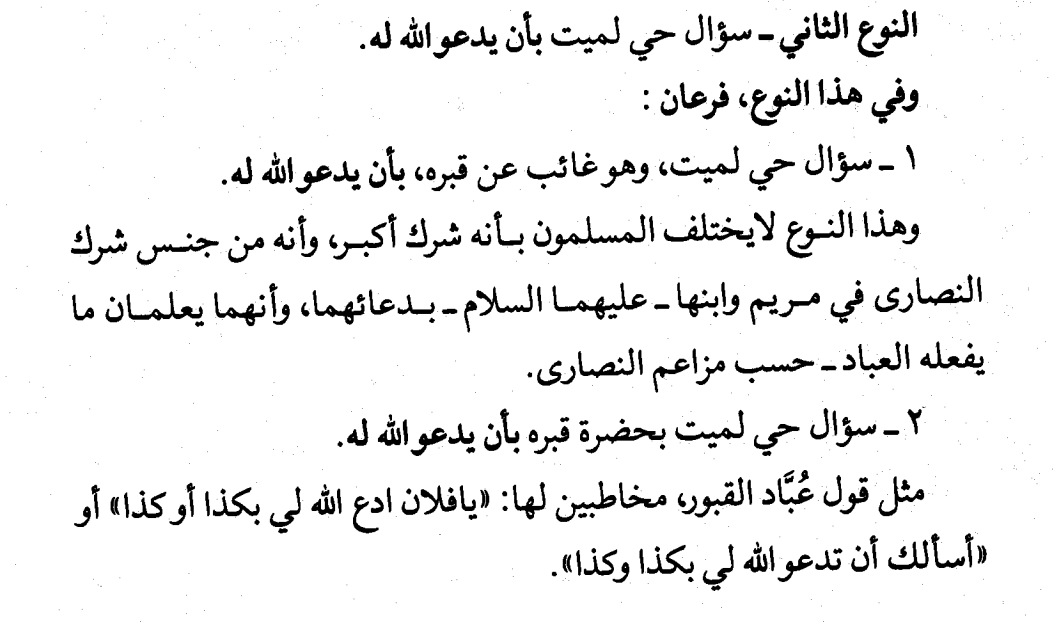
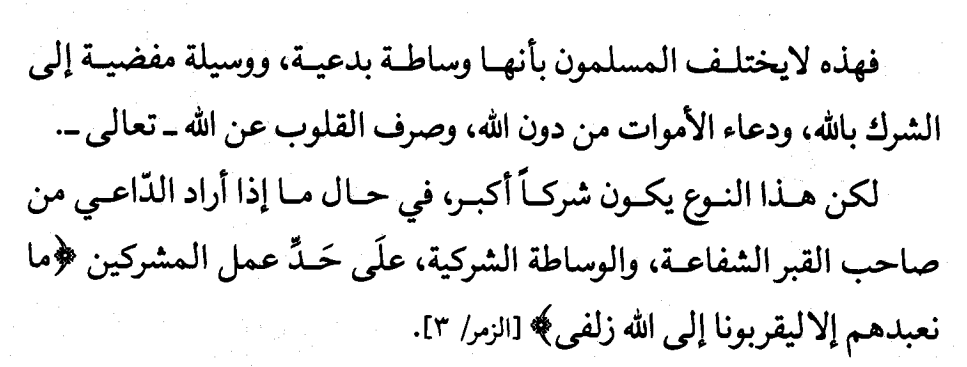
Note that Bakr's statement "لا يختلف المسلمون بأنها وساطة بدعية" if the intent by "Muslims" is the companions, the Salaf, the early Ahl Al Hadith and the 4 Imams of the Fiqh schools, then this is correct.
But if it means the Muslims as an Ummah throughout its existence, then this is inaccurate as latecomer jurists from the followers of the 4 Imams have said 'asking the Prophet at his grave to make Dua to Allah is recommended after one finishes his Hajj and visits Madinah'
Ibn Taymiyyah (see Majmu' Al Fatawa 1/159 & 1/241) and Ibn Abdul Hadi (see Al Saarim Al Munkee p.265) said:
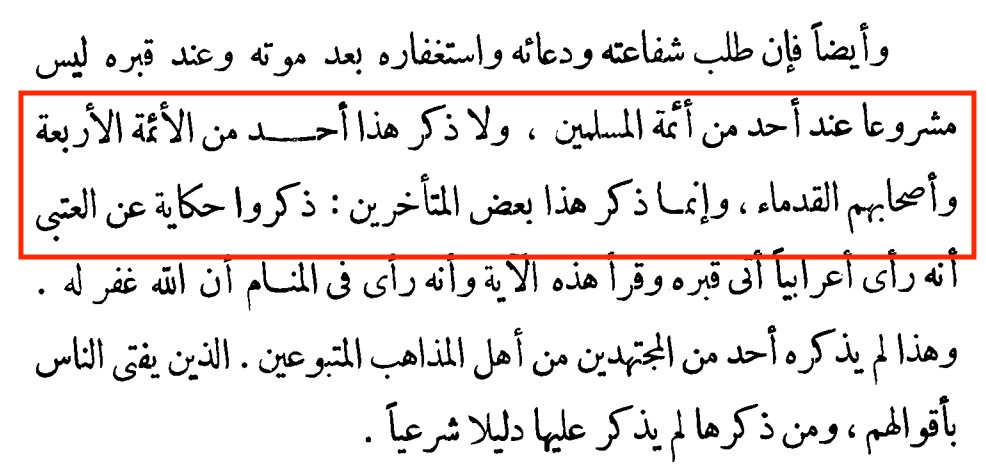
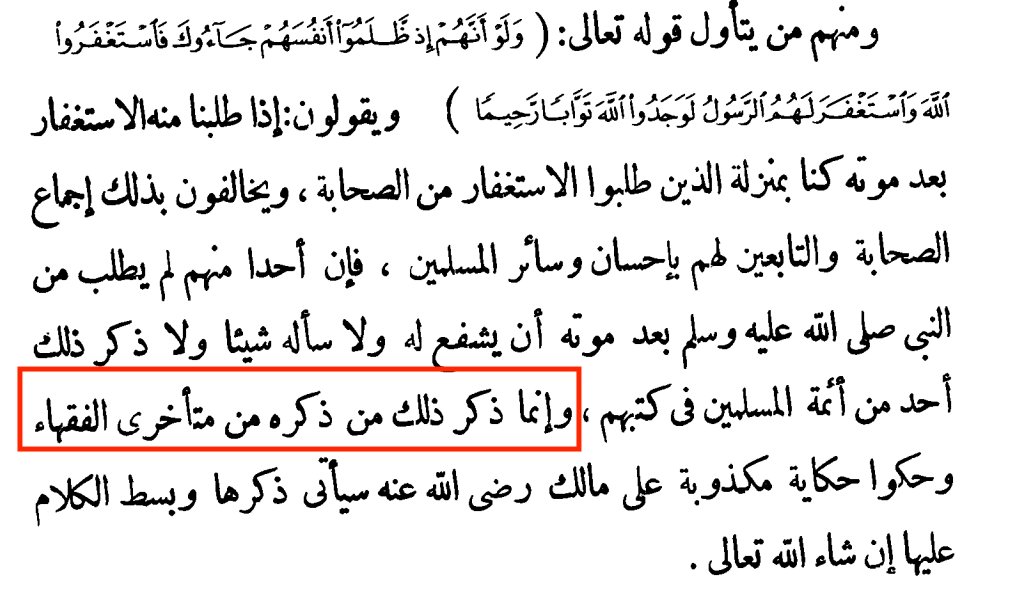
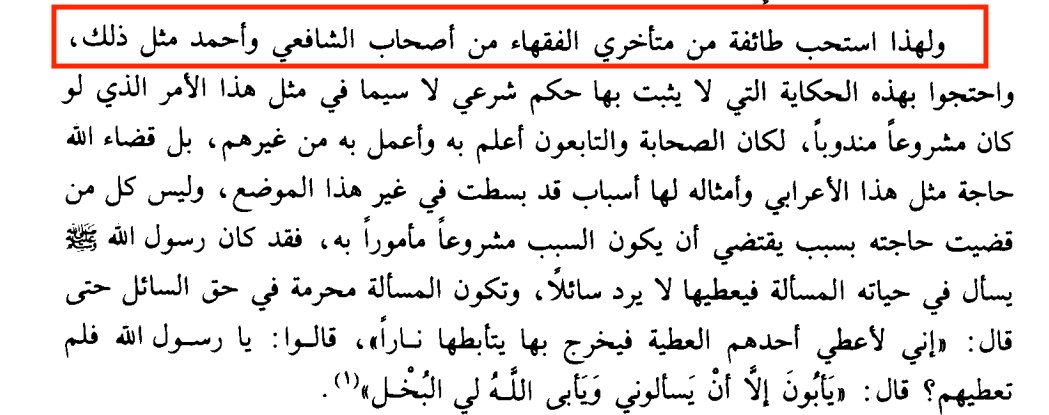
And they are correct, as we have latecomer jurists who did say this.
See Ibn Qudamah's Mughni [3/478-479] as an example.
You'll also find it in Al Nawawi's Majmu' [8/274-275]
See Ibn Qudamah's Mughni [3/478-479] as an example.
You'll also find it in Al Nawawi's Majmu' [8/274-275]

And whilst their Khilaf is a new Khilaf (relative to the agreement in the early period of the Sahaba/Salaf), none of the scholars in their time or after their time labelled this major Shirk until the Imam Al Mujaddid MiAW رحمه الله and the early Najdi scholars who followed him.
However, latter Najdi scholars labelled it a Bid'ah and a pathway to Shirk, but not major Shirk.
These include Abdullateef b. AbdulRahman Aal Al Shaykh, Mahmoud Shukri Al Aaluusi, Ibn Uthaymeen, Abdurrahman Naasir Barraak, AbdulAziz Turayfi and Bakr Abu Zayd
These include Abdullateef b. AbdulRahman Aal Al Shaykh, Mahmoud Shukri Al Aaluusi, Ibn Uthaymeen, Abdurrahman Naasir Barraak, AbdulAziz Turayfi and Bakr Abu Zayd
Thus, the point of contention here is:
"What is the ruling on asking a dead person to make Dua for you like you would someone alive to make Dua for you?"
Once this is established, much of the statements of Ibn Taymiyyah used in this issue will become clear.
End of Point 1
"What is the ruling on asking a dead person to make Dua for you like you would someone alive to make Dua for you?"
Once this is established, much of the statements of Ibn Taymiyyah used in this issue will become clear.
End of Point 1
Point 2: What is Du'a Al Ibadah?
Al Alusi mentions that it is intrinsically known that Du'a Al Ibadah is to invoke that which only Allah is capable of and seeking that from one who is alive or one who is dead.
See Fath Al Mannān the completion of Abdul Lateef's Minhaj Al Ta'sis
Al Alusi mentions that it is intrinsically known that Du'a Al Ibadah is to invoke that which only Allah is capable of and seeking that from one who is alive or one who is dead.
See Fath Al Mannān the completion of Abdul Lateef's Minhaj Al Ta'sis
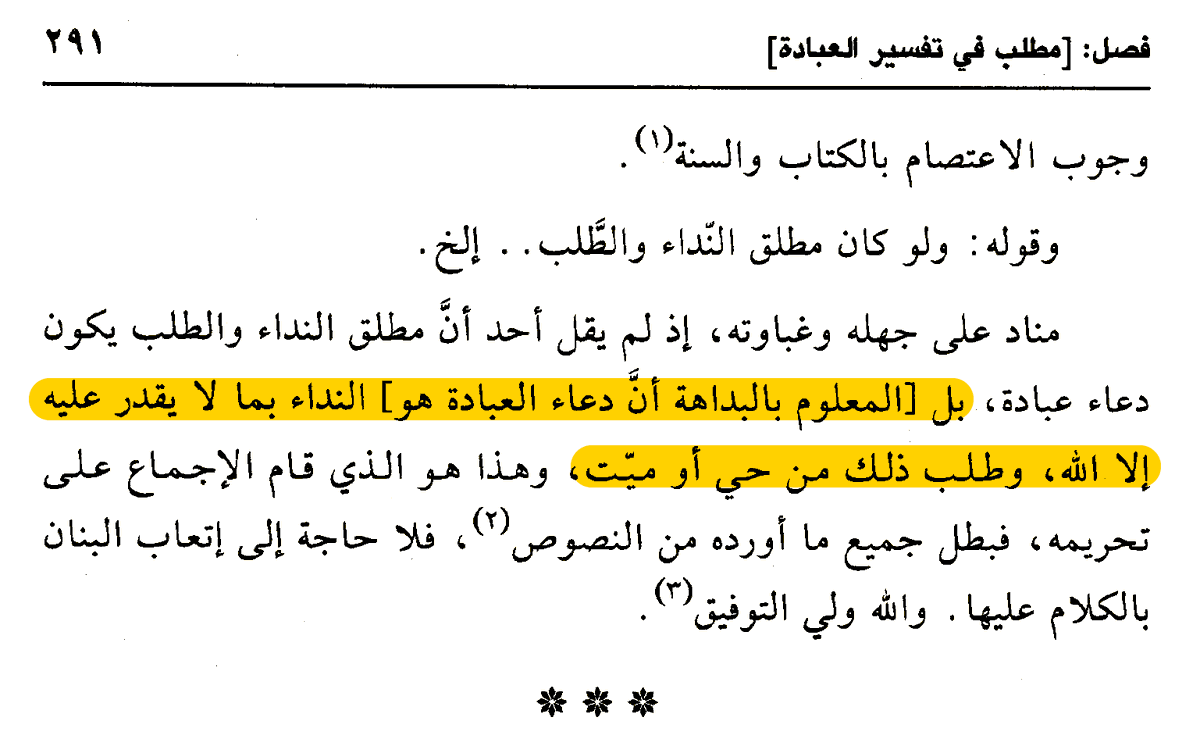
What we can learn from this is that for one to ask a being that is alive in a way that is free from Shirk ( worshipping other than Allah or attributing to other than Allah descriptions of Ruboobiyyah) is not major Shirk and is permissible.
Likewise, to ask this to a dead person at his grave in the same exact manner must also not be major Shirk.
It is not sound to say that it is permissible when sought from an alive person then when the exact same thing is done to a dead person at their grave it becomes major Shirk
It is not sound to say that it is permissible when sought from an alive person then when the exact same thing is done to a dead person at their grave it becomes major Shirk
just because it was sought from a dead person.
Rather, the correct ruling is to say that it is an innovation, minor shirk and can be a pathway to major shirk because it is taking something as a means when it has not been affirmed universally nor by Sharia as being a sound means
Rather, the correct ruling is to say that it is an innovation, minor shirk and can be a pathway to major shirk because it is taking something as a means when it has not been affirmed universally nor by Sharia as being a sound means
Point 3: Misusage of Taymiyyan quotes
Quote 1: Majmu Al Fatawa 1/158-159
Quote 1: Majmu Al Fatawa 1/158-159
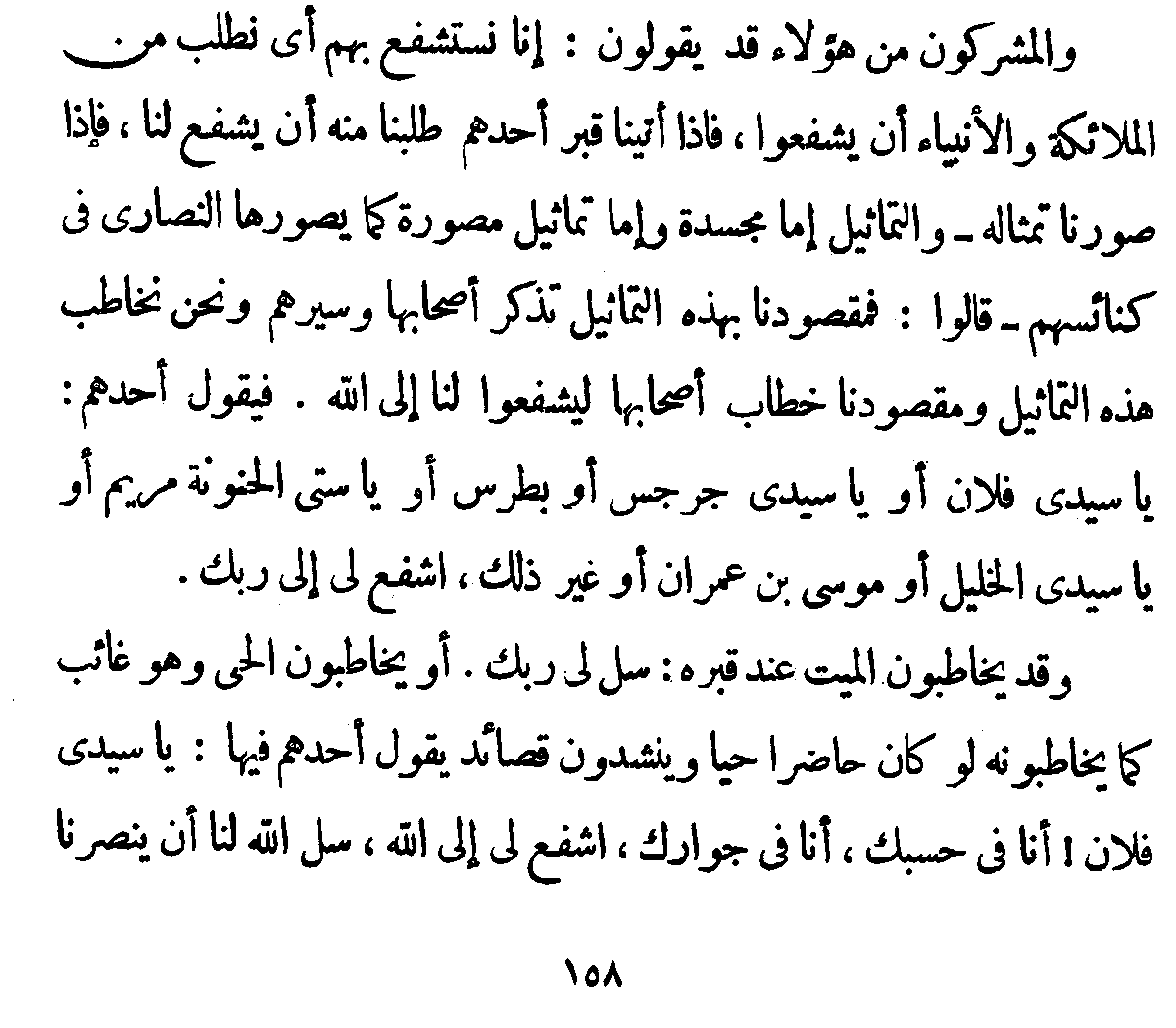
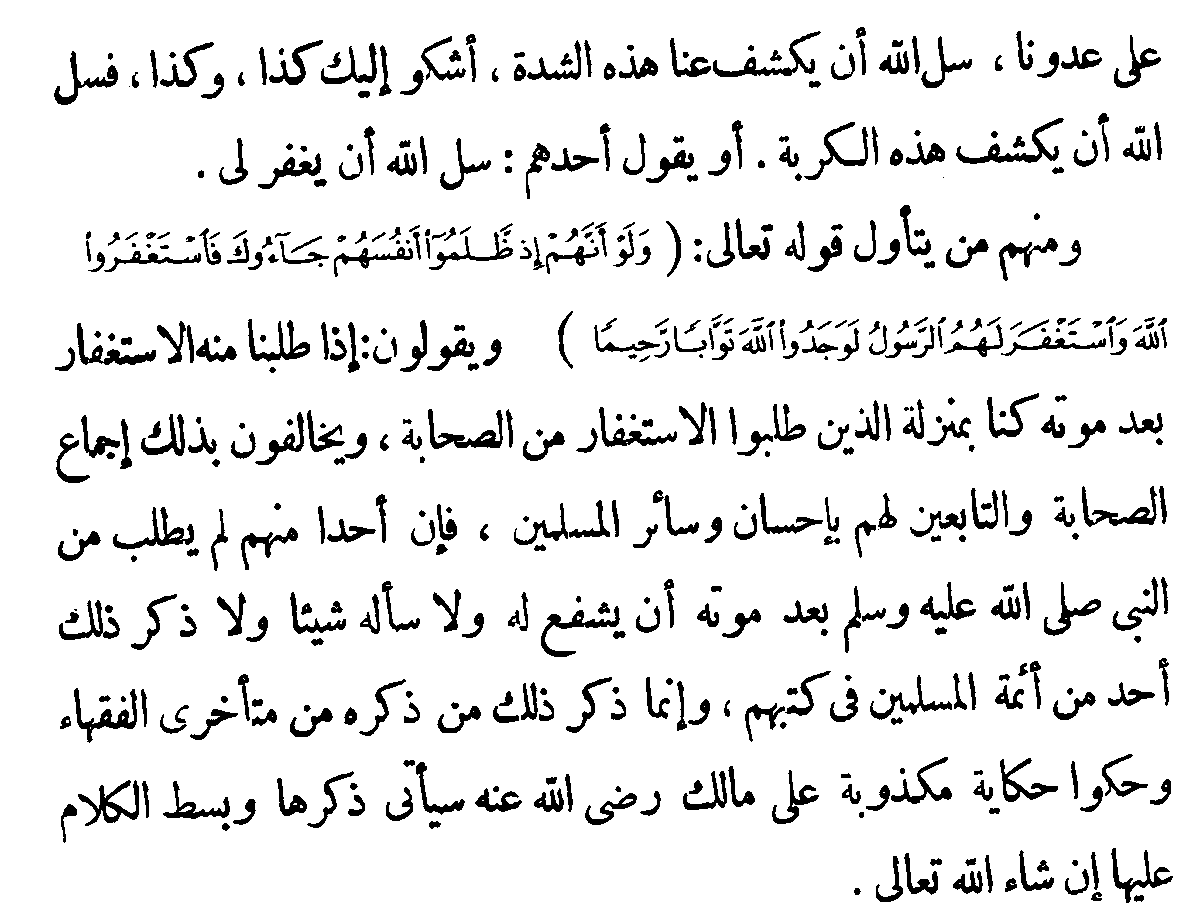
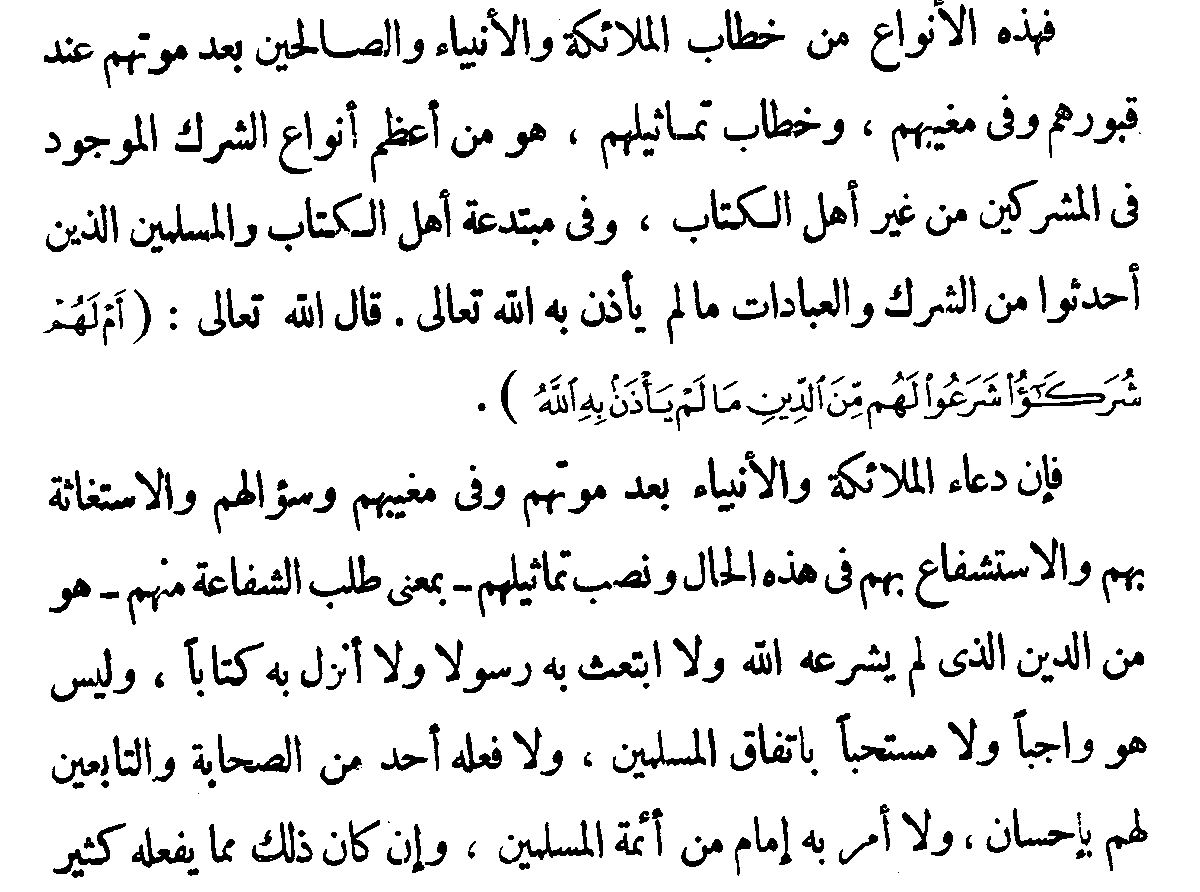

When you read this passage, you can see that the first part is connected to the Christians and the claimants to Islam.
He then generalises it to all the different categories of those who commit Shirk.
He then generalises it to all the different categories of those who commit Shirk.
It is known that the Shafa'ah sought by the original Kuffar is the Shafa'ah negated in the Qur'an as Mujahid mentioned in the Tafsir of ما نعبدهم إلا ليقربونا إلى الله زلفى when he affirmed that the Christians said this before the Kuffar of Quraysh.
Likewise, it is known that this belief, in and of itself, is Shirk, whether or not one seeks from them or not and not matter what form the seeking takes.
What strengthens the case for Ibn Taymiyyah's speech being specific to these people is what he says at the end.
What strengthens the case for Ibn Taymiyyah's speech being specific to these people is what he says at the end.
فَإِنَّ دُعَاءَ الْمَلَائِكَةِ وَالْأَنْبِيَاءِ بَعْدَ مَوْتِهِمْ وَ فِي مَغِيبِهِمْ وَسُؤَالَهُمْ
وَالِاسْتِغَاثَةَ بِهِمْ وَالِاسْتِشْفَاعَ بِهِمْ فِي هَذِهِ الْحَالِ وَنَصْبَ تَمَاثِيلِهِمْ بِمَعْنَى طَلَبِ الشَّفَاعَةِ مِنْهُمْ
وَالِاسْتِغَاثَةَ بِهِمْ وَالِاسْتِشْفَاعَ بِهِمْ فِي هَذِهِ الْحَالِ وَنَصْبَ تَمَاثِيلِهِمْ بِمَعْنَى طَلَبِ الشَّفَاعَةِ مِنْهُمْ
Contemplate over بِمَعْنَى طَلَبِ الشَّفَاعَةِ مِنْهُمْ...
The speech of Ibn Taymiyyah here revolves around that which is linked to their statements re the Shirki Shafa'ah negated in the Qur'an.
Thus, those claimants to Islam mentioned in this passage follow that same way.
The speech of Ibn Taymiyyah here revolves around that which is linked to their statements re the Shirki Shafa'ah negated in the Qur'an.
Thus, those claimants to Islam mentioned in this passage follow that same way.
And that makes this passage outside of the point of contention outlined in point 1.
And, with that all said, this quote is not explicit in saying that asking someone at their grave to make dua (with the caveats mentioned earlier) is shirk akbak.
And, with that all said, this quote is not explicit in saying that asking someone at their grave to make dua (with the caveats mentioned earlier) is shirk akbak.
Loading suggestions...